
End-to-End Multi-Omics Partners for an Auditable Metabolomics Workflow
Submit Your InquiryModern metabolomics teams don't just want peak tables. They need decision-ready science they can defend in a review meeting, in a manuscript, or during a QA audit. That is why many metabolomics service providers now operate as end-to-end multi-omics partners: stitching together rigorous study design, transparent QC/QA, MSI-aligned identification, FAIR-by-design metadata, and integration with proteomics and transcriptomics—so that findings move from data to discovery without breaking the audit trail.
This guide explains how the market shifted, what an auditable metabolomics workflow looks like in practice, and how ion mobility—including collision cross-section (CCS) in LC-IM-MS—adds orthogonal evidence to raise metabolite identification confidence. Throughout, we map practical steps to community standards such as the Metabolomics Standards Initiative (MSI), the FAIR Guiding Principles, and NIH Data Management and Sharing (DMS) expectations (see policy notice NOT-OD-21-013), while keeping ICH M10 in view as a fit-for-purpose validation mindset rather than the primary lens.
Key takeaways
- Peak tables alone are rarely sufficient for biomarker discovery, MoA studies, or translational decisions; reviewers expect an auditable metabolomics workflow with explicit QC/QA, traceable processing, and MSI-aligned identification evidence.
- CCS in LC-IM-MS is a powerful orthogonal coordinate that can improve metabolite identification confidence when reported with proper notation, calibration disclosure, and uncertainty, as recommended by the ion mobility community.
- Decision-ready deliverables include SOPs, QC metrics, audit trails, machine-readable metadata (ISA-Tab/ISA-JSON), and repository-ready packages aligned to FAIR and NIH DMS.
- Multi-omics integration (metabolomics with proteomics and transcriptomics) strengthens biological interpretation and model robustness when strategies like DIABLO, MOFA+, or WGCNA are chosen fit-for-purpose.
- Selecting an end-to-end partner is less about promises and more about governance: SLAs, QC acceptance criteria, data provenance, and external validation plans.
Introduction
Most R&D teams have felt the gap: a large study returns a spreadsheet with thousands of features, but there's little clarity on identification confidence, QC drift, or how to translate the data into mechanism and milestones. Peak tables are necessary, not sufficient. What moves programs forward is a defensible line of evidence—well-powered design, transparent QC/QA, reproducible processing, and traceable reporting that stands up to peer review and internal governance.
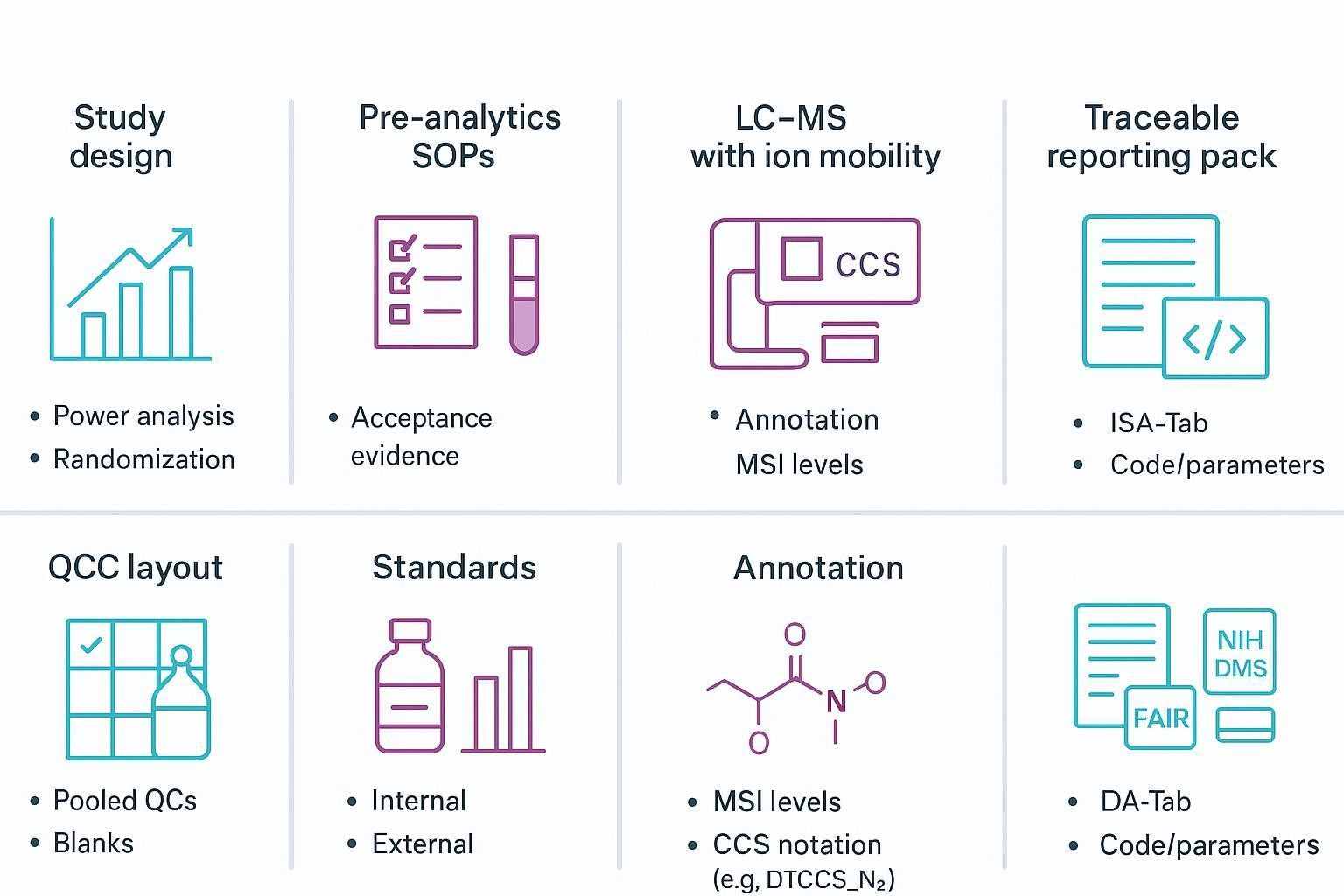
In preclinical research, decision-ready, auditable deliverables typically include: study design documentation (power analysis, randomization, blinding), explicit QC layout with pooled QCs and blanks, internal and external standard strategies, calibration logs, identification evidence tables mapped to MSI levels (and, where applicable, CCS notation and tolerances), code/parameters for processing, and repository-ready metadata. When paired with proteomics and transcriptomics, metabolomics signals can be situated in pathways and networks to clarify MoA and reduce false leads.
What follows is a practical, standards-aware resource that shows how service providers evolved into multi-omics partners—and how to assess whether a workflow is truly audit-ready.
The Market Shift: How Metabolomics Service Providers Became Multi-Omics Partners
Why Peak Tables Alone No Longer Meet R&D Needs
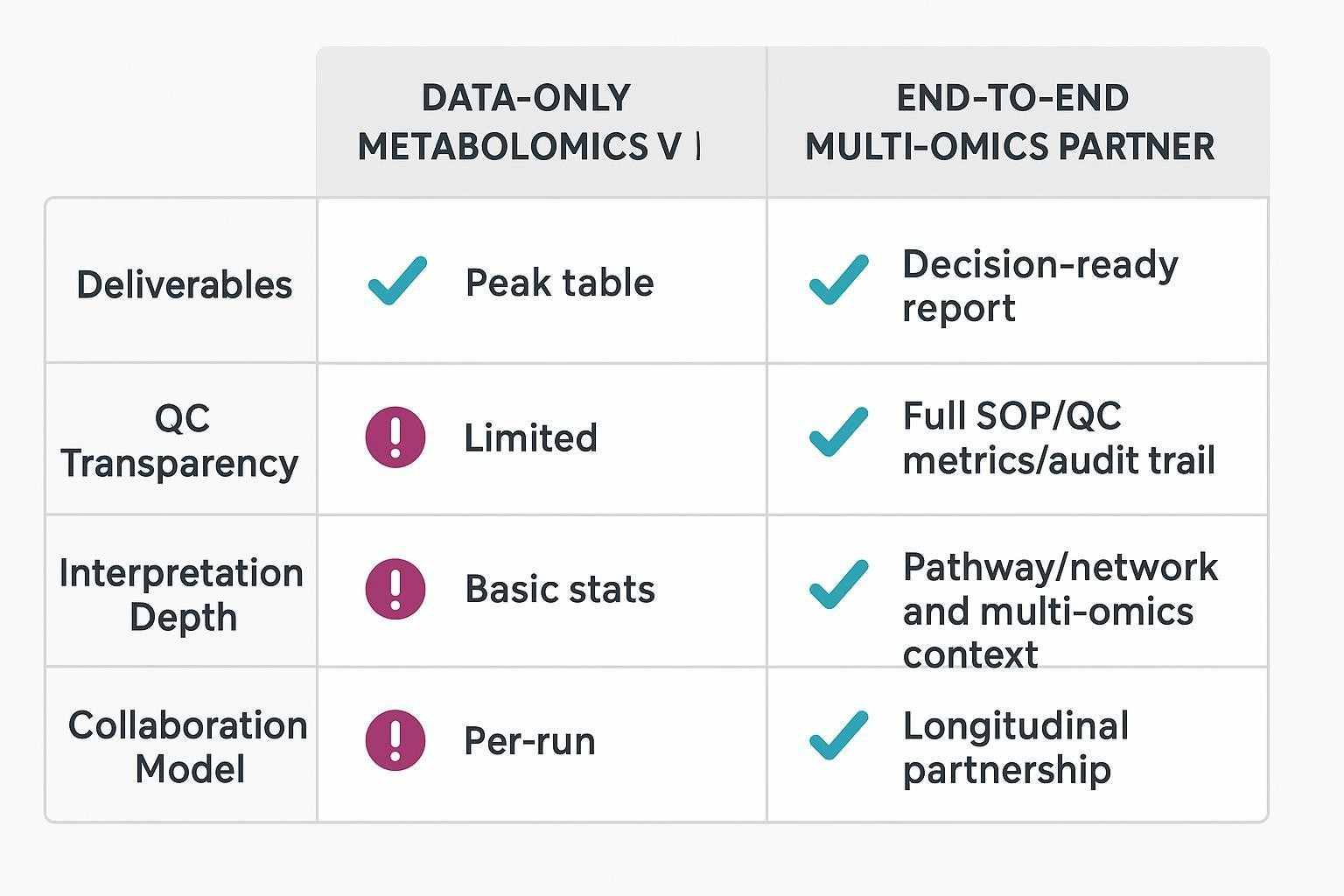
A peak table summarizes detected features, but it doesn't, by itself, communicate identification confidence, instrument stability, or the evidence behind a hit. Reviewers now expect to see: pooled QC performance, batch/drift correction rationale, internal standard recoveries, and explicit identification criteria consistent with MSI levels. Without these, biomarker claims remain brittle. CCS from LC-IM-MS can reduce ambiguity by adding a structure-sensitive dimension, but only when reported with clear notation, calibration provenance, and uncertainty—so teams can judge whether a match is persuasive or provisional.
R&D Drivers and Industry Consolidation (2023–2026)
Across 2023–2026, several drivers nudged providers from "data-only" toward partnership models: larger cohorts demanding robust drift correction; multi-batch, cross-site designs; NIH DMS policy requiring shareable, well-described datasets; and journal expectations for minimum information and identification confidence. As CCS databases (e.g., community resources describing experimental CCS values) expanded and FAIR-aligned tooling matured, sponsors sought providers who could deliver not just numbers, but also provenance and interpretation.
Decision-Ready Deliverables (SOPs, QC Metrics, Audit Trails)
Decision readiness hinges on transparent artifacts: SOPs for pre-analytics and acquisition; QC layouts with pooled QC cadence and blanks; internal/external standards and calibration logs; processing parameters and change logs; identification evidence tables binding MS/MS, retention behavior, and, where used, CCS with proper notation and tolerances; and repository-ready ISA-Tab/mwTab packages. These materials make it possible to trace every claim back to measurements and assumptions.
AI-Enabled Platforms and Longitudinal Research Partnerships
Automation and learning systems can standardize preprocessing and flag anomalies across studies, but they're only as persuasive as their documentation. Longitudinal partnerships work when each run appends to an auditable knowledge base—QC trends, calibrant performance, model versions—so that future analyses start from proven, reproducible baselines rather than reinventing the pipeline.
An End-to-End, Auditable Multi-Omics Workflow From Sample to Insight
Study Design and Pre-Analytical Controls (Power Analysis, Randomization, SOPs)
Auditable results begin before the first injection. Document inclusion/exclusion criteria, sample size justification, and randomization/blinding schemes. Define pre-analytical SOPs for collection, stabilization, storage, and extraction to minimize batch effects. Plan a QC layout that interleaves pooled QCs and blanks; specify internal standards and their points of addition. Pre-register analysis plans where appropriate, and lock down file-naming, versioning, and chain-of-custody conventions.
Data Generation and Quality Control (QC/QA, MSI Guidelines, ICH M10 Compliance)
Acquisition should capture instrument conditions and calibration, including any ion mobility parameters. For LC-IM-MS, note bath gas, temperature, pressure, and whether CCS is primary (e.g., DTIMS at well-characterized low field) or calibrated (e.g., TWIMS/TIMS against reference CCS sets). Follow MSI-aligned reporting for sample prep, analytical settings, and identification evidence. Use pooled QCs to monitor stability and enable drift/batch correction; track internal standard recoveries over time. Treat ICH M10 as a fit-for-purpose validation mindset—articulate what "accuracy" and "precision" mean for your study goals without overpromising universal thresholds.
Data Processing, Normalization, and Reproducible Reporting
State software versions and parameters for peak detection, alignment, and deconvolution. Describe normalization choices (e.g., internal standard scaling, probabilistic quotient, QC-based approaches) and missing-value handling. Document batch correction methods and diagnostics. Package code, parameters, and logs into a reproducible bundle. Export machine-readable metadata (ISA-Tab/ISA-JSON) alongside raw mzML and processed matrices to support FAIR reuse and NIH DMS compliance.
Deliverables That Support Biology, Bioinformatics, and Program Decisions
Decision-ready deliverables integrate biology and analytics: pathway- and network-level summaries, identification evidence tables with MSI levels and CCS fields, drift-corrected abundance matrices with QC diagnostics, and a provenance-rich report that a statistician and a biologist can both navigate. For readers who want to dive deeper into analysis workflows and interpretation frameworks, see Metabolomics Data Analysis .
Reporting essentials for IM–MS/CCS
| Field | What to report | Why it matters |
|---|---|---|
| Instrument/platform | DTIMS/TWIMS/TIMS; manufacturer/model | Clarifies whether CCS is primary or calibrated |
| Bath gas and conditions | Gas type, temperature, pressure, E/N | CCS depends on gas and field conditions |
| Measurand and notation | K0 and CCS with notation (e.g., DTCCS_N2, TWCCS_N2) | Ensures unambiguous interpretation |
| Ion details | Adduct, charge state, m/z, polarity | CCS and fragmentation depend on ion form |
| Calibration disclosure | Calibrants list, class matching, calibration function | Enables assessment of bias/uncertainty |
| Uncertainty | Combined standard uncertainty and contributors | Supports defensible tolerance settings |
| Database and tolerance | Library name and match window (%, Ų) | Makes evidence thresholds explicit |
Multi-Omics Integration for Biomarker Discovery and Mechanism of Action (MoA)
Multi-Omics Data Integration Strategies (DIABLO, MOFA+, WGCNA)
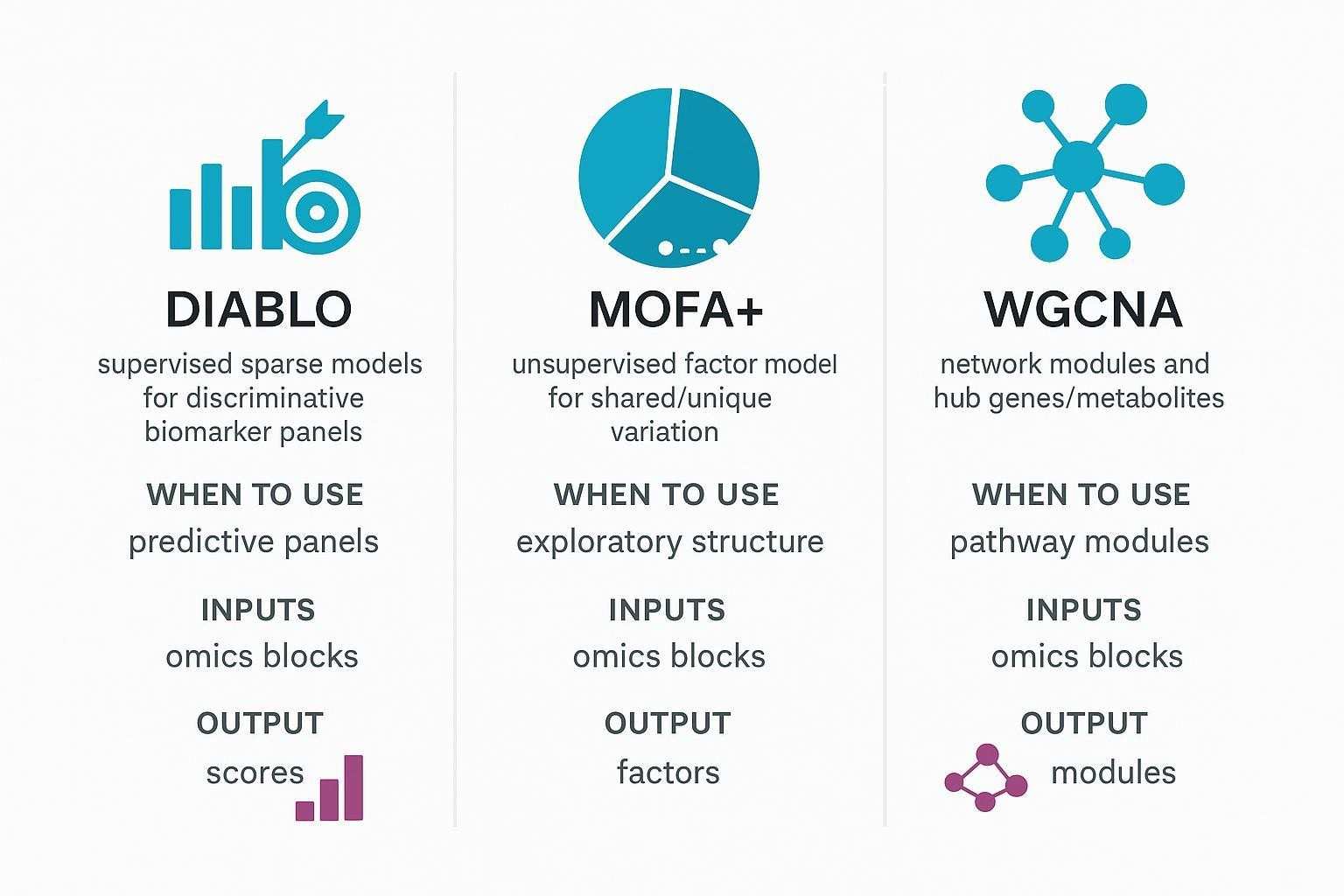
No single method fits all programs. DIABLO (sparse, supervised) is strong when you have labeled phenotypes and want discriminative panels. MOFA+ (unsupervised) is suited to discovering shared and modality-specific variation without labels. WGCNA excels at module detection and hub prioritization, often clarifying pathway-level hypotheses. Choose based on study goals, cohort size, and tolerable assumptions about linearity and sparsity.
For readers evaluating cross-omics study designs and deliverables, explore Multi-omics Service for examples of integration scopes and analysis outputs.
Pathway Analysis, Network Topology, and Biological Interpretation
In practice, you'll bind metabolite-level findings to pathways and networks to see whether signals cohere mechanistically. Network topology (centrality, community structure) can surface leverage points for intervention or validation. Keep uncertainty visible: when identification confidence is mixed (e.g., MSI 1–2 blend), propagate that uncertainty into pathway scores rather than collapsing to point estimates. CCS can help distinguish isomers that would otherwise inflate or blur pathway signals, but it should be presented as orthogonal support rather than a definitive identifier on its own.
Model Validation, Performance Metrics, and Calibration
Whether supervised or unsupervised, validate models with nested resampling, calibration plots, and external datasets where available. Track drift across batches and re-validate whenever acquisition conditions shift. For DIABLO-like predictive panels, report sensitivity to preprocessing (e.g., batch correction variants) and feature stability across folds. For MOFA+/WGCNA, confirm that discovered factors/modules replicate under perturbation and align with pathway priors.
Selecting and Governing an End-to-End Multi-Omics Service Partner
When a Data-Only Vendor Is Enough and When an End-to-End Partner Is Needed
A data-only vendor can suffice for small, exploratory studies where internal teams will handle QC analytics, identification rigor, and integration. As soon as you require cross-batch comparability, formal identification evidence (MSI), CCS-informed confidence, and repository-ready deliverables, an end-to-end partner becomes more efficient and defensible.
SLAs, QC Acceptance Criteria, and Audit Readiness
Write SLAs that specify acceptance criteria and artifacts: QC cadence and content, internal/external standard strategies, calibration and CCS notation/reporting if ion mobility is used, identification rules by MSI level, drift/batch correction documentation, and reproducible reporting bundles. As a neutral example, a provider like Creative Proteomics publicly documents study workflows and analysis deliverables; readers can review scope and expectations in the Metabolomics Service overview to inform their own SLA drafting. The goal is not promotion but clarity: what exactly will be delivered, and how will quality be evidenced?
Data Management, FAIR Principles, NIH DMS Compliance, and Data Provenance
An end-to-end partner should deliver ISA-Tab/ISA-JSON metadata, raw/processed data with persistent identifiers, and a provenance bundle (code, parameters, logs). Aligning to FAIR improves reuse; aligning to NIH DMS satisfies funded-project expectations and reduces rework at submission. Repositories such as MetaboLights and Metabolomics Workbench provide templates and validators that make acceptance smoother.
Risk Management, Project Timelines, and External Validation Strategies
Plan for instrument maintenance windows, calibrant supply changes, and personnel turnover by codifying SOPs and automating provenance capture. Maintain "known-good" frozen pipelines for key analyses. Budget time for external validation—orthogonal assays, independent cohorts, or blinded re-analyses—so that claims don't rest on a single processing choice or dataset.
Governance artifacts and acceptance evidence (examples)
| SLA item | Acceptance criterion (qualitative) | Evidence example |
|---|---|---|
| QC layout | Pooled QC cadence and blanks declared; stability demonstrated | QC trend plots; pre/post drift-correction diagnostics |
| Internal standards | Class-matched roster and recovery checks documented | Recovery plots; deviation flags with justifications |
| Identification rules | MSI-level mapping and orthogonal evidence plan | Evidence table linking MS/MS, RT/index, CCS notation/tolerance |
| CCS reporting (if used) | Notation, calibration disclosure, uncertainty included | DTCCS_N2/TWCCS_N2 fields; calibrant list; u_c summary |
| Reproducible reporting | Code/parameters, logs, and ISA-Tab/mwTab provided | Versioned repository; parameter files; ISA-Tab validation |
| Data sharing | FAIR-by-design; NIH DMS-ready package | Repository submission files; PIDs; access statement |
FAQs
Q1: What evidence is required for MSI Level 1 vs Level 2 identification?
A: Level 1 requires an authentic reference standard measured under the same conditions plus at least one additional orthogonal piece of evidence (e.g., MS/MS or retention behavior). Level 2 relies on high-quality library/database matches and/or physicochemical properties without in-lab standards. Report all evidence and conditions transparently to support review.
Q2: How should I choose CCS match tolerance for LC-IM-MS data?
A: Set tolerances with calibration quality and uncertainty in mind. Disclose whether CCS is primary (e.g., DTIMS) or calibrated (e.g., TWIMS/TIMS), note the database used, and state windows by adduct or class. Include combined uncertainty (u_c) to justify your choice.
Q3: When does ion mobility/CCS materially improve metabolite annotation?
A: CCS provides a structure-sensitive dimension that helps separate or filter isomers and reduce false positives, particularly when MS/MS is ambiguous or retention shifts occur across batches. It strengthens, but does not replace, spectral and chromatographic evidence.
Q4: What should be in an audit-ready deliverable from an end-to-end partner?
A: SOPs, QC layout and results, internal/external standard strategies, calibration logs, identification evidence tables (MSI levels with CCS notation if used), drift/batch correction documentation, and a reproducible reporting bundle (code, parameters, logs, ISA-Tab/mwTab) suitable for repository submission.
Q5: How do I make my metabolomics package FAIR and NIH DMS-compliant?
A: Provide persistent identifiers, rich machine-readable metadata (ISA-Tab/ISA-JSON), standardized formats (mzML, mwTab), access statements, and a clear sharing timeline. Target repositories like MetaboLights or Metabolomics Workbench and include provenance so others can reproduce processing.
For scoping an end-to-end project and its deliverables broadly, see Metabolomics Service as a neutral point of reference when drafting acceptance lists.
References
- Gabelica V, et al. Recommendations for reporting ion mobility–mass spectrometry measurements. Mass Spectrom Rev. 2019. PMID: 30707468. See the community guidance on notation, calibration, and uncertainty in the peer-reviewed article: Recommendations for reporting ion mobility–MS measurements.
- Sumner LW, et al. Proposed minimum reporting standards for chemical analysis: CAWG Metabolomics Standards Initiative (MSI). Metabolomics. 2007. PMCID: PMC3772505. The foundational identification confidence framework is outlined in the open-access paper: Proposed minimum reporting standards for chemical analysis.
- Wilkinson MD, et al. The FAIR Guiding Principles for scientific data management and stewardship. Sci Data. 2016. PMID: 26978244. FAIR concepts and their implications for metabolomics metadata are detailed here: The FAIR Guiding Principles.
- Zhou Z, et al. Ion mobility collision cross-section atlas (AllCCS). Nat Commun. 2020. An extensive CCS resource and methodology context: Ion mobility collision cross-section atlas (AllCCS).

 Contact Us