

Collision Cross Section (CCS) in LC-IM-MS: Why It Matters for Metabolite Identification
Submit Your InquiryWhat Is CCS in LC-IM-MS and What Does It Measure?
Collision cross section (CCS) is a gas-phase physicochemical property that reflects how an ion behaves when moving through a buffer gas under an electric field. In plain terms, it's related to an ion's effective size and shape (and how charge is distributed), as experienced during collisions with gas molecules.
In LC-IM-MS, ions generated by electrospray ionization enter an ion mobility region before mass analysis. Ion mobility separates ions based on how easily they drift through gas—larger or more extended ions typically experience more collisions and travel more slowly than compact ions. This provides a separation dimension that is orthogonal to LC retention time and to mass-to-charge ratio.
A critical practical distinction:
- Drift time (or arrival time) is what the instrument directly measures.
- CCS is the normalized value derived from mobility that is meant to be compared across experiments.
For drift-tube ion mobility in particular, CCS is related to mobility via the Mason–Schamp relationship (instrument parameters like gas, temperature, and field strength matter). A useful way to think about it is:
Key Takeaway: Drift time tells you "how long it took on this instrument," while CCS is the attempt to express that observation as a comparable structural descriptor.
That said, CCS is not "universal" in the way a neutral chemical identifier is. It's generally more transferable than retention time, but comparability still depends on platform type, calibration, and measurement context.
Key Concepts of CCS in LC-IM-MS
CCS is not a replacement for m/z, retention time, or MS/MS. Those features capture different parts of molecular identity—composition, chromatographic behavior, and fragmentation evidence.
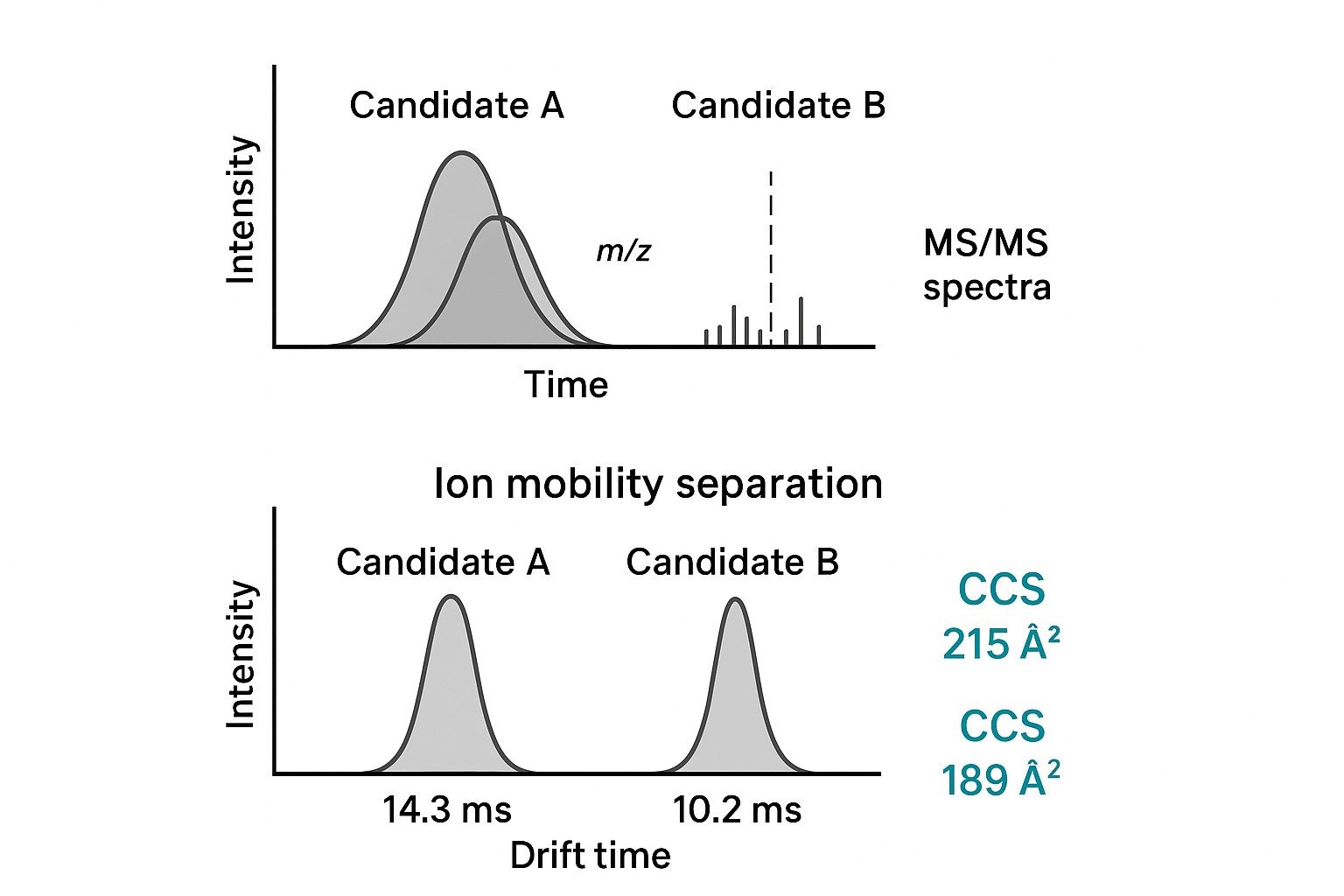
CCS is an orthogonal feature that can strengthen annotation confidence. When a candidate structure matches accurate mass and MS/MS but its CCS disagrees with a reference value, that mismatch is informative.
CCS comparability depends on calibration and method control. CCS values should be interpreted alongside the ion mobility platform type and calibration strategy used.
Adduct form matters. The same compound measured as [M+H]⁺ versus [M+Na]⁺ can adopt different conformations and show different CCS values. If your library CCS is for one adduct but your data were acquired as another, you may be comparing the wrong things.
How CCS Should Be Interpreted Across Measurement Contexts
CCS reporting most commonly occurs under low-field conditions, and CCS values should always be contextualized:
- Drift time is instrument-specific, while CCS is the normalized comparison value.
- CCS interpretation depends on ion mobility modality and calibration.
- CCS matching should be done with adduct-consistent, platform-aware references.
Why Traditional LC-MS/MS Can Struggle with Metabolite Identification
Even a carefully tuned LC-MS/MS method can struggle with metabolite identification in real studies because the chemical space is dense, and biology is messy.
First, isomeric and isobaric compounds can share the same nominal (and even exact) mass. In metabolomics, many biologically distinct molecules have near-identical elemental formulas or differ only by subtle structural rearrangements. Their fragmentation can also be highly similar—especially when the fragments reflect common substructures.
Second, complex matrices increase co-elution. Biological backgrounds contribute thousands of ions with overlapping retention windows. Even when chromatographic peaks look "clean," co-eluting ions can still enter the collision cell together.
Third, untargeted workflows generate ambiguity by design: you detect thousands of features, but reference standards exist for only a fraction. That means many features end up with multiple "plausible" annotations based on accurate mass alone.
Finally, retention time is powerful within a single validated method, but retention time transferability is limited. Small differences in column chemistry, gradient, plumbing, and instrument configuration can shift retention enough to break direct comparisons.
Common Bottlenecks in Metabolite Identification
The table below summarizes common identification bottlenecks and the types of evidence that are most likely to resolve them. It's not a guarantee—just a way to reason about where CCS in LC-IM-MS is likely to contribute.
| Bottleneck | Why it happens | What it can break | Where CCS helps |
|---|---|---|---|
| Structural isomers | Same formula, different connectivity | Often needs standards or extra orthogonal evidence | Sometimes helps; depends on ΔCCS and IM resolving power |
| Co-eluting background | Matrix ions overlap in LC | Creates mixed precursor selection and interference | Helps by separating ions before fragmentation |
| Chimeric / mixed MS/MS | Multiple precursors fragment together | Inflates candidate matches | Helps reduce spectral complexity upstream |
| Limited reference standards | Many metabolites have no standard | Prevents Level 1 confirmation | Helps narrow candidates when libraries exist |
| Incomplete MS/MS libraries | Coverage gaps by class/adduct | Leaves ambiguous candidates | CCS databases/prediction can add a second filter |
How CCS Improves Metabolite Identification in LC-IM-MS
CCS improves metabolite identification confidence because it adds a second structural gate that is not derived from chromatography or fragmentation.
In a typical LC-MS/MS annotation flow, the evidence chain might look like this: accurate mass suggests a shortlist; MS/MS library search suggests a few strong candidates; retention time offers some support if standards or validated RT windows exist. But if two candidates are isomers with similar fragments—or if the MS/MS spectrum is chimeric—those filters can still fail.
CCS offers a different kind of check. If you have a reference CCS for the same adduct on a comparable platform, CCS matching can rule out candidates that otherwise look plausible. In practice, this often doesn't produce a single "perfect" answer—but it can turn a long shortlist into a manageable one.
Ion mobility can also reduce spectral complexity by separating co-migrating ions before fragmentation. That matters because many false positives in untargeted metabolomics aren't caused by library failures—they're caused by spectra that don't correspond to a single clean precursor in the first place.
In practice, the value of CCS is usually reflected in two ways:
- CCS helps you reject wrong annotations more confidently.
- CCS helps you prioritize the right candidates for follow-up (standards, targeted confirmation, or orthogonal experiments).
When CCS Adds Practical Value in Metabolite Identification
CCS in LC-IM-MS is most useful when it turns your reasoning from "this seems likely" into "this is consistent across orthogonal evidence." That's especially important for publication-grade reporting.
- Better support for distinguishing related structures (when CCS differences are measurable and reproducible).
- Cleaner evidence chains in complex samples by reducing chimeric MS/MS.
- Stronger support for Level 2-style annotations when paired with MS/MS and other evidence (and reported transparently).
- More transparent filtering logic in untargeted workflows: readers can see what was matched (m/z, fragments, CCS) and what thresholds were used.
CCS vs Retention Time and MS/MS in Metabolite Identification
CCS, retention time, and MS/MS provide different types of evidence in metabolite identification. In practice, the question that matters is: what kind of ambiguity are you facing, and which piece of evidence is most likely to resolve it?
Retention time is about chromatographic interactions under a specific method. MS/MS is about fragmentation pathways under specific collision energy and instrument settings. CCS is about gas-phase mobility under a defined mobility modality and calibration.
They're not competing measurements—they're complementary. A defensible LC-IM-MS metabolite identification workflow treats them as different lenses on the same underlying question.
How CCS Compares with Retention Time and MS/MS
| Evidence type | What it mainly constrains | Strength | Failure mode to watch |
|---|---|---|---|
| m/z (MS1) | Formula/candidate filtering | Fast and broadly applicable | Isomers and isobars remain |
| Retention time | Chromatographic behavior | Strong within one validated method | Poor transfer across labs/methods |
| MS/MS | Fragment evidence | Often most diagnostic for structure | Chimeric spectra; library gaps |
| CCS | Gas-phase size/shape descriptor | Orthogonal, often reproducible | Platform/adduct dependence; incomplete coverage |
How to Interpret CCS Alongside Retention Time and MS/MS
- Retention time remains the strongest evidence when you have validated methods and authentic standards under the same chromatographic conditions.
- CCS is often more transferable than retention time, but it's not universally interchangeable across all ion mobility platforms.
- Authentic standards are still required for full reference-standard-based confirmation. CCS can narrow candidates, but it does not replace "same compound, same method, same fragmentation" confirmation.
When you compare LC-MS vs LC-IM-MS, the right question isn't "does ion mobility always improve identification?" It's "does your study suffer from the failure modes ion mobility can reduce?"
When Does CCS Add Real Value in Metabolomics Studies?
CCS tends to add the most value when identification ambiguity is a limiting factor, not just an inconvenience.
In untargeted workflows, many features never become conclusions—they remain "interesting signals" because the team can't defend a specific identity. That hurts downstream biology: pathway enrichment becomes less interpretable, mechanistic claims become fragile, and follow-up experiments risk targeting the wrong metabolite.
CCS in LC-IM-MS can be a pragmatic tool for triage: which features deserve targeted confirmation? Which candidates are inconsistent with a known CCS? Which signals are likely chimeric and need re-acquisition?
Metabolomics Study Types That Benefit Most from CCS
- Biomarker discovery studies with complex matrices, where co-elution and background interference are common.
- Large-cohort untargeted profiling, where you need a consistent filtering rule across batches.
- Lipidomics workflows, where structural density is high and many species are closely related.
- Exposure-related or mixed-matrix studies, where exogenous compounds and metabolites coexist.
- Cross-laboratory workflows that need more transferable evidence than retention time alone.
For teams outsourcing or collaborating on complex projects, it also helps to have an end-to-end workflow that explicitly states how annotation confidence is built. In practice, many Untargeted Metabolomics Service workflows rely on transparent, staged filtering rather than a single library score.
What CCS Can and Cannot Resolve
The most defensible way to use collision cross section metabolomics data is to treat CCS as constraint, not proof.
CCS can improve discrimination among some isomers and closely related compounds—especially when ΔCCS is large enough relative to measurement precision and the instrument's resolving power. In a metabolite CCS library context, there are classes where CCS adds substantial discriminatory value, and classes where it adds little.
But CCS does not universally resolve all positional, stereochemical, or double-bond ambiguities. Two structures can be different in biologically important ways and still present extremely similar gas-phase mobilities.
Quality also depends on instrument platform, calibration strategy, and database quality. A mismatch between your acquisition context and the reference library's context can create false disagreements.
Key Limitations of CCS in Metabolite Identification
- Platform-to-platform variability: CCS values are not always directly comparable across different ion mobility modalities without careful calibration alignment.
- Adduct dependence: CCS values can shift with adduct type and charge state.
- Limited empirical CCS coverage: many metabolites and adducts still lack measured CCS values.
- Prediction error: in silico CCS can help screen candidates, but it should be labeled as predicted and treated as supportive.
- Residual ambiguity: highly similar structures may remain unresolved without authentic standards.
If your key biological claim depends on distinguishing two near-isomers, the safest workflow is to use CCS to prioritize which authentic standards to purchase or synthesize—then confirm under matched conditions.
Ion Mobility Platforms and CCS Calibration Basics
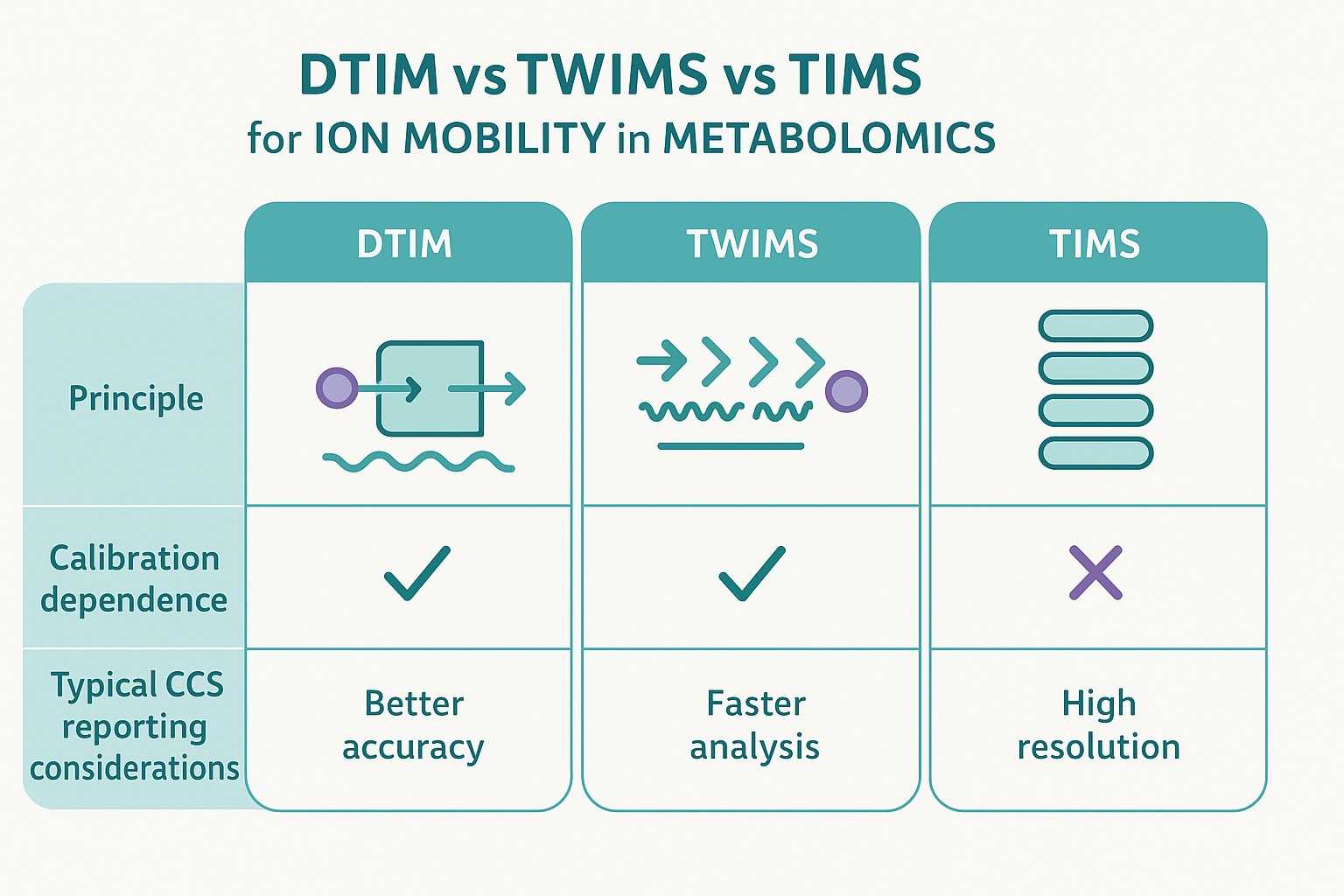
Ion mobility metabolomics is not a single technology. The most common platforms in metabolomics include drift tube ion mobility (DTIM), traveling wave ion mobility (TWIMS), and trapped ion mobility spectrometry (TIMS). They share the high-level goal—separate ions by mobility—but differ in how mobility is generated and how CCS is obtained.
A practical rule for academic teams: CCS is easiest to interpret when you can clearly state which platform produced it and how it was calibrated.
- DTIM measurements are often considered the most directly interpretable for CCS because the physics is closer to first-principles mobility relationships.
- TWIMS and TIMS can report CCS, but CCS values depend more explicitly on calibration models and chosen calibrants.
Core Principles for CCS Calibration
A calibration strategy that is "good enough" for screening may not be good enough for a paper where the identification hinges on CCS. The safest approach is to treat calibration as part of your QA/QC system, not a one-time setup.
- Use fit-for-purpose calibrants appropriate for the mass and mobility range.
- Keep adduct form consistent when comparing experimental and reference CCS values.
- Define tolerance windows in advance rather than tuning after you see results.
- Recalibrate when performance checks indicate drift or unacceptable deviation.
What Should Be Reported for CCS Data?
If CCS is used to support annotations, include at minimum:
- Ion mobility platform and acquisition mode
- Calibration compounds or calibration strategy
- Adduct form used for matching
- CCS tolerance window applied in annotation
CCS Databases, Predicted CCS, and Annotation Workflows
CCS databases exist, but coverage is uneven by chemical class, adduct, and instrument context. For many metabolites—especially those that don't ionize cleanly or appear in multiple adduct forms—measured CCS values may be absent.
That's where predicted CCS becomes useful. Predicted CCS can act like a "sanity filter" when combined with other evidence: accurate mass + MS/MS narrows candidates; predicted CCS can help deprioritize candidates that are structurally inconsistent with the observed mobility.
The risk is overconfidence. Predicted CCS is not a substitute for measured CCS, and neither predicted nor measured CCS is a substitute for authentic standards when a claim requires Level 1 confirmation.
Recommended CCS Annotation Workflow
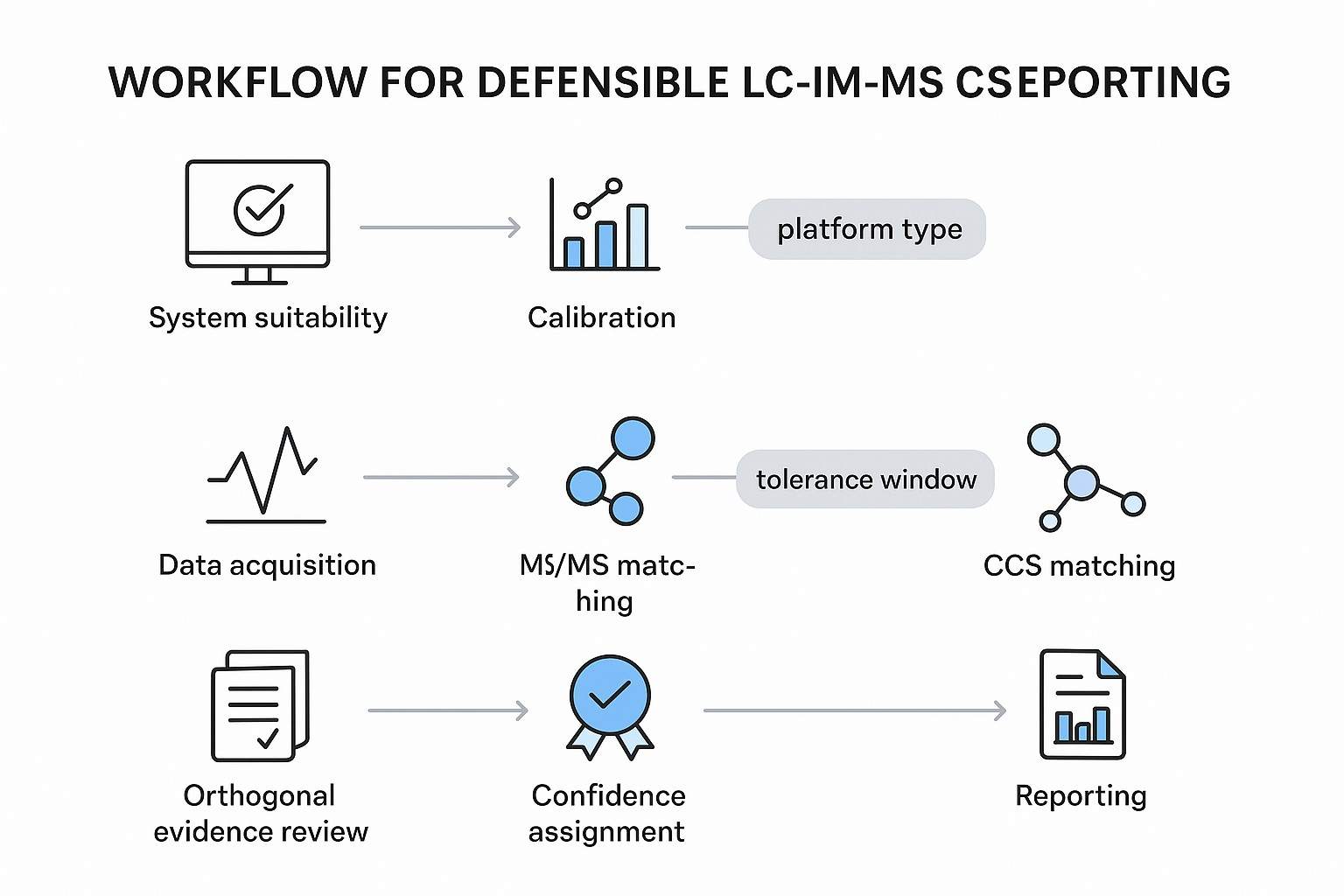
This workflow is designed as a staged decision process in which each step contributes a different layer of evidence. In this context, CCS should be used as an additional constraint alongside accurate mass, MS/MS, and retention time where applicable, rather than as a standalone decision rule.
- Feature detection and preprocessing
- Candidate generation from accurate mass
- MS/MS matching
- Retention time review where applicable
- CCS matching against experimental or predicted values
- Confidence assignment and reporting
Best Practices for Using CCS Databases
- Prefer experimentally measured CCS values where available.
- Check whether library CCS was acquired on comparable platforms and for the same adduct type.
- Keep prediction-based evidence clearly labeled as predicted rather than measured.
Using CCS in LC-IM-MS for Large-Scale Metabolomics Studies
In large untargeted studies, you often have two competing risks:
- being too permissive and accumulating false positives that pollute downstream biology, or
- being too strict and losing real signals because your criteria are not portable across batches.
CCS can help, but only if the operational model is disciplined. A CCS window chosen post hoc can inflate apparent confidence without actually improving correctness.
Where CCS commonly helps in large studies:
- Candidate filtering at scale: applying a consistent constraint across many features.
- Cross-batch review: flagging features whose CCS shifts beyond expected tolerance.
- Prioritization for validation: identifying a subset of high-impact features worth standards-based confirmation.
Operational Considerations for Large-Scale CCS Workflows
- Throughput impact: ion mobility adds data dimensions and can affect acquisition time and processing complexity.
- Calibration and QC requirements: CCS is only as stable as your calibration discipline.
- Integration with pipelines: ensure your software stack retains IM metadata (platform, adduct, calibration, CCS tolerances).
- Reporting: record CCS tolerance and acceptance rules in the same place as MS/MS matching criteria.
QA/QC Requirements for CCS Workflows
- System suitability checks before analytical runs.
- Daily or batch-level review of calibration performance.
- Defined triggers for recalibration or data review.
- Documentation of uncertainty, tolerance windows, and acceptance criteria.
How to Report CCS Data in LC-IM-MS Studies
A reviewer doesn't need to love ion mobility to accept CCS-supported identifications. But they do need to understand what you measured, how you calibrated it, and what rule you used to decide a match.
Clear and well-structured CCS reporting improves the transparency, credibility, and reproducibility of metabolite annotations:
- State CCS measurement conditions and platform type.
- Specify calibration approach and adduct form.
- Report matching tolerances and database source.
- Distinguish experimental CCS from predicted CCS.
- Keep annotation confidence transparent and aligned with reporting standards.
Minimum Reporting Elements for CCS Data
| Reporting element | Why it matters |
|---|---|
| IM platform and acquisition mode | Determines how CCS is derived and compared |
| Calibration details | Defines traceability and expected uncertainty |
| Adduct used for matching | Prevents mismatched comparisons |
| CCS value and tolerance window | Makes the decision rule explicit |
| Library or prediction source | Enables audit and reproducibility |
| Final annotation confidence level | Prevents overinterpretation |
| Uncertainty/exclusion/recalibration criteria | Shows method discipline |
Frequently Asked Questions
What does CCS measure in LC-IM-MS?
CCS measures an ion's effective collisional area in a buffer gas during ion mobility separation, reflecting gas-phase size/shape and charge-related interactions. It's best interpreted as an orthogonal structural descriptor that complements m/z, retention time, and MS/MS.
How is CCS different from drift time?
Drift time is the instrument's observed arrival time under a specific mobility setup; CCS is the normalized value derived from mobility that's intended for comparison. CCS is more comparable than drift time, but it still depends on platform type and calibration strategy.
Is CCS more reliable than retention time?
Not universally. Retention time can be extremely strong evidence within a validated chromatographic method using standards, while CCS can be more transferable across methods when calibration is controlled. The most defensible identifications combine both when available.
Can CCS replace MS/MS in metabolite identification?
No. CCS is complementary evidence and works best alongside accurate mass and MS/MS fragment matching. CCS can narrow candidates and reject false positives, but it does not provide the same structural specificity as fragmentation patterns.
Can CCS resolve all isomers in metabolomics?
No. CCS can separate some isomers when their mobility differences are large enough and the instrument resolving power is sufficient, but many positional or stereochemical isomers remain ambiguous. When a claim depends on an isomer call, authentic standards and orthogonal confirmation are still the safest route.
What CCS tolerance window should I use?
Define a CCS tolerance window before analysis and justify it using platform type, calibration performance, and quality control results. A post hoc window chosen to "make matches work" weakens defensibility.
Are CCS databases available for untargeted metabolomics?
Yes, but coverage is incomplete and can be adduct- and platform-dependent. Prefer experimentally measured CCS libraries when available, and treat predicted CCS as supportive rather than definitive evidence.
Can CCS be predicted if my metabolite isn't in a database?
Yes. Machine-learning and physics-informed approaches can predict CCS to support candidate screening, but prediction error is non-zero and should be clearly labeled as predicted in reporting.
Is LC-IM-MS always worth using?
Not always. LC-IM-MS is most valuable when identification ambiguity is a major bottleneck (e.g., isomer-rich chemistry, high background, large cohorts, or reviewer-driven identification rigor). If your conclusions don't hinge on challenging identifications, the added complexity may not pay off.
Talk With Our Team
If your study requires stronger metabolite annotation confidence, better handling of isomeric complexity, or a clearer identification workflow, our team can help you evaluate whether CCS in LC-IM-MS fits your metabolomics question.
A practical starting point is to align the analytical approach with your study's risk: whether you need broad discovery, defensible filtering for a large cohort, or standards-based confirmation for a focused set of candidates. Many teams begin with untargeted profiling and then move into confirmation-oriented quantification when a shortlist of metabolites must be defended in a manuscript.
If you want to discuss confirmation strategy and method transparency for publication-grade results, Targeted Metabolomics Analysis Service is a practical next step.
References
- Collision Cross Section as a Molecular Descriptor in Ion Mobility Spectrometry-Mass Spectrometry
- Collision Cross Section (CCS) Measurement and Prediction: An Important Supplementary Parameter in Omics Research
- Metabolite collision cross section prediction without energy minimization
- Guidelines and considerations for building multidimensional metabolite libraries using LC-ESI-MS/MS and IM-MS
- Ion Mobility Collision Cross Section Compendium
- Drift Tube Ion Mobility: How to Reconstruct Collision Cross Section Values from Arrival Time Distributions

 Contact Us