
Multi-omics at Cohort Scale: How Integrated Metabolomics Drives Biomarker Discovery in Large Consortia
Submit Your InquiryMetabolomics sits close to phenotype. In large consortia and cohort-style research programs—especially in preclinical and translational oncology—this proximity helps translate molecular signals into decisions about pharmacodynamics (PD), toxicity risk, and companion biomarkers. But scaling from pilot studies to thousands of samples across years and sites changes the game. Long analytical runs, shifting batches, uneven metadata, and annotation uncertainty can drown true biology in technical variance unless you engineer QC/QA and batch correction up front and make integration choices that survive audit.
This guide provides a practical blueprint: study design patterns, analytical pitfalls, QC placement and batch-effect correction, standardized preprocessing and MSI-grounded annotation, integration strategies across omics layers, and how to prioritize biomarker candidates that replicate across batches and subgroups. The examples anchor on oncology PD/tox and companion biomarker discovery, but the methods generalize to any large multi-omics cohort.
Key takeaways
- Metabolomics adds phenotype-proximal context that improves subgrouping, pathway interpretation, and biomarker prioritization in multi-omics cohorts.
- Cohort scale demands engineered QC/QA: pooled QCs, SST, reference materials, and objective acceptance criteria (RSD, ICC, drift slopes, QC clustering).
- Combine QC-based within-batch correction (LOESS/RLSC) with between-batch harmonization (ComBat) when batches differ—validate with pre/post metrics.
- Use standardized preprocessing and MSI identification levels to separate exploratory features from high-confidence IDs before integration.
- Choose integration strategies (pathway, correlation/network, machine learning, mQTL/mGWAS) with overfitting controls and cross-layer concordance checks.
- Prioritize biomarkers that show statistical robustness, reproducibility across sites/batches, annotation confidence, and pathway-level support.
- Deliver reanalysis-ready packages: data, metadata, QC/batch-correction reports, annotated tables with MSI levels, and integration summaries.
Why Metabolomics Matters in Cohort-Scale Biomarker Discovery
Metabolites reflect pathway fluxes influenced by genetics, transcription, protein activity, microbiome crosstalk, diet/exposures, and drugs. That makes metabolomics a phenotype-proximal readout that fills gaps left by upstream layers. In cohort settings, this proximity improves:
- Sensitivity to PD/tox signals: shifts in central carbon metabolism, redox balance, lipid remodeling, or xenobiotic biotransformation can indicate on-target activity or unintended liabilities before histology changes are detectable.
- Subgrouping: metabolite patterns can stratify responders vs. non-responders or reveal exposure-driven clusters that genomics alone cannot resolve.
- Pathway interpretation: multi-omics at cohort scale benefits when metabolite changes cohere with transcript/protein shifts, strengthening biological narratives for candidate biomarkers.
Metabolomics is especially relevant when the study involves microbiome interactions, diet/exposure variation, or drug metabolism—all frequent realities in oncology discovery and translational research. When integrated carefully with proteomics, transcriptomics, and genotype data, it turns correlation into cross-layer consistency.
Study Design Considerations for Large Cohort Multi-Omics
Large consortia typically operate under one (or a hybrid) of these designs, each with implications for QC, metadata, and analysis.
- Prospective longitudinal cohorts: maximize temporal inference and intra-subject contrasts. They require tight preanalytical controls (collection windows, fasting status), and drift-resistant QC placement because runs extend over months.
- Multi-center cross-sectional studies: extend diversity and sample size but amplify site effects; randomization and cross-site harmonization become critical.
- Retrospective biobank studies: cost-effective access to scale; quality hinges on storage integrity and the documentation of freeze–thaw cycles and handling.
- Nested case–control: efficient for specific endpoints (e.g., toxicity events); sampling frames must be transparent to avoid hidden confounding.
Define endpoints, subgroup logic (e.g., responders by PD readouts), and covariates early. Metadata should minimally include fasting status, collection time, site, medication/exposure status, storage history, and freeze–thaw counts; these fields drive covariate models and QC decisions.
Two common plasma-derived matrices—plasma and serum—are often used alongside urine, CSF, stool, or tissue extracts. Each has pros and caveats at cohort scale:
| Sample type | Typical oncology cohort use | Strengths | Caveats at scale |
|---|---|---|---|
| Plasma | Systemic PD/tox panels; xenobiotic metabolism | Broad coverage; anticoagulants stabilize clotting | Additive effects (EDTA/heparin) on certain ions; site-to-site tube variation |
| Serum | Clinical biobank legacy; lipid remodeling | Rich lipidome; extensive historical data | Clotting-time variability; potential metabolite consumption during clot |
| Urine | Noninvasive tox markers and exposure readouts | High sensitivity for xenobiotics; large volumes | Hydration variability; normalization strategy required (creatinine/specific gravity) |
| CSF | Neurotox/oncology adjuncts | Direct CNS proximity | Invasive collection; low-volume constraints |
| Stool | Microbiome–host co-metabolism | SCFA/bile acid insights | Heterogeneity; storage temperature sensitivity |
| Tissue extracts | Tumor metabolic state | High local signal; aligns with proteo/transcriptome | Sampling bias; ischemia time effects |
Analytical Challenges in Cohort-Scale Metabolomics
Cohort-scale programs run for months to years and often span multiple instruments and sites. The main bottlenecks are predictable—and solvable—if you plan for them:
- Long acquisition windows: retention-time and intensity drift accumulates; instruments age and undergo maintenance.
- Inter-batch and inter-site variation: different columns, source tune states, and operators introduce step changes.
- Preanalytical heterogeneity: variable thaw protocols, handling times, or matrix effects drive unwanted variance.
- Incomplete metadata: missing fields (e.g., fasting, meds) obscure confounding and undermine covariate models.
- Uneven annotation confidence: MS1 features balloon; few reach MSI Level 1 without standards.
- Cross-platform alignment: linking targeted panels, untargeted features, and lipid species to the same biological entities is nontrivial.
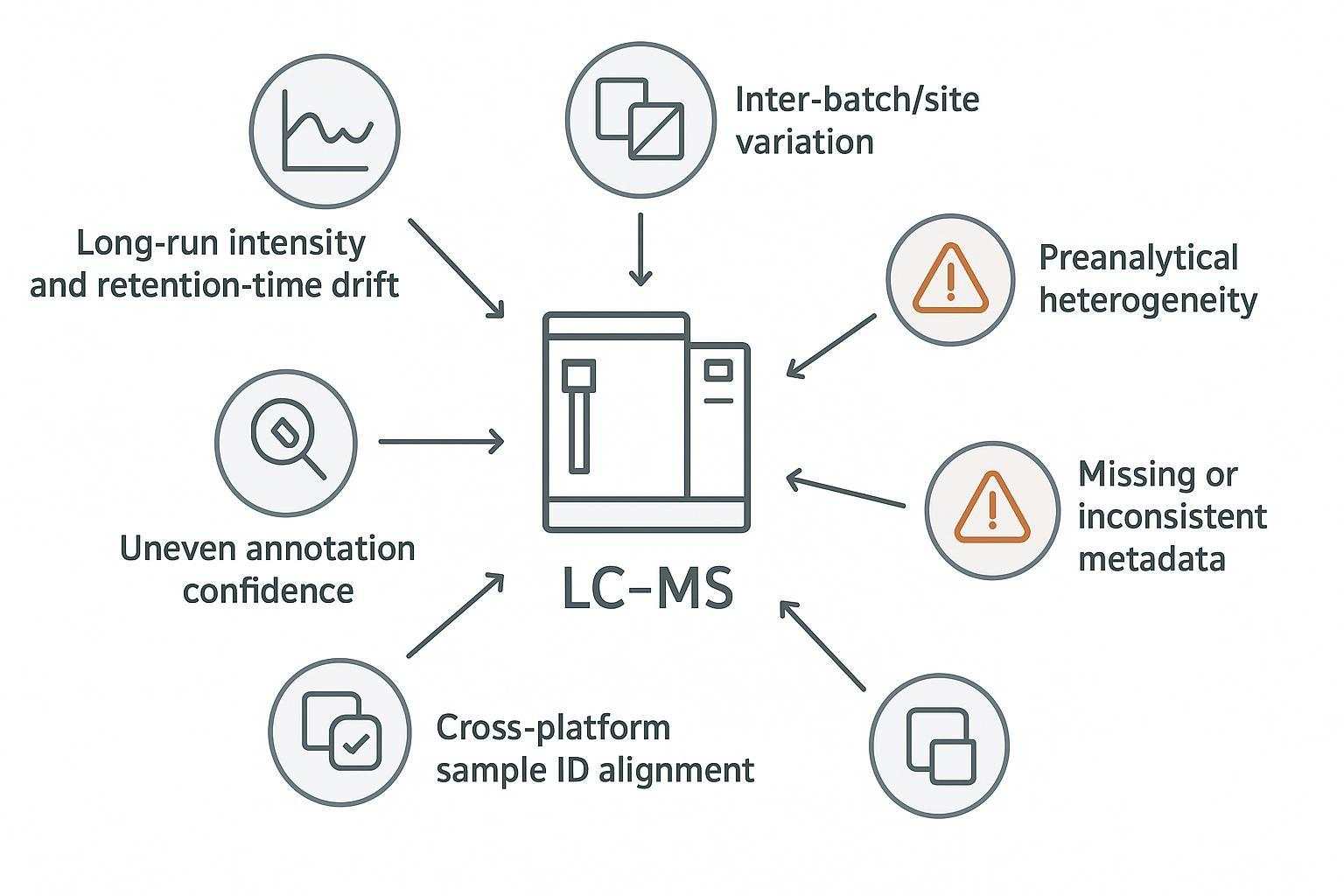
These issues justify a different analytical framework from small studies: denser QC placement, explicit drift monitoring, robust correction strategies, and transparent evidence for every normalization choice.
QC Strategy and Batch Effect Correction
A scalable QC architecture has three pillars: standardized test materials, deliberate sample placement, and objective evaluation metrics.
- Pooled QC and reference materials
- Pooled QC injections every 5–10 study samples and at batch edges help monitor precision and condition the LC–MS system. Community practice surveys emphasize their central role in untargeted workflows, with labs targeting median pooled QC RSD ≤10–20% for endogenous metabolites (see community assessments summarized in Broeckling 2023, Analytical Chemistry; and related QA/QC reports).
- System suitability tests (SST) before each batch confirm mass accuracy, sensitivity, and RT stability.
- Reference materials such as NIST SRM 1950 or matrix-matched RMs provide long-run anchors for between-batch harmonization.
- Randomization and monitoring
- Randomize samples across batches and injection order within batches; interleave sites and subgroups to avoid confounding.
- Monitor retention time and intensity drift continuously; plot run-order slopes for sentinel features and internal standards.
- Correction strategies and when to use them
- QC-based LOESS/RLSC is effective for within-batch drift when pooled QCs are dense.
- ComBat (empirical Bayes) can align batch means/variances post within-batch correction for multi-batch harmonization.
- When QCs are sparse or drift is complex, benchmark TIGER or SERRF-like methods and corroborate with metrics.
Selection guidance at a glance:
| Scenario | Recommended approach | Rationale | Primary checks |
|---|---|---|---|
| Dense pooled QCs with clear intra-batch drift | QC-RLSC (LOESS) within batch | Corrects run-order drift using QC anchors | QC RSD down; drift slope ~0; tight QC clustering |
| Multiple heterogeneous batches | QC-RLSC within batch + ComBat across batches | Empirical Bayes aligns means/variance after intra-batch fix | Pre/post RSD, ICC up; batch separation down in PCA |
| Sparse QCs or complex non-linear drift | TIGER/SERRF-like methods; benchmark vs LOESS/ComBat | Handles heteroscedastic drift; reduces overfitting risk | RSD/MAE↓; subject clustering preserved |
| Long-run targeted HT assays with RMs | RM-based normalization (e.g., NIST SRM 1950) | Anchors multi-year stability | Control charts stable; ICC high |
Objective metrics to report pre/post correction include pooled QC RSD distributions, intraclass correlation coefficients (ICC), PCA/UMAP showing tight QC clustering, and run-order drift slopes trending toward zero. Authoritative discussions include community best-practice summaries for untargeted metabolomics in 2023 and QC frameworks published in 2024.
For readers seeking an end-to-end overview of preprocessing stages that feed into correction, see data preprocessing and a stepwise untargeted metabolomics analysis process .
Data Processing and Metabolite Annotation
Standardize preprocessing across batches and sites before you integrate layers.
- Feature filtering and missingness: remove features that fail QC performance thresholds; handle missing values with strategies aligned to data-generating mechanisms (e.g., censored vs. sporadic dropouts). Transformation and scaling should be applied consistently across batches after correction.
- Untargeted vs targeted roles at cohort scale: use untargeted acquisition for discovery breadth, then escalate promising candidates to targeted/absolute quantitation for verification and cross-cohort comparability. If verification is anticipated, design for it early (stable isotope internal standards, RM alignment, and calibration ranges).
- Annotation workflow and MSI levels: classify identification confidence using MSI levels—Level 1 requires confirmation with authentic standards under the same conditions; Level 2 uses high-quality MS/MS library matches; Level 3 is compound class; Level 4 unknown. Report evidence explicitly (exact mass tolerance, RT window, library/source, spectral similarity score) and maintain a mapping table across platforms.
When you require breadth for discovery in oncology cohorts, untargeted metabolomics can supply scalable coverage; subsequent annotation and confirmation should adhere to MSI principles before inclusion in decision-grade panels.
Multi-Omics Data Integration at Cohort Scale
Integration should increase interpretability and stability—not inflate spurious associations. Choose an approach matched to your objective and guard against overfitting.
- Pathway-based integration: aggregate feature-level signals to pathway/module scores, then align with transcript/protein pathway activity; this reduces dimensionality and emphasizes biological coherence.
- Correlation-based integration: compute cross-omic correlation structures to find modules spanning layers; validate stability via bootstrapping and test whether identified modules persist across batches/sites.
- Network analysis: construct metabolite–protein–transcript networks; prioritize nodes with cross-layer support and pathway centrality, while avoiding degree-bias artifacts.
- Machine learning feature selection: use nested cross-validation with stability selection to identify multi-omic panels; report calibration and variance explained; include permutation tests and control for batch/site variables.
- Genetics integration (mGWAS/mQTL): link metabolites to variants and upstream expression/proteins; incorporate LD-aware colocalization and, where justified, Mendelian randomization to probe causal architectures.
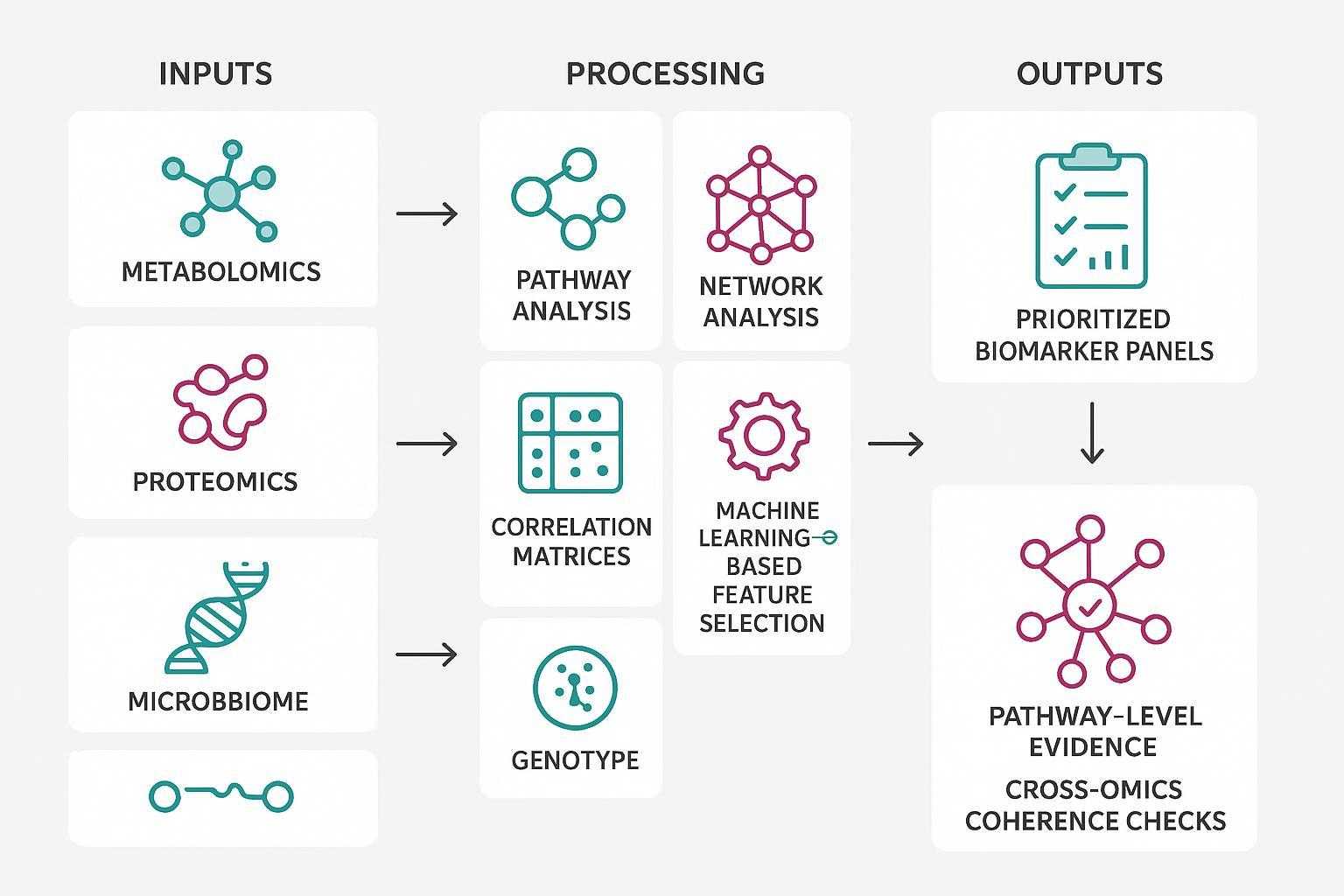
Done well, integration provides "biological triangulation": candidate biomarkers gain credibility when metabolite changes align with pathway-level transcript/protein shifts and, where available, genetic instruments.
Biomarker Discovery and Prioritization in Large Consortia
Discovery at cohort scale is less about hunting the biggest P-value and more about ranking candidates that will survive replication and downstream validation.
- Single analyte vs multi-marker panels: panels often outperform single features due to pathway-level redundancy and noise resilience. Use nested CV and prospective-like splits by batch/site to avoid optimistic bias.
- Reproducibility across strata: require consistent direction and effect size across batches/sites/subgroups; track ICC improvements post-correction.
- Annotation confidence and biological coherence: weight MSI Level 1/2 higher; reward candidates supported by cross-omic pathway evidence and plausible MoA.
- Prioritization criteria: statistical robustness (FDR, calibration), reproducibility, MSI level, pathway support, and feasibility for targeted quantitation (availability of standards, ionization behavior, matrix stability).
- Common failure modes: drift-driven artifacts, overfitting from leakage across sites/batches, unstable annotations, and pathway incoherence.
A practical gating sequence for oncology PD/tox programs: broad untargeted discovery → QC-audited correction and filtering → cross-omics/pathway prioritization → targeted/absolute quantitation for verification → blinded replication across batches/sites.
Reporting Standards and Minimum Deliverables for Cohort-Scale Studies
Standardized outputs accelerate decision-making and peer review. Your reporting package should be reanalysis-ready and audit-friendly.
- QC summary: pooled QC RSD distributions, SST outcomes, control charts for internal standards/reference materials.
- Batch correction summary: method rationale, parameters, and pre/post metrics (RSD, ICC, PCA/UMAP QC clustering, drift slopes) with figures.
- Annotated metabolite table: IDs with MSI levels and evidence fields (mass tolerance, RT, library/source, MS/MS similarity scores), plus cross-platform mapping keys.
- Differential and subgroup analyses: effect sizes with uncertainty, covariate adjustments, sensitivity analyses.
- Integration summary: pathway/network results, cross-layer concordance, model calibration and stability diagnostics.
- Biomarker ranking: criteria and evidence badges (robustness, reproducibility, MSI, pathway support, feasibility for targeted verification).
- Reanalysis-ready data: processed matrices, code or notebooks, software versions, parameters, random seeds, and complete metadata dictionaries.
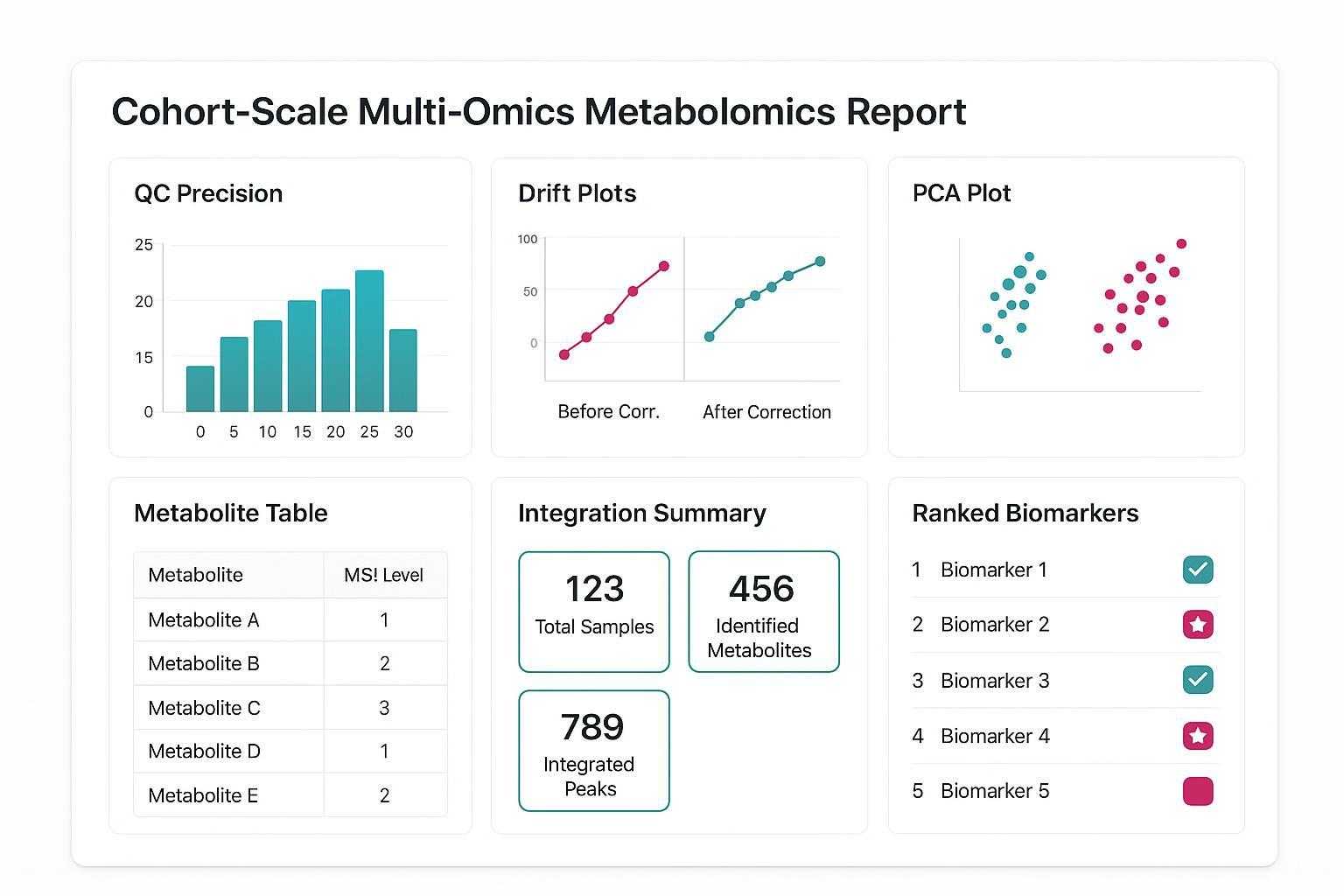
For teams building or auditing these workflows, additional context on steps and handoffs is available in untargeted metabolomics analysis process and data preprocessing resources.
Frequently Asked Questions
Why is metabolomics important in large cohort studies?
Metabolomics is closer to phenotype than upstream layers, capturing pathway fluxes and exposure/drug effects. In multi-omics cohorts, it strengthens subgrouping and offers pathway-level evidence that complements genomics, transcriptomics, and proteomics.
How do you reduce batch effects in multi-year metabolomics studies?
Engineer QC/QA first: pooled QCs, SST, and reference materials. Randomize across batches/sites, monitor RT/intensity drift, then apply QC-based within-batch correction (LOESS/RLSC) and between-batch harmonization (e.g., ComBat). Confirm success with pooled QC RSD, ICC, QC clustering, and reduced drift slopes.
Is untargeted metabolomics enough for cohort-scale biomarker discovery?
Untargeted is ideal for discovery breadth. For decision-grade use and cross-cohort comparability, escalate promising features to targeted/absolute quantitation with internal standards and calibration—especially before external validation or regulatory-facing milestones.
What sample types are most commonly used in large cohort metabolomics?
Plasma and serum dominate; urine is powerful for exposure/tox markers; CSF supports neuro-oncology or neurotox contexts; stool captures microbiome–host metabolism; tissue extracts profile tumor metabolic states. Choose based on endpoint, feasibility, and storage integrity.
Can retrospective biobank samples still be used for metabolomics?
Yes—if storage quality is high and freeze–thaw history is documented. Run pre-analytical QC assessments (e.g., degradation markers), use RMs where possible, and apply conservative filtering if QC metrics underperform.
How does mGWAS differ from traditional GWAS?
mGWAS associates genetic variants with metabolite levels rather than disease traits directly. It can reveal enzyme activities or pathway regulation that, in turn, inform disease mechanisms or biomarker biology.
What makes a biomarker candidate strong in a multi-omics cohort study?
Stability across batches/sites, robust effect sizes with controlled FDR, high MSI identification confidence, pathway-level and cross-omics coherence, and feasibility for targeted verification. Multi-marker panels with these traits typically outperform single analytes.
Conclusion
Metabolomics has become central to multi-omics at cohort scale because it connects upstream regulation to phenotype. But scale punishes ad hoc workflows: QC architecture, batch-effect modeling, and metadata discipline determine whether signals persist across years and sites. Integration choices matter as much as data generation—pathway and network context, correlation structures, and genetics-aware analyses help separate robust biology from noise. Teams that standardize deliverables and maintain an audit trail ultimately discover and prioritize biomarkers more efficiently—and more credibly—across large consortia.
Talk With Our Team
If you are planning a large cohort or consortium-based multi-omics study, our team can support metabolomics workflow design, QC strategy, batch correction, annotation, and cross-omics interpretation. For discovery breadth at scale, see untargeted metabolomics and related resources on data preprocessing and untargeted metabolomics analysis process .
References
- Community practices and QA/QC in untargeted LC–MS metabolomics: Broeckling CD et al., 2023, Analytical Chemistry. See the open summary in the NIH archive: Current practices in LC–MS untargeted metabolomics.
- QC frameworks emphasizing pooled QCs, drift monitoring, and acceptance criteria: Recommendations and Guidelines for Robust Quality Control in Metabolomics (2024, Analytical Chemistry).
- Workshop report on QA/QC best practices: Dunn WB et al., 2023. Metabolomics 2022 workshop report.
- Technical variation elimination benchmarking: Han S et al., 2022. TIGER: technical variation elimination for metabolomics data.
- Multi-batch harmonization with within-batch correction plus ComBat: Habra H et al., 2022. Alignment and analysis of a disparately acquired multibatch LC–MS dataset.
- Reference-material-based normalization in high-throughput LC–MS/MS: Omic-scale quantitative LC–MS/MS using NIST SRM 1950 (2023, Analytical Chemistry) and Ref-M approach (2022, Analytical Chemistry).
- MSI identification framework and annotation workflow guidance: Alseekh S et al., 2021. Mass spectrometry-based metabolomics: a guide for annotation workflows and Zulfiqar M et al., 2023. The reproducible Metabolome Annotation Workflow (MAW).
- Genetics-integrated metabolomics references: Auwerx C et al., 2023. Connecting genetic variation, metabolites, and traits; and mGWAS-Explorer methods overview.
- Reporting frameworks and reanalysis standards: OECD Metabolomics Reporting Framework (MRF).

 Contact Us