

LC-MS vs LC-IM-MS: How to Choose the Right Platform for Your Study
Submit Your InquiryIf you run metabolomics long enough, you eventually hit the same crossroads: your current LC-MS workflow is generating a long list of statistically "significant" features—but too many of them sit behind ambiguous annotations, co-elution, or matrix-driven interference. At that point, the question becomes less about buying a newer instrument and more about choosing the right evidence for the scientific decision you need to make.
This is why the LC-MS versus LC-IM-MS debate is best framed as a platform selection problem. In other words, you're not choosing a technology because it is fashionable; you're choosing a workflow because it changes what you can reasonably conclude. For preclinical teams, that difference matters: a platform decision affects candidate ranking, validation strategy, reporting defensibility, and how confidently you can connect a signal to a mechanism.
In practice, the right answer depends on your study goals, matrix complexity, identification needs, throughput constraints, and what your downstream consumers (translational stakeholders, QA, journal reviewers, or auditors) will expect to see.
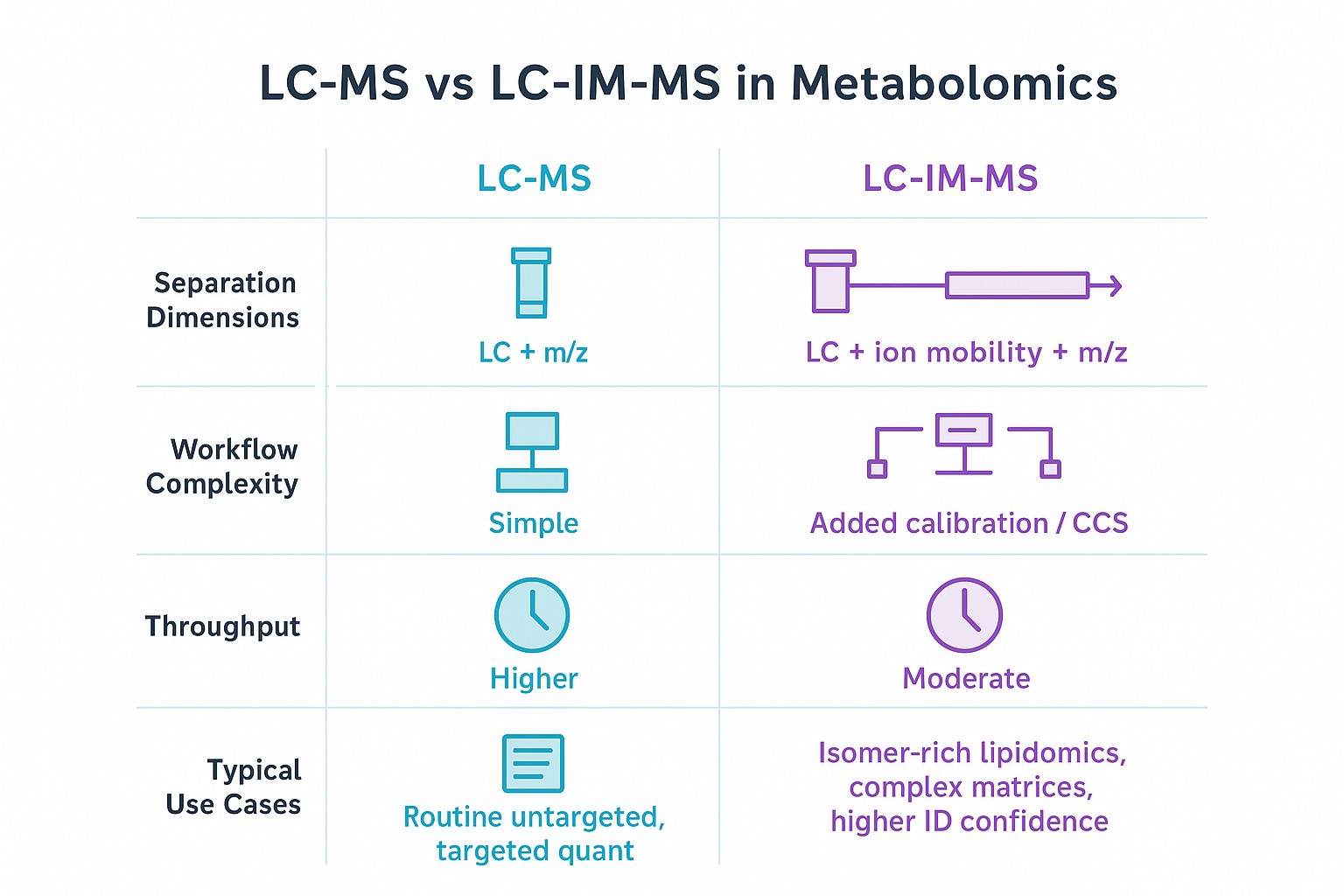
What Decision Are You Really Making?
Most teams think they are choosing between "standard LC-MS" and "LC-IM-MS with ion mobility." What they're actually choosing is whether to keep a simpler, higher-throughput pipeline—or accept extra complexity in order to reduce ambiguity that is already distorting downstream interpretation.
A helpful way to ground metabolomics platform selection is to identify the study's real bottleneck. In some programs, the bottleneck is straightforward: you need stable throughput, cross-batch consistency, and robust quantification across dozens to hundreds of samples. In others, the bottleneck is decision risk: you can't confidently tell whether the feature you're prioritizing is a metabolite of interest, an isomer, an in-source fragment, or a matrix-confounded artifact.
Ion mobility does not automatically make a study "better." It can, however, change the shape of uncertainty in the dataset by adding an orthogonal gas-phase separation and enabling collision cross section (CCS) as an additional descriptor. That only pays off if uncertainty around co-elution or structural overlap is what is limiting biological interpretation or candidate prioritization.
Core questions to define first
Before comparing instrument specs or software ecosystems, define what kind of answer the project needs to produce.
- Is the main goal broad discovery, targeted quantification, or structural discrimination?
- Are isomers or co-eluting compounds likely to be a major problem?
- Is identification ambiguity limiting the biological value of the study?
- Will extra analytical complexity improve the final decision quality?
When Conventional LC-MS Is Usually the Better Choice
In many preclinical metabolomics programs, conventional LC-MS is not a compromise—it is the appropriate platform because it delivers sufficient evidence at a sustainable operational burden. If your study's downstream decisions can be made at the pathway or module level (rather than depending on single-feature structural specificity), the incremental value of ion mobility often shrinks.
LC-MS is also typically the best choice when robustness and scaling matter most. For large cohorts, longitudinal studies, and multi-batch designs, the strongest scientific advantage is often not "more dimensions," but fewer degrees of freedom that can drift. A well-controlled LC-MS pipeline—with consistent sample preparation, rigorous QC samples, and a realistic annotation-confidence strategy—often produces results that are easier to defend and reproduce.
If you're in an early discovery phase, it can be rational to start with LC-MS, see where ambiguity becomes a true decision bottleneck, and then escalate selectively. Many teams use LC-MS to establish the signal landscape and then apply higher-specificity methods only where the program is already "paying" for ambiguity.
For readers planning outsourcing or mixed internal/external execution, it can also help to align your platform choice with your intended deliverables. If your goal is broad profiling plus interpretable biological outputs, conventional workflows like untargeted metabolomics service offerings are usually designed around LC-MS/MS and fit well with hypothesis generation and pathway mapping.
Typical examples
Conventional LC-MS is often the practical first-line choice for:
- Standard discovery metabolomics
- Many targeted quantification panels
- Routine comparative studies across treatment groups
- Follow-up studies focused on known metabolite sets
When LC-IM-MS Is Worth Considering
LC-IM-MS becomes more compelling when the structure of the dataset—not just the number of features—starts limiting what you can conclude. That often happens in chemically dense regions (lipid species, bile acids, steroids), in challenging matrices (feces, tissue, environmental extracts), or in studies where candidate prioritization depends on distinguishing closely related features.
A common failure mode in LC-MS-only workflows is "annotation sprawl": one significant feature maps to multiple plausible candidates, each implying a different biology. If your downstream decision depends on ranking a handful of candidates for validation (rather than reporting pathway-level shifts), this ambiguity can become the dominant source of project risk.
Ion mobility can add value by separating ions with the same m/z that differ in gas-phase mobility, and by supporting CCS as a reproducible descriptor that complements retention time and MS/MS. In a global metabolomics performance study, adding ion mobility increased separation and helped address isobaric/isomeric overlap and matrix noise, although LC-MS alone can still be advantageous for simpler processing and, depending on mode, limits of detection—underscoring that "more dimensions" is not free value (see Performance of a High-Pressure Liquid Chromatography–Ion Mobility–Mass Spectrometry System for Global Metabolomics).
Evidence from TIMS-based workflows also illustrates how an ion mobility dimension can reduce false positives by separating analytes from interferences and using CCS as an additional filter, particularly in complex matrices; at the same time, closely related isomers may still remain unresolved when their CCS differences are below practical prediction/measurement windows (see Trapped Ion Mobility Improves Annotation Accuracy in LC-HRMS Workflows).
⚠️ Warning: Ion mobility can reduce interference-driven ambiguity, but it doesn't eliminate the need for disciplined study design, QC strategy, and conservative identification claims—especially when decisions will be audited or used to prioritize costly downstream validation.
Typical examples
LC-IM-MS is worth considering when the study is expected to suffer from structural overlap that can't be resolved "well enough" with LC-MS alone:
- Lipidomics with dense structural overlap
- Complex exposure-related studies
- Untargeted profiling in challenging biological matrices
- Biomarker discovery projects where ambiguity weakens interpretation
- Projects that need stronger differentiation among closely related features
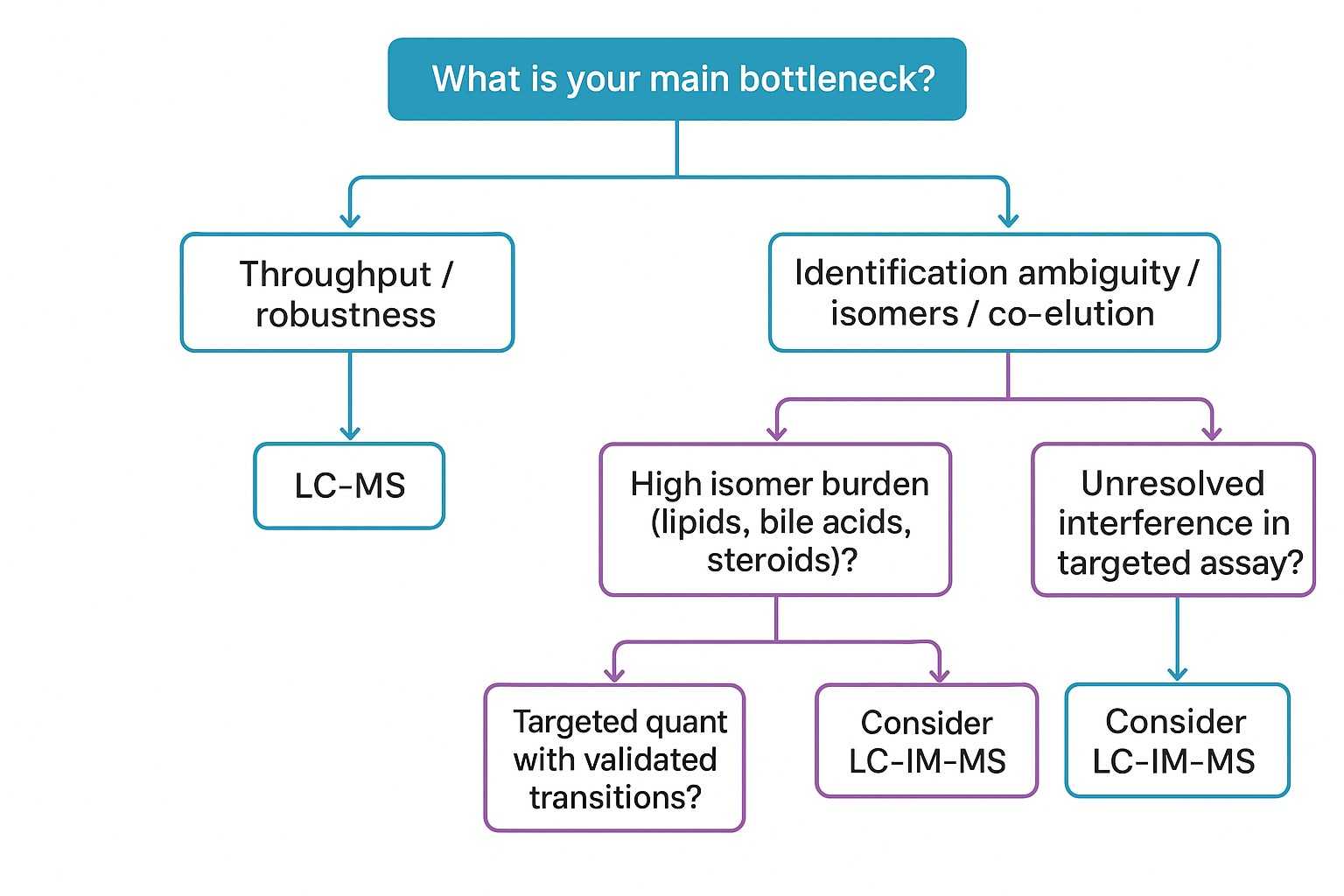
Key Trade-Offs Between LC-MS and LC-IM-MS
The most useful LC-MS vs LC-IM-MS in metabolomics comparison is not a spec sheet; it's a discussion of what each workflow makes easier—and what it makes harder.
Analytical depth
Ion mobility adds separation and can improve selectivity in regions where multiple analytes compete for the same chromatographic and MS/MS "attention." It also enables CCS as another piece of evidence. A curated CCS library study showed how CCS can function as a molecular descriptor for metabolites and support isomer discrimination, while also highlighting practical dependencies on ion forms/adducts and the fact that CCS is not a universal identifier by itself (see Collision Cross Section as a Molecular Descriptor in Ion Mobility–Mass Spectrometry of Metabolites).
At the same time, LC-MS can be analytically sufficient when the study's conclusions do not hinge on structural discrimination at the single-feature level. In many biological narratives, the most robust claims are about pathway shifts and coordinated metabolite sets—not isolated molecular identities.
Throughput and operational burden
LC-MS is typically easier to scale, standardize, and troubleshoot. When cohorts get larger, the risk profile changes: drift, batch effects, and process variance can become more damaging than a modest amount of annotation ambiguity.
LC-IM-MS introduces additional calibration and optimization requirements. That burden can be justified when ambiguity is the bottleneck, but it becomes an unnecessary tax when the study's limiting factor is sample number, schedule constraints, or the need for strict SOP harmonization.
Data-processing requirements
Ion mobility metabolomics workflows add another dimension of data that can sharpen interpretation—if your team can process and report it responsibly. Additional dimensions often mean more parameters to harmonize (feature alignment in mobility space, CCS calibration strategy, library matching logic), and greater sensitivity to how software handles multi-dimensional peak picking.
For decision-makers, the operational question is rarely "can we generate LC-IM-MS data?" but "can we generate it consistently and interpret it defensibly across batches and over time?"
Cost and return on value
Return on value should be assessed as "does this change the decision?" rather than "does this produce more features?" Ion mobility is most defensible when it reduces false positives that would otherwise drive wasted validation, or when it enables a higher-confidence shortlist that changes which candidates advance.
Reporting and reproducibility
LC-IM-MS can strengthen evidence when CCS and mobility separation are documented transparently. But it also raises reporting expectations: readers may reasonably ask how CCS was calibrated, what tolerances were used, and how mobility evidence was combined with retention time and MS/MS.
For preclinical programs where data may be reused or audited, reporting discipline is part of method validity. If a workflow cannot be explained clearly, it becomes difficult to defend, reproduce, or transfer.
How Study Type Affects Platform Choice
The same platform can be "right" or "wrong" depending on what kind of question you're asking and how the results will be used.
Discovery-focused untargeted studies
In early-stage discovery, LC-MS is often the most efficient platform to map global shifts and generate hypotheses. It's particularly strong when paired with strong QC and an explicit plan for how annotation confidence will be handled—e.g., distinguishing feature-level statistics from confirmed metabolite identities.
LC-IM-MS becomes more attractive when discovery runs repeatedly surface dense, ambiguous regions that block biological interpretation. In those cases, adding mobility can change the candidate landscape enough to justify the extra processing.
If your discovery program is being set up for external execution, it's worth reviewing how LC-MS workflows are typically implemented in modern metabolomics labs, including LC-MS/MS acquisition options and how they map to untargeted profiling deliverables (see LC-MS: Advanced Approach in Metabolomics Analysis ).
Targeted metabolomics
When analytes are predefined and methods are validated, conventional LC-MS (often LC-MS/MS in MRM/PRM style) is commonly sufficient. The key risks tend to be calibration strategy, sample handling, and cross-batch comparability, not feature ambiguity.
LC-IM-MS may be useful in select targeted cases where interference cannot be resolved chromatographically and where the assay's decision threshold is sensitive to that interference. The "right" use case is usually not "add ion mobility everywhere," but "add it where interference is already known to bias quantification."
For teams building or evaluating targeted panels, it can be useful to align terminology and expectations around method intent and identification confidence (see Targeted metabolomics overview ).
Large-cohort or high-throughput studies
As scale increases, the dominant risk often becomes operational variance. LC-MS may be preferred because it is easier to standardize across runs and sites, and because data-processing pipelines are typically more mature.
LC-IM-MS can still be valuable in large studies if candidate prioritization depends heavily on stronger structural discrimination. But in that case, many teams consider a staged strategy: use LC-MS broadly, then apply LC-IM-MS to a focused subset of samples or candidates where ambiguity is highest.
Lipidomics and structurally dense applications
Among common metabolomics applications, lipidomics is one of the most frequent "ion mobility makes sense" categories because structural overlap is not an edge case; it is the baseline. When the scientific question depends on distinguishing closely related lipid features, mobility separation and CCS evidence are more likely to materially improve conclusions.
Questions to Ask Before Adding Ion Mobility
Ion mobility workflow decisions tend to go wrong when teams treat extra analytical depth as a virtue in itself. The more defensible framing is: "What problem will ion mobility solve that our current LC-MS workflow cannot solve well enough?"
Ask these questions before committing to LC-IM-MS:
- Will the additional separation dimension solve a problem that standard LC-MS cannot solve well enough?
- Is identification ambiguity a real decision bottleneck in this study?
- Can the team support the added calibration, processing, and reporting requirements?
- Will the extra information improve biological interpretation, candidate ranking, or downstream validation choices?
- Is the study likely to benefit from more selective filtering rather than simply more features?
A practical threshold
If adding ion mobility does not materially improve candidate prioritization or decision confidence, conventional LC-MS is usually the better platform—because it is easier to run, easier to standardize, and easier to defend.
A Practical Framework for Choosing Between LC-MS and LC-IM-MS
The simplest useful framework for metabolomics platform selection is a sequence of decisions that progressively asks: what uncertainty matters most, and what evidence reduces it?
- Define the biological or analytical question
- Identify the main source of uncertainty in the current workflow
- Assess matrix complexity and expected structural overlap
- Decide how much structural confidence the project actually needs
- Estimate the operational burden of adding ion mobility
- Choose the simpler platform unless the added complexity clearly solves a meaningful problem
To make this more actionable, the matrix below turns those questions into a study-design-oriented view. Treat it as a starting point for discussion—not a universal rule.
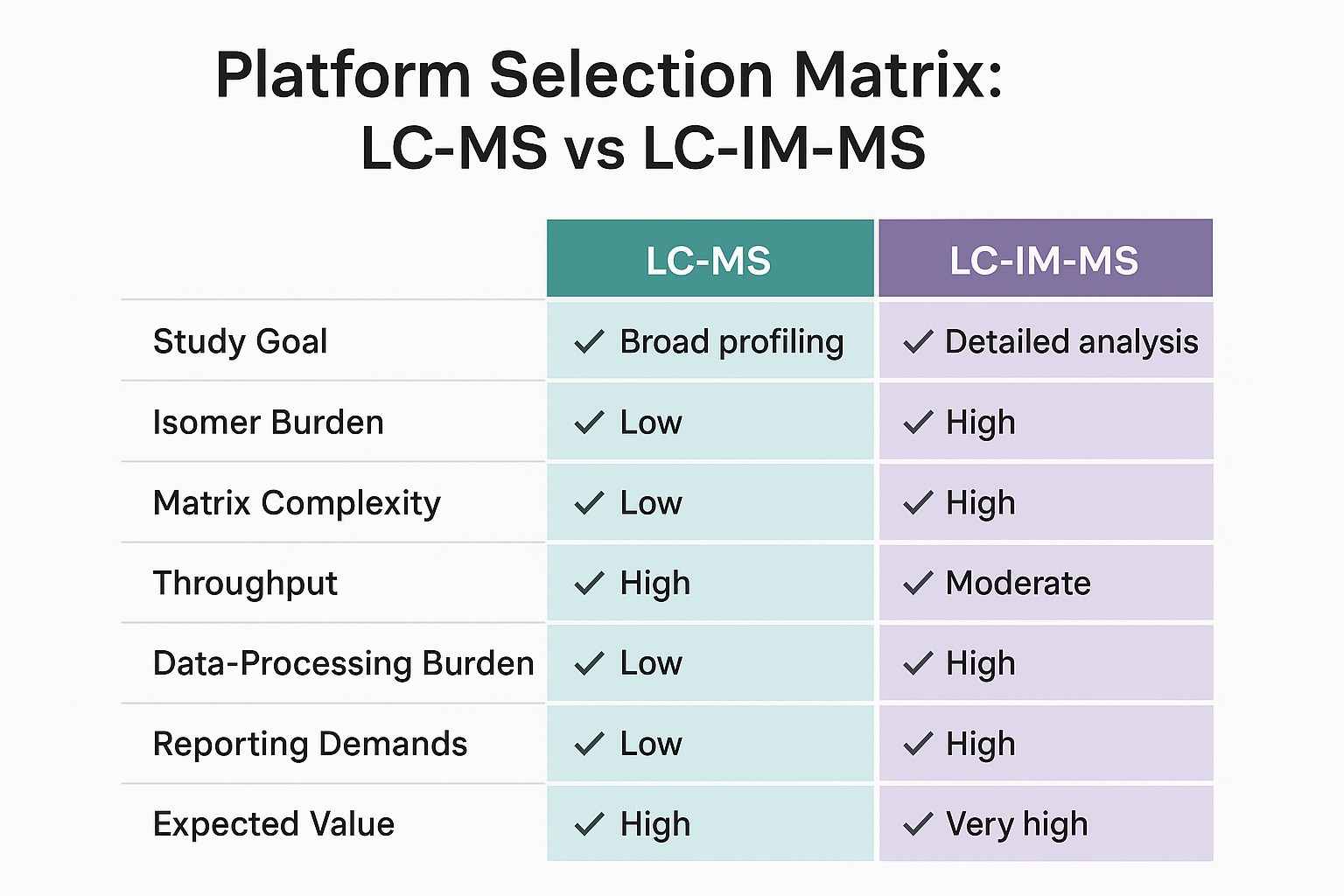
A quick comparison table (text version for copying into study docs)
| Decision dimension | LC-MS is usually a better fit when… | LC-IM-MS is worth considering when… |
|---|---|---|
| Study goal | You need broad profiling or routine quantification with defensible trends | You need structural discrimination to rank candidates or reduce ambiguity |
| Isomer burden | Isomers aren't expected to dominate your key findings | Isomers/co-elution are expected to dominate key findings (e.g., lipids, steroids) |
| Matrix complexity | Matrix is relatively manageable and interference is controllable | Matrix is challenging and interference/co-elution is a recurrent issue |
| Throughput | Scale and consistency are primary constraints | You can accept lower throughput in exchange for higher selectivity |
| Data processing | Team needs mature, standardized pipelines | Team can support multi-dimensional processing and CCS reporting |
| Reporting expectations | Standard MS/MS evidence is fit-for-purpose | Stakeholders expect stronger structural confidence and transparency |
Common Mistakes in Platform Selection
Most platform mistakes are not technical failures—they're assumption failures.
The most common pattern is choosing LC-IM-MS because it sounds more advanced, then discovering late that the bottleneck was sample handling, batch correction, or statistical design. In those projects, additional dimensions do not repair the core problem; they add another layer of variability to control.
A second mistake is underestimating the data-processing and reporting burden. An ion mobility metabolomics dataset can be exceptionally powerful, but it raises the bar for how you describe calibration, matching logic, and confidence thresholds.
A third mistake is expecting ion mobility to solve every annotation problem. Mobility can separate many interferences and provide orthogonal evidence, but it does not replace authenticators like MS/MS, retention behavior, and—when needed—standards.
Conversely, some teams use conventional LC-MS even when unresolved ambiguity is already limiting the project. If the same set of ambiguous features repeatedly consumes validation time, it may be more efficient to change the evidence early rather than over-invest in downstream cleanup.
Finally, platform decisions often get made before the biological question is defined. In preclinical work, "what are we trying to decide?" should come before "what can the instrument do?"
Minimum Reporting Considerations for Either Platform
If your results need to stand up to peer review, internal governance, or re-analysis later, minimum reporting is not bureaucracy—it is what turns data into a reusable asset.
At a minimum, document:
- Clear statement of study goal and why the chosen platform fits that goal
- Transparent method description and acquisition conditions
- Consistent sample handling and QC design
- Annotation confidence presented in a way that matches the chosen workflow
- Explicit limitations of the selected platform and what types of ambiguity may remain
Key Takeaway: A platform choice is only as strong as the reporting that allows others to reproduce—and critique—the evidence behind it.
Frequently Asked Questions
Platform fit and decision thresholds
Is LC-IM-MS always better than LC-MS?
No. LC-IM-MS is "better" only when the added separation changes interpretation or candidate ranking in a way that affects your next decision.
When should I stay with conventional LC-MS?
Stay with LC-MS when your conclusions are stable at pathway/module level, your targeted assays are already interference-controlled, or scale and cross-batch consistency are the dominant constraints.
When to choose LC-IM-MS in metabolomics?
Choose LC-IM-MS when co-elution/isomers are repeatedly driving ambiguous IDs, false positives, or unstable candidate prioritization—especially in structurally dense chemistry (e.g., lipids) or complex matrices.
What does ion mobility add to metabolite identification?
Ion mobility adds an orthogonal separation and enables CCS as an additional descriptor, which can reduce plausible candidates when m/z and retention time alone are not discriminating enough.
What is CCS in ion mobility metabolomics?
CCS (collision cross section) is a gas-phase property related to ion size/shape under defined conditions. Treat it as complementary evidence alongside retention time and MS/MS—not a standalone identifier.
Will ion mobility replace MS/MS for identification?
No. Ion mobility is best viewed as a selectivity layer that can reduce interferences and narrow candidate lists; MS/MS remains central to structural elucidation.
Does LC-IM-MS improve every untargeted metabolomics project?
Not necessarily. If mobility evidence doesn't change your short list of biologically plausible candidates, it may add processing burden without improving decision quality.
Can I start with LC-MS and move to LC-IM-MS later?
Yes. A staged strategy is common: use LC-MS to map signals broadly, then apply LC-IM-MS to a focused subset where ambiguity or interference is demonstrably limiting.
Is platform choice mainly a budget decision?
Budget matters, but the more defensible criterion is return on evidence: does ion mobility reduce the uncertainty that is actually limiting your study's conclusions?
Talk With Our Team
If you're evaluating LC-MS versus LC-IM-MS for a metabolomics project, it often helps to discuss your study's decision bottleneck before you lock in a platform. Creative Proteomics supports both untargeted and targeted workflows, with reporting and bioinformatics designed to translate analytical outputs into interpretable, publication-ready insights.
A practical next step is to share your study goal, sample type, cohort size, and identification confidence requirements, and then map the most defensible workflow for those constraints. You can explore Metabolomics services to see typical study types and deliverable expectations—and, if you're still in the selection phase, share a short description of your sample matrix and what "high-confidence identification" means for your program so the platform can be matched to the decision you need to make.
References
- Performance of a High-Pressure Liquid Chromatography-Ion Mobility-Mass Spectrometry System for Global Metabolomics
- Collision Cross Section as a Molecular Descriptor in Ion Mobility-Mass Spectrometry of Metabolites
- The Application of Ion Mobility Mass Spectrometry to Metabolomics

 Contact Us