

Can Metabolomics Detect PFAS and Other Environmental Chemicals in Exposure Studies?
Submit Your InquiryEnvironmental exposure research is increasingly asked to do two things at once: (1) measure what got into the body and (2) explain what it did after it got there. Metabolomics is powerful for the second task—and sometimes surprisingly useful for the first—but only if we're precise about what "detect" means.
In practice, metabolomics supports environmental chemical studies in three distinct ways: it can sometimes observe the chemical itself, it can capture evidence of exposure through transformation products, and it can quantify downstream metabolic disruption even when the exact chemical is not confidently identified. Treating these as interchangeable is one of the fastest ways to end up with results that are hard to interpret and hard to defend.
Why This Question Matters in Exposure Research
As exposome frameworks mature, researchers want workflows that move beyond single-analyte biomonitoring while still producing evidence that holds up under peer review. That's why the question "can metabolomics detect PFAS?" comes up so often: PFAS are exposure-relevant, persistent, and biologically active—and they're frequently discussed alongside "other environmental chemicals" in the same grant aims.
The catch is that PFAS and other contaminants don't behave identically inside analytical workflows. Standard untargeted metabolomics is usually optimized for endogenous metabolites: broad chemical coverage, robust relative quantification, and pathway-level interpretation. Many xenobiotics—especially those present at ultra-trace levels or requiring class-specific cleanup—sit outside that comfort zone.
So the foundational distinction you want to keep explicit throughout any exposure paper is this:
- Detecting a parent chemical is different from detecting a biotransformation product, and both are different from detecting a metabolic response signature.
Those three outputs can coexist in the same dataset, but they are not interchangeable forms of evidence.
What Metabolomics Can Detect in Environmental Exposure Studies
Direct Detection of Exogenous Chemicals
Under some designs, metabolomics can detect environmental chemicals (or exposure-related compounds) directly in biospecimens. This is most plausible when the compound is present at sufficient abundance, ionizes efficiently, and has chromatographic behavior that produces a clean, distinguishable feature rather than an early-eluting, suppressed signal.
Even then, direct detection needs careful language. Untargeted workflows often end in a spectrum of identification confidence—from a robust match to a reference standard, all the way down to a feature that is only "consistent with" a chemical class. Without MS/MS evidence and an appropriate confirmation strategy, a detected feature may be scientifically useful but not defensible as a confirmed chemical measurement.
Detection of Biotransformation Products
For many exposures, biotransformation products are more realistic markers than parent compounds. This is especially true when the parent compound is unstable, rapidly cleared, or analytically difficult to retain and ionize.
Biotransformation evidence is different from parent-compound measurement in a way that matters for interpretation: it can support plausibility of exposure and offer timing clues, but it does not automatically translate to the same quantitative or regulatory meaning as a validated parent-compound concentration.
Detection of Exposure-Associated Metabolic Signatures
Metabolomics is often most powerful as a biological response lens: revealing pathway disruption, metabolic stress, lipid remodeling, bile acid shifts, and changes in energy metabolism that are associated with exposure.
For PFAS specifically, human studies and reviews frequently report recurring associations with lipid classes and energy-related pathways—while also emphasizing study-design caveats (cross-sectional sampling, confounding, and heterogeneous metabolite identification confidence). These response signatures can support exposure–response research and mechanism-building, but they should not be presented as equivalent to confirmed chemical detection.
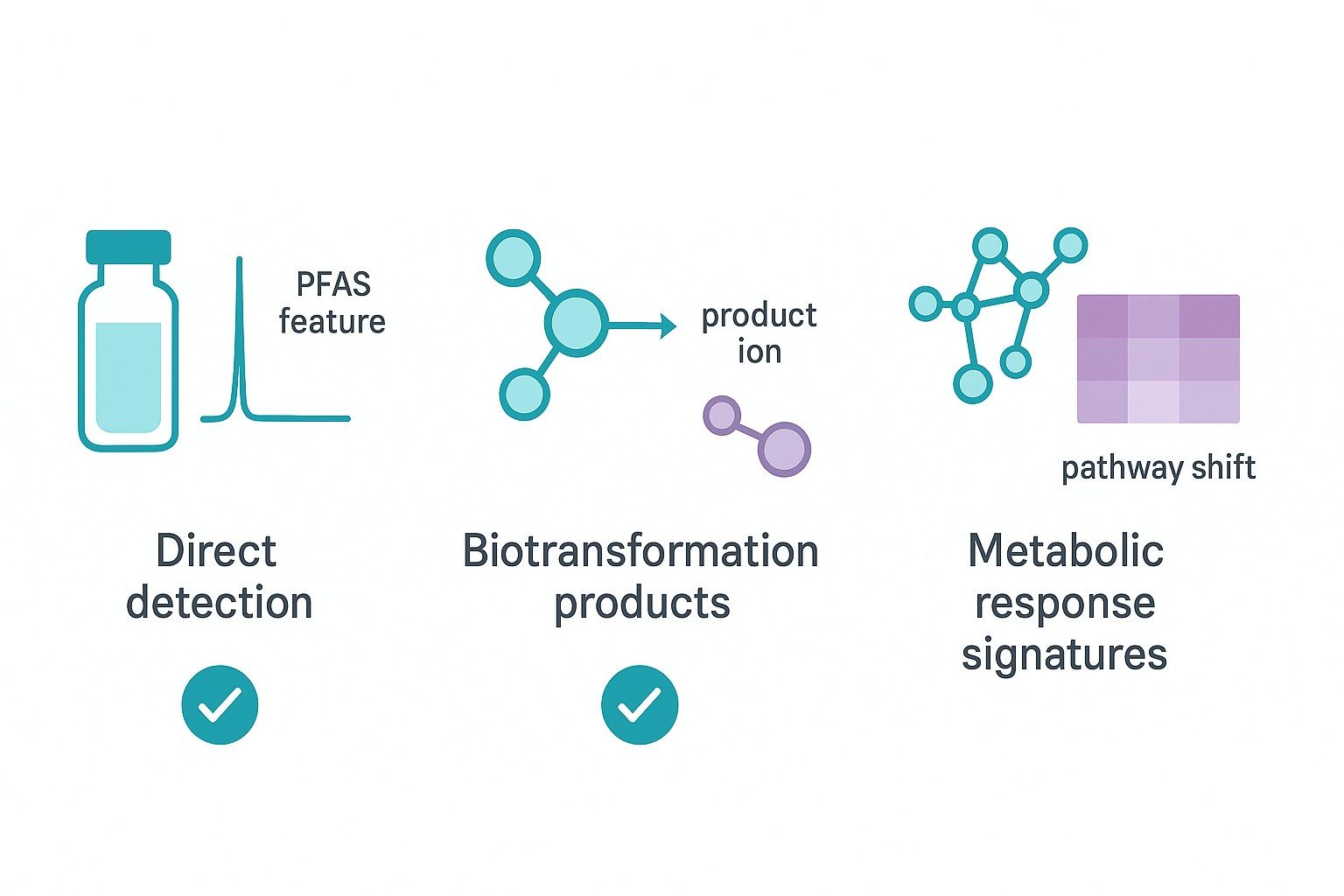
A practical way to keep interpretation rigorous is to treat these three outputs as different evidence types rather than points on a single certainty scale.
| What metabolomics shows | What it can support | What it does not automatically prove |
|---|---|---|
| A feature consistent with a xenobiotic (exogenous chemical) | Possible presence of a parent chemical (needs confirmation) | Validated quantitation or definitive identity without standards/MS/MS |
| A plausible biotransformation product | Exposure plausibility + metabolism/timing clues | Parent-compound concentration or exposure dose |
| Endogenous pathway shifts ("response signatures") | Biological impact and candidate mechanisms | Which chemical(s) caused the effect, or that exposure occurred at all |
Can Metabolomics Detect PFAS Directly?
Yes, in some cases—but only when the metabolomics workflow is designed to retain and ionize PFAS and to generate the evidence needed for confident annotation.
PFAS should be treated as a distinct analytical case, not a generic example of "environmental chemicals." Detecting PFAS in a metabolomics dataset is also not the same as running a dedicated PFAS quantitation assay.
Here's the operational difference:
- A dedicated PFAS assay is typically optimized for low-level sensitivity, contamination control, and defensible quantitation.
- A standard untargeted metabolomics workflow is typically optimized for broad endogenous metabolite coverage, which can leave PFAS under-extracted, poorly retained, or insufficiently fragmented for confirmation.
The result is a pattern many groups encounter: metabolomics can clearly show PFAS-associated metabolic disruption while the PFAS themselves are absent or only tentively annotated.
Key Takeaway: If your primary endpoint is "Which PFAS are present, and at what level?", plan a PFAS-optimized chemical measurement. Use metabolomics to add biological context—not to substitute for confirmation.
Why PFAS and Other Environmental Chemicals Should Not Be Grouped Too Broadly
PFAS as a Special Case
PFAS are often discussed in exposome research because of persistence, exposure relevance, and biological impact. But their analytical behavior can differ from many smaller, more transient, or more easily transformed environmental chemicals.
Two implications follow immediately:
- Success (or failure) detecting PFAS in an untargeted workflow does not predict performance for all other chemical classes.
- PFAS studies benefit from explicit communication about identification confidence, because many workflows will not achieve "confirmed structure with reference standard" for every reported PFAS.
Other Environmental Chemicals With Different Detection Profiles
"Other environmental chemicals" is too broad to treat as a single analytical category. A more useful way to set expectations—and to improve study design discussions—is to classify chemicals by how likely they are to be captured in broad HRMS metabolomics workflows.
A practical classification is:
- More likely to be detected in broad HRMS workflows: compounds with compatible ionization and retention under common LC conditions, adequate abundance in the chosen biospecimen, and stable signals that survive typical extraction.
- Partially captured depending on sample type and timing: chemicals with short half-lives, strong matrix dependence, or rapid transformation—where detection may hinge on whether you sampled the right compartment at the right window.
- Better suited to targeted chemical analysis: ultra-trace contaminants, compounds requiring specialized cleanup, or classes with high background interference where confirmation and quantitation are central to the study question.
This framing avoids overgeneralization and keeps "metabolomics environmental chemical detection" discussions anchored in workflow reality rather than optimism.
What Determines Whether a Chemical Will Be Detected
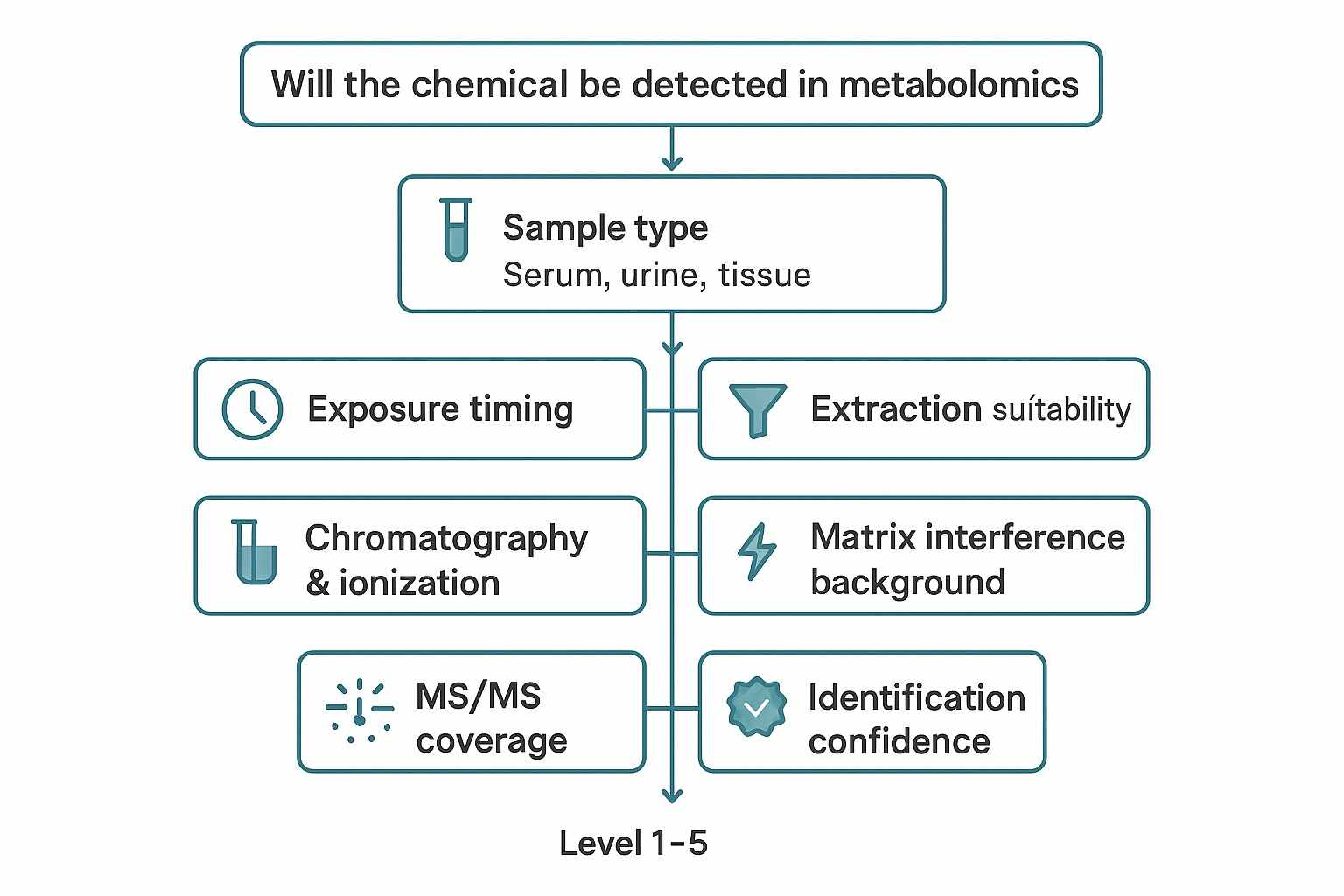
In exposure studies, "detectability" is not a property of the chemical alone; it's a property of the chemical inside your workflow. The same compound may be detectable in serum but not urine, detectable after acute exposure but not in delayed sampling, or detectable only when chromatography and ionization are tuned for it.
The determinants that most often decide outcomes are:
- Sample type and biospecimen suitability
- Exposure timing relative to sample collection
- Compound abundance and persistence
- Matrix complexity and background interference
- Extraction, chromatography, and ionization selectivity
- MS/MS coverage and annotation confidence
For PFAS, biospecimen choice is often central because PFAS partition differently across matrices. If you're trying to interpret a negative result, the first questions should be "Was the sampling window appropriate?" and "Did the matrix support retention, ionization, and confirmation?"—not "Does this population have no exposure?"
When Untargeted Metabolomics Is Most Useful
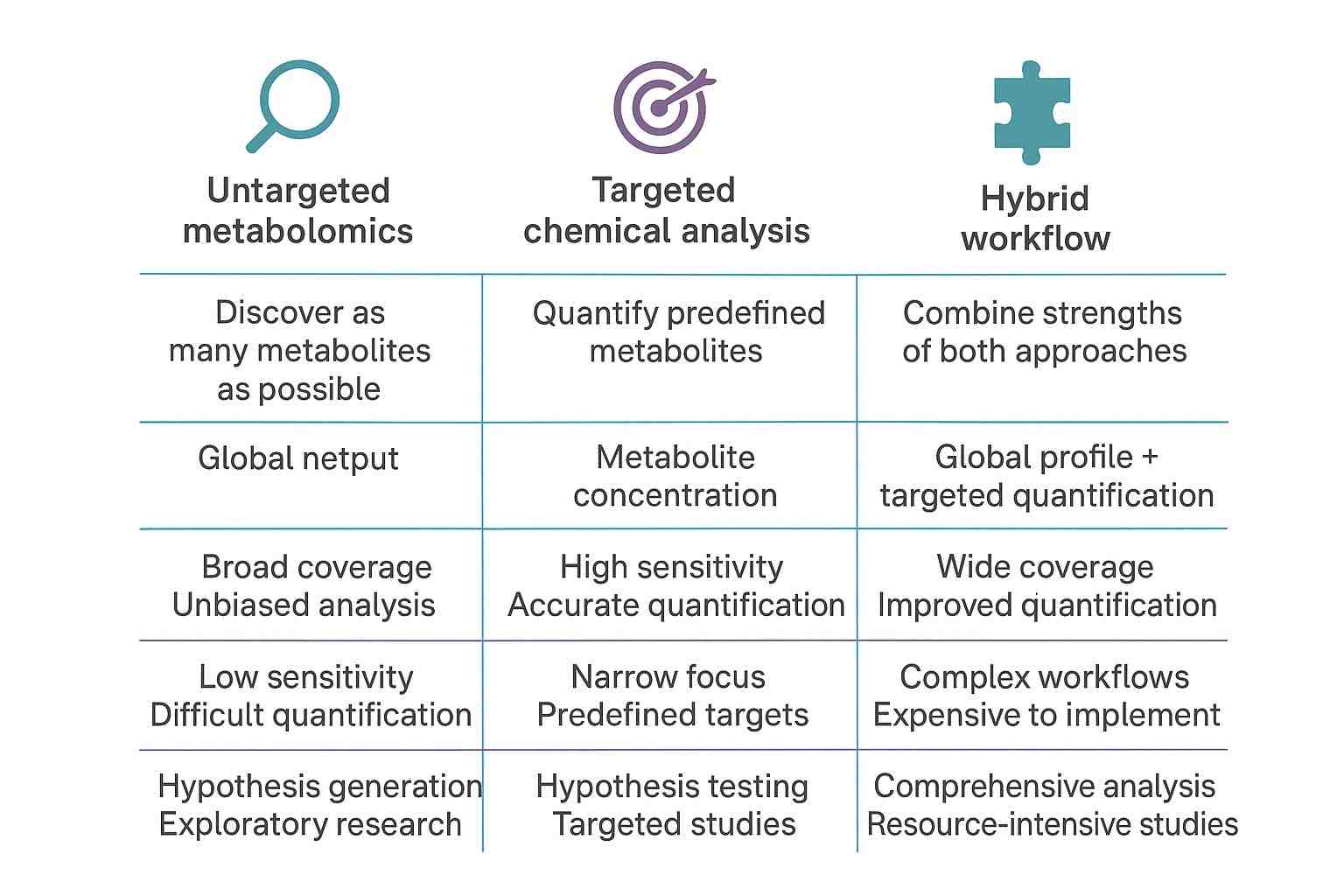
Untargeted metabolomics is most useful when the goal is breadth and biological context.
It's a strong fit when you need discovery of unknown or mixed exposure signals, when you're doing early-stage screening in exposome studies, or when your study is fundamentally about exposure-associated perturbations rather than compound-level confirmation. In those scenarios, the most important outputs are coherent differential patterns, reproducible QC behavior, and interpretable pathway shifts.
In practice, untargeted metabolomics also works well as the "first pass" in a staged workflow: it helps you decide which chemical classes and pathways deserve targeted follow-up and which apparent signals are more likely to be diet, medication, or batch effects.
For readers who need a concrete sense of how these projects typically progress from raw data to interpretable biology, Untargeted metabolomics analysis process provides a useful overview of preprocessing, differential analysis, and pathway interpretation.
When Targeted Chemical Analysis Is Still Necessary
Low-Abundance or Difficult-to-Detect Compounds
Some environmental chemicals fall below the practical sensitivity range of broad metabolomics workflows, especially in complex matrices or when exposure is intermittent. Dedicated targeted assays are still necessary when the objective is specific chemical measurement rather than broad discovery.
This is often the case in PFAS biomonitoring, where the study objective may be "measure a defined PFAS list," not "discover any PFAS-related signal." If that's the aim, it's more defensible to plan targeted measurement up front rather than treat PFAS detection in untargeted metabolomics as a hope.
Confirmation and Quantitative Decision-Making
Targeted methods become non-negotiable when your study requires concentration estimates, compound-level certainty, or interpretation that depends on accurate quantitation.
Untargeted discovery and confirmatory exposure measurement are not interchangeable because confirmation standards differ (standards/MS/MS), quantitation requirements differ (calibration/internal standards), and background control differs (class-specific contamination and matrix effects).
Regulatory, Biomonitoring, and High-Confidence Exposure Assessment
When a study requires strong compound confirmation, metabolomics should not be presented as a stand-alone replacement for targeted environmental chemical analysis. A hybrid strategy is often more credible: use metabolomics to generate biological context and candidate features, and add targeted methods or structured HRMS identification workflows for defensible exposure claims.
If your project is moving from discovery toward confirmatory measurement, targeted metabolomics service is a relevant next step for studies that require high-confidence quantitation and consistent reporting.
A Better Way to Frame Metabolomics in PFAS and Environmental Chemical Research
A common misstep is treating metabolomics as if it were one thing. A more accurate framing is to treat metabolomics as four complementary roles.
Discovery Tool
Metabolomics is useful for broad screening and identifying candidate exposure-related signals—especially when your exposure landscape is mixed or only partially characterized.
Internal Exposure Readout
Metabolomics provides an internal readout of what is present in the body (and what the body is doing). This can add realism to exposure research by anchoring your interpretation in internal biology rather than external measurements alone.
Biological Response Lens
Metabolomics is particularly strong for linking exposure to metabolic effects, pathway shifts, and potential mechanisms. The scientific value here is not "we found the chemical," but "we found the biological footprint and can now test specific hypotheses."
Part of a Hybrid Exposure Workflow
For many PFAS and environmental chemical studies, the most defensible design is hybrid: use untargeted metabolomics to discover response signatures and candidate exposure-related features, then apply targeted confirmation where your conclusions require compound-level certainty.
Common Misinterpretations to Avoid
Several interpretation errors recur in PFAS and broader exposomics papers.
- Equating metabolic perturbation with confirmed chemical detection. A lipid shift associated with PFAS is not the same thing as detecting PFAS in the sample.
- Treating tentative annotation as confirmed exposure evidence. If a structure is not confirmed with appropriate evidence, report it transparently rather than implying certainty.
- Assuming a negative result means no exposure occurred. Sampling window, biospecimen choice, extraction chemistry, and background interference can all erase a real exposure signal.
- Ignoring the effect of biospecimen choice and sampling window. The same exposure can look very different across matrices.
- Presenting metabolomics as a universal replacement for targeted analysis. Metabolomics adds context and discovery power; it does not automatically replace confirmation.
How to Choose the Right Strategy for PFAS and Environmental Chemical Studies
Start with the primary study question: discovery, confirmation, quantitation, or mechanism.
- If your goal is discovery and biological context, use untargeted metabolomics when breadth matters most.
- If your goal is confirmation or quantitation, add targeted methods early—especially for low-abundance or high-stakes chemicals.
- If your study needs both breadth and defensible exposure claims, plan a hybrid design up front.
If you're designing a staged workflow, a practical sequence is to start broad and then narrow: initial untargeted screening → candidate features and pathways → targeted confirmation for priority chemical classes → deeper biological interpretation.
For groups that want publication-ready datasets with transparent processing and interpretable outputs, untargeted metabolomics service is a natural starting point, and targeted metabolomics data analysis techniques can help align targeted follow-up with rigorous reporting expectations.
Pro Tip: Before you commit, map each planned conclusion to the evidence type you will have—confirmed chemical, biotransformation product, or response signature—and make sure your methods can actually support that claim.
Frequently Asked Questions
Can metabolomics directly detect PFAS?
Yes, sometimes. PFAS can be directly detected if the workflow is designed for PFAS retention/ionization and includes MS/MS and an explicit confirmation strategy. But detection in an untargeted metabolomics run is not automatically equivalent to a dedicated PFAS quantitation assay, which is typically optimized for sensitivity, contamination control, and validated quantitation.
Can metabolomics detect other environmental chemicals besides PFAS?
Yes, but detection is chemical-class and workflow dependent. Compounds that are abundant enough in the chosen biospecimen, stable in the sampling window, and compatible with your extraction/LC/ionization settings are more likely to be captured. Short-lived chemicals or ultra-trace contaminants are more likely to require targeted assays or class-specific screening.
Does detecting a metabolic response prove chemical exposure?
No. Metabolic response signatures support exposure–response interpretation and hypothesis generation, but they do not confirm that a specific chemical was present in your sample or that it caused the observed changes.
When should targeted analysis be added?
Add targeted analysis when your conclusions require compound-level certainty or quantitative interpretation. This includes biomonitoring comparability, dose–response modeling, and any study where "we observed a signal" is not sufficient to support the claim.
Can untargeted metabolomics identify PFAS exposure in humans?
It can identify PFAS-associated metabolic changes, and it may detect PFAS features depending on method fit. If the study's primary question is "Which PFAS are present?", include PFAS-optimized measurement rather than relying on untargeted metabolomics alone.
What metabolic changes are associated with PFAS exposure?
Lipid pathways and energy-related metabolism are frequently reported. Across cohorts, studies often observe perturbations in glycerophospholipids and sphingolipids, alongside changes in amino acid and bile acid metabolism; however, patterns vary by cohort design, confounder control, and identification confidence.
Are there biomarkers for PFAS in blood from metabolomics studies?
There are candidate biomarkers, but few are universally validated. Metabolomics can propose metabolites that track with PFAS exposure in specific populations, but most require replication, careful mixture/confounder modeling, and clear identification confidence before they can be treated as reliable biomarkers.
References
- PFAS Exposures and the Human Metabolome: A Systematic Review
- Updated Guidance for Communicating PFAS Identification Confidence in Nontargeted Analysis
- Determination of 30 Per- and Polyfluoroalkyl Substances (PFASs) in Human Plasma Using a High-Throughput LC–MS/MS Method
- Concentrations of Per- and Polyfluoroalkyl Substances in Paired Maternal Plasma and Breast Milk
- Non-Targeted Metabolomics and Associations with Per- and Polyfluoroalkyl Substances Exposure in Humans: A Scoping Review

 Contact Us