

How Metabolomics Supports Exposure Measurement in Exposome Research
Submit Your InquiryExposome research asks a deceptively simple question: what are people actually exposed to across the life course—and how do those exposures become biology? In practice, the question is hard because exposures are heterogeneous (chemicals, diet, drugs, lifestyle, occupation), dynamic (they change day-to-day), and often poorly captured by external records alone.
That's where metabolomics in exposome research becomes especially useful. Rather than relying only on external exposure records, metabolomics measures small molecules in biospecimens, which can reflect both exogenous chemicals and downstream metabolic changes. When interpreted alongside study design, sampling context, and identification confidence, this molecular layer can help connect exposure evidence to internal dose and early biological response—without implying that one platform can capture the full exposome.
Key Takeaway: In exposome studies, metabolomics is most defensible when you separate three questions: Was an exposure present? Did it reach the body (internal dose)? Did it perturb biology (response)?
Why Exposome Research Needs More Than External Exposure Data
The exposome includes environmental chemicals, diet, drugs, lifestyle factors, occupational exposures, and other non-genetic influences that accumulate across the life course. Many of these exposures occur as mixtures, vary across geography and time, and interact with host factors such as age, microbiome, and physiology.
External exposure records—questionnaires, occupational logs, environmental monitoring, wearable sensors, or geospatial proxies—are valuable, but they typically describe contact potential rather than what was absorbed, distributed, metabolized, or excreted. Even when external measures are strong, they often leave key gaps: internal uptake can vary by route (inhalation vs ingestion), physiology, co-exposures, and metabolism.
For that reason, exposome research increasingly combines external exposure assessment with biospecimen-based molecular readouts. In the literature, this is often framed as integrating "bottom-up" exposure information with "top-down" molecular evidence, because the two approaches address different parts of the exposure question.
What Metabolomics Adds to Exposome Research (and Why It Matters for Metabolomics in Exposome Research)
Metabolomics captures a broad set of small molecules, including endogenous metabolites and, in some cases, signals consistent with xenobiotics or their biotransformation products. In an exposome context, that matters because it creates a molecular bridge between exposure and biology.
First, metabolomics can sometimes provide evidence that a compound (or metabolite derived from it) is present in vivo, which is closer to internal dose than an external proxy. Second, even when a compound cannot be confidently identified, metabolomics can reveal exposure-associated pathway disruptions—oxidative stress patterns, lipid remodeling, shifts in energy metabolism, xenobiotic-processing signatures, and microbiome-mediated transformations.
Compared with questionnaire-based or source-based exposure assessment alone, metabolomics can therefore provide a more direct readout of what reaches the body and how the body responds. This is why metabolomics has become especially valuable in epidemiology, environmental health, nutrition research, and population-scale exposome studies.
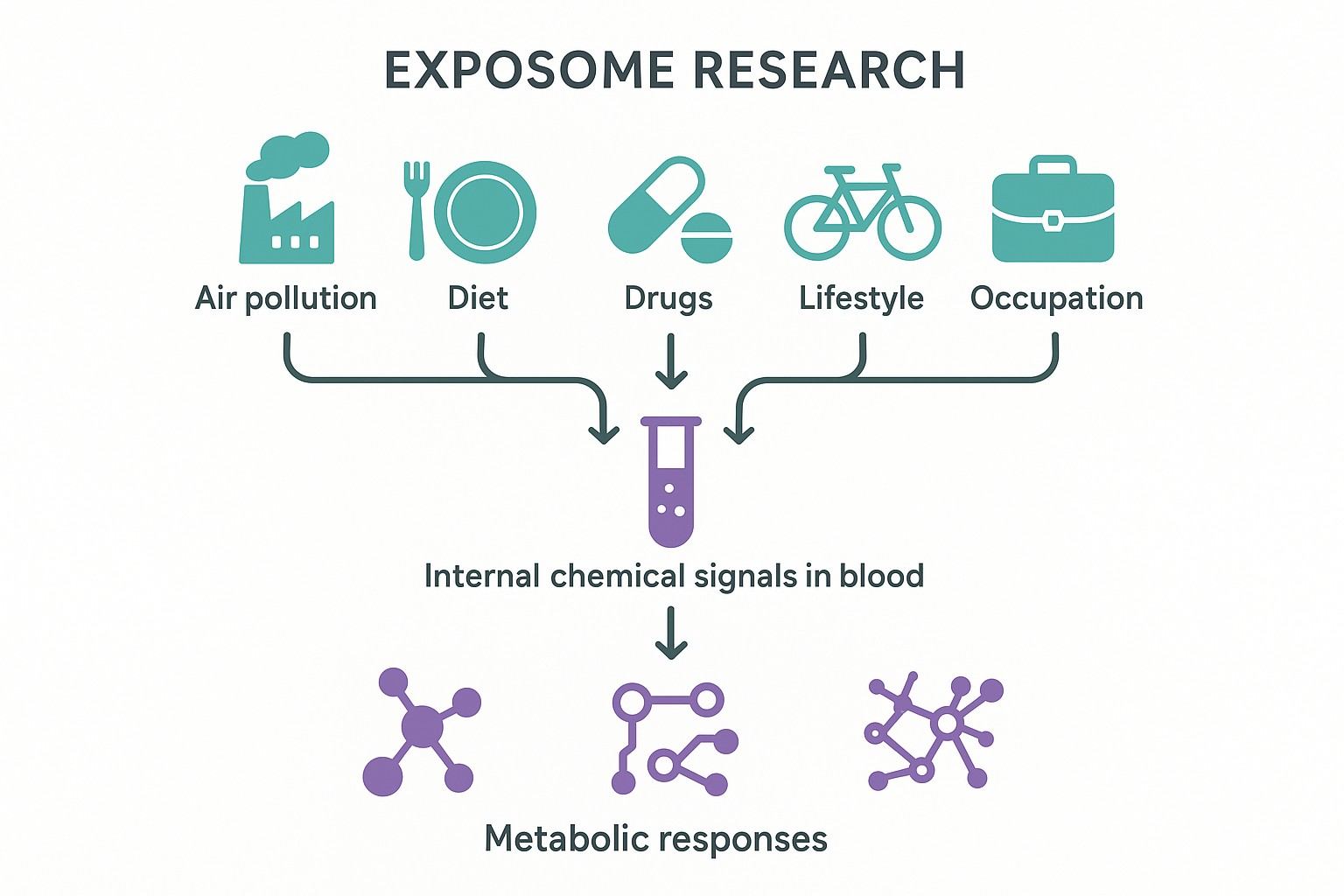
How Metabolomics Supports Exposure Measurement in Exposome Studies
Detecting Exogenous Compounds and Their Metabolites
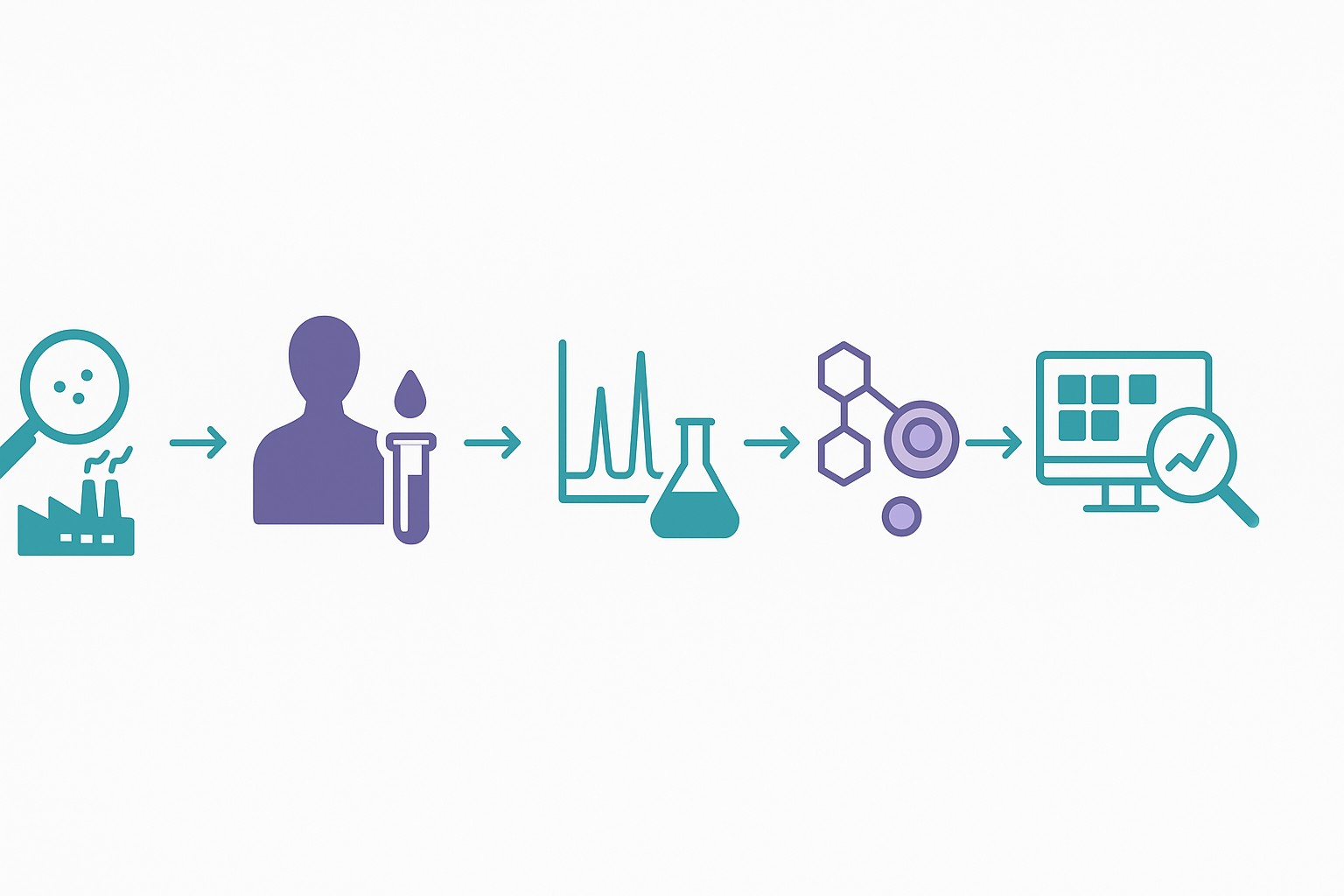
In favorable cases, metabolomics can detect environmental chemicals, dietary compounds, drug-related molecules, and biotransformation products in biological samples. When the chemistry and the workflow align, this provides direct evidence that specific molecules are present in vivo—one of the strongest forms of exposure measurement.
However, detection strength depends on more than instrument resolution. Coverage varies by compound class, abundance, matrix complexity, and the sampling window. Short-lived compounds may be missed if biospecimen collection occurs outside the relevant time frame. Low-abundance chemicals can fall below detection limits in untargeted workflows, and confident identification often requires MS/MS matching against reference spectra or standards.
When the goal is to prioritize exogenous signals and their metabolites, an exposomics-oriented design is usually more appropriate than generic metabolomics alone—particularly when the study must balance coverage with identification confidence. For example, Exposomics Analysis Services can be a relevant internal resource when a study needs broad screening of exogenous compounds alongside structured reporting and bioinformatics.
Measuring Internal Exposure Rather Than External Contact Alone
Internal exposure reflects what has been absorbed, circulated, transformed, or excreted by the body. In exposome studies, this matters because two individuals can have similar external contact but very different internal dose due to physiology, behavior, timing, or metabolism.
Metabolomics complements external exposure estimates by showing whether a suspected exposure leaves a measurable molecular signature in biospecimens—blood, urine, and other matrices. The key benefit is interpretability: internal biospecimen signals can strengthen the plausibility that an exposure reached biological systems, rather than remaining an external proxy.
That said, internal exposure is not automatically "better" than external measurement. It can blur timing (because internal signals integrate over some window), and it can be confounded by diet, microbiome, medication use, and underlying health status. The practical goal is alignment: choose the biospecimen and timing that best match the exposure window you care about.
Capturing Biological Response to Exposure
Some exposures are better characterized by the metabolic disturbances they trigger than by direct detection alone. This happens when the parent compound is transient, chemically diverse, or hard to identify in untargeted data—yet the biological response is measurable.
Metabolomics can reveal pathway-level changes linked to oxidative stress, inflammation, energy metabolism, lipid remodeling, xenobiotic processing, and microbiome-mediated transformation. Response patterns can strengthen exposure–response research even when compound identification is incomplete, but they should be interpreted as response evidence unless exposure identity is independently supported.
But response profiling has a different evidentiary meaning than direct exposure measurement. Dose–response designs and repeated measures can help distinguish structured biological effects from noise. Method work on dose–response metabolomics emphasizes that multi-dose experiments can better connect metabolic features to potency and mechanism than single-dose comparisons (see Patti et al., 2020 in the References).
What Counts as Exposure Measurement Versus Response Profiling
A recurring source of confusion in exposome papers is treating any exposure-associated metabolite change as proof of a measured exposure. In reality, exposure research typically draws on multiple evidence tiers.
Direct exposure measurement focuses on detecting exogenous chemicals or their validated metabolites. Response profiling focuses on endogenous metabolic changes that are associated with exposure. Many studies use both, but they should not be presented as equivalent forms of evidence.
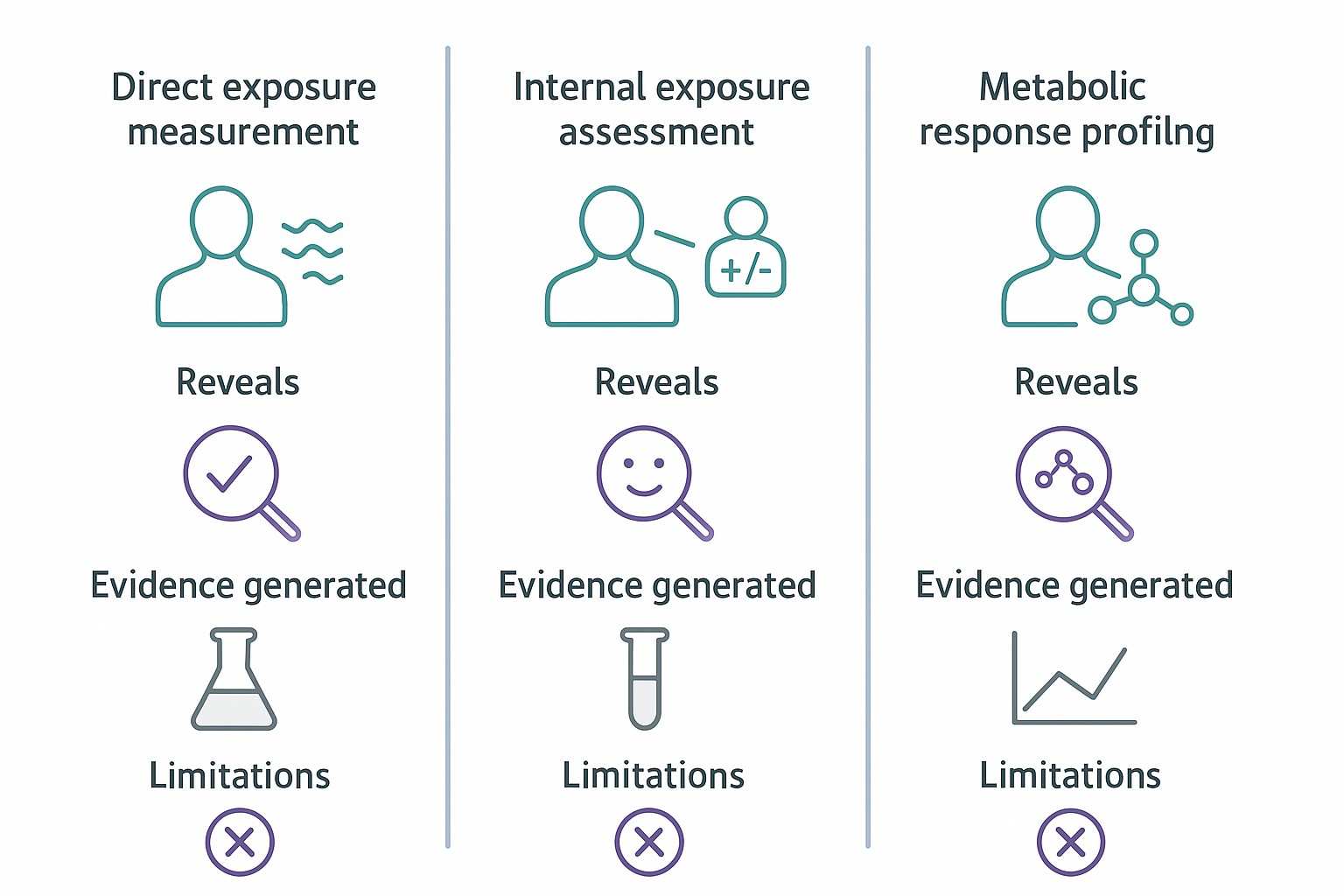
The table below is a practical way to separate the claims you can make from the data you actually have.
| Role of metabolomics in an exposome study | What you're trying to show | Typical evidence generated | Key limitations / cautions |
|---|---|---|---|
| Direct exposure measurement | A specific exogenous chemical (or metabolite) is present in vivo | MS feature + MS/MS match; standard confirmation; targeted quantification | Coverage limits; identification confidence; sampling window |
| Internal exposure assessment (internal dose) | The body absorbed/processed the exposure (even if the external source is uncertain) | Parent/metabolite presence; patterns consistent with xenobiotic processing | Confounding by diet/drugs; matrix effects; mixed routes |
| Metabolic response profiling | Exposure is associated with pathway-level biological effects | Differential endogenous metabolites; enriched pathways/network shifts | Association ≠ causation; response is not proof of exposure identity |
When Metabolomics Is Most Useful in Exposome Studies
Population and Epidemiology Studies
Large cohorts need scalable molecular measurements that can be integrated with outcomes and covariates. Metabolomics supports exposome epidemiology by enabling discovery of exposure-associated patterns across many participants and timepoints, and by providing intermediate molecular phenotypes that can be tested alongside health outcomes.
In that context, metabolomics can also support a "meet-in-the-middle" strategy, in which exposures are tested against intermediate metabolic signals that may plausibly connect exposure patterns to downstream biology or health outcomes.
Environmental and Occupational Exposure Research
In occupational or environmentally exposed populations, metabolomics can help detect exposure-related compounds or their metabolites, compare exposed vs reference groups, and characterize biological perturbations that align with exposure intensity or duration.
This use case is strongest when sampling timing is aligned to exposure windows and when the study includes metadata that supports interpretation: job tasks, location, PPE usage, diet, smoking status, medications, and shift timing. Without that context, internal signals are easier to misread.
Nutrition, Lifestyle, and Drug Exposure Studies
Diet and drugs can be among the most influential short-term drivers of metabolic variation—both as exposures and as confounders. Metabolomics can identify dietary markers, supplement-related metabolites, pharmaceutical exposure signals, and compliance-related metabolic patterns.
This is particularly useful when self-reported exposure data is incomplete or inaccurate. For example, metabolomics can reveal whether a dietary pattern likely changed, or whether a medication exposure is consistent with reported use, while also characterizing downstream metabolic effects.
Where Metabolomics Alone May Not Be Enough
Metabolomics is powerful, but it is not a complete exposure measurement solution on its own.
Not all exposures are detectable in standard metabolomics workflows. Some compounds are short-lived or rapidly transformed, which means a single timepoint can miss them. Others are present at low abundance, requiring targeted assays with higher sensitivity. Even when signals are present, structural identification can remain incomplete in untargeted workflows because spectral libraries and standards do not cover the full chemical space (a key bottleneck emphasized in Wan et al., 2025 in the References).
Technical limitations also matter for exposure interpretation. Matrix effects and ion suppression can bias measured intensities, especially when comparing biologically different groups. Practical method work shows that matrix effects can lead to misclassification of truly altered metabolites if not handled carefully (see Song et al., 2020 in the References).
For these reasons, metabolomics is often combined with targeted exposomics, classical biomonitoring assays, environmental measurements, questionnaires, and wearable/sensor data to build a stronger exposure assessment.
Build a Stronger Exposure Measurement Strategy With Complementary Methods
Combine Untargeted Discovery With Targeted Confirmation
Untargeted metabolomics is valuable for discovery: it can surface unexpected exposure markers, mixed-exposure patterns, and pathway-level perturbations. But when a study needs to claim a specific exposure was present—or when exposure level matters—targeted follow-up is often the most defensible next step.
A practical strategy is to use untargeted profiling to nominate candidate markers, then confirm and quantify priority compounds using targeted methods with MS/MS evidence and standards where possible. In other words, a targeted vs untargeted metabolomics decision is often less about ideology and more about aligning analytical confidence with the claim you plan to make.
If you need a service-oriented internal reference for targeted confirmation workflows, Targeted Metabolomics Analysis Service is a relevant starting point for planning higher-confidence validation and quantification.
Integrate External and Internal Exposure Data
External exposure information—environmental monitoring, dietary logs, occupational records, geospatial data, and personal sensors—adds essential context about source and timing. Internal metabolomics signals, in turn, provide evidence about uptake and biological effects.
The interpretive power comes from integration. Pairing the two helps you answer questions like:
- Was the exposure plausible given location/behavior?
- Does biospecimen timing match the compound's expected half-life and excretion route?
- Are the internal signals consistent with metabolism/biotransformation pathways?
When external monitoring is incomplete, internal signatures can still support hypothesis generation. When internal identification is uncertain, external measurements can narrow the candidate space.
Match the Workflow to the Exposure Question
The best metabolomics strategy depends on what you need to claim.
Discovery-first designs are appropriate when exposures are unknown, mixed, or poorly measured externally. Targeted designs are appropriate when specific chemical classes are already defined (e.g., regulatory questions, known contaminants, predefined dietary compounds). Hybrid strategies are often the most practical for exposome studies because they balance screening breadth with measurement confidence.
If your study requires broad profiling across many endogenous pathways and careful QC, Metabolomics Service can be a relevant internal reference for untargeted coverage and downstream analysis planning.
Evidence Priorities in Exposome-Focused Metabolomics
In exposome work, the type of evidence matters as much as the statistical association.
Direct detection of exogenous compounds or validated metabolites provides the strongest support for exposure measurement. High-quality MS/MS evidence, reference libraries, authentic standards, and orthogonal confirmation (when feasible) increase confidence.
Quantitative or semi-quantitative data are important when exposure level matters or when dose–response modeling is part of the inference. Endogenous metabolic changes can be highly informative—especially for mechanism and early effect—but they should be framed as response evidence unless exposure identity has been independently supported.
Practical principle: Before writing the results section, decide whether the claim is direct exposure detection, internal dose evidence, or response profiling, and align the identification and validation plan to that claim.
Common Pitfalls in Interpreting Metabolomics for Exposure Research
Even careful studies can drift into overinterpretation. The most common pitfalls include:
Treating all metabolic perturbations as proof of measured exposure is a conceptual error. A response signature may support exposure–response hypotheses, but it doesn't identify the exposure by itself.
Overstating tentative annotations as confirmed chemical identities is another major credibility risk. Untargeted annotation levels vary widely, and many features remain unknown or ambiguously assigned.
Timing is also frequently underappreciated. Sample collection that does not match the exposure window (or the excretion biology of the compound class) can produce false negatives for direct detection and misleading positives for indirect response signals.
Finally, it's easy to assume one platform can capture the full exposome. In reality, analytical coverage depends on chemistry, and exposure measurement is often strengthened by combining metabolomics with targeted assays and external exposure data.
How to Choose the Right Metabolomics Strategy for Exposome Research
Start with the primary objective: exposure discovery, exposure confirmation, exposure–response analysis, or biomarker development. Each objective implies a different balance between breadth and confidence.
Next, match the sample type to the expected exposure window. Urine may be appropriate for recent exposures and excreted metabolites, while blood can capture circulating signals but may reflect different kinetics and matrix effects. Repeated sampling can be more informative than a single timepoint when exposures are variable.
Then decide early whether untargeted metabolomics, targeted analysis, or a hybrid workflow best fits the claim you plan to make. If publication-grade exposure confirmation is required, plan validation steps up front: MS/MS confirmation, standards where feasible, QC samples, batch-effect monitoring, and transparent reporting of annotation confidence.
Frequently Asked Questions
Can metabolomics directly measure exposure?
Yes—sometimes. Metabolomics can detect certain xenobiotics or their metabolites in biospecimens, but whether you can make a direct exposure claim depends on chemistry, sampling window, matrix complexity, and identification confidence (often requiring MS/MS and standards).
How is "internal exposure" different from "external exposure"?
External exposure describes contact potential (e.g., air measurements, questionnaires, occupational records). Internal exposure reflects what was absorbed, transformed, circulated, or excreted—and is therefore closer to internal dose in the body.
Is metabolomics the same as exposomics?
No. Metabolomics measures a broad set of small molecules and can support exposome research, but exposomics is a broader exposure-science framework that integrates external measurements, biospecimen chemistry, and interpretation across the life course.
What is the biggest limitation of untargeted metabolomics for exposure measurement?
Identification. Untargeted workflows can detect many features, but many cannot be confidently assigned to a specific chemical without MS/MS evidence, reference spectra, or authentic standards.
When should targeted methods be added to an exposome study?
Add targeted methods when you need higher-confidence confirmation, higher sensitivity for low-abundance chemicals, or quantitative/semi-quantitative exposure measurement for prioritized compounds.
How do you avoid confusing exposure signals with biological responses?
Predefine your evidence tier. Treat xenobiotics/validated metabolites as exposure measurement, and treat endogenous pathway shifts as response profiling unless exposure identity is independently supported (e.g., standards, orthogonal assays, or convergent external monitoring).
What samples are best for measuring environmental exposures with metabolomics?
It depends on exposure kinetics and the question. Urine often captures recent exposures and excreted metabolites, while blood captures circulating signals and may better reflect internal distribution. Repeated measures and careful timing usually improve interpretability.
Can metabolomics prove causality in exposome research?
No. Metabolomics can strengthen exposure–response evidence and help propose mechanisms, but causal inference typically requires longitudinal design, triangulation with external exposure data, and validation in independent cohorts or experimental systems.
Use Metabolomics to Connect Exposure Signals With Biological Meaning
Metabolomics is most powerful in exposome research when it's used to bridge exposure detection, internal dose, and biological response—while keeping those claims distinct.
The strongest studies are explicit about what was measured (exogenous compounds, internal signatures, or endogenous responses), transparent about identification confidence, and deliberate about sample timing and validation. When the workflow is matched to the exposure question, metabolomics can improve exposure interpretation, strengthen biomarker discovery, and produce results that are easier to defend in peer review.
If you're planning an exposome study, it often helps to map your exposure window to sample type first, then decide where untargeted screening ends and targeted confirmation begins.
References
- Wild, Christopher P. "The exposome: from concept to utility". International Journal of Epidemiology 41.1 (2012): 24-32. https://doi.org/10.1093/ije/dyr236.
- Vermeulen, Roel, et al. "The exposome and health: Where chemistry meets biology". Science 367.6476 (2020): 392-396. https://doi.org/10.1126/science.aay3164.
- Walker, Douglas I., et al. "The Metabolome: a Key Measure for Exposome Research in Epidemiology". Current Epidemiology Reports 6 (2019): 93-103. https://doi.org/10.1007/s40471-019-00187-4

 Contact Us