

Metabolomics + Proteomics Integration: Enzyme–Substrate–Pathway Framework With Example Deliverables
Submit Your InquiryMetabolomics and proteomics are often analyzed in parallel and reported as two separate "top hit" lists. Integration becomes powerful when those lists are translated into a mechanistic story: which pathway segment is shifting, where the likely constraint sits, and what to validate next. This guide helps you:
- Turn metabolomics + proteomics into a mechanistic narrative using enzyme–substrate–pathway logic
- Avoid common misreads: "protein up" ≠ "flux up", and single-metabolite claims without pathway context
- Know what integration outputs should look like (tables/figures) and how to use them to prioritize validation
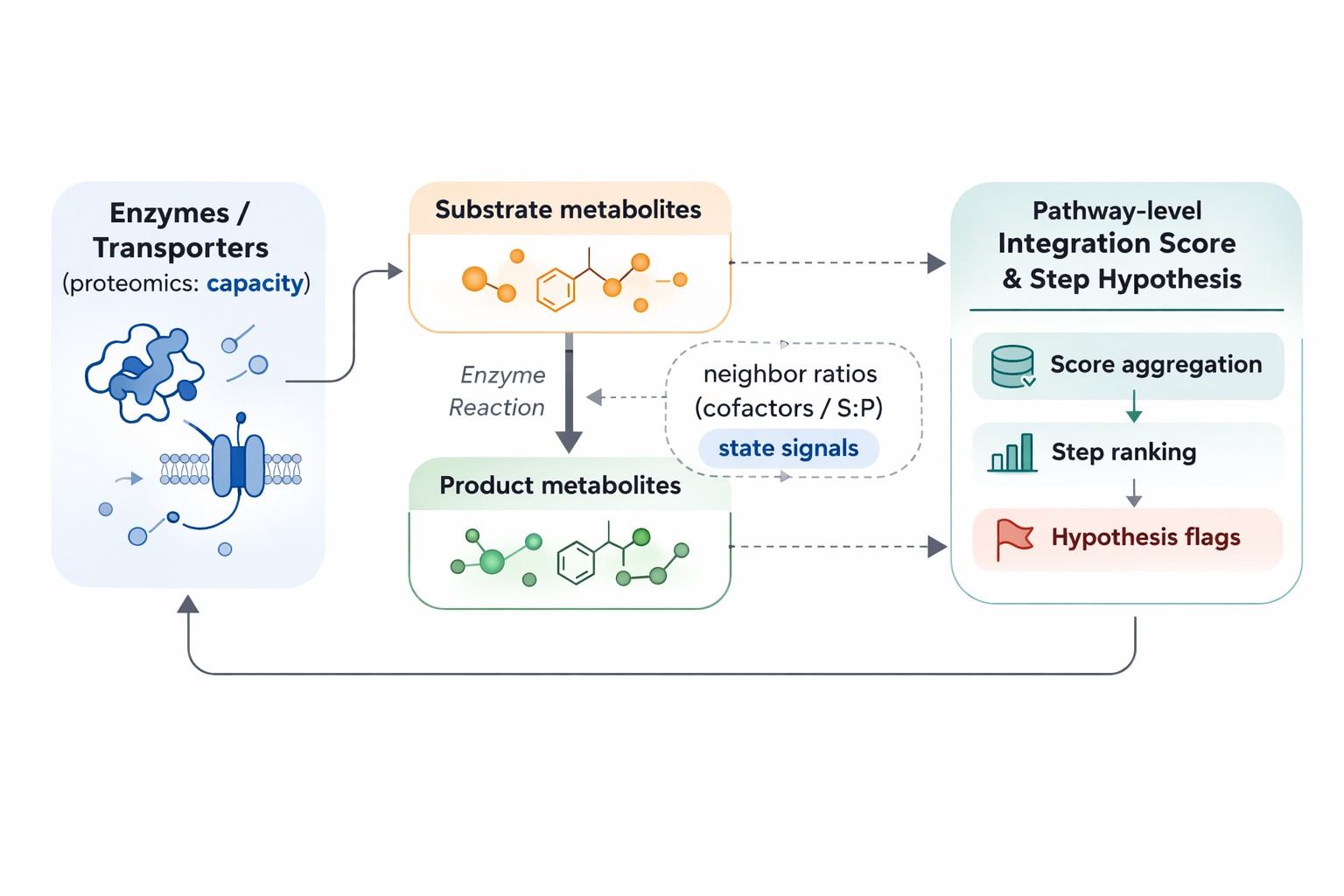 Figure 1. "Enzyme–Substrate–Pathway framework": enzymes/transporters linked to substrate/product metabolites within a pathway, highlighting where evidence accumulates (protein abundance/activity proxies + metabolite ratios + pathway-level scores).
When Proteo-Metabolomics Is the Right Combination
Proteomics can indicate capacity and regulatory intent (enzyme complexes, transporters, isozymes), while metabolomics captures state (substrate/product pools, redox and energy indicators). Combining them is especially valuable when either layer alone would leave ambiguity.
Proteo-metabolomics is a strong fit when you need to:
- Build mechanism-level interpretations where enzyme regulation and metabolic state both matter
- Position an effect within a pathway ("upstream supply vs downstream bottleneck") rather than naming isolated biomarkers
- Compare conditions where upstream regulation is unclear (stress response, drug perturbation, knockdown/overexpression)
- Resolve conflicting single-omics results (protein changes without metabolite shifts, or vice versa)
The practical advantage is not "more significant features." The advantage is that two layers allow you to test whether a pathway story is directional, step-consistent, and falsifiable.
The Core Framework: Capacity vs State vs Pathway Constraint
A useful integration story separates what each layer can and cannot claim.
Capacity (primarily proteomics)
Proteomics is strongest for signals like:
- Enzyme/complex abundance and coordinated complex behavior
- Transporters and compartment-facing enzymes
- Isozyme patterns and pathway "re-wiring" through paralogs
Proteomics often reflects the upper bound of potential activity (what could happen), not what is happening at this moment.
State (primarily metabolomics)
Metabolomics is strongest for:
- Substrate/product pools consistent with local constraints
- Cofactor indicators (e.g., energy and redox context)
- Pathway-level "chemical phenotype" that often integrates multiple upstream signals
Metabolites can shift due to flux changes, but also due to transport, compartmentation, buffering, or diet/media inputs—so context matters.
Constraint (the step-level hypothesis you can validate)
A constraint hypothesis is the step (or small set of steps) that best explains:
- Enzyme/transport evidence (capacity signals), and
- Substrate/product patterns (state signals), and
- Pathway directionality and branch behavior
This is why pathway-step reasoning typically beats "top hits." A single significant metabolite rarely carries enough information to locate the constraint without neighboring metabolites and enzyme context.
Data Alignment Essentials Without Getting Lost in Preprocessing
Integration succeeds or fails on alignment details that are easy to overlook. The goal is not to turn your paper into a methods manual; it is to ensure the resulting mechanistic claims are traceable.
Sample Pairing and Design Alignment
Start with one reconciled manifest across layers:
- Sample IDs, conditions, timepoints, batches/sites, and any planned covariates
- Clear rules for missingness: which samples are excluded from paired analyses, and why
Paired designs are easiest to interpret. If pairing is incomplete (common in real projects), enforce consistent rules:
- Use paired-only for step-level hypotheses
- Use larger single-omics sets for exploratory context, then re-check paired directionality
Mapping Proteins to Reactions and Metabolites
Enzyme–reaction–metabolite mapping is often many-to-many:
- Isozymes: multiple proteins catalyze the same reaction
- Complexes: multiple subunits are required for activity
- Transport: metabolite changes may reflect movement rather than conversion
- Metabolite ID ambiguity: isomers and adducts can complicate "reaction membership"
A defensible approach is to use reaction- or step-level summaries when feature-level mapping is fragile. Step-level summaries reduce false specificity and increase auditability.
What to Record for Traceability
Record enough metadata so another analyst can reproduce your mapping:
- Protein IDs and protein group rules (how you handle shared peptides)
- Metabolite ID confidence levels and isomer notes
- Versioned pathway references and mapping tables used (KEGG/Reactome/HMDB references, if applicable)
For metabolomics processing and downstream analysis planning, these internal resources can help align expectations early:
A Practical Step-by-Step Interpretation Workflow
The objective is repeatable interpretation that produces a short list of step-level hypotheses and a clear validation plan—not a network diagram with hundreds of edges.
Start at the Pathway Level
Begin by identifying pathways with convergent support across layers:
- A coherent pattern of enzyme/complex changes and metabolite shifts
- Multiple metabolites supporting the same pathway segment (not isolated singletons)
- A directionality story that does not contradict known biochemistry
Use a pathway shortlist stage to avoid overfitting to one dramatic feature that is actually a confounder.
Zoom to Pathway Steps Using Enzyme–Substrate Logic
For each candidate pathway, examine step-level evidence using a consistent checklist:
- Enzyme/transport proteins: abundance shifts, complex coordination, isozyme switching
- Substrate/product patterns: pooled levels for neighbors around the step
- Local ratios (when defensible): substrate/product or cofactor-linked ratios that reflect local constraint patterns
- Cofactor context: energy/redox and other contextual metabolites that change interpretation
- Branch behavior: rerouting at branch points, compensation routes, bypass steps
The goal is to end with a step-level hypothesis that is explicit enough to test.
Classify the Mechanism You're Seeing
Common mechanism categories are:
- Supply-limited: pathway signal driven by upstream substrate availability or precursor delivery
- Capacity-limited: enzyme/complex abundance suggests a ceiling, consistent with substrate accumulation or product depletion patterns
- Transport-limited: transporter shifts and compartment-facing metabolite patterns dominate
- Compensation/bypass: branch rerouting masks expected substrate/product changes at a single step
- Isozyme switching: paralogs shift with a subtle metabolite signature that looks inconsistent unless isozymes are modeled
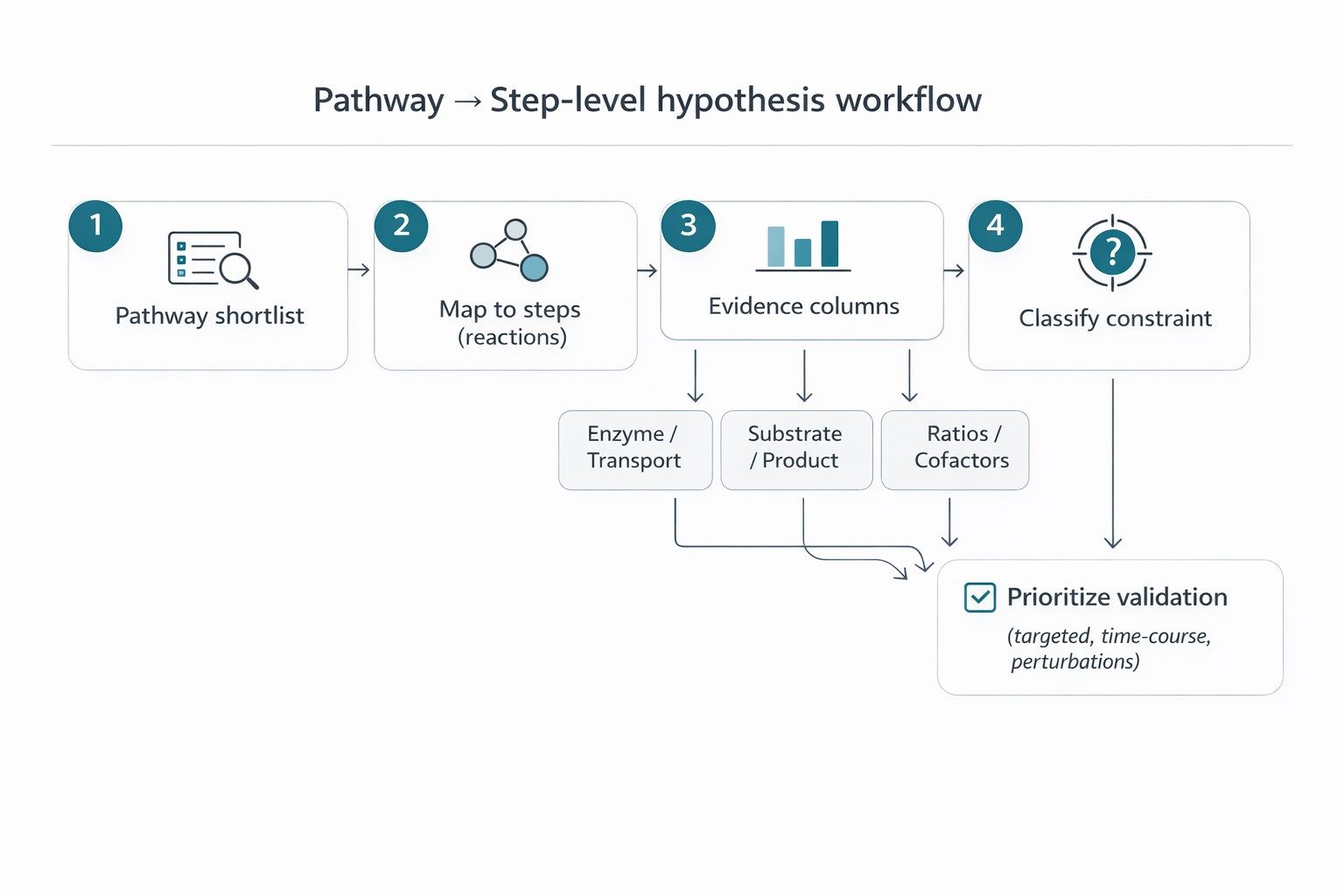 Figure 2. "From pathway signal to step-level hypothesis": pathway shortlist → step mapping → evidence columns (enzyme, substrate/product, ratios, cofactors) → classify constraint type → prioritize validation.
Common Discordance Patterns and How to Interpret Them
Discordance is not a failure—it is often the biological signal. The mistake is interpreting discordance as "one omics is wrong."
Protein Changes Without Metabolite Changes
Possible explanations:
- Buffering and redundancy: alternate enzymes/branches compensate
- Time-lag: proteome reprogramming precedes metabolite shifts
- Activity regulation dominates: post-translational regulation or allostery changes activity without changing abundance
- Compartment effects: local changes are diluted in bulk metabolite measurements
Interpretation tip: treat "protein-only" shifts as capacity changes unless you have neighboring metabolite evidence that supports a local constraint.
Metabolite Changes Without Protein Changes
Possible explanations:
- Substrate availability: precursor delivery changes due to upstream processes
- Transport constraints: altered uptake/efflux changes pools without enzyme abundance shifts
- Enzyme activity changes: allostery, PTMs, or inhibitor presence alters activity
- Matrix and context effects: media, diet, circadian timing, or sample handling can dominate
Interpretation tip: require multi-metabolite support within a pathway segment before asserting a step-level mechanism.
Opposite Directions Within the Same Pathway
Common reasons:
- Feedback control: downstream products regulate upstream steps
- Branch-point rerouting: one branch drains intermediates while another accumulates
- Mixed cell populations: bulk measurements average divergent cell states
- Rate-limiting step moves: the bottleneck shifts under perturbation
Interpretation tip: focus on "where the signs agree" at the step level, and label ambiguous regions as hypotheses rather than conclusions.
Integration Outputs That Work: Example Deliverables
Mechanism claims are only as strong as the deliverables that support them. A good deliverables pack enables review, collaboration, and validation planning.
Pathway-Level Summary Table (Core Deliverable)
This table should answer: "Which pathways show convergent, directional evidence across layers, and how strong is that evidence?"
| Pathway | Proteomics Direction | Metabolomics Direction | Step(s) Implicated | Evidence Quality | Validation Targets |
|---|---|---|---|---|---|
| TCA cycle segment | Complex II/III ↑ | succinate ↑, fumarate ↓ | SDH / fumarase region | high coverage; stable across batches | succinate/fumarate (targeted), SDH activity proxy |
| Amino acid catabolism | enzyme set ↓ | upstream AA ↑ | branch-point step | moderate; some missingness | targeted AA panel; time-course |
Step-Level Evidence Table (The "Mechanism Table")
This table should answer: "What is the most plausible constraint step, and what evidence supports that step-level hypothesis?"
| Step | Enzyme/Transport Evidence | Substrate/Product Evidence | Cofactor/Ratio Context | Consistency | Constraint Hypothesis |
|---|---|---|---|---|---|
| A → B | enzyme A ↑; isozyme switch | A ↑; B ↔ | ATP/ADP suggests energy stress | stable across strata | capacity-limited at A with compensation |
| Transport X | transporter ↓ | extracellular marker ↑; intracellular substrate ↓ | redox unchanged | timepoint-specific | transport-limited entry step |
Figures That Support Claims
Figures should make the logic visible:
- Step-aware pathway heatmaps (enzymes aligned to reaction steps with neighboring metabolites)
- Evidence "barcodes" showing which layer supports which step
- Optional network view only if stability-checked and summarized into interpretable modules
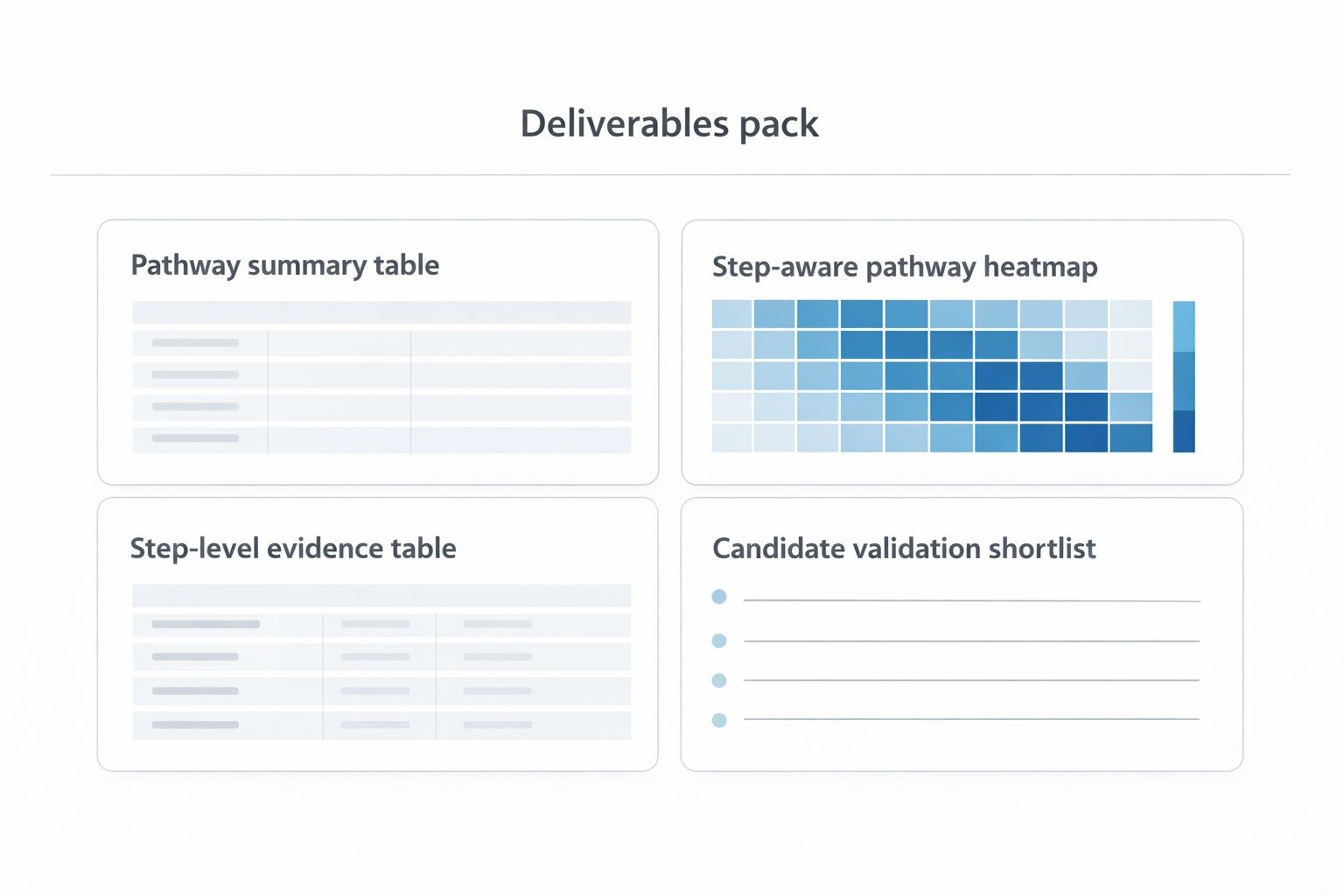 Figure 3. Mockup of an "example deliverables pack": pathway summary table, step-level evidence table, step-aware pathway heatmap, and candidate validation shortlist with evidence columns.
Validation Roadmap: What to Do Next With a Step-Level Hypothesis
A good integration analysis ends with a validation plan that matches the claim level.
Prioritization Rules for Validation
Prioritize steps that show:
- Strong multi-layer convergence (multiple metabolites + consistent enzyme/transport signals)
- Stability across batches, timepoints, and reasonable sensitivity checks
- Biological plausibility as a flux constraint (rate-limiting, supply-limited, transport-limited)
Practical Validation Options
Common next steps include:
- Targeted metabolite verification for key substrates/products and relevant cofactors
- Time-course follow-up to test lag and compensation behavior
- Perturbations aligned to the implicated step (inhibition, knockdown/overexpression, substrate supplementation)
- Orthogonal readouts for enzyme activity proxies when feasible
When you need verification-grade quantification for pathway-relevant metabolites, targeted workflows are often the fastest route to confirm directionality and robustness:
Pitfalls That Commonly Break Proteo-Metabolomics Stories
These are the issues most likely to trigger reviewer pushback or internal stakeholder skepticism:
- Treating protein abundance as flux without metabolite support
- Ignoring compartmentalization and transport when interpreting pool changes
- Overconfident one-to-one mapping claims (single protein → single reaction; single metabolite → single step)
- Batch-driven "convergence" that disappears after QC review
- Reporting without stating mapping assumptions and ID confidence notes
If discovery is the goal, untargeted metabolomics is a strong first pass—but it should be paired with a verification strategy for key claims:
Deliverables Checklist (What to Ask For)
Use this checklist to keep your project integration-ready and review-ready:
- One reconciled sample manifest across layers
- Pathway summary table + step-level evidence table (with mapping notes)
- QC summary per layer + batch composition confirmation
- Figures pack (editable + final) with a short interpretation guide
- Reproducibility notes: versions/parameters for mapping and scoring
Frequently Asked Questions (FAQs)
What questions does proteo-metabolomics answer better than either layer alone?
Proteo-metabolomics is strongest for locating pathway constraints. Proteomics indicates capacity changes (enzymes, complexes, transporters), while metabolomics indicates state changes (substrate/product pools, cofactors). Together, they help decide whether an effect is supply-limited, capacity-limited, or transport-limited and which step is most consistent with the observed evidence. This reduces reliance on single-feature narratives and supports validation planning aligned to a specific pathway segment.
Why do proteins and metabolites disagree in the same pathway?
Disagreement is common because abundance and activity are not the same. Proteins can change without metabolite shifts due to buffering, redundancy, time-lag, or post-translational regulation. Metabolites can change without protein shifts due to substrate availability, transport constraints, compartment effects, or allostery. A step-level evidence table that includes neighboring metabolites and cofactor context usually clarifies whether the disagreement reflects regulation, compensation, or an upstream confounder.
What level of mapping is defensible: feature-level or pathway-step level?
Pathway-step level is often more defensible in multi-omics integration because enzyme–reaction mapping is many-to-many (isozymes, complexes) and metabolite IDs can be ambiguous (isomers). Feature-level claims are defensible only when mapping confidence is high (clear protein assignment, confident metabolite ID) and the local pathway neighborhood supports the same directionality. When mapping is fragile, reaction-step summaries and pathway-level concordance reduce false specificity.
What does a good "mechanism deliverable" look like?
A strong deliverable set includes (1) a pathway-level summary table showing directionality across layers and evidence quality, (2) a step-level evidence table linking enzymes/transporters to substrate/product patterns and cofactor context, and (3) a compact figure pack (step-aware heatmaps, evidence barcodes). The deliverables should also include mapping assumptions, ID confidence notes, and QC summaries so reviewers can audit how the mechanism hypothesis was derived.
What should be validated first after integration?
Validate the smallest set of pathway-relevant metabolites that best tests the step-level hypothesis, prioritizing those with high detectability and consistent direction across strata. Targeted verification is often the first step for key substrates/products and cofactors because it improves comparability across batches and supports precise directionality claims. If time-lag or compensation is suspected, a short time-course can clarify whether proteins lead metabolite changes or vice versa.
References
- Yizhak, Keren, et al. "Integrating quantitative proteomics and metabolomics with a genome-scale metabolic network model." Bioinformatics 26.12 (2010): i255–i260. https://doi.org/10.1093/bioinformatics/btq183
- Cox, Jürgen, and Matthias Mann. "MaxQuant enables high peptide identification rates, individualized p.p.b.-range mass accuracies and proteome-wide protein quantification." Nature Biotechnology 26 (2008): 1367–1372. https://doi.org/10.1038/nbt.1511
- Pang, Zhiqiang, et al. "MetaboAnalyst 6.0: towards a unified platform for metabolomics data processing, analysis and interpretation." Nucleic Acids Research 52.W1 (2024): W398–W406. https://doi.org/10.1093/nar/gkae253
- Zelezniak, Adrian, et al. "Enhanced flux prediction by integrating relative expression and relative metabolite abundance into thermodynamically consistent metabolic models." PLOS Computational Biology 15.3 (2019): e1007036. https://doi.org/10.1371/journal.pcbi.1007036
- Zhang, Xue, et al. "Integration of Proteomics and Metabolomics Revealed Metabolic Regulation of ACTH-Secreting Pituitary Adenoma." Frontiers in Endocrinology 9 (2018): 678. https://doi.org/10.3389/fendo.2018.00678

 Contact Us