

MS/MS, Retention Time, and Spectral Libraries: Building a Robust Identification Workflow
Submit Your InquiryMetabolite identification remains one of the most difficult and most consequential steps in LC-MS metabolomics. Modern platforms can detect thousands of features from a single biological matrix, but feature detection alone does not create biological meaning. The real challenge begins when those features must be translated into defensible metabolite identities that can support pathway interpretation, biomarker discovery, cross-study comparison, or downstream validation.
This is where many untargeted metabolomics projects become vulnerable. Exact mass may narrow the candidate space, but it rarely resolves structural ambiguity on its own. MS/MS fragmentation can provide structure-relevant evidence, but fragmentation quality and acquisition context matter. Retention time can strengthen or weaken a proposed identity, yet it is often misused outside of method context. Spectral libraries make annotation scalable, but a high similarity score is not equivalent to confirmation.
A robust identification workflow therefore depends on evidence integration rather than single-point matching. Exact mass, isotopic pattern, adduct assignment, MS/MS, retention time, and reference spectra each contribute a different type of evidence. When these layers are combined in a transparent way, metabolite annotation becomes more selective, more reproducible, and more useful for real decision-making.
For teams planning discovery studies, Untargeted Metabolomics Service provides broad LC-MS/MS profiling support for hypothesis generation and feature discovery. When a project requires stronger statistical interpretation, QC-aware preprocessing, and downstream reporting logic, Metabolomics Data Analysis becomes equally important. And when a smaller set of high-value metabolites needs more focused confirmation or reproducible follow-up quantification, Targeted Metabolomics Analysis Service is often the right next step.
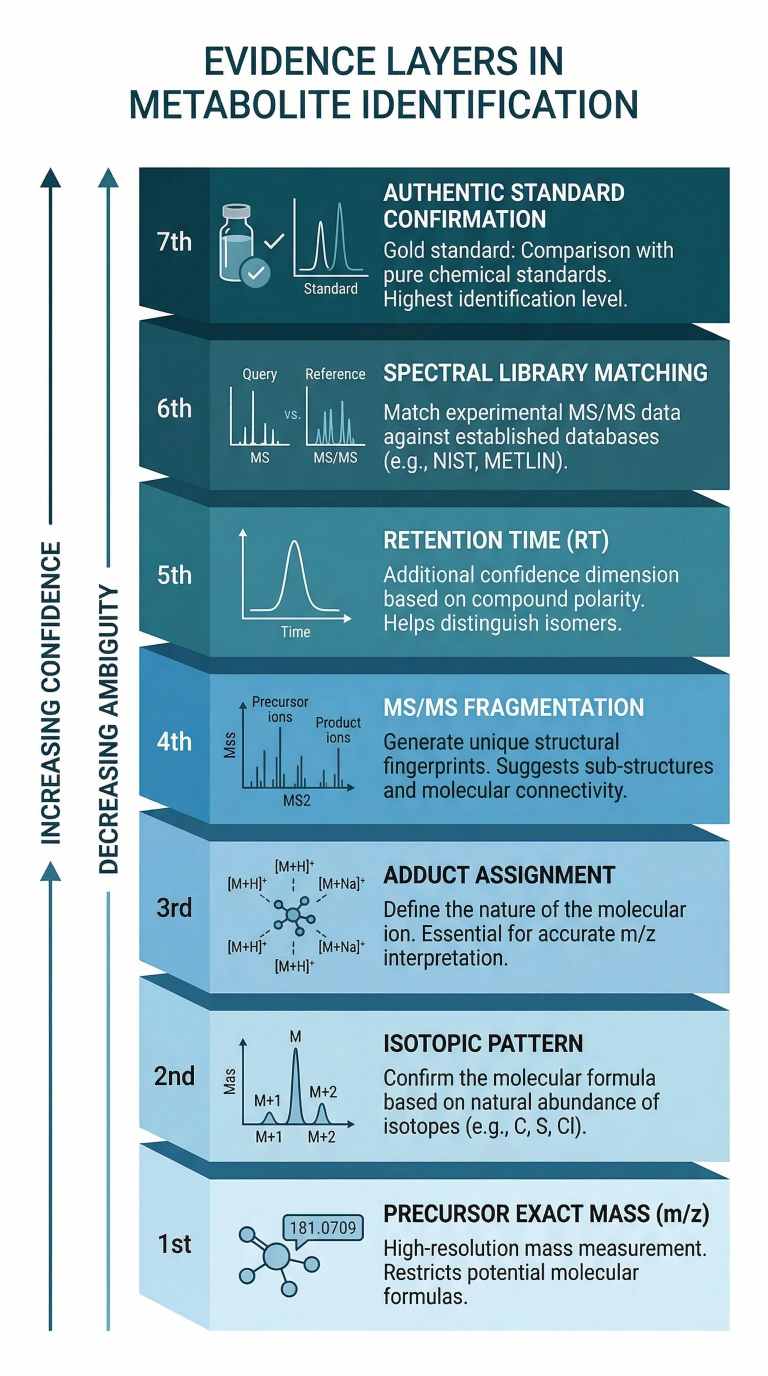 Figure 1. A layered evidence model for metabolite identification in LC-MS. Exact mass narrows candidates, while MS/MS, retention time, spectral matching, and authentic standards progressively increase confidence.
Why Exact Mass Is Not Enough
High-resolution LC-MS is extremely effective for narrowing formula space, but it does not solve the central ambiguity of untargeted metabolomics. Many metabolites share the same elemental formula, nearly identical precursor masses, or ion forms that are difficult to distinguish without additional context. Isomers are the clearest example, but ambiguity can begin even earlier if the observed ion is assigned incorrectly.
A protonated molecule, sodium adduct, ammonium adduct, in-source fragment, or isotope peak can all lead to different candidate retrieval outcomes. If ion-species annotation is wrong, the entire downstream interpretation can drift. This is why strong workflows do not treat precursor mass as a naming engine. They use it as an initial filter to define chemical plausibility.
In practice, precursor m/z, mass error, isotopic pattern, and adduct logic should be evaluated together. These features help determine whether a signal is analytically credible and which formulas remain reasonable. That is valuable, but it still does not establish identity. A mass-only assignment may look precise on paper while remaining weak in structural terms.
What exact mass does well
- It rapidly narrows the number of plausible molecular formulas.
- It supports early candidate generation in large untargeted datasets.
- It can eliminate obviously implausible assignments before deeper review.
What exact mass cannot do reliably
- It cannot distinguish structural isomers.
- It cannot verify that the correct ion species has been assigned.
- It does not support compound-level claims without orthogonal evidence.
Key point: Exact mass is necessary for candidate narrowing, but insufficient for confident metabolite identification.
What MS/MS Adds to Identification
MS/MS is where annotation begins to move beyond formula plausibility toward structure-relevant evidence. By fragmenting a selected precursor ion into product ions, tandem mass spectrometry reveals patterns that can be compared against reference spectra or interpreted for substructural logic. This is often the most important step in separating merely possible candidates from chemically plausible ones.
In real datasets, a single precursor mass may map to many candidate metabolites. Fragmentation helps shrink that list because major product ions, neutral losses, and diagnostic fragments can be inconsistent with most candidates. In metabolite classes with recognizable fragmentation behavior, MS/MS is especially valuable for class-level and sometimes compound-level annotation.
At the same time, MS/MS is often overinterpreted. Product-ion spectra are only as useful as the conditions under which they were generated. Low-abundance precursors may produce sparse spectra. Co-eluting features can lead to chimeric fragmentation. Instrument platform, collision energy, and precursor isolation windows can all affect what the spectrum looks like. A strong match improves confidence, but it does not make the surrounding analytical context irrelevant.
What MS/MS contributes
- Structure-relevant fragment evidence
- Better candidate reduction than mass alone
- Compatibility with spectral library workflows
- Stronger support for class-level and compound-level annotation
What affects MS/MS quality
| Factor | Why it matters | Typical risk |
|---|---|---|
| Collision energy | Changes fragmentation pathways and relative ion intensities | Good compounds may score poorly under mismatched settings |
| Isolation purity | Determines whether one precursor or several entered fragmentation | Chimeric MS/MS spectra |
| Signal intensity | Controls spectral completeness and reproducibility | Sparse, low-information fragment patterns |
| Instrument platform | Affects fragmentation behavior and signal response | Cross-platform mismatch |
Key point: MS/MS is one of the strongest evidence layers in LC-MS metabolomics, but only when interpreted in the context of acquisition quality and precursor logic.
Why Retention Time Still Matters
Retention time is sometimes treated as a secondary feature because it is method-dependent. That is true, but it misses why retention time is useful in the first place. Under a controlled chromatographic method, retention behavior provides orthogonal evidence that mass and fragmentation alone cannot replace. It tells you whether a proposed identity behaves plausibly on the actual LC system used for the study.
This becomes especially important when candidate metabolites are structural isomers or belong to closely related compound families. Two candidates may have the same precursor mass and broadly similar fragmentation, yet separate chromatographically because of differences in polarity, stationary-phase interaction, or local structure. In those cases, retention time is not an accessory detail. It is a decision-making layer.
Retention time should, however, be interpreted with discipline. Its evidence value is highest when compared against an authentic standard analyzed under the same column chemistry, gradient, mobile phase, and instrument conditions. It is weaker when transferred across methods or laboratories without normalization. Retention index or other normalization strategies can improve comparability in some workflows, but they do not turn RT into a universal property.
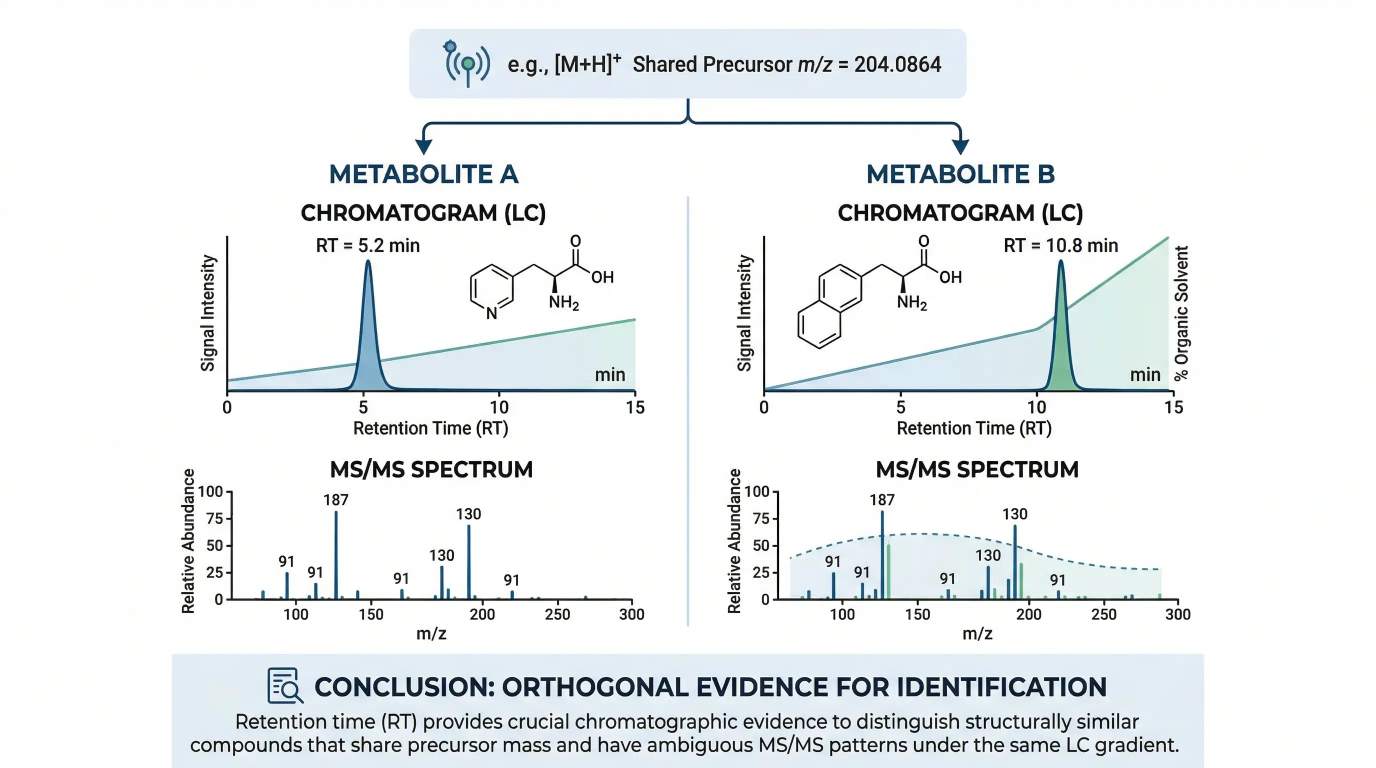 Figure 2. Retention time can distinguish candidate metabolites that remain ambiguous after mass and MS/MS review, especially within isomer-rich metabolite classes.
Where retention time is most useful
- Distinguishing structural isomers
- Reviewing high-priority candidate metabolites
- Challenging plausible but not decisive library matches
Retention time evidence: strong vs weak use
| Use case | Confidence contribution |
|---|---|
| Same-method comparison to authentic standard | Strong |
| Same-method comparison to internal historical data | Moderate |
| Cross-lab comparison without normalization | Weak |
| Generic literature RT expectation only | Very weak |
Key point: Retention time does not replace MS/MS, but it often determines whether a proposed identity remains chromatographically plausible.
How Spectral Libraries Improve Annotation
Spectral libraries make metabolite annotation scalable. Without them, every feature would require more extensive manual interpretation, which is impractical in large untargeted studies. By comparing experimental MS/MS spectra against measured or predicted reference spectra, researchers can prioritize candidates much more efficiently and with better consistency across projects.
Not all libraries are equal. Empirical libraries are built from experimentally acquired spectra of authentic standards and usually provide the strongest evidence when the correct ion form and compatible acquisition conditions are represented. In-silico tools extend coverage into chemical space that experimental libraries do not yet cover. They are valuable in discovery workflows, but their output should normally be treated as supporting rather than definitive evidence.
A useful library match depends on more than a score. The precursor ion must be reasonable. The adduct should be consistent. The major fragments should make chemical sense. The metadata should be deep enough to judge compatibility. Forward and reverse dot-product behavior can be informative, especially when background peaks or co-fragmentation are suspected, but similarity metrics still need review in context.
What makes a library match more credible
- Correct precursor ion and adduct form
- Compatible acquisition and collision conditions
- Chemically plausible major fragments
- Good spectral quality
- Sufficient metadata depth
What a library score cannot prove on its own
- That the precursor assignment is correct
- That the MS/MS spectrum is not chimeric
- That retention behavior supports the candidate
- That an authentic standard would agree under matched conditions
Key point: A spectral library score is useful evidence, not proof of identity.
Putting the Evidence Together
A robust identification workflow is not a single database search followed by a named peak list. It is a staged reduction of uncertainty. Each evidence layer narrows the space further, and each layer has its own failure modes. This is why good workflows are built to preserve uncertainty where uncertainty remains.
A practical strategy starts with feature quality review and ion annotation, then moves through candidate generation, MS/MS assessment, spectral library matching, retention-time review, and confidence assignment. High-priority metabolites can then be escalated to authentic standard confirmation or transferred into targeted validation.
| Evidence layer | Main question it answers | Common overreach |
|---|---|---|
| Exact mass + isotopes | Which formulas remain plausible? | Reporting mass-only hits as identified metabolites |
| Adduct review | Which ion form is actually observed? | Searching the wrong precursor |
| MS/MS | Which candidates fit the fragment evidence? | Treating every strong score as definitive |
| Spectral library | Does the spectrum resemble a known reference? | Ignoring acquisition context |
| Retention time | Is the candidate chromatographically plausible? | Comparing RT across unmatched methods |
| Authentic standard | Does the identity hold under matched conditions? | Skipping standards for key biological claims |
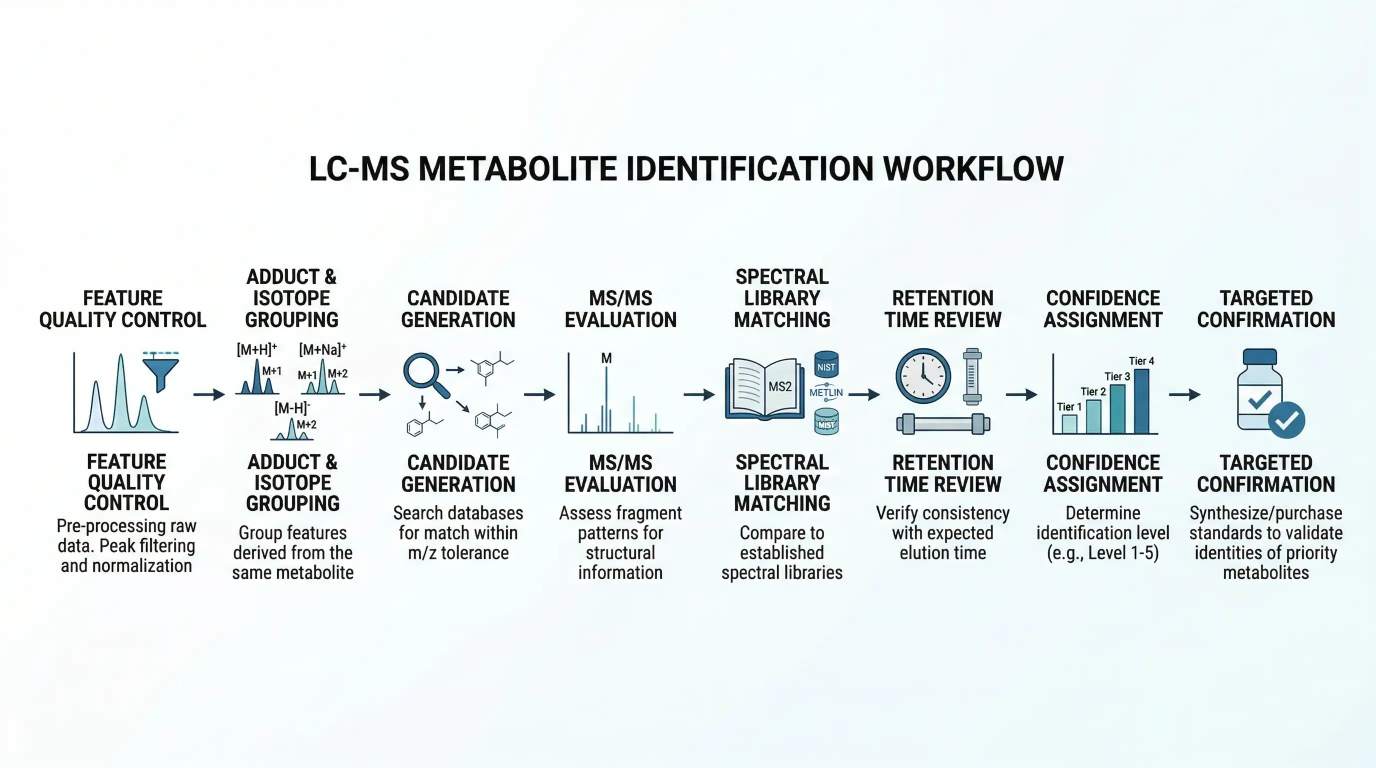 Figure 3. A practical metabolite identification workflow for LC-MS projects, from feature quality control to confidence assignment and targeted confirmation of priority metabolites.
A realistic workflow for real studies
In discovery-stage metabolomics, the best workflow is rarely the one that produces the longest named-metabolite list. It is the one that prevents false certainty from entering biological interpretation. A biomarker-discovery study may tolerate tentative candidates during early screening, but the handful of metabolites driving the final narrative usually need a much higher confirmation threshold.
At that stage, discovery and validation should be treated as connected workflows rather than separate silos. Broad profiling helps generate candidates. Focused follow-up helps determine which candidates can support stronger claims. That is one reason Targeted Metabolomics Analysis Service is often the right next step after broad discovery when a project moves toward validation.
Reporting Confidence Without Overclaiming
Metabolite names can create a false sense of certainty if the evidence supporting them is not made visible. This is why confidence reporting matters. It protects not only the manuscript or report, but also the biological interpretation itself. A same-method standard match is not equivalent to a strong library hit. A class-level lipid annotation is not equivalent to a unique structure. A reproducible unknown is not a failed result.
A practical confidence model should distinguish between confirmed, probable, tentative, and unknown features. This does not require overcomplicated reporting, but it does require that the evidence category be visible enough for collaborators, reviewers, and downstream users to understand what is actually known.
A simple confidence model
| Confidence tier | Typical evidence | Safe claim |
|---|---|---|
| Confirmed structure | Authentic standard under matched conditions, often with MS/MS and RT agreement | Compound-level identification |
| Probable structure | Strong MS/MS and library support without same-run standard confirmation | High-confidence annotation |
| Tentative candidate or class | Partial fragment evidence, class-specific fragments, or in-silico support | Candidate-level or class-level annotation |
| Unknown feature | Reproducible signal without defensible structure | Unknown but biologically relevant feature |
Key point: Confidence categories help teams communicate what the data support without overstating certainty.
Common Failure Points in Identification Workflows
Many annotation failures begin upstream. Poor peak quality, unresolved adducts, unstable baselines, contamination, low-abundance precursors, and weak deconvolution all reduce the value of downstream MS/MS and library review. Identification should therefore not be treated as a purely downstream bioinformatics task. It depends directly on analytical quality and preprocessing decisions.
This is one reason Metabolomics Data Analysis should be viewed as part of the identification workflow rather than a separate statistical endpoint. Preprocessing, QC filtering, missing-value handling, and feature curation all affect which signals are credible enough to interpret at all.
Frequent causes of weak annotation
| Problem | Why it happens | What it affects |
|---|---|---|
| Mass-only naming | Pressure to maximize named metabolites | Inflated confidence |
| Wrong adduct assignment | Ion-species ambiguity | Incorrect candidate retrieval |
| Chimeric MS/MS | Co-elution or impure precursor isolation | Misleading fragment pattern |
| RT overinterpretation | Method mismatch | False confirmation |
| Poor upstream QC | Weak peaks or unstable features | Unreliable downstream annotation |
Key point: Identification confidence is only as strong as the data quality and review logic that support it.
When to Use Standards, Targeted Follow-Up, or Additional Review
Not every feature in an untargeted study needs authentic standard confirmation. That would be inefficient and often unnecessary. But not every high-scoring library hit should be treated as publication-level evidence either. The more useful question is which metabolites would materially change the interpretation if they were wrong.
That typically includes biomarker candidates, pathway-defining metabolites, top-ranked mechanistic hits, and compounds selected for downstream assay development or cross-study comparison. At that point, a project often benefits from moving beyond broad profiling into more selective validation. This is why Metabolomics Service is best understood as a continuum that can extend from untargeted discovery to focused follow-up rather than a single one-size-fits-all workflow.
When to escalate confidence requirements
- A metabolite becomes central to the biological conclusion
- A candidate will be used in downstream validation
- Cross-study comparison depends on compound-level accuracy
- A manuscript claim requires stronger structural confidence
Key point: Standard-based confirmation is most valuable where an incorrect annotation would change the story, not where it would merely add another named feature.
What Not to Overinterpret
A defensible workflow is partly defined by what it refuses to overclaim. A strong library score does not make retention time irrelevant. A plausible retention time does not rescue poor MS/MS. A class-level annotation does not justify compound-specific mechanistic conclusions. And a reproducible unknown should not be hidden simply because it cannot yet be named.
This restraint matters because metabolite annotation remains incomplete even with better software, richer public resources, and stronger community standards. The most credible workflows are often the ones that preserve uncertainty honestly, rather than collapsing every signal into a specific compound name.
FAQs
Is exact mass enough to identify a metabolite?
No. Exact mass is excellent for narrowing formula space, but it cannot reliably distinguish structural isomers or validate compound-level identity on its own. In most workflows, exact mass should be treated as candidate-generation evidence rather than confirmation.
Why can a high spectral library score still be wrong?
Because the score may reflect a wrong adduct, incompatible collision conditions, a chimeric spectrum, or incomplete metadata. A strong score improves confidence, but it still needs precursor review, fragment plausibility, and chromatographic context.
When is retention time strong evidence?
Retention time is strongest when compared with an authentic standard analyzed under the same LC conditions. It is weaker when moved across columns, gradients, or laboratories without normalization.
What is the difference between empirical and in-silico spectral matching?
Empirical matching compares your experimental spectrum to one measured from an authentic standard. In-silico matching compares it to a predicted fragmentation pattern. Empirical evidence is usually stronger, while in-silico tools are useful for extending coverage when reference standards are unavailable.
Should unknown features be reported?
Often yes. If an unknown feature is reproducible, statistically robust, and biologically relevant, it can still be worth reporting. The key is to label it honestly as unknown or tentative rather than assigning an unsupported compound name.
When should a project move from untargeted to targeted metabolomics?
Usually when a smaller set of metabolites begins to drive interpretation, validation, or publication claims. At that point, targeted follow-up is often better suited for stronger quantification, reproducibility, and focused confirmation.
What should I ask a metabolomics provider about identification quality?
Ask how they handle adduct annotation, MS/MS review, library matching, retention-time evidence, confidence categories, and standard-based confirmation for priority metabolites. Those details usually matter more than instrument names alone.
References
- Sumner LW, Amberg A, Barrett D, et al. Proposed minimum reporting standards for chemical analysis. Metabolomics. 2007;3(3):211-221.
- Creek DJ, Dunn WB, Fiehn O, et al. Metabolite identification: are you sure? And how do your peers gauge your confidence?. Metabolomics. 2014;10(3):350-353.
- Schymanski EL, Jeon J, Gulde R, et al. Identifying small molecules via high resolution mass spectrometry: communicating confidence. Environmental Science & Technology. 2014;48(4):2097-2098.
- Viant MR, Kurland IJ, Jones MR, Dunn WB. How close are we to complete annotation of metabolomes?. Current Opinion in Chemical Biology. 2017;36:64-69.
- Horai H, Arita M, Kanaya S, et al. MassBank: a public repository for sharing mass spectral data for life sciences. Journal of Mass Spectrometry. 2010;45(7):703-714.
- de Jonge N, Kind T, Fiehn O, et al. MassBank: an open and FAIR mass spectral data resource. Nucleic Acids Research. 2026;54(D1):D601-D609.

 Contact Us