

Multi-omics Pitfalls & Troubleshooting: Missing Values, Batch Effects, Spurious Correlations, Overfitting — A Prevention Checklist
Submit Your InquiryIntroduction
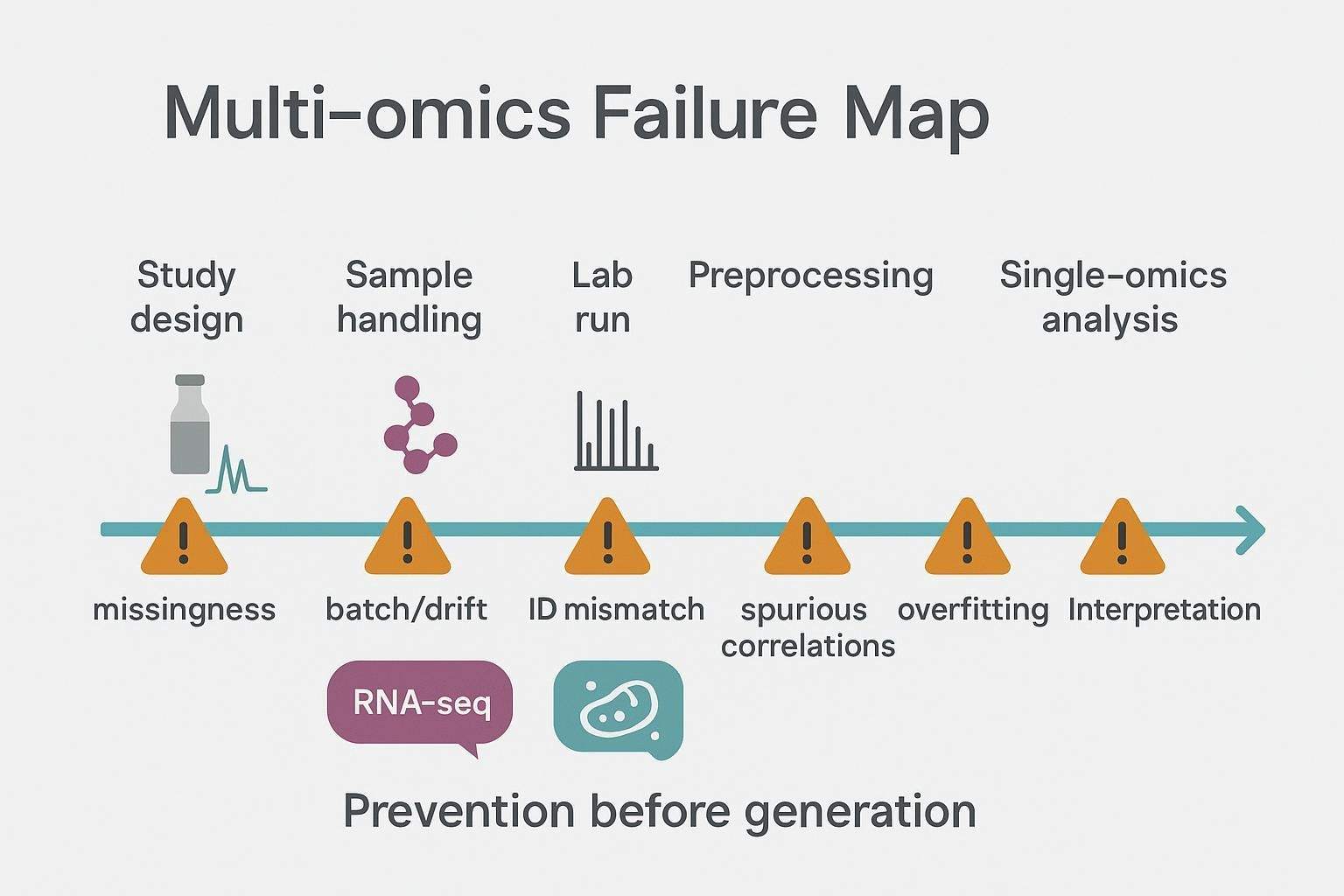
Multi-omics projects promise rich biological insight—but common failure modes still derail reproducibility, interpretation, and downstream decisions. Missing values creep in, batches dominate your embeddings, "perfect" networks vanish on replication, and models that shine in cross-validation fall apart on holdouts. Most of these problems are preventable if you design for quality up front and apply modality-aware QC across metabolomics, proteomics, and (when relevant) transcriptomics/microbiome.
This prevention-first guide provides a stepwise checklist spanning study design → data generation → preprocessing → integration → reporting, with fast triage and practical playbooks. It focuses on LC/GC–MS metabolomics and MS-based proteomics, with targeted notes for transcriptomics and microbiome where pitfalls differ.
How to use this guide
- Start with Quick Triage to identify your dominant failure mode.
- Apply the Prevention Checklist before generating data.
- Use the Troubleshooting Playbooks when results look suspicious.
Key takeaways
- Prevention beats rescue: balance groups within batches, log everything, and anchor normalization to QCs/controls before any batch adjustment.
- Diagnose missingness mechanisms (MCAR/MAR/MNAR) and validate imputation choices with sensitivity analyses at feature and pathway/module levels in your multi-omics pitfalls checklist mindset.
- Detect batches with embeddings and quantitative metrics; correct within modality; then verify that biology is conserved and overcorrection avoided.
- Reduce spurious links with pre-filtering, sparsity, multiple-testing control, and explicit confounder adjustment; stress-test associations via bootstrap, holdouts, and replication.
- Stop overfitting at the source: split first, fit preprocessing inside folds, use nested CV, and keep a final untouched test set when feasible.
Study design and QC foundations (prevention starts here)
Sampling, blocking, and randomization
- Balance groups and key timepoints within each batch/run to avoid confounding biology with batch; aim for minimum mixing so each batch contains multiple groups/timepoints.
- Define a blocking strategy you can document: run date, operator, plate, extraction batch. Keep these as explicit columns in your manifest.
- Randomize within practical limits (shipping waves, instrument windows). For longitudinal studies, pre-plan for missing visits and potential drift across extended runs.
Reference materials and replicates strategy
- Replicates in practice
- Technical replicates track instrument/process stability.
- Extraction replicates capture prep variance.
- Biological replicates generalize to the population or condition.
- Reference materials you should plan
- Pooled QC: representative matrix; inject at regular intervals to model drift. Common practice is every 6–10 samples, with 2–5 also used depending on load; document your cadence and rationale, as summarized in a 2023 scoping review in Analytical Chemistry (Broeckling et al.). See background on normalization options in the Creative Proteomics overview of metabolomics data normalization methods.
- Blanks: detect carryover/contamination; examine blank signatures to set thresholds for exclusion. For practical preprocessing context, see this overview of untargeted metabolomics data preprocessing.
- Anchor samples: repeated, well-characterized samples to assess cross-batch comparability.
Modality-specific QC metrics and logs
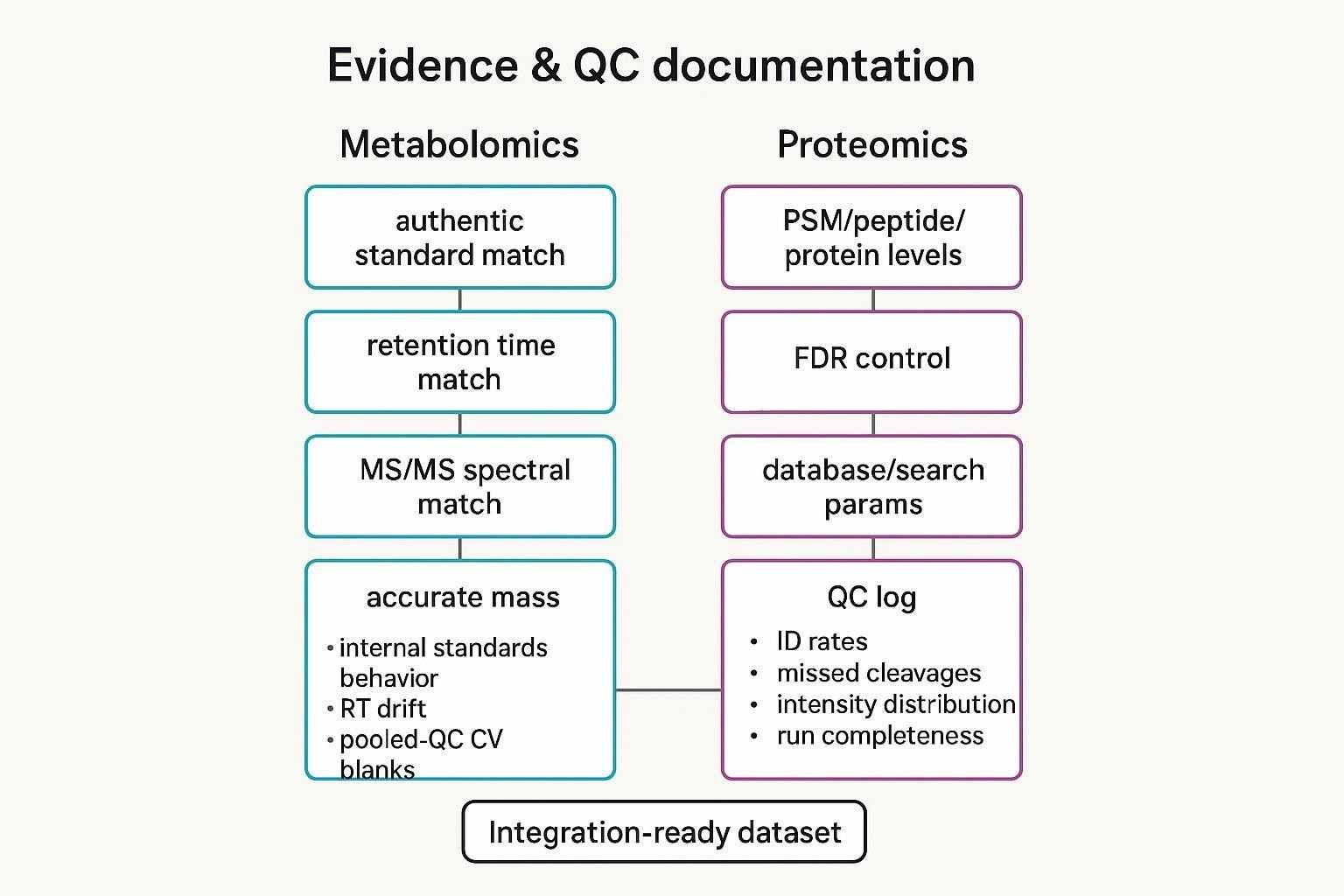
- Metabolomics: track internal standards behavior, retention time (RT) drift, peak shape, pooled-QC CV trends, and blank contamination patterns; keep run-order and event logs from day one.
- Proteomics: monitor PSM/peptide/protein identification rates, missed cleavages, intensity distributions, run completeness, and instrument performance summaries; encode IDs with HUPO-PSI formats where applicable.
- Transcriptomics/microbiome (notes): record library size/complexity, mapping rates/depth; for microbiome, remember compositional constraints.
- QC logs to maintain: run order, batch membership, extraction date, operator, instrument settings, known events/deviations, and rerun notes.
Practical example: Identification evidence and QC documentation
Clear identification evidence and QC documentation reduce downstream ambiguity, prevent reprocessing, and make cross-omics integration reproducible.
Metabolomics: confirmed identification with authentic standards
When a feature is confirmed using an authentic standard, record the evidence needed for verification:
- standard source/provenance
- retention time alignment window (and tolerance)
- MS/MS match reference (library/source) and match criteria
- mass accuracy tolerance (when applicable)
Proteomics: identification confidence and search provenance
To keep protein-level conclusions auditable, retain:
- identification levels reported (PSM / peptide / protein)
- FDR thresholds applied at each level and the decoy strategy
- complete search parameters (database name/version, enzyme, fixed/variable modifications, mass tolerances)
What "good documentation" looks like (minimum set)
- a compact ID-evidence table (fields above, per feature/protein)
- a QC summary table (pooled-QC CV trends, blanks/contamination checks, internal standard behavior when used)
- a change log for any reprocessing (what changed, when, and why)
Missing values: diagnosis, imputation, validation
Diagnose missingness mechanisms (MCAR / MAR / MNAR)
- Practical cues
- MCAR: random scatter not linked to intensity or design.
- MAR: patterned by observed factors (batch, run order, timepoint).
- MNAR: abundance-linked dropouts (LOD-like), common in metabolomics and proteomics.
- Rapid diagnostics
- Missingness heatmap by batch/group/timepoint.
- Missingness vs intensity plot to reveal left-censoring.
- Compare pooled-QC vs sample missingness to distinguish system vs biology.
- Check feature-wise stability across replicates/batches. For a concise overview of mechanism-aware strategies, see Frontiers in AI's review on missing data in multi-omics (2023).
Choose imputation strategies by mechanism and modality
- Rules of thumb and guardrails
- Filter first: set minimum detection frequency thresholds a priori.
- Choose imputation by mechanism; avoid one-size-fits-all.
- Never impute before creating your evaluation splits.
- Modality nuances
- Metabolomics: distinguish censored (LOD-like) MNAR from processing-driven missingness; half-minimum or censored models can be baseline options, but validate via sensitivity analyses. See background in our guide on untargeted preprocessing choices .
- Proteomics: stochastic sampling and low abundance induce MNAR mixed with MAR/MCAR; consider model-based or low-rank methods and cap imputation when missingness is extreme.
- Microbiome: zeros are compositional; avoid naïve imputers that ignore log-ratio structure.
- Avoid common traps
- Performing feature selection on imputed values without sensitivity checks.
- Imputing across the entire dataset before splitting for model evaluation.
Validate with sensitivity analyses and downstream stability
- Re-run key contrasts under multiple plausible missingness treatments.
- Check stability at multiple levels: feature hit lists, pathway/module conclusions, effect-direction consistency.
- Report missingness decisions transparently: what was filtered, what was imputed, and why.
Batch effects: detection, correction, conservation
Detect with embeddings and quantitative mixing metrics
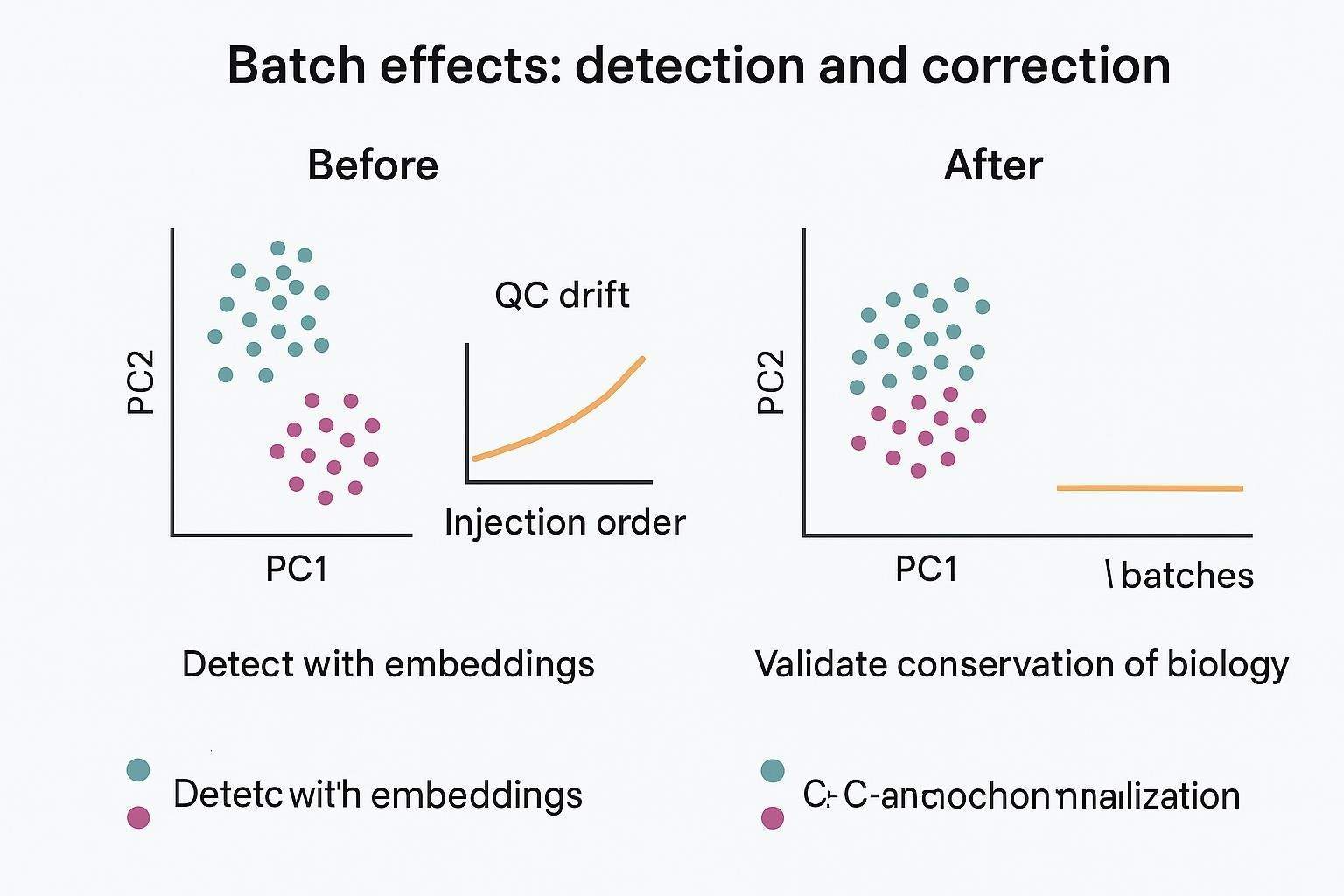
- Visual diagnostics: PCA/UMAP colored by batch vs biology; look for batch-dominated separation.
- Quantitative diagnostics: batch separation or mixing scores; QC drift summaries; variance partitioning (e.g., PVCA) to quantify contributions from batch vs biology. Guidance on planning and assessment is discussed in Genome Biology's 2024 review of batch effects.
- Identify sources: extraction batch vs instrument run vs operator vs plate effects.
Correct per modality before integration
- Conservative correction sequence
- Normalize within each modality (anchor to QCs/controls) before batch adjustment. QC-based drift correction methods such as robust LOESS (QC-RLSC) are widely applied; see Analytical Chemistry 2024 notes on QC-anchored drift correction for contemporary implementation context.
- Apply batch adjustment appropriate to the data (e.g., ComBat, limma's removeBatchEffect; ratio-based scaling where justified).
- Design prerequisites
- Correction fails when biology is confounded with batch.
- Ensure minimum mixing: every batch includes multiple biological groups/timepoints.
Validate biological conservation and avoid overcorrection
- Post-correction checks
- Replicate agreement improves; QC drift signatures reduce.
- Known/expected biology remains plausible.
- Red flags
- True group differences collapse uniformly.
- Pathway-level patterns flatten across contrasts.
- Cross-omics alignment becomes implausibly "perfect."
Spurious correlations: reduce false links
Feature selection, sparsity, and multiple testing
- Why false links explode: high dimensionality, multiple comparisons, redundant features.
- Practical controls
- Pre-filter low-quality/unstable features (e.g., high QC CVs, poor detection frequency).
- Use sparsity/stability selection when building networks/modules.
- Correct for multiple testing; report effect sizes and uncertainty, not just p-values.
Confounding control and causal awareness
- Common confounders: batch, time, diet/handling, cell density, extraction timing.
- Controls that reduce false associations
- Adjust for confounders (fixed effects; mixed models for repeated measures).
- Stratify by batch/timepoint when warranted.
- Include negative controls or placebo-association checks.
Integration choices to curb spurious associations
- Prefer robust levels when appropriate
- Pathway/module-level integration often improves interpretability and stability.
- Use conditional/partial association methods with explicit assumptions.
- Stress-test associations
- Bootstrap stability of edges/modules.
- Holdout validation (subject-level for longitudinal designs).
- Replication across batches/cohorts when possible.
Overfitting and evaluation governance
Leakage-free preprocessing and nested cross-validation
- Where leakage occurs
- Normalization/batch correction using all samples before splitting.
- Feature selection informed by the full dataset.
- Longitudinal leakage (the same subject's timepoints in train and test).
- Governance rules
- Split first; fit all preprocessing within training folds only.
- Use nested cross-validation for hyperparameter tuning.
- Keep a final untouched test set when feasible.
Regularization, parsimony, and robust baselines
- Prefer simpler baselines before complex models
- Mixed-effects models for trajectories.
- Pathway-level scoring plus linear models.
- Regularization strategies
- Penalized models, early stopping, and limited feature sets.
- Stability checks
- Confirm that top features and directions persist across resamples.
External validation, calibration, and transparent reporting
- Validate on independent batches/cohorts when available; report calibration and uncertainty, not just accuracy.
- Provide model cards: inputs, preprocessing, parameters, performance across folds, and failure cases. For context on common evaluation pitfalls in biomedicine, see a recent systematic review of ML bias in health data (2024) discussed within the broader literature.
Prevention checklist (printable) — your multi-omics pitfalls checklist
Before data generation
- Hypothesis and primary contrasts defined.
- Batch balancing and randomization plan documented.
- QC material plan: pooled QCs, blanks, anchor samples, replicate design.
- Metadata minimum set defined and captured consistently.
During generation
- QC insertion frequency adhered to (document cadence and acceptance ranges).
- Run logs maintained (events, deviations, instrument notes).
- Early-warning monitoring: drift, ID rates, missingness trends.
After generation (analysis)
- Missingness strategy applied with sensitivity checks.
- Batch correction validated for conservation of biology.
- Integration method assumptions documented and tested.
- Leakage-proof evaluation plan executed.
Troubleshooting playbooks (fast "if-then" actions)
If missingness spikes in one batch
- Check QC drift, blanks, instrument logs, extraction events.
- Reprocess peak picking/ID with consistent parameters.
- Consider rerun/re-extraction of the affected batch if QC confirms failure.
If embeddings separate by batch
- Confirm whether biology is confounded with batch; fix design if so.
- Apply conservative within-modality normalization first.
- Re-check using pathway/module summaries before deeper integration.
If networks don't replicate
- Re-test with confounder adjustment and stability selection.
- Report module-level results instead of single-edge claims.
- Require holdout/replication before committing to validation experiments.
If predictive performance collapses on holdout
- Audit leakage points; enforce subject-level splits for longitudinal data.
- Simplify the model; re-run nested CV; evaluate calibration.
- Report uncertainty and failure cases transparently.
Reporting checklist and deliverables for reviewers and editors
- Sample manifest reconciliation across modalities (IDs, missing samples, exclusions).
- QC summary package: drift plots, ID/QC metrics, missingness heatmaps, exclusion/rerun log.
- Preprocessing and correction details: parameters, software versions, decision rationale.
- Sensitivity analysis summary (missingness, correction variants, robustness).
- Integration method statement: assumptions, diagnostics, stability checks.
- Reproducibility bundle: data dictionary, metadata schema, scripts/notebooks, provenance log. For a walkthrough-style context on data analysis deliverables, see Creative Proteomics' metabolomics data analysis overview.
Conclusion
Priority prevention actions in this multi-omics pitfalls checklist
- Balanced design with rigorous QC logging.
- Mechanism-aware missingness handling with sensitivity checks.
- Conservative, QC-anchored batch correction validated for biological conservation.
- Stability and replication checks to avoid spurious links.
- Leakage-proof evaluation with nested CV and an untouched test set when feasible.
Common red flags and quick responses
- Batch-dominated embeddings → verify mixing; normalize within modality; reassess with pathway summaries.
- "Too perfect" networks → add confounders; test stability; require replication.
- Holdout collapse → audit leakage; simplify; recalibrate; report uncertainty.
Have a project in mind? Share your design, modalities, and constraints to receive a structured risk audit and mitigation plan tailored to your study.
References
- MSI Level 1 reporting and evidence trails: Metabolomics Standards Initiative (Sumner et al., 2007) .
- Batch-effect planning, detection, and correction: Genome Biology review (Yu et al., 2024) .
- Missing data mechanisms and strategy: Frontiers in AI review (2023) .
- Proteomics reporting, repositories, and PSI formats: PRIDE database resources (Nucleic Acids Research, 2022) .
- QC-anchored drift correction in practice: Analytical Chemistry perspective (2024) .

 Contact Us