

Confounders in Multi-omics: Managing Medication, Diet, and Circadian Rhythms
Submit Your InquiryThis resource focuses on research study design, metadata capture, QC safeguards, and analysis strategies.
Key takeaways
- Treat confounders as design variables, not post-hoc nuisances: standardize what you can, record the rest, and pre-specify how you will model it.
- Prioritize Tier 1 items first (sampling time, feeding state, major handling deviations); these can fully mimic biological group effects across omics.
- Minimal, consistent metadata beats incomplete detail: capture timing windows and recent changes for medication, feeding status and last intake time, and exact collection clock-time.
- QC flags tied to handling and exposure windows catch problems early and guide sensitivity analyses.
- Report confounder handling with a simple register: what was standardized, recorded, modeled, and how robustness was demonstrated.
Why this matters
- Confounders are a leading cause of non-reproducible findings, contradictory cross-omics results, and avoidable rework.
- In multi-omics, a confounder can propagate across layers and appear as a convincing "mechanism" unless it's captured, controlled, or modeled. Put plainly: if morning-only cases are compared to afternoon-only controls, you may be measuring clocks, not biology.
- This guide provides a practical approach to:
- identify high-impact confounders,
- define what to standardize vs record,
- add QC flags that catch problems early,
- report confounder handling in a reviewer-friendly way.
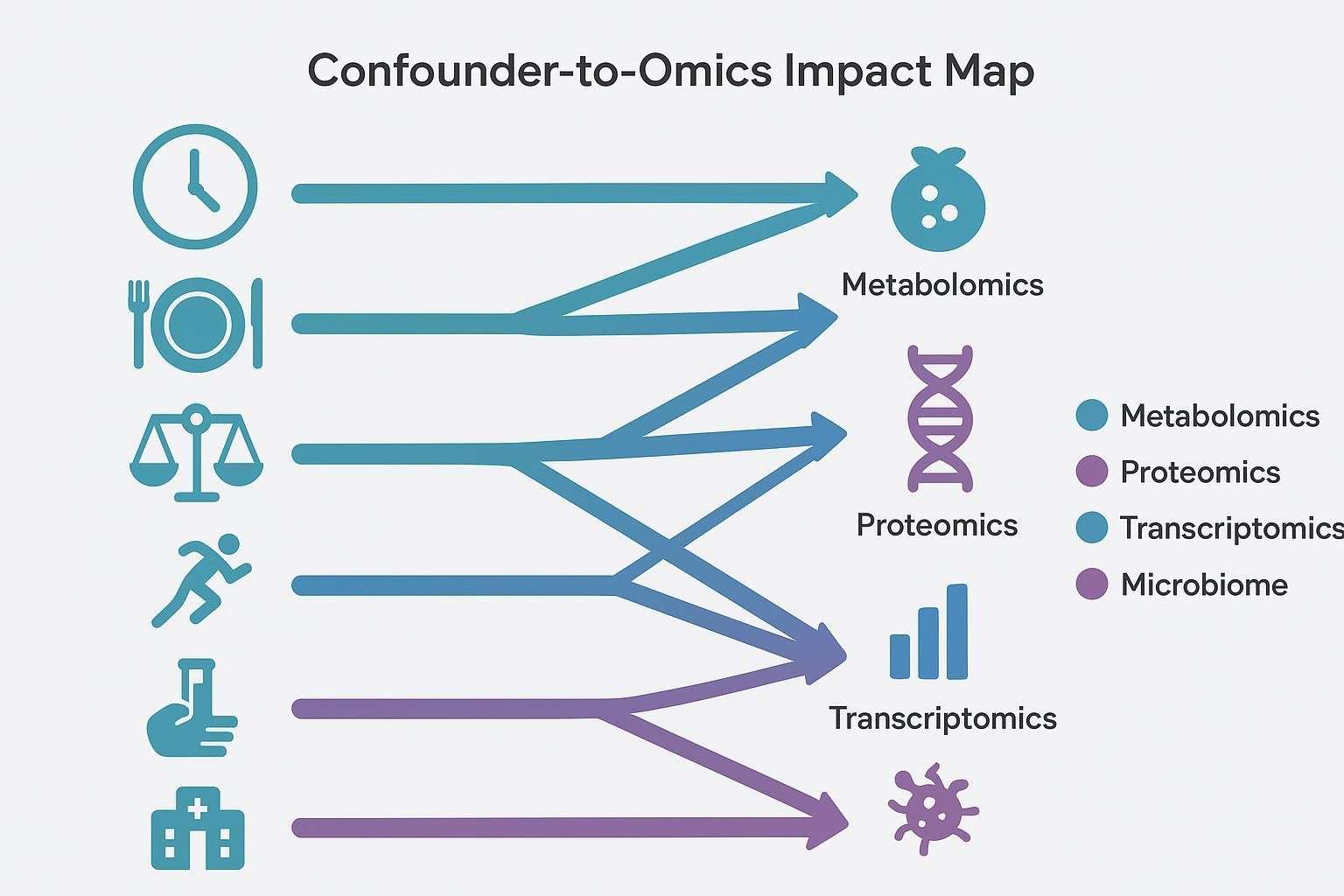
Common scenarios and the confounders most likely to dominate
- Intervention / time-course studies: timing consistency, diet windows, recent exposure changes, batch/run drift
- Human cohort research studies: exposure patterns, diet variability, circadian timing, site/operator differences
- Microbiome + metabolomics projects: diet, antibiotic exposure history, stool handling and stabilization, compositional artifacts
- Blood/plasma/serum workflows: hemolysis, processing delays, feeding state, sampling time
- Multi-site collection: site SOP differences, shipping conditions, operator and equipment variability
What counts as a confounder?
- Any factor that changes omics readouts independently of your study question, and is unevenly distributed across:
- groups (case vs control),
- timepoints (longitudinal),
- sites/operators,
- batches/runs.
A risk-based approach: standardize, record, model
Prioritization tiers
Below is a compact tiering to focus effort where it matters most.
| Tier | What to do | Typical examples | Why it's high impact |
|---|---|---|---|
| Tier 1 | Standardize where possible; else record precisely and pre-specify modeling | Sampling clock-time, feeding/fasted state, major handling deviations (hemolysis, processing delays) | Can fully mimic group effects and flip conclusions |
| Tier 2 | Record consistently; model as covariates or stratify; add sensitivity analyses | Diet variability/patterns, broad medication exposure classes, site/operator differences | Often explains substantial variance but harder to align perfectly |
| Tier 3 | Capture when feasible to strengthen robustness checks | Sleep quality proxy, recent travel, minor supplements | Improves sensitivity analyses; lower ROI if resources are tight |
A simple decision rule
If a factor differs systematically across groups or timepoints, plan to standardize it or record it for modeling, and define how it will be handled before analysis. Think of it as pre-registering your confounder plan.
Medication exposure as a confounder (capture and mitigation without overreach)
Why medication exposure can strongly shape multi-omics signals
- Direct biochemical pathway modulation (often evident in metabolomics) and class-dependent effects that can confound disease associations; recent cohort work shows the need for explicit deconfounding of drug classes to avoid biased links between metabolites and phenotypes, as discussed in the 2023 analysis of drug–metabolite associations in heart failure cohorts in the United States and Europe by Hua and colleagues in the open-access article Microbial metabolites in chronic heart failure (Hua 2023, open access).
- Indirect effects via inflammation, liver enzyme activity, and microbiome perturbations; time-dependent exposure effects are seen in temporal proteomics studies like the 2021 nicotine exposure profiling in human cells by Navarrete-Perea and colleagues in Molecular Omics (Navarrete-Perea 2021).
- Polypharmacy and adherence variability can create large baseline spread and group imbalance if not balanced or modeled.
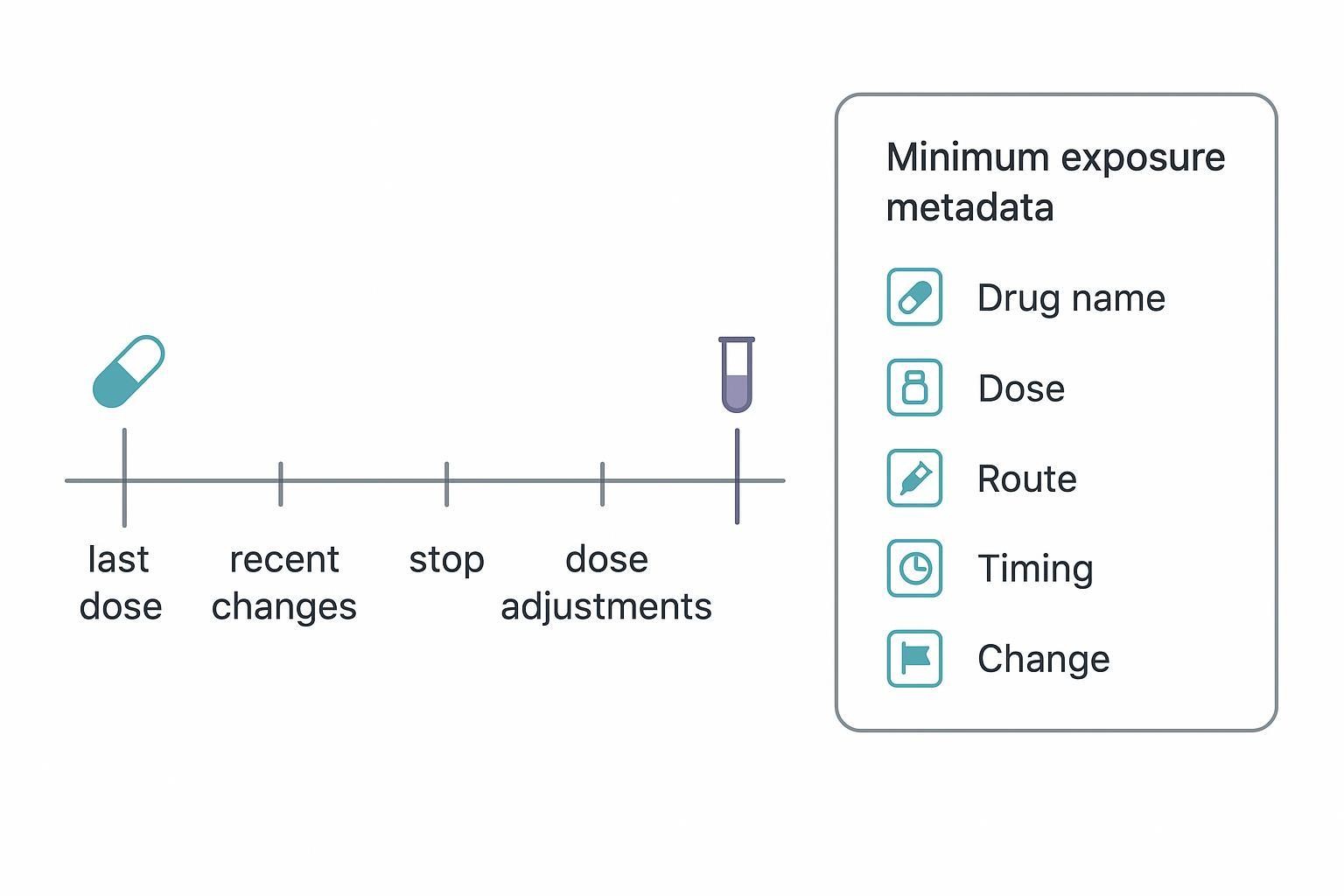
What to record (minimum viable metadata)
Capture the smallest set that preserves timing context and exposure class.
| Field | Rationale |
|---|---|
| Drug generic name and class | Enables class-level modeling when agent details are incomplete |
| Route and (if feasible) dose/regimen | Helps interpret magnitude and timing of expected effects |
| Hours since last dose at sampling | Anchors acute exposure windows for analysis |
| Recent change flag (start/stop/dose) within a defined window | Identifies unstable windows for sensitivity analyses |
| Antibiotic exposure within X weeks (Y/N) | Captures lingering microbiome/metabolite shifts |
| Notes/uncertain | Prefer "unknown" over guessed values |
Mitigation options in study design (choose what's feasible)
- Balancing: avoid concentrating high-impact exposure patterns in one group or one site.
- Sampling consistency: where feasible, sample in comparable windows relative to typical exposure timing.
- Pre-specified analysis flags: define exposure classes/windows that trigger stratified analyses, covariate adjustment, or sensitivity analyses (rather than ad hoc decisions after seeing results). The deconfounding approach for drug classes described by Hua et al. (2023) is a useful template.
Neutral example — targeted quantification in exposure-aware designs: In studies where a subset of exposure-sensitive metabolites must be compared across groups despite mixed medication classes, a targeted LC–MS/MS panel with isotope-labeled internal standards and calibration curves can support stable, cross-batch quantification suitable for covariate-adjusted models and sensitivity checks. For instance, Creative Proteomics' targeted metabolomics service provides internal-standard–based quantification and QC documentation that can be used to support confounder-aware workflows. Use such panels to quantify key readouts consistently, then model exposure-class covariates and test robustness with and without flagged windows.
QC flags and diagnostics
- Inspect embeddings (e.g., UMAP) colored by exposure categories and recent changes; clustering suggests exposure-dominant variance.
- Run sensitivity checks:
- exclude flagged exposure windows,
- adjust for exposure class categories,
- compare effect direction and pathway-level stability before and after adjustment, as deconfounding studies recommend (Hua 2023).
Diet and feeding state (standardize what you can, model what you can't)
Why diet-related variability is hard to average out
- Short-term effects (hours): macronutrient-driven shifts, bile acid dynamics, energy metabolites that can move rapidly with intake.
- Medium-term effects (days): microbiome functional changes and metabolite production.
- Long-term patterns (weeks): baseline metabolic setpoints vary across individuals and dietary patterns.
Practical standardization options (pick one and apply consistently)
- Fasted sampling window: define and communicate a consistent fasting interval.
- Standardized pre-sample meal: use when fasting is impractical.
- Structured dietary logging: when neither fasting nor standardized meals are feasible.
Minimal diet metadata (high impact, low burden)
| Field | Notes |
|---|---|
| Fasted vs fed at sampling | Primary stratification/covariate field |
| Last intake time (HH:MM) | Model as an interval since intake |
| Alcohol/caffeine window (predefined hours) | Capture acute stimulatory/depressant effects |
| Major diet pattern/restrictions | e.g., ketogenic, vegetarian, recent major change |
| Recent antibiotic exposure history | Important for microbiome-linked endpoints |
Evidence from pre-analytical and dietary impact overviews underscores how standardized windows and simple intake metadata reduce bias in serum and plasma metabolomics (González‑Domínguez 2020; Thachil 2024).
Analysis mitigations
- Include fasted/fed status and last intake interval as covariates when recorded.
- Stratify analyses if mixed feeding states exist.
- Sensitivity analyses excluding extreme deviations around sampling.
Circadian timing and time-of-day effects (design it in, don't "fix it later")
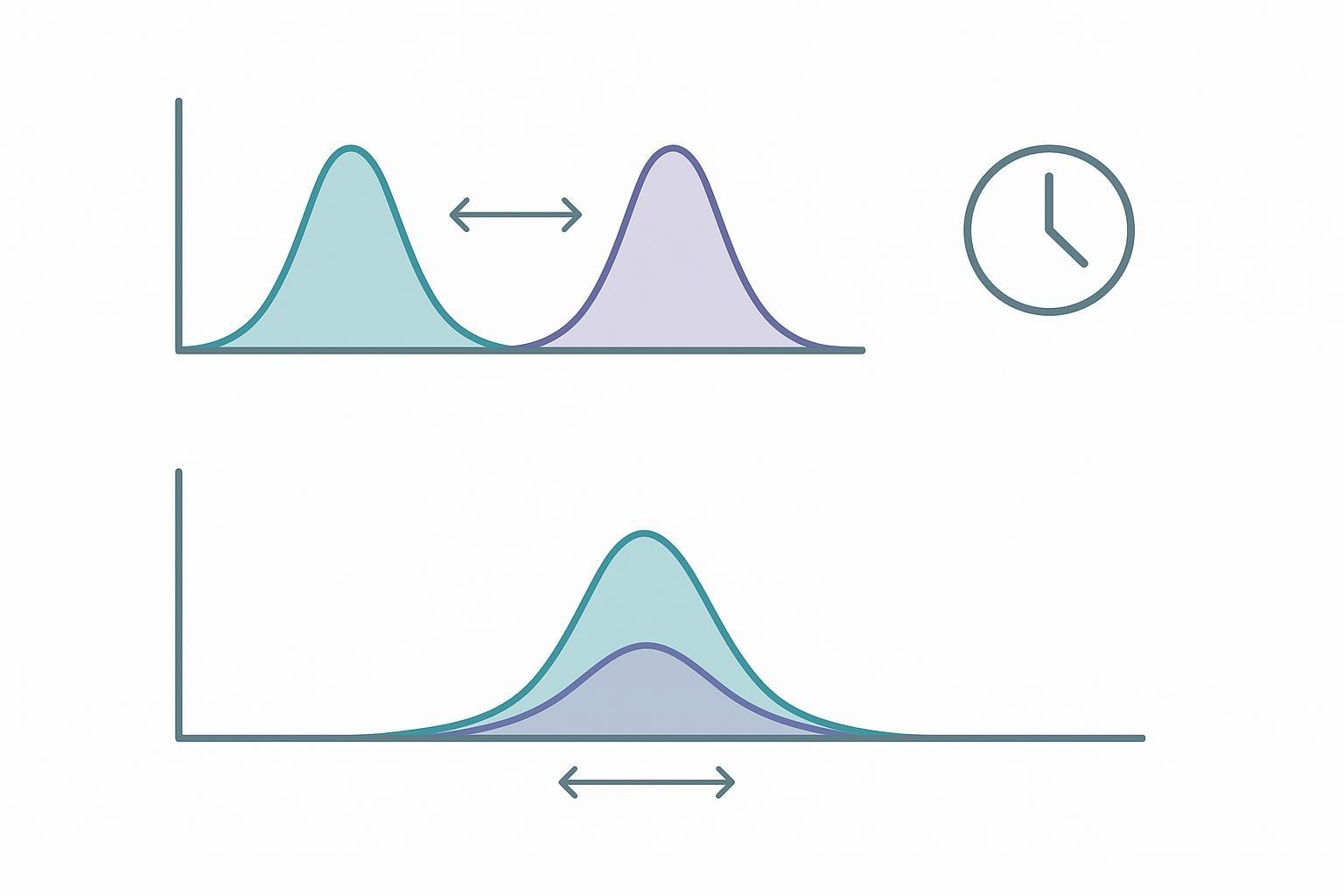
What circadian confounding looks like
- Samples cluster by sampling time rather than biology.
- Group effects flip direction across time windows.
- Strong rhythmic pathways dominate differential signals.
Best practices to reduce time-of-day confounding
- Define a sampling clock-time window and keep it consistent across groups and visits.
- In longitudinal studies, keep each subject's sampling times as consistent as practical across visits.
- Record exact collection time for every sample; treat it as first-class metadata. Reviews in metabolism research explicitly recommend this design-first approach to improve reproducibility (Deota 2025).
Modeling strategies (when perfect alignment isn't possible)
- Include time-of-day as categorical bins (e.g., morning/afternoon) or continuous time with smooth terms; cosinor/GAM approaches are common in circadian analysis.
- Test group × time-of-day interactions if the design suggests they may exist.
Additional confounders worth screening (fast but actionable)
- Exercise and acute stress: can shift metabolic and inflammatory signals.
- Smoking/vaping and alcohol: introduce both acute and chronic signatures.
- Infection/inflammation state: broad effects across multiple layers.
- Hydration status (especially urine): affects concentration and variability.
- Hormonal cycle status (when relevant): can introduce periodic variance.
- Site/operator differences: SOP drift, equipment differences, shipping variability; modern reviews emphasize QC-anchored correction and SOP alignment for robustness (Märtens 2023; Yu 2023).
Pre-analytical confounders: handling artifacts that masquerade as biology
- Hemolysis and blood processing delays.
- Freeze–thaw events and storage temperature excursions.
- Shipping variability and inconsistent stabilization timing.
- Stool handling variability (if included): stabilizer use, time-to-freeze, thaw events.
What to log every time (minimum handling metadata)
| Field | Notes |
|---|---|
| Collection-to-stabilization/freezing time | Pre-centrifugation target; slower changes at 4°C vs room temperature |
| Centrifugation parameters | RPM/g × minutes × temperature |
| Storage temperature and duration | Track per aliquot |
| Freeze–thaw count | Minimize; some analytes are sensitive |
| Shipping conditions | Dry ice vs cold packs; note exceptions |
| Hemolysis score | Define thresholds for exclusion or sensitivity |
Quantitative guidance from pre-analytical studies shows rapid changes at room temperature for metabolites like lactate and hypoxanthine and broad impacts of hemolysis, underscoring the need for both logging and QC flags (Gegner 2022; Searfoss 2022; Thachil 2024).
A practical mitigation playbook (design → operations → analysis)
Design-stage checklist
- List the top expected confounders for your question (start with exposure/diet/circadian).
- Decide what will be: standardized (Tier 1), recorded for modeling (Tier 2), optionally captured (Tier 3).
- Define sampling windows and handling targets.
- Balance key confounders across groups, sites, and batches.
Operations-stage checklist
- Use a concise "minimum metadata" form that field teams can complete reliably.
- Log deviations explicitly (time window missed, handling delay, unusual events).
- Keep SOPs consistent across sites/operators and document changes.
Analysis-stage checklist
- Confounder screening:
- embeddings colored by confounders,
- variance partitioning (where feasible),
- QC flags tied to handling metadata.
- Modeling plan:
- covariate adjustment,
- stratified analyses,
- sensitivity analyses.
- Stability checks:
- feature-level stability,
- pathway/module-level stability,
- effect direction consistency.
QC flag decoder (use as a guide, not a straitjacket):
| Flag | Typical trigger | Default action |
|---|---|---|
| time_mismatch | Out-of-window clock-time vs protocol | Model time-of-day; consider sensitivity exclusion |
| fed_state_mixed | Mixed fasted/fed within a contrast | Stratify or adjust; exclude extremes in sensitivity |
| recent_exposure_change | Start/stop/dose change within window | Sensitivity exclusion; report robustness |
| hemolysis_high | Above lab-defined threshold | Exclude or analyze separately; document impact |
| processing_delay_high | Exceeds pre-centrifugation target | Adjust if possible; sensitivity exclusion if severe |
Reporting package
- A confounder table: what was standardized, recorded, and modeled.
- A metadata dictionary and SOP summary (including handling logs).
- QC flags, exclusions, and rationale (with impact summary).
- Sensitivity analysis summary demonstrating robustness.
- Reusable templates (recommended): minimal metadata template, deviation log template, confounder risk register.
Red flags and immediate remediation steps
- Sampling time differs systematically across groups or sites.
- Feeding state is mixed without reliable recording.
- Recent high-impact exposure changes cluster in one group/timepoint.
- Handling deviations are frequent but not logged.
- Results change drastically when adjusting for a single confounder (requires deeper review). When that happens, perform variance partitioning and check for interactions; modern overviews of batch/site correction and variance modeling provide practical options (Kim 2021; Yu 2024).
Conclusion
Confounders are manageable when treated as design variables, not afterthoughts. Highest-ROI actions: align sampling windows, standardize feeding state or log it consistently, capture exposure timing and recent changes, and log handling deviations with QC flags. Next step: apply the checklists and templates here to your protocol before sample collection and pre-register your confounder plan.
FAQs
What are the highest-priority confounders in multi-omics designs?
Sampling clock-time, feeding/fasted state, and major pre-analytical deviations (hemolysis, processing delays). These can fully mimic biological group effects if unaddressed.
How much metadata is "enough" to control medication exposure?
Capture drug class, hours since last dose, and recent change flags. Class-level covariates plus sensitivity exclusions for recent-change windows cover most exposure confounding seen in cohort analyses.
What if I can't standardize fasting across all participants?
Record fasted/fed and last intake time. Then stratify or adjust for these fields and run sensitivity analyses excluding extremes around the sampling window.
How do I handle time-of-day when multi-site logistics vary?
Define site-specific windows that overlap in clock-time, record exact collection times, and model time-of-day (bins or continuous with smoothers). Check for group × time interactions.
Which QC flags should I implement first?
Start with time_mismatch, fed_state_mixed, recent_exposure_change, hemolysis_high, and processing_delay_high. Tie each flag to a default analysis action and document exceptions.
What analysis strategies reduce confounder bias without overfitting?
Use parsimonious covariate adjustment for Tier 1–2 factors, variance partitioning to assess contributions, and pre-specified sensitivity analyses. Avoid ad hoc post-hoc decisions.
References
- González‑Domínguez R, et al. Recommendations and Best Practices for Standardizing the Pre-Analytical Processing of Blood Samples for Metabolomics (2020). Accessible at the National Library of Medicine: https://pmc.ncbi.nlm.nih.gov/articles/PMC7344701/
- Gegner HM, et al. Pre-analytical processing of plasma and serum samples for combined proteome and metabolome analysis (2022). PubMed record: https://pubmed.ncbi.nlm.nih.gov/36605986/
- Searfoss R, et al. Impact of hemolysis on multi-OMIC pancreatic biomarker measurements (2022). Open-access article: https://pmc.ncbi.nlm.nih.gov/articles/PMC8786830/
- Thachil A, et al. An Overview of Pre-Analytical Factors Impacting Omics Analyses (2024). Open-access review: https://pmc.ncbi.nlm.nih.gov/articles/PMC11433674/
- McClain KM, et al. Preanalytical Sample Handling Conditions and Their Effects (2021). Journal link: https://academic.oup.com/aje/article/190/3/459/5909774
- Märtens A, et al. Instrumental Drift in Untargeted Metabolomics (2023). Methods overview: https://pmc.ncbi.nlm.nih.gov/articles/PMC10222478/
- Kim T, et al. A hierarchical approach to removal of unwanted variation for MS metabolomics (2021). Article: https://pmc.ncbi.nlm.nih.gov/articles/PMC8371158/
- Yu Y, et al. Correcting batch effects in large-scale multiomics studies (2023). Article: https://pmc.ncbi.nlm.nih.gov/articles/PMC10483871/
- Yu Y, et al. Assessing and mitigating batch effects in large-scale omics (2024). Methods perspective: https://pmc.ncbi.nlm.nih.gov/articles/PMC11447944/
- Daskalakis NP, et al. Systems biology dissection of PTSD and MDD across brain regions (2024). Application of integrated variance modeling: https://pmc.ncbi.nlm.nih.gov/articles/PMC11203158/
- Hua S, et al. Microbial metabolites in chronic heart failure — drug deconfounding across cohorts (2023). Open access: https://pmc.ncbi.nlm.nih.gov/articles/PMC10245034/
- Navarrete-Perea J, et al. Temporal proteomic changes induced by nicotine in human cells (2021). Open access: https://pmc.ncbi.nlm.nih.gov/articles/PMC8199844/
- Deota S, et al. Accounting for Time-of-day Effects to Improve Reproducibility and Translation of Metabolism Research (2025). Review: https://pmc.ncbi.nlm.nih.gov/articles/PMC12584160/

 Contact Us