
Multi-omics Data Integration Methods: How to Choose Joint Analysis vs. Network vs. Pathway vs. ML (With a Selection Table)
Submit Your InquiryModern studies often collect transcriptomics, proteomics, metabolomics, and more—yet choosing among multi-omics data integration methods can feel like "method chasing." This guide offers a decision-first way to match your scientific goal, study design, and data constraints to a method family you can defend in manuscripts and review meetings.
Key takeaways
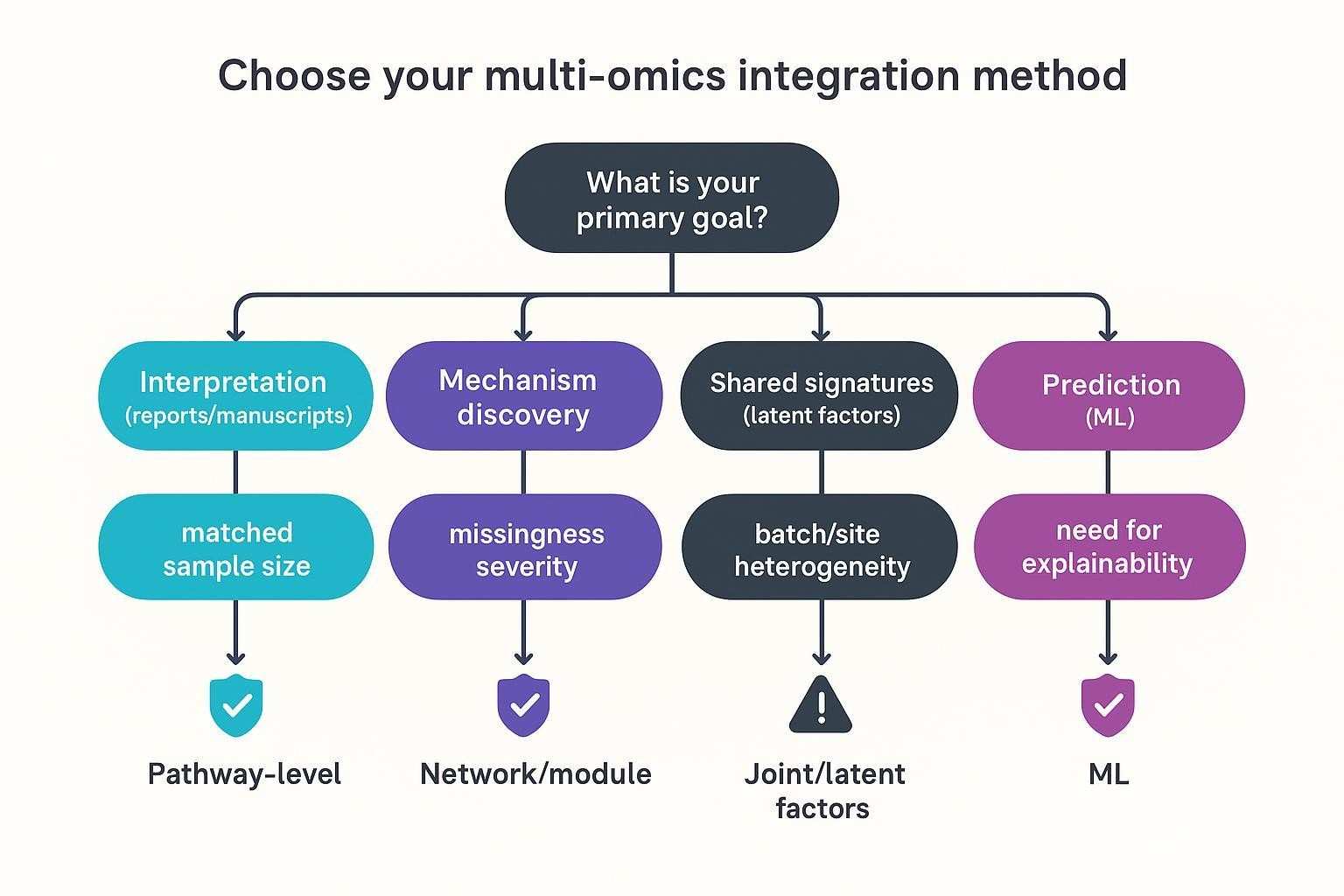
- Start with the decision you need to make. Pick from four families—pathway-level, network/module, joint/latent factors, and ML—based on goal, constraints, and prior knowledge.
- Make data integration-ready before selection: pairing/traceability, scale comparability, missingness taxonomy, batch checks, and annotation limits (especially metabolite IDs).
- Use the selection table and flowchart to align stakeholders and avoid "method chasing."
- Apply guardrails: control confounders, test stability and sensitivity, and prevent leakage in predictive pipelines.
The integration hierarchy: from linking to modeling
Integration goals are not equivalent; the complexity of your approach should match the decision you need to make.
- Linking compares results across layers without forcing a single joint model. Example: differential genes, proteins, and metabolites funneled to pathway analysis, then contrasted for concordance.
- Summarizing elevates features to pathway/module/factor-level representations. You integrate at a higher abstraction for robustness and interpretability.
- Modeling builds joint models and/or predictive algorithms with strict validation. Use only when you can support the burden of proof.
The three selection questions that decide everything
First, clarify your goal: Are you optimizing for manuscript-ready interpretation, generating mechanism hypotheses, extracting shared signatures for stratification, or delivering validated prediction? Second, inventory constraints: matched sample size, severity and mechanism of missingness, and batch/site heterogeneity. Third, assess prior knowledge: pathway curation depth and identification confidence (especially for metabolites). The intersection of these answers points reliably to one of the four families below.
Selection table: compare core integration strategies
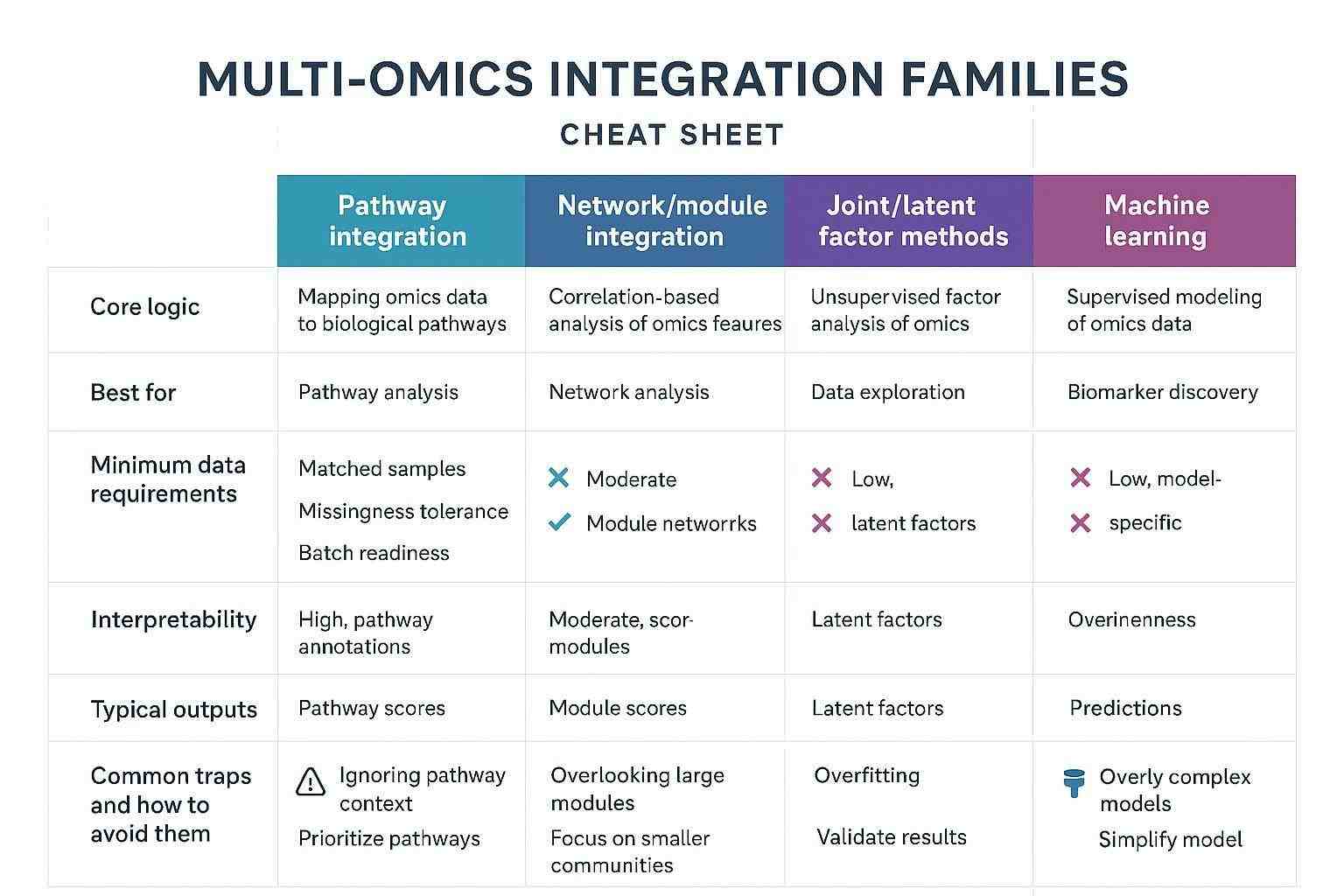
Below is a compact, printable table summarizing the four families. Use it to align the team before deep-diving into tools.
| Method family | Core logic | Best for | Minimum data requirements (matched samples, missingness tolerance, batch readiness) | Interpretability | Typical outputs (tables/figures) | Common traps and how to avoid them |
|---|---|---|---|---|---|---|
| Pathway integration | Aggregate features into pathway scores/enrichment per omic, then compare/concord pathways across layers | Reports/manuscripts needing robust biology-first summaries | Works with tens per group (≈≥20). Tolerates modality-specific missingness. Batch must be checked and plausibly corrected | High | Pathway score tables; cross-layer concordance; ranked pathways with direction/evidence columns | Reference dependence; ambiguous metabolite mapping; "pathway inflation" if batch remains → cross-validate databases, label ID confidence, run sensitivity analyses |
| Network/module integration | Build inter/intra-layer networks to discover modules that co-vary and associate with phenotypes | Mechanism hypotheses and module/hub candidates | Prefer ≥50–100 matched samples; moderate missingness; confounders modeled | Medium–High (module-level) | Module membership lists; hub candidates; network figures; stability metrics | Spurious edges from confounding/multiple testing; unstable modules with small N → adjust for covariates, control FDR, use resampling/holdouts |
| Joint/latent factor integration | Decompose multi-omics matrices to shared/omic-specific factors yielding sample scores and loadings | Shared signatures/embeddings for clustering/stratification | Prefer ≥30–50 matched samples; consistent scaling; address block-wise missingness | Medium (factor-level) | Factor scores; loadings; variance explained; cross-omics embeddings | Scaling sensitivity; factors capture batch/site if confounded → run sensitivity to scaling, include batch terms or regress out, verify biology via enrichment |
| ML (prediction-oriented) | Supervised models across omics to predict outcomes with strict validation and error analysis | Prediction under leakage-proof design | Depends on task; prioritize strict split strategy; preprocess inside CV; nested tuning | Low–Medium (requires model cards and feature stability) | Performance with uncertainty; calibration; error analysis; stable feature importance | Leakage, data hunger, overfitting → subject/site/time-aware splits, nested CV, in-fold preprocessing, calibration and failure-mode reporting |
Prerequisites: make the data integration-ready before choosing methods
Pairing and traceability
Create a single source of truth—one manifest joining sample IDs across modalities and timepoints, with explicit flags for modality-specific dropouts. For longitudinal designs, include visit indices and collection windows. This traceability underpins later split strategies and prevents leakage.
Scale and comparability (the "scale difference" problem)
Decide the level of integration: raw features, pathway/module summaries, or latent factors. Then standardize within and across omics accordingly (e.g., log transform where appropriate, z-score, Pareto scaling). Choose transformations that align with your interpretability needs; for latent-factor models, consistent scaling across blocks prevents one data type from dominating.
Missingness and detection behavior
Characterize missingness per modality: random (MCAR), covariate-linked (MAR), or abundance/left-censored (MNAR). Set filtering thresholds up front and avoid heavy-handed imputation that invents signal—particularly in metabolomics where MNAR is common. Plan sensitivity checks to ensure key findings are not imputation-driven.
Batch effects and drift
Quantify whether batch or site dominates early components via PCA/UMAP and variance partitioning. If correction is warranted and not wholly confounded with biology, apply design-aware methods and then re-validate that plausible biology re-emerges. Always check that QC samples indicate drift control before integrating.
Annotation and mapping limits (especially for metabolomics)
State identification confidence (e.g., MSI levels) and acknowledge many-to-many mappings across genes/proteins/metabolites. Report pathway evidence with directionality and ID confidence columns, and consider alternate databases to test robustness.
Pathway-level integration (the "biology-first" approach)
When to use it
Choose pathway-level integration when you need robust, explainable results across omics layers and your sample size is moderate. It is well suited to scenarios with different missingness behaviors across modalities and reviewers who prefer pathway narratives.
What you typically deliver
Expect pathway score/enrichment tables for each layer, a cross-layer concordance summary, and a ranked list of pathways with directionality and evidence columns (including ID confidence and database source). Figures usually show side-by-side pathway shifts across omes and a compact concordance heatmap.
Assumptions and pitfalls
Your conclusions depend on the quality and coverage of reference databases. Feature-to-pathway mapping, particularly for metabolites and isomers, is ambiguous and should be labeled. Residual batch effects can inflate pathway hits. Mitigate by cross-validating with multiple pathway resources and running sensitivity analyses that exclude lower-confidence IDs.
Common tool examples (optional context)
Representative workflows include pathway scoring and joint pathway analysis frameworks; choose tools that support evidence columns and multi-database queries.
Network and module-based integration (the "topology-first" approach)
When to use it
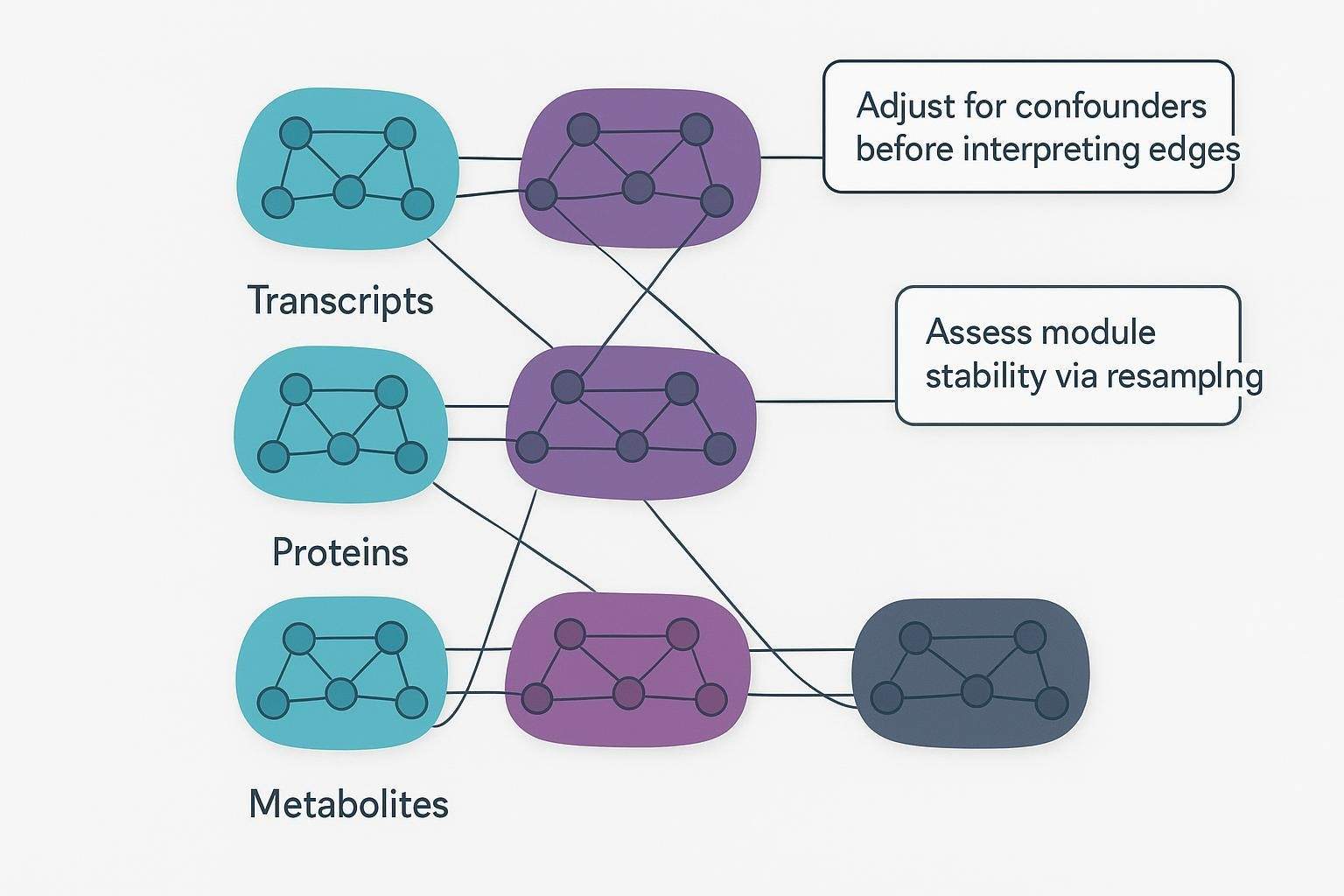
Pick network/module approaches when you aim to discover co-varying programs that suggest mechanisms and candidate hubs—provided you can run robustness testing (resampling/holdouts) and adjust for confounders.
What you typically deliver
Deliver module membership tables, hub candidates, module-to-phenotype associations, and network figures annotated with stability metrics. Include covariate-adjusted associations to separate biology from nuisance structure.
Assumptions and pitfalls
Edges can be driven by confounders or multiple testing artifacts, and modules may be unstable with small N or high missingness. Plan bootstrap/permutation stability checks and control FDR where edge inference is statistical. Treat site/batch as covariates or adjust upstream before interpreting edges.
Common tool examples (optional context)
WGCNA-like module discovery for each omic, cross-omic correlation networks, and sample-fusion approaches (e.g., similarity network fusion) that integrate at the subject level.
Joint analysis / latent factor integration (the "statistical-first" approach)
When to use it
Use joint/latent factor models when you want shared axes of variation across modalities and sample-level scores for clustering, stratification, or trajectory summaries. Accept reduced single-feature interpretability in exchange for compact signatures.
What you typically deliver
Provide latent factor scores per sample, per-omic contributions/loadings, variance explained, and low-dimensional embeddings that show group or timepoint separation. Enrich high-loading features post hoc to connect factors back to pathways.
Assumptions and pitfalls
These methods are sensitive to scaling decisions and can capture batch/site structure if the design is confounded. Plan scaling sensitivity analyses, consider including batch terms or regressing batch before factorization when appropriate, and check biological plausibility via enrichment of high-loading features.
Common tool examples (optional context)
Examples include O2PLS-style shared variation models and supervised integration like DIABLO; method choice should follow your goal and label availability.
Machine learning integration (prediction-oriented)
When it's appropriate
Choose ML when your primary deliverable is predictive performance under rigorous validation and error analysis. This often applies to risk stratification or prospective decision-support problems.
What you typically deliver
Report model performance with uncertainty, calibration quality, and error modes. Include stable feature-importance summaries with resampling or perturbation checks to demonstrate reliability.
Guardrails that must be in place
Match the split strategy to the design (e.g., subject-level splits for longitudinal, site-level for multi-site). Perform all preprocessing and feature selection inside cross-validation folds; use nested CV for tuning; and, when feasible, keep a final untouched test set. Report calibration (e.g., reliability curves) and failure modes, not just accuracy.
Method choice by study type
Cross-sectional cohorts
Start with pathway-level integration or joint latent factors for robust summaries. Use networks only if you can quantify stability and control confounders. Consider ML only when you have a strong validation plan and adequate matched samples.
Longitudinal/time-course designs
Treat time explicitly via mixed models, time-aware pathway scores, or trajectory summaries. Prevent leakage across timepoints of the same subject in predictive settings. Interpret cross-layer disagreement through plausible time-lag mechanisms before labeling it inconsistent.
Multi-site studies or heterogeneous sampling
Prioritize pathway/module summaries that are resilient to site effects. Require strong batch/site validation before deeper integration or ML; consider site-aware splits in predictive contexts.
To make consultation seamless when you need an external design review, you can explore the neutral option of Creative Proteomics multi-omics consulting once you have a draft manifest and QC summaries.
A practical workflow: from raw data to integration outputs
Move stepwise and document assumptions so reviewers can follow your logic:
- QC gate: verify drift control, characterize missingness, test for batch/site dominance, and confirm sample pairing.
- Within-modality results: run differential analyses and compute pathway summaries per omic; capture parameters and database versions.
- Integration selection: use the three decision questions and the selection table to choose a family; state the rationale.
- Robustness checks: run stability (resampling/holdouts), sensitivity to missingness thresholds and batch correction choices; for ML, perform nested CV with in-fold preprocessing.
- Reporting package: include assumptions, parameter tables, evidence columns (e.g., ID confidence), figures, and reproducibility notes (software versions, seeds, database releases).
Common pitfalls and how to prevent them
- Integrating before QC leads to batch becoming the "shared signal." Always pass the QC gate first.
- Treating correlation as mechanism without confounder control. Adjust and validate before causal language.
- Feature-level integration with weak IDs or ambiguous mapping. Elevate to pathway/module or clearly label evidence levels.
- Overcorrecting batch can flatten biology. Inspect post-correction variance and pathway plausibility.
- Leakage or unstable feature selection in ML. Enforce leakage-proof splits and report stability of importance.
- Reporting without assumptions, parameters, and stability evidence. Include a concise model or method card.
Deliverables: what "good outputs" look like for each method family
- Pathway: pathway score tables, cross-layer concordance summaries, interpretable figures with directionality and evidence columns.
- Network/module: module lists, hub candidates, stability metrics, and annotated network visualizations.
- Joint/factors: sample scores, loadings, embeddings, and variance explained, plus enrichment linking factors to biology.
- ML: a model card (splits/CV), performance with uncertainty and calibration, error analysis, and stable feature-importance summaries.
FAQ
Q: Which integration method is most interpretable for reports and manuscripts?
A: Pathway-level integration yields the most straightforward narrative and figures for reviewers. It summarizes across omics, tolerates different missingness behaviors, and supports evidence columns (directionality, ID confidence, database source) for auditability.
Q: When should I choose pathway-level integration over correlation networks?
A: Choose pathway-level when your priority is robust, manuscript-ready interpretation and sample size is moderate. Prefer networks when you can test stability (resampling/holdouts) and adjust for confounders to propose mechanistic modules.
Q: How can I tell my "integration" is actually batch effect?
A: If batch/site explains leading components or dominates clustering after minimal preprocessing, and correction flips or erases signals, you likely have batch-driven integration. Validate with variance partitioning, QC sample trends, and pathway plausibility checks pre/post correction.
Q: What makes network integration stable enough to trust?
A: Modules that recur across resamples, maintain associations after covariate adjustment, and survive multiple-testing correction are more trustworthy. Report selection frequencies and validate key edges or modules in holdouts when feasible.
Q: When is ML worth it, and how do I prevent leakage?
A: Use ML only when prediction is the primary outcome and you can enforce leakage-proof splits matched to the design (subject/site/time-aware), perform preprocessing inside folds, tune with nested CV, and report calibration/error analyses.
Q: How should I handle missing values across modalities before integration?
A: Diagnose mechanism (MCAR/MAR/MNAR), set modality-aware filtering, avoid heavy imputation under MNAR (common in metabolomics), and perform sensitivity checks to ensure conclusions are not imputation-driven.
References
- Baião AR, Godinez-Vidal AR, et al. A technical review of multi-omics data integration methods. Brief Bioinform. 2025;26(4):bbaf355. https://academic.oup.com/bib/article/26/4/bbaf355/8220754
- Sanches PHG, et al. Strategies for comprehensive multi-omics integrative data analysis. 2024. https://pmc.ncbi.nlm.nih.gov/articles/PMC11592251/
- Novoloaca A, et al. Comparative analysis of integrative classification methods for multi-omics. 2024. https://pmc.ncbi.nlm.nih.gov/articles/PMC11234228/
- Kumar R, et al. Network-based analyses of multiomics data in biomedicine. 2025. https://pmc.ncbi.nlm.nih.gov/articles/PMC12117783/
- Jiang W, et al. Network-based multi-omics integrative analysis methods in drug discovery. 2025. https://pmc.ncbi.nlm.nih.gov/articles/PMC11954193/
- Ebrahimi A, et al. sCIN: contrastive learning framework preventing data leakage. Brief Bioinform. 2025;26(4):bbaf411. https://academic.oup.com/bib/article/26/4/bbaf411/8241298
- Zhang J, et al. Deep learning–driven multi-omics analysis workflow. Brief Bioinform. 2025;26(4):bbaf440. https://academic.oup.com/bib/article/26/4/bbaf440/8242583
- Baena-Miret S, et al. A framework for block-wise missing data in multi-omics. PLoS ONE. 2024. https://pmc.ncbi.nlm.nih.gov/articles/PMC11265675/
- Krutkin DD, et al. To impute or not to impute in untargeted metabolomics. J Am Soc Mass Spectrom. 2025. https://pubs.acs.org/doi/10.1021/jasms.4c00434
- Frölich A, et al. Imputation in lipidomics datasets. Proteomics Clin Appl. 2024. https://analyticalsciencejournals.onlinelibrary.wiley.com/doi/10.1002/pmic.202300606
- Metz TO, et al. Introducing identification probability for metabolite IDs; MSI expansion. 2024. https://pubmed.ncbi.nlm.nih.gov/39131324/
- Wieder C., et al. Pathway analysis in metabolomics—pitfalls in ORA. PLoS Comput Biol. 2021. https://pmc.ncbi.nlm.nih.gov/articles/PMC8448349/

 Contact Us