
Multi-omics Deliverables Explained: What You Receive (Data, QC, Figures) and How to Use Them
Submit Your InquiryIf you're planning metabolomics within a multi-omics study, you can start from our metabolomics service overview.
What this guide clarifies
- Exactly what files, tables, and figures are typically delivered in a multi-omics project
- How to review deliverables quickly (what to check first, what "good" looks like)
- How to use outputs for publications, internal reports, and follow-up validation
- What to request up front to avoid rework and missing pieces
Key takeaways
- A complete multi-omics deliverables package spans eight folders: raw data, processed matrices, QC, statistics, integration, figures, metadata, and reproducibility. Each has a clear purpose and acceptance checks. For a practical reference, see our multi-omics service deliverables scope.
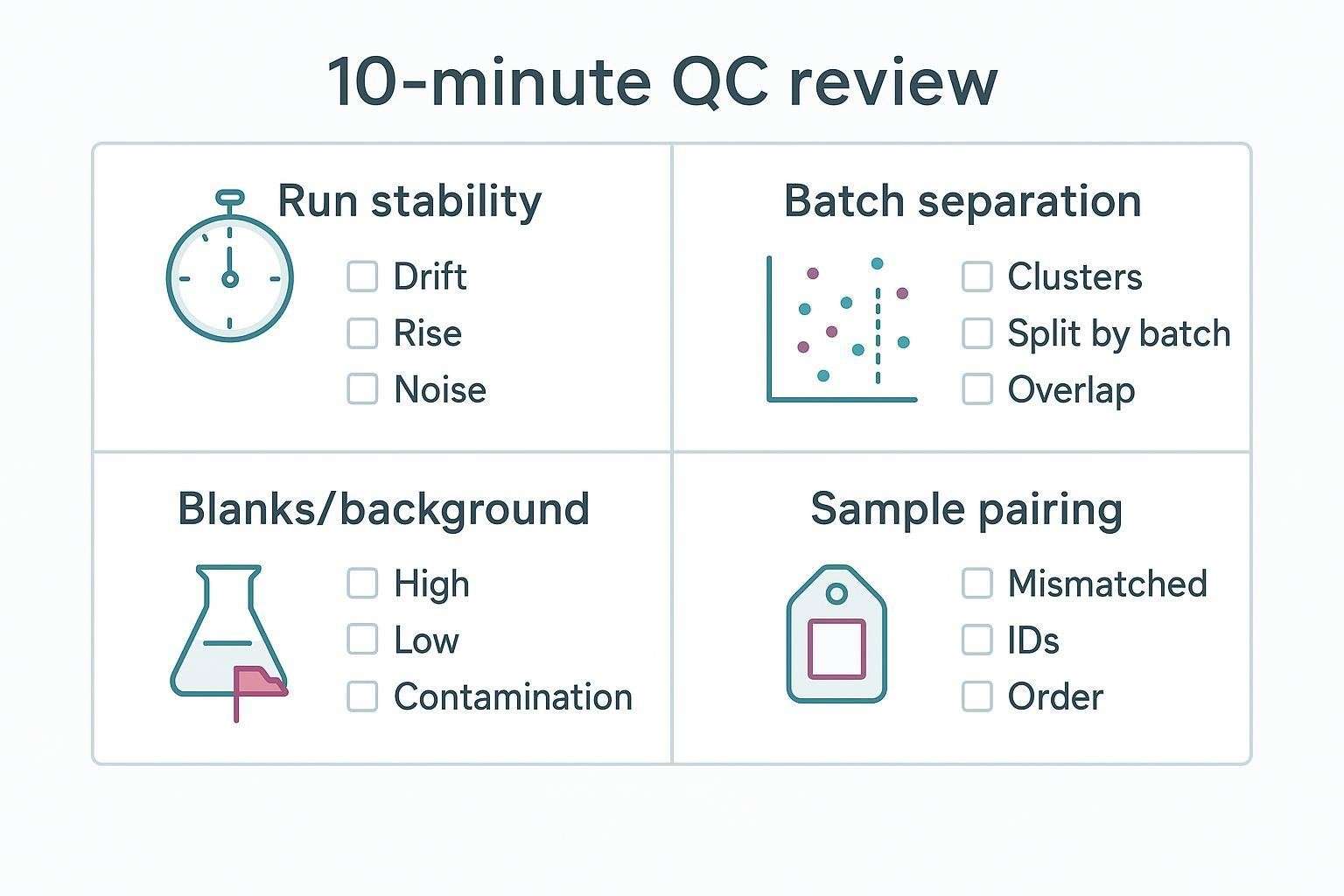
- Start your review with a focused multi-omics QC checklist: pooled QC behavior, batch separation, blanks/background, and sample pairing across layers.
- Favor analysis-ready, well-annotated processed data matrices for multi-omics while keeping raw files for traceability and any reprocessing requests.
- Pathway-level integration outputs help build a defensible narrative without overclaiming feature-level causality; document methods and thresholds.
- Lock in a reproducibility bundle early: parameters.yml, environment files, and run/change logs. It prevents "we can't reproduce this" later and speeds verification handoff.
Multi-omics deliverables at a glance (the minimum set)
A robust package contains a small number of predictable components that map to publication and audit needs. The table below summarizes the minimum practical set and typical file forms.
| Component | Typical files/examples |
|---|---|
| Project overview | overview.xlsx (design, counts, exclusions); readme.txt |
| Sample manifest + dictionary | manifest.xlsx; dictionary.xlsx (field definitions, allowed values) |
| Raw data | LC–MS: .raw/.mzML; Proteomics: RAW + mzIdentML/mzTab; RNA-seq: FASTQ; run_order.csv; acquisition_settings.pdf |
| Processed data matrices for multi-omics | matrix_metabolomics.csv; matrix_proteomics.csv; matrix_transcriptomics.csv; annotations_*.csv; missingness_summary.csv |
| QC summary | qc_summary.csv; pooled_QC_CV_hist.png; drift_plot.png; blanks_report.csv |
| Primary statistics | diff_results_layer.csv (log2FC, p, q); top_features.csv; enrichment_results.csv |
| Pathway-level integration outputs | pathway_summary_across_layers.csv; module_membership.csv; cross_layer_candidates.csv |
| Multi-omics figures and report package | figure_set_hi_res/.png; figure_sources/.ai, *.svg; captions_and_notes.docx |
| Reproducibility documentation for omics | parameters.yml; environment.yml; container_tag.txt; run_log.md |
File-by-file: what you receive and why it matters
Sample manifest and metadata package
What's included
The manifest is a single source of truth: sample IDs, groups, timepoints, batch/site, and sample type, paired with a data dictionary defining allowed values and missingness codes. A deviation/exclusion log records removals and reasons so downstream analyses remain auditable.
How to use it
Use the manifest to verify pairing across omics layers and completeness before opening any results. With consistent IDs and a dictionary, you can filter/stratify analyses and reproduce figures without ambiguity. Standards such as MIAME and MINSEQE emphasize structured sample/series metadata; following them improves reuse.
Raw data and instrument outputs (reference layer)
What's included
Modality-native raw instrument files, run order/batch assignment records, and concise acquisition settings summaries. These align with common repository requirements and protect traceability.
How to use it
Retain raw files to support independent reprocessing and to audit unexpected batch patterns or run events. Traceable inputs and method notes make subsequent reviews faster and more defensible.
Processed data matrices (analysis-ready tables)
What's included (per omics layer)
A feature-by-sample abundance matrix with stable feature IDs, a companion annotation table (identifiers, names, confidence/notes, mapping fields), and a missingness summary by feature and sample.
How to use it
These matrices enable immediate modeling and custom analyses. Start with rapid sanity checks: feature counts by layer, missingness distribution, and batch composition across groups. In metabolomics, report annotation confidence (e.g., MSI levels) so consumers can weigh evidence appropriately.
QC deliverables (what you check before trusting results)
What's included
Per-batch and project-level QC summary tables, drift/consistency plots, blanks/background checks, and sample quality flags with thresholds used.
"First 10 minutes" QC review checklist
Ask yourself: are pooled QCs stable, is there batch separation, are blanks clean, and do sample IDs pair across layers without gaps? This fast triage prevents misinterpretation later.
Primary analysis outputs (per layer)
What's included
Differential results tables with effect size and direction, p-values plus multiple-testing corrections; summary statistics tables (top features, ranked lists); and within-layer enrichment summaries where appropriate.
How to use it
Confirm directionality and effect-size consistency across comparisons, then prioritize candidates for follow-up validation. Transparent reporting of effect thresholds and FDR control supports manuscript tables and peer review.
Multi-omics integration outputs (how layers are summarized together)
What's included (typical)
Pathway-level summary tables across layers that report concordance and directionality, module/program summaries with membership lists, and a cross-layer candidate list with evidence columns indicating which layer supports what.
How to use it
Use pathway-level profiles to craft a defensible biological narrative without overclaiming feature-level causality. Concordant signals across omics strengthen claims and guide targeted verification panels.
Figures and visualization pack (editable + publication-ready)
What's included
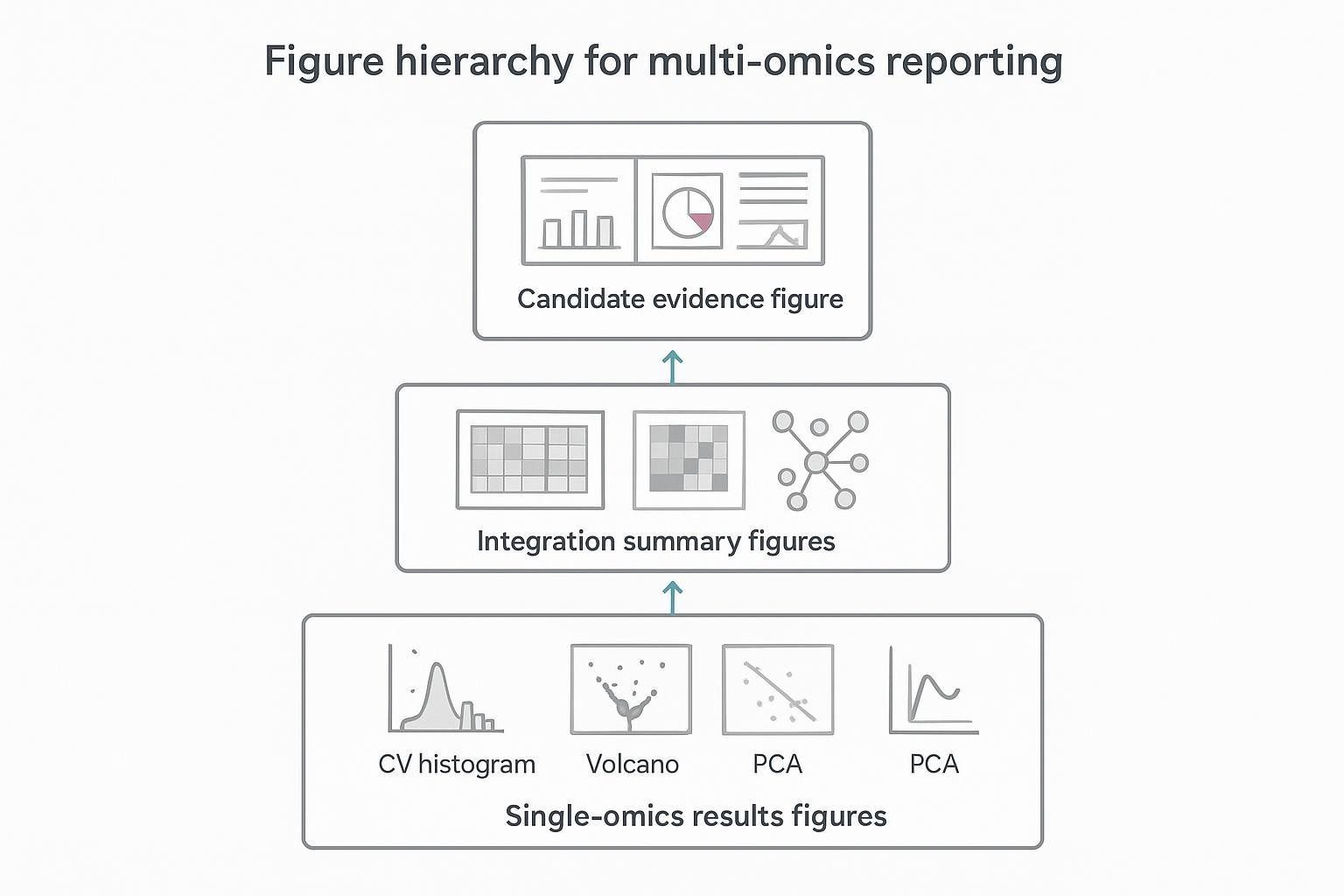
A figure set organized by purpose—data overview, QC summaries, per-layer results, and integration views—delivered as high-resolution images plus editable sources, alongside a captions/notes file.
How to use it
Assemble manuscript figures with consistent labeling and traceable inputs, or build internal slide decks with a clear story from QC to candidates.
Reproducibility and provenance deliverables (what prevents "we can't reproduce this")
What's included
A parameter record (normalization choices, filters, model settings, versions), a software/toolchain summary with environment notes, and an analysis run log that documents changes between drafts or reruns.
How to use it
Together, these files allow you to reproduce key tables and figures, respond to reviewer questions, and extend analyses to future cohorts without starting from scratch. Packaging parameters and environments aligns with FAIR principles for reusability.
Optional deliverables you may want to request up front
Consider asking for a "deliverables index" listing each output and purpose, a candidate prioritization rubric (evidence scoring columns), a sensitivity/robustness summary explaining how conclusions change under reasonable alternatives, and a simplified stakeholder brief tied to the main outputs.
How to request deliverables clearly (a short template)
- Study goal + primary comparisons
- Sample manifest requirements and required metadata fields
- Required outputs:
- Processed matrices + annotation tables
- QC pack + exclusion log
- Primary differential tables
- Integration summary tables
- Figure pack (editable + final)
- Parameter/provenance record
For readers who prefer a ready-made, vendor-neutral package specification, you may also review a multi-omics service description as a reference point: multi-omics service.
FAQ
What are the minimum multi-omics deliverables I should expect?
A: At minimum, a manifest with dictionary, raw files per modality, processed data matrices with annotations, a QC summary pack, differential results, pathway-level integration outputs, a figure pack (high-res + editable), and reproducibility documentation (parameters, environment, run log).
What QC outputs should be included to verify data quality?
A: Include pooled QC CV tables, drift/consistency plots versus run order, blanks/background assessments, and sample-level flags with applied thresholds. A concise multi-omics QC checklist speeds the first review.
Do I receive raw data and processed data, and why do both matter?
A: Yes. Processed data matrices are analysis-ready and fuel rapid modeling, while raw files preserve traceability and enable independent reprocessing or audits when questions arise.
What does an "integration result" look like in deliverables (tables/figures)?
A: Expect pathway-level summaries with per-omics enrichment scores and a combined statistic, optional module/program membership tables, and a cross-layer candidate list with explicit evidence columns, plus heatmaps or network views summarizing concordance and directionality.
Which files are needed to reproduce figures and rerun analyses later?
A: The parameters.yml (normalization, filters, models), environment files (e.g., environment.yml or container tag), exact input matrices/annotations, and the run/change log are sufficient in most cases to regenerate core figures and tables.
What should I request if I plan targeted verification after discovery?
A: Ask for a cross-layer candidate list with evidence, ranked by effect size and concordance, and provide a candidate prioritization rubric. Request stable feature IDs and reference materials/standards where applicable to ease panel development. For discovery-first studies, start with untargeted metabolomics service before moving into targeted verification.
References
- Wilkinson MD, Dumontier M, Aalbersberg IJ, et al. The FAIR Guiding Principles for scientific data management and stewardship. Sci Data. 2016. https://pubmed.ncbi.nlm.nih.gov/26978244/
- Perez-Riverol Y, Bai J, Bandla C, et al. The PRIDE database resources in 2022. Nucleic Acids Res. 2022. https://pubmed.ncbi.nlm.nih.gov/34723319/
- Sumner LW, Amberg A, Barrett D, et al. Proposed minimum reporting standards for chemical analysis: Metabolomics Standards Initiative. Metabolomics. 2007. https://pubmed.ncbi.nlm.nih.gov/24039616/

 Contact Us