

Platform & QC for Multi-omics: How to Judge Data Quality and Cross-omics Consistency (Includes Chromatogram Reading Basics)
Submit Your InquiryMulti-omics studies only pay off when the data are audit-ready, comparable across modalities, and biologically faithful after correction. This guide gives you a practical, platform-focused playbook to evaluate data health, prevent and repair batch/drift, read basic chromatograms for go/no-go decisions, and determine whether your datasets are truly integration-ready.
Key takeaways
- Start with quick triage before interpreting anything: pooled-QC behavior, blank contamination, missingness, and batch/date/operator separation.
- Apply a three-layer quality model—pre-analytical, analytical, post-analytical—to every modality, then add integration-readiness checks.
- For metabolomics and proteomics, monitor pooled-QC CVs, drift vs injection order, identification/FDR stability, and blanks/internal standards.
- Detect batch effects quantitatively, mitigate conservatively (QC-anchored or covariate-aware methods), and validate that biology is preserved.
- Cross-omics consistency checks should focus on pathway/module concordance and sample-level summaries—not feature-by-feature matches.
- Keep deliverables transparent: run order, QC packs, preprocessing provenance, and robustness summaries are non-negotiable.
Quick triage: what to check before you interpret anything
- Do QC samples behave consistently across the run (drift, CV, missingness)?
- Do samples separate by batch/date/operator rather than biology?
- Do blanks show carryover/contamination that overlaps your "hits"?
- Are sample IDs/timepoints paired correctly across omics layers?
- Do cross-omics signals agree at pathway/module level (not feature-by-feature)?
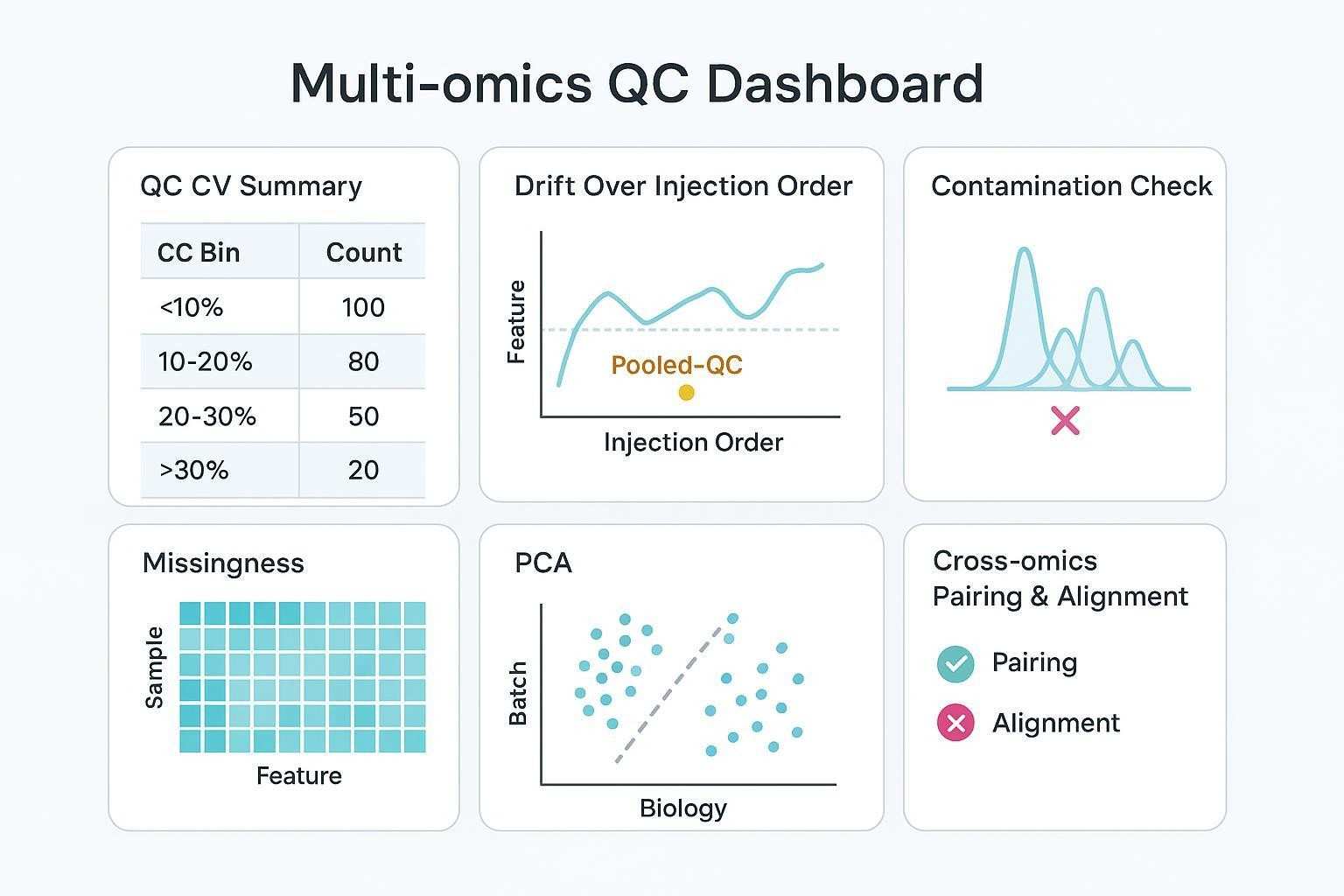
A QC framework that works across modalities
What "QC" means for multi-omics
Quality control is not one chart or one threshold—it's the sum of:
- Pre-analytical handling consistency (time-to-stabilization, freeze–thaw, site SOP, chain of custody)
- Analytical performance and contamination control (drift, run order, blanks/QCs, internal standards where relevant)
- Post-analytical reproducibility (processing parameters, versioning, audit logs, container hashes)
- Integration readiness (pairing, scaling comparability, mapping assumptions, cross-omics concordance)
The three QC layers
- Pre-analytical QC: Document collection/processing timelines, stabilization protocols, storage, and shipments; monitor temperature excursions and freeze–thaw counts.
- Analytical QC: Randomize run order; interleave pooled QCs and blanks; verify system suitability; track drift (intensity and retention time), ID/FDR metrics, and internal standard behavior.
- Post-analytical QC: Version and export all software parameters; record normalization/batch-adjustment choices; keep audit logs and checksums; produce robustness variants and compare outcomes.
Platform basics: why "good" looks different by omics
- Metabolomics (LC-MS/GC-MS): Priorities include drift control, peak quality, ion suppression assessment, blank artifacts, and internal standard recovery.
- Proteomics (DDA/DIA): Track identification rates and 1% FDR, run completeness, intensity distribution stability, missed cleavages, and MNAR missingness.
- Transcriptomics (if included): Depth and mapping rates, library prep batch effects, duplication/rRNA fractions, and outlier detection.
- Microbiome (if included): Negative controls for contamination, compositional constraints, extraction-kit/site batch effects, and sparsity patterns.
Modality-specific QC: what to check and what it means
Metabolomics QC (LC-MS/GC-MS)
Minimum QC artifacts to review
- Pooled-QC CV summary (feature-level and global)
- Drift over injection order (intensity, retention time)
- Blanks: carryover and background features
- Missingness patterns by batch/group/timepoint
- Internal standards behavior (when used)
Red flags that should trigger a pause
- QC drift aligned with injection order or maintenance events
- Blank peaks overlapping key features
- Batch-linked missingness spikes
- Inconsistent retention time across QCs
Proteomics QC (DDA/DIA)
Minimum QC artifacts to review
- ID performance trends (PSM/peptide/protein counts over runs)
- FDR thresholds and consistency across batches
- Run completeness and intensity distribution stability
- Missingness patterns (abundance-linked vs batch-linked)
- QC/standards runs (if used)
Red flags that should trigger a pause
- Progressive ID loss across run order
- Inconsistent database/version or search parameters across batches
- Batch-dependent abundance shifts unrelated to design
Transcriptomics QC (if included)
- Sequencing depth and mapping rate consistency
- Library prep batch effects and outlier samples
- Duplication/rRNA content (as applicable)
- Gene body bias (as applicable)
Microbiome QC (if included)
- Negative controls and contamination signatures
- Sequencing depth and compositional constraints
- Extraction-kit/site batch effects
- Outlier detection and sparsity patterns
Chromatogram reading basics (for go/no-go decisions)
What to look for in seconds
- Peak shape: sharp/symmetric vs broad/tailing
- Retention time stability in QCs
- Co-elution/interference indications
- Carryover/ghost peaks in blanks
- Elevated baseline/background
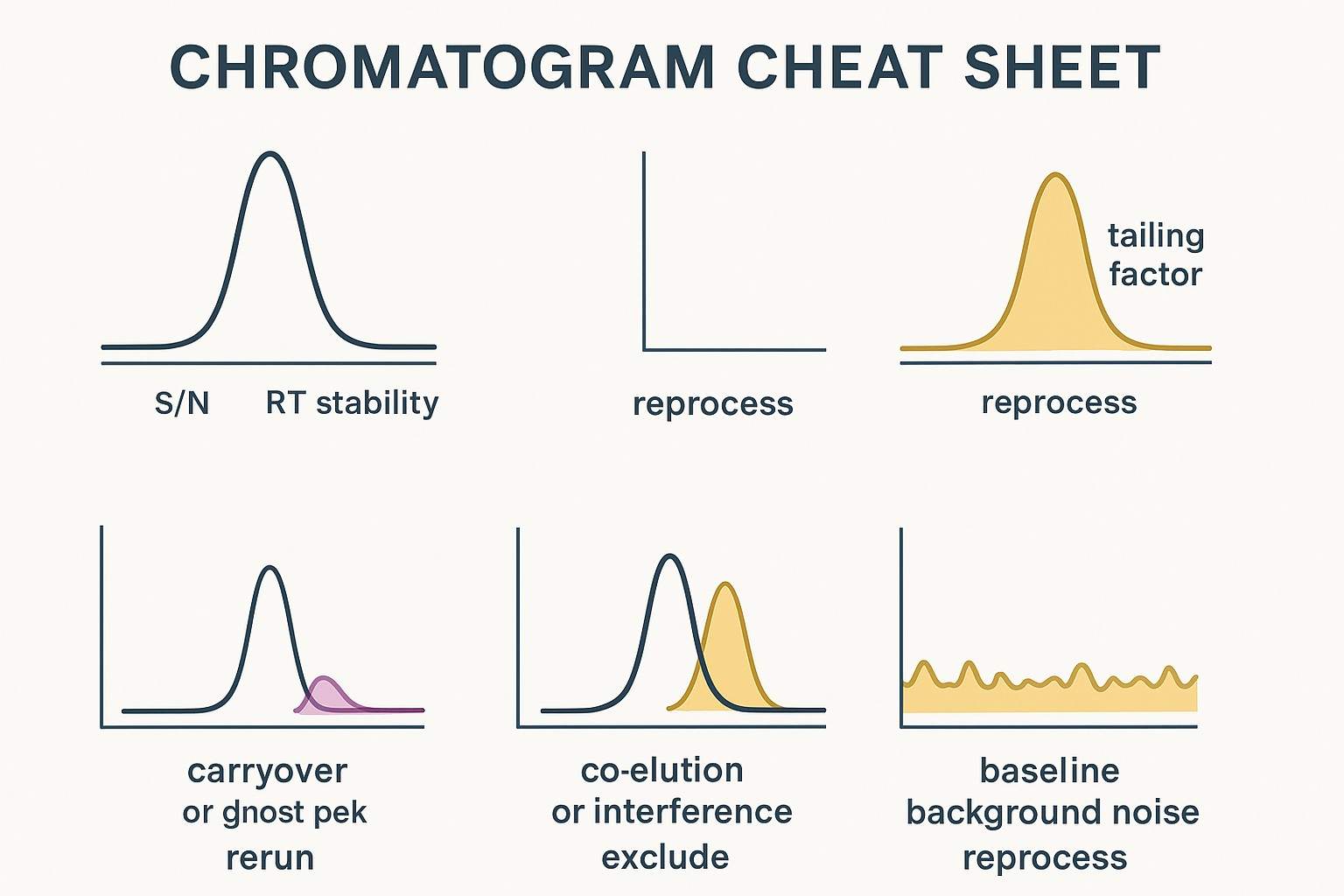
Quick lookup table for go/no-go:
| Chromatogram cue | Symptom to watch | Likely cause | Suggested action |
|---|---|---|---|
| Clean Gaussian-like peak, stable RT | High S/N, consistent integration | Healthy separation | Proceed |
| Tailing/broad peak | Long tail, high FWHM | Column overload, matrix effects | Reprocess with adjusted integration; consider rerun if severe |
| Co-elution/interference | Overlapping peaks, distorted apex | Inadequate separation | Reprocess with refined peak picking; rerun if target critical |
| Carryover/ghost in blanks | Peak in blank at target RT/mz | Carryover/contamination | Stop-the-line; clean, rerun; exclude affected features |
| Elevated baseline | Raised noise, poor S/N | Source/solvent issues | Reprocess; investigate system; rerun if unresolved |
Batch effects and drift: detect, mitigate, and validate
Detect batch effects
- PCA/UMAP colored by batch vs biology
- QC drift plots and missingness heatmaps
- Variance partitioning across batch, site, group, timepoint
Mitigation hierarchy
Prevent problems where possible, correct conservatively when necessary, then validate that biology is preserved.
| Level | Approach | Examples |
|---|---|---|
| Prevention | Balanced design, randomized order, interleaved pooled QCs and blanks | Block randomization, system suitability tests |
| Correction | QC-anchored normalization; covariate-aware batch adjustment | QC-RLSC/SERRF (metabolomics); ComBat with biological covariates |
| Validation | Confirm biology is preserved | Pathway/module stability, replicate concordance, plausible effect sizes |
Overcorrection warning signs
- True contrasts collapse uniformly across many features
- Pathway-level patterns become implausibly flat
- Cross-omics agreement becomes "too perfect" across unrelated pathways
Cross-omics consistency: "integration readiness" checks
Must-pass identity and pairing checks
- Sample ID reconciliation across modalities
- Timepoint alignment (for longitudinal studies)
- Accounting for modality-specific dropouts (what's missing where, and why)
Should-pass concordance checks
- Sample-level summary concordance across layers (global intensity/QC score patterns)
- Pathway/module-level directionality where biologically plausible
- Stability across batches/subsets (repeatability of high-level conclusions)
Interpreting disagreement without overreacting
- Time-lag between regulation and abundance (transcripts vs proteins vs metabolites)
- Microbiome functional prediction vs measured metabolites (hypothesis vs validation)
- Layer-specific sensitivity and missingness effects
For teams planning multi-layer integration, a overview of multi-omics integration support and deliverables is available here: multi-omics integration support.
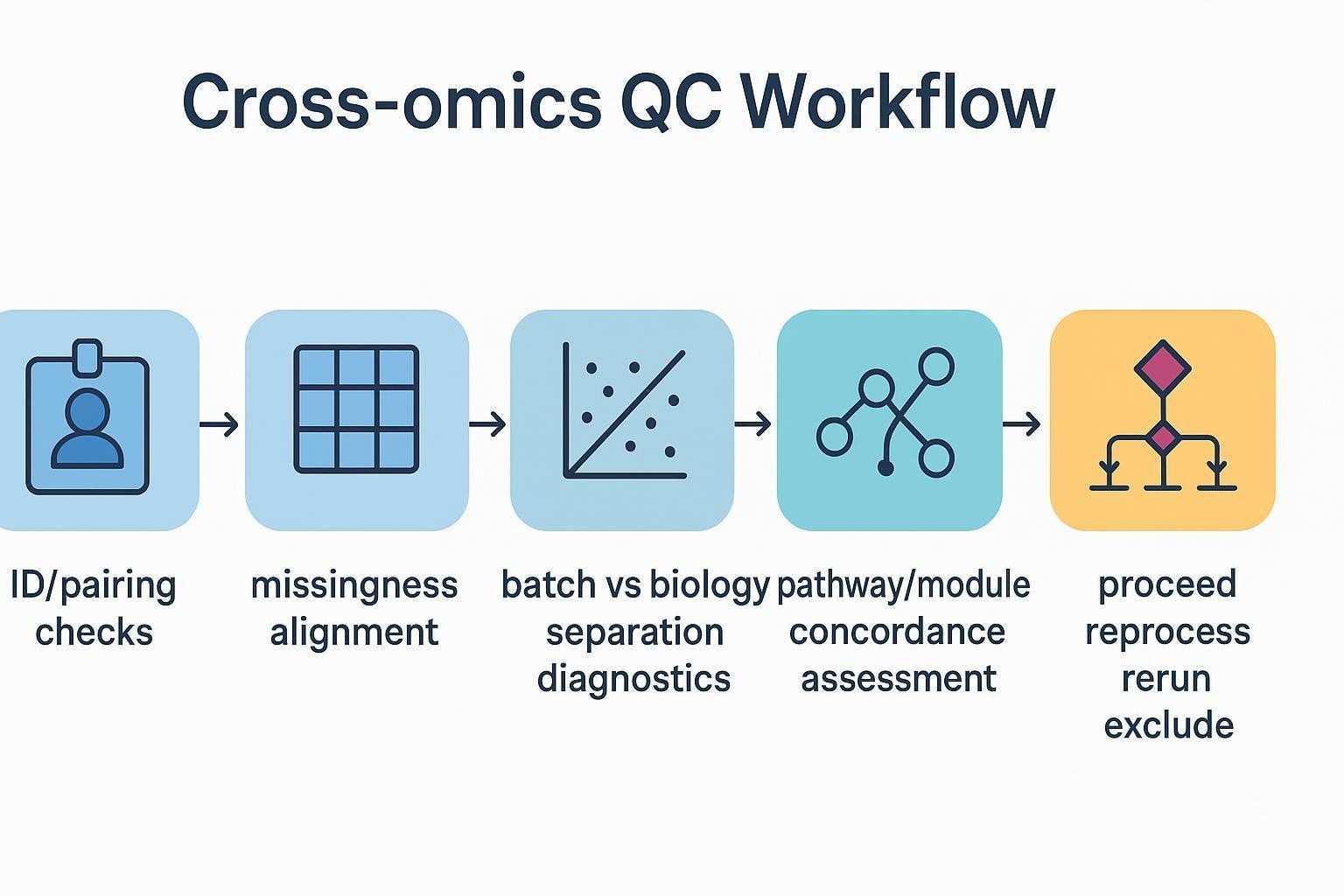
Decision rules: rerun, reprocess, exclude, or proceed
| Trigger type | Examples | Recommended action | Documentation required |
|---|---|---|---|
| Stop-the-line | Contamination in blanks; severe drift uncorrectable; ID mismatches | Halt, investigate, rerun; exclude affected data | Root-cause notes; maintenance logs; rerun rationale |
| Proceed with caution | Moderate drift corrected and validated; localized issues | Proceed, but quantify impact and note limitations | Sensitivity analysis; impact summary |
| Exclude feature/sample | Irreparable interference; unstable RT; unusable missingness | Exclude from downstream; consider targeted follow-up | Exclusion log with criteria and timestamps |
| Proceed | Healthy QC metrics, preserved biology | Continue to integration | QC pack archived; provenance complete |
What to request in deliverables (QC transparency)
- QC summary pack: drift plots, QC CV tables, blank checks, missingness heatmaps
- Run order and batch composition confirmation
- Preprocessing provenance: software versions, parameters, normalization/correction choices
- Robustness summary: key findings stable to reasonable QC/correction variants
If you want a concise overview of downstream statistical workflows and reporting artifacts for metabolomics, review our: metabolomics data analysis.
FAQ
Q: What QC metrics matter most for multi-omics studies?
A: Prioritize modality health (e.g., pooled-QC CVs and drift for metabolomics; ID/FDR stability for proteomics; depth/mapping for RNA-seq; negative controls for microbiome), then cross-omics readiness (ID pairing, missingness alignment, pathway-level concordance). Keep decisions anchored to held-out QC validation and stability of biological conclusions.
Q: How can I tell batch effects are dominating my data?
A: If PCA/UMAP separates strongly by batch/date/operator, if pooled-QC points drift with injection order, or if variance partitioning attributes more variance to batch than group/timepoint, batch effects are likely dominant. Confirm with missingness heatmaps and replicate concordance checks.
Q: What do pooled QCs and blanks detect in practice?
A: Pooled QCs detect drift, precision loss, and retention time instability; they also anchor correction methods. Blanks reveal carryover and background contamination, especially when peaks overlap targets—treat overlap as a stop-the-line event until resolved.
Q: How do I decide rerun vs exclude based on chromatograms?
A: Overlapping peaks in blanks or irreparable co-elution merit rerun or exclusion. Broad/tailing peaks and elevated baselines often justify reprocessing first; rerun if targets are critical or RT instability persists. Use the quick lookup table above to standardize decisions.
Q: Can batch correction remove real biology, and how can I detect overcorrection?
A: Yes. Warning signs include uniform collapse of known contrasts, implausibly flat pathways, and suspiciously tight cross-omics agreement in unrelated pathways. Validate with pathway/module stability checks, replicate concordance, and effect-size plausibility.
Q: What cross-omics checks should I run before integration?
A: Complete identity/pairing reconciliation, align timepoints, quantify modality-specific dropouts, verify sample-level summary concordance, and confirm pathway/module directionality is plausible. Only then proceed to integration.
References
- Zhang X et al. Five Easy Metrics of Data Quality for LC–MS-Based Global Metabolomics (2020). https://pmc.ncbi.nlm.nih.gov/articles/PMC7943071/
- Rodriguez J et al. Normalizing and Correcting Variable and Complex LC–MS (pseudoDrift) (2022). https://pmc.ncbi.nlm.nih.gov/articles/PMC9144304/
- Han S et al. TIGER: Technical Variation Elimination for Metabolomics Data (2022). https://pmc.ncbi.nlm.nih.gov/articles/PMC8921617/
- Pirttilä K et al. Comprehensive Peak Characterization (CPC) in Untargeted LC–MS (2022). https://pmc.ncbi.nlm.nih.gov/articles/PMC8878835/
- Thomas SN et al. Clinical LC–MS/MS System Suitability and QC Concepts (2022). https://pmc.ncbi.nlm.nih.gov/articles/PMC9735147/
- Bereman MS et al. AutoQC Loader & Skyline Panorama for Performance Monitoring (2016). https://pmc.ncbi.nlm.nih.gov/articles/PMC5406750/
- Tsantilas KA et al. A Framework for Quality Control in Quantitative Proteomics (2024). https://pmc.ncbi.nlm.nih.gov/articles/PMC11030400/
- Naake T et al. MsQuality Package and mzQC Metrics (2023). https://pmc.ncbi.nlm.nih.gov/articles/PMC10580266/
- Pino LK et al. Best Practices for DIA on Orbitrap Instruments (2020). https://pmc.ncbi.nlm.nih.gov/articles/PMC7338082/
- Barkovits K et al. Requirements for DIA Spectral Libraries (2019). https://pmc.ncbi.nlm.nih.gov/articles/PMC6944235/
- Hitz BC et al. ENCODE Uniform Analysis Pipelines Overview (2023). https://pmc.ncbi.nlm.nih.gov/articles/PMC10104020/
- ENCODE Project. Bulk RNA-seq Data Standards. https://www.encodeproject.org/data-standards/encode4-bulk-rna/
- Hornung BVH et al. Issues and Current Standards of Controls in Microbiome Research (2019). https://pmc.ncbi.nlm.nih.gov/articles/PMC6469980/
- Karstens L et al. Controlling for Contaminants in Low-Biomass 16S rRNA Gene Sequencing (2019). https://pmc.ncbi.nlm.nih.gov/articles/PMC6550369/
- Bokulich NA et al. Measuring the Microbiome: Best Practices (2020). https://pmc.ncbi.nlm.nih.gov/articles/PMC7744638/
- Yu Y et al. Correcting Batch Effects in Large-Scale Multiomics Studies (2023). https://pmc.ncbi.nlm.nih.gov/articles/PMC10483871/
- Yu Y et al. Assessing and Mitigating Batch Effects in Large-Scale Omics Studies (2024). https://pmc.ncbi.nlm.nih.gov/articles/PMC11447944/
- Hernández-Lemus E et al. Methods for Multi-omic Data Integration in Cancer Research (2024). https://pmc.ncbi.nlm.nih.gov/articles/PMC11446849/
- Subramanian I et al. Multi-omics Data Integration, Interpretation, and Its Application (2020). https://pmc.ncbi.nlm.nih.gov/articles/PMC7003173/

 Contact Us