

Endogenous vs Exogenous Metabolites: How to Interpret Metabolomics Data
Submit Your InquiryUntargeted metabolomics is a powerful way to see biology "as it is," but it rarely measures biology in isolation. When you interpret metabolomics data, the hardest step is often deciding whether a signal reflects endogenous vs exogenous metabolites—or a mixed-origin intermediate that sits in between.
A typical LC–MS or GC–MS dataset will capture host metabolism, diet-derived chemistry, drug and supplement signals, environmental exposures, host–microbiome co-metabolites, and a non-trivial amount of laboratory background.
That's why the endogenous vs exogenous distinction isn't semantic—it's interpretive infrastructure. If you call a diet-derived feature a disease biomarker, you risk a study that looks exciting on a volcano plot but fails in replication. If you call a medication metabolite "endogenous dysregulation," you can end up chasing the wrong mechanism. And if you ignore lab background, you can build models that learn plasticware rather than biology.
This resource focuses on practical, defensible interpretation: how to separate what a metabolite is (identification confidence) from where it likely came from (source attribution), and how to report ambiguity without losing the signal.
Why the Distinction Matters in Metabolomics
Metabolomics datasets often capture signals from endogenous vs exogenous metabolites at the same time: host metabolism, diet, drugs, environmental exposures, microbiome-related transformation, and laboratory background—all in one feature table. In plasma/serum, this can mean a mixture of tightly regulated endogenous pathways and short-lived exogenous exposures; in urine, it can mean a clearance-weighted "log" of both exposure and metabolism; and in feces/stool, it can mean a strong microbial imprint that blurs origin categories by design.
Misclassifying metabolite origin can distort biological interpretation, weaken biomarker validity, and reduce reproducibility. The risk is highest when studies have uncontrolled diet, unrecorded medication use, variable collection timing, or incomplete QC filtering.
Source-aware interpretation is especially important in biomarker discovery, exposome research, nutrition studies, microbiome studies, and translational research—precisely the study types where untargeted profiling is commonly used for discovery.
What Endogenous vs Exogenous Metabolites Mean
Before building any workflow, it helps to agree on definitions that are strict enough to be useful, but flexible enough to handle mixed-origin biology.
Endogenous Metabolites
Endogenous metabolites are compounds produced or transformed within the organism through normal or perturbed biological processes. In practice, this category includes metabolites tied to amino acid metabolism, lipid metabolism, energy metabolism, redox balance, and signaling pathways.
Importantly, "endogenous" does not mean "unchanging." Endogenous metabolites can shift rapidly with fasting/feeding, circadian effects, inflammation, stress, and disease states. That's why context (matrix, timing, cohort design) is part of the definition in real datasets.
Exogenous Metabolites
Exogenous metabolites are compounds introduced from outside the organism—dietary molecules, drugs, environmental chemicals, additives, contaminants, and their transformation products.
Some exogenous compounds appear transiently and are most visible in short windows after intake or exposure. Others persist, accumulate, or are biotransformed into downstream metabolites that may overlap with endogenous pathways. That overlap is where most interpretation errors happen.
Why Origin Is Harder to Interpret Than It Sounds
A metabolite's chemical identity does not automatically prove where it came from. Even when MS/MS annotation is strong, origin can remain ambiguous because:
- The same molecule may have both endogenous and exogenous origins.
- Host–microbiome co-metabolism can blur source boundaries, especially in stool and urine.
- External exposures can trigger downstream changes in endogenous pathways, creating response signals that shouldn't be confused with direct source markers.
A helpful mental model is to separate identity from interpretation:
- Identity: "What is this feature most likely to be?"
- Origin: "Given study context and evidence, what source class is most defensible?"
Treating those as two separate questions reduces overcalling and makes reporting more reproducible.
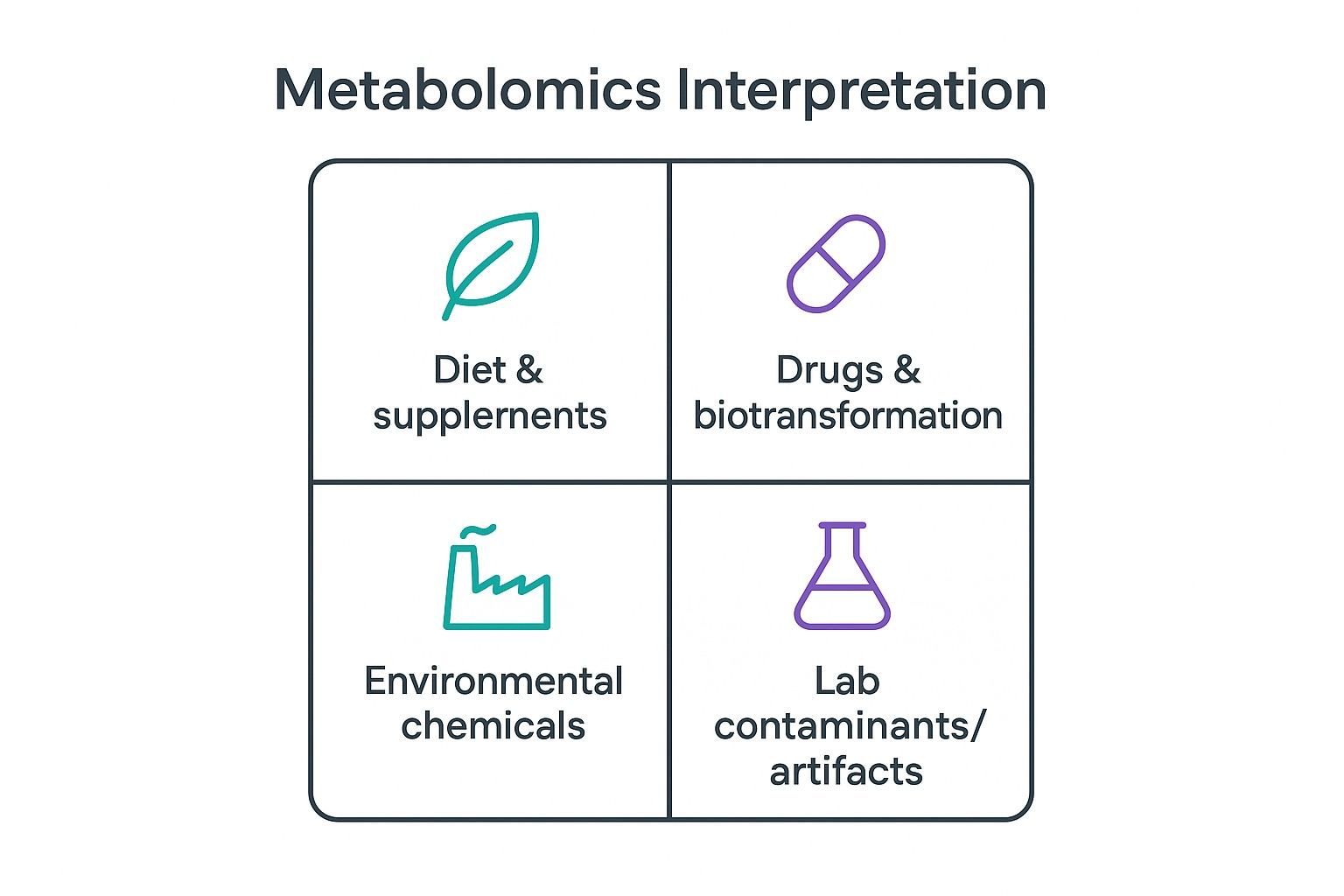
Common Sources of Exogenous and Mixed-Origin Signals
When researchers say "exogenous signals," they often mean very different things: a food-derived compound, a parent drug, a plasticizer background feature, or a microbial transformation product. Grouping them explicitly helps you choose the right validation logic.
Diet, Supplements, and Food-Derived Compounds
Food-derived molecules may appear directly or after host and microbial transformation. For example, many polyphenols are extensively transformed by gut microbes into smaller phenolics that can be detected in urine or plasma; reviews of polyphenol metabolism emphasize that microbial biotransformation can dominate what you ultimately measure in humans (see Dietary Polyphenol, Gut Microbiota, and Health Benefits and The Chemistry of Gut Microbial Metabolism of Polyphenols).
Because diet is a strong, structured exposure, dietary signals can be mistaken for disease-related biomarkers if study context is ignored. This is especially common in case-control designs with uncontrolled feeding state, since diet correlates with lifestyle and health behaviors.
Drugs and Biotransformation Products
Parent drugs, conjugates, and downstream metabolites can overlap with endogenous pathways or share fragments/adduct patterns that complicate annotation. Medication-related signals are often among the strongest differentiators between cohorts—even when medication use is not the intended study variable.
In practice, you'll often want to interpret these features in a separate layer (exposure/medication layer) rather than mixing them into "endogenous biology." If your key question involves parent drugs, conjugates, or downstream drug metabolites, Drug Metabolism Analysis Services can support metabolite characterization and biotransformation interpretation.
Environmental Chemicals and Consumer Exposures
Pollutants, additives, packaging-related compounds, and other external exposures can contribute detectable signals. Their presence may reflect true exposure, transient contact, or downstream biological impact depending on matrix and timing.
A useful caution: some exposure markers are sparse and transient, while endogenous response markers can be abundant and persistent. Conflating those two can lead to claims like "we detected exposure" when you've actually detected a generic stress or inflammation response.
Laboratory Contaminants and Background Signals
Some exogenous-looking features arise from reagents, plasticware, carryover, handling, or environmental background. These features should be ruled out before biological source interpretation.
Community discussions emphasize pooled QCs, blanks, and other QA/QC measures as standard practice in LC–MS metabolomics; for example, Current Practices in LC-MS Untargeted Metabolomics summarizes how pooled QC and related QC approaches are commonly used. When the goal is to interpret origin, blanks are not optional—they are part of the origin evidence.
Common Boundary Cases in Metabolomics Interpretation
Most interpretation mistakes happen at boundaries—where the biology is real but the source story is underdetermined.
The Same Molecule With Multiple Possible Origins
Some compounds can be synthesized endogenously, acquired through diet, or produced through microbial metabolism. Identity alone is often insufficient for source assignment.
This is where conservative classification helps: rather than forcing a binary label, treat the metabolite as mixed-origin or source-uncertain unless you have study-design evidence (diet intervention, dosing, washout, time course) that strengthens the origin call.
Host–Microbiome Co-Metabolism
Many metabolites reflect combined host processing and microbial transformation rather than a single source category. In feces/stool this is expected, but the key point is that these products often appear in urine and plasma as well.
For nutrition and microbiome studies, it's often more defensible to treat these features as mixed-origin by default and then use additional cues (diet logs, microbiome data, temporal dynamics) to refine the interpretation.
Exposure-Driven Changes in Endogenous Metabolism
Xenobiotics can alter amino acid, lipid, oxidative stress, or energy pathways. These altered endogenous metabolites are informative response markers, but they shouldn't be reported as direct exposure markers without stronger evidence.
Exposomics frameworks explicitly distinguish exogenous exposure signals from downstream metabolic effects. For example, The metabolome: A key measure for exposome research in environmental health describes how the metabolome can bridge exposure and biological effect, and Integrated Exposomics/Metabolomics for Rapid Exposure and Effect Analysis highlights integrated measurement of both exposure and effect.
Contamination Versus True Exposure
A detected exogenous-looking signal is not automatically biologically meaningful. If the feature is high in blanks, tracks with injection order, or appears inconsistently across replicates, your best interpretation may be "background" rather than "exposure."
In practical reporting, it's often better to remove or flag these features early than to construct a biological narrative around them.
Identification Confidence and Source Attribution Are Not the Same
Metabolomics interpretation becomes far more robust when you explicitly separate two confidence axes.
What Identification Confidence Can Tell You
Annotation confidence helps establish what a feature likely is. Higher-confidence identification improves interpretability and reduces misannotation risk.
In the workflow sense, this is where untargeted discovery often transitions into confirmatory work. If the study's conclusions rely on a small set of key metabolites, it's common to use targeted assays to quantify and confirm those molecules with higher confidence (for example, via a targeted LC–MS/MS panel with authentic standards).
What Identification Confidence Cannot Prove
Even a well-annotated metabolite doesn't automatically reveal whether its source is endogenous, exogenous, or mixed. Chemical identity and biological origin should be treated as separate interpretation questions.
This is especially true for molecules that sit at host–microbiome boundaries, overlap with dietary chemistry, or exist in multiple metabolic pools.
Use Orthogonal Evidence to Strengthen Interpretation
Retention behavior, MS/MS quality, isotope patterns, standards, and cross-platform support can strengthen metabolite identification.
Source attribution still depends on study design, exposure context, matrix, and timing—so the strongest practice is to bring "non-MS evidence" (diet records, dosing schedules, collection times, metadata completeness) into the interpretation layer.
Use QC and Data Processing to Reduce False Source Attribution
Before any origin claims, you want to establish that the feature is real, reproducible, and not a technical artifact.
Review blanks, pooled QCs, dilution behavior, and feature reproducibility before biological interpretation. Drift control and batch correction matter because technical variation can masquerade as exposure-related biology. And feature-level inspection—adducts, isotopes, in-source fragments, deconvolution—helps avoid classifying redundant ions as independent "exogenous signals."
A practical approach is to treat contaminants/background as a separate "evidence gate" before classification. This aligns with broader QA/QC discussions in the metabolomics community (e.g., mQACC workshop outputs).
Pro Tip: When a feature is present in blanks at comparable intensity (or shows classic carryover behavior), it may be analytically real but biologically uninterpretable. Flag it early instead of debating endogenous vs exogenous.
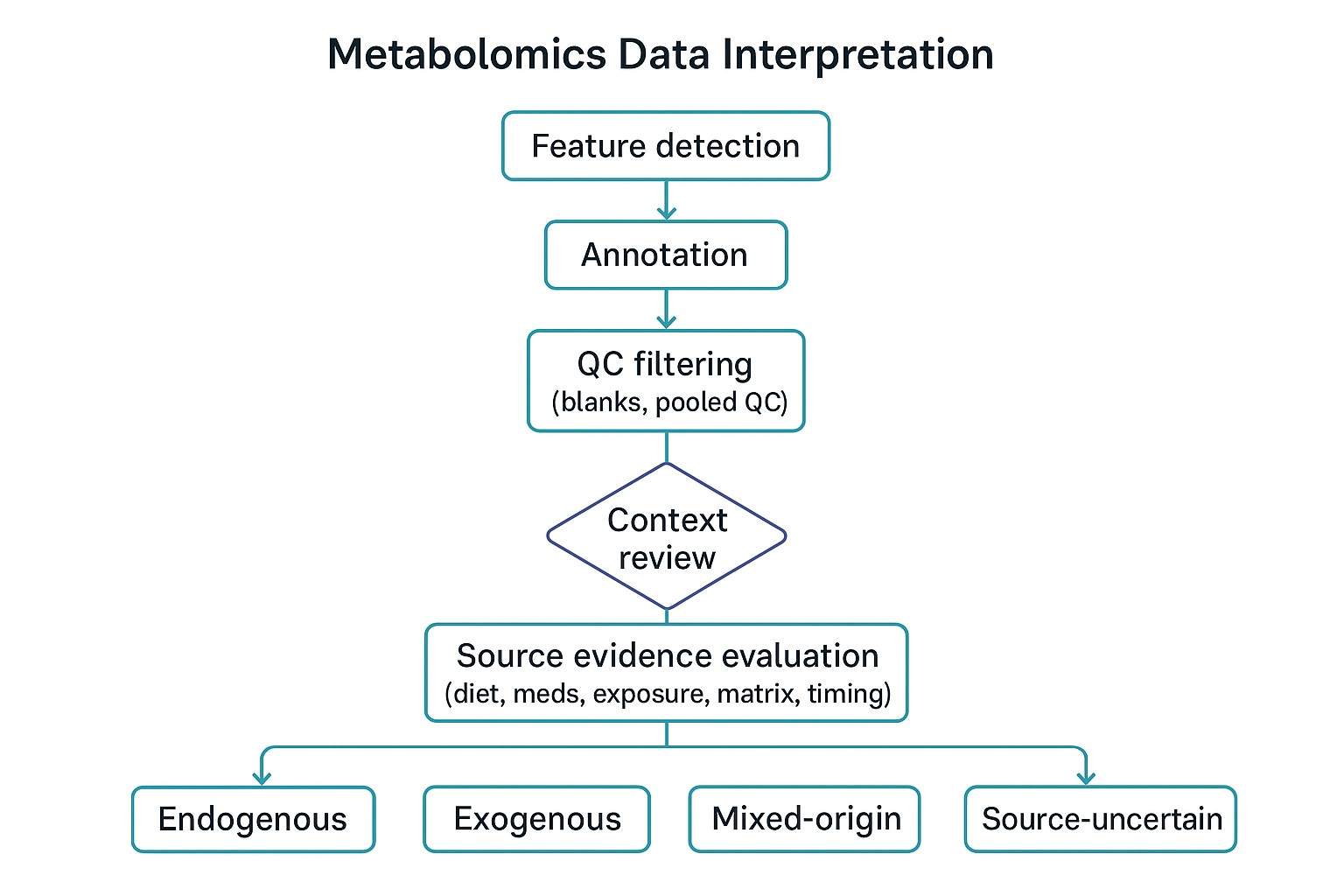
A Practical Framework for Interpreting Metabolite Origin
The goal of an interpretation framework is not to eliminate uncertainty—it's to make your uncertainty explicit, consistent, and defensible.
Start With Metabolite Identity
Confirm what the feature most likely is before inferring where it came from. If your annotation is tentative, treat any origin call as tentative too.
When the downstream biological conclusion depends on a handful of metabolites, consider moving from discovery to confirmatory quantification. That's often where broad untargeted profiling (for discovery and pathway context) pairs naturally with a targeted panel for key features.
Evaluate Study Context
Consider diet, medication use, known exposures, intervention design, cohort characteristics, and collection conditions. Ask whether the metabolite is plausible in the biological and experimental setting.
In practice, "context review" becomes a structured checklist in your analysis notes: what do you know about feeding state, supplement use, antibiotics, smoking status, occupational exposures, and sample handling? Missing metadata should lower source confidence.
Check Matrix and Sampling Window
Plasma/serum, urine, and feces/stool provide different source information:
- Plasma/serum often emphasizes circulating bioactives and host-regulated pools.
- Urine captures excretion and can amplify exposure and clearance signals.
- Feces/stool strongly reflects microbial metabolism and dietary residue, making mixed-origin interpretation common.
Timing relative to feeding, dosing, exposure, or intervention strongly affects interpretation. If timing is variable or unknown, classify more conservatively.
Review Analytical and Biological Cues
Assess retention behavior, adduct patterns, isotope patterns, and platform corroboration. Look for exposure-response trends, covariance with related features, and fit with known biology.
When cues disagree (e.g., strong ID confidence but inconsistent QC behavior), treat that disagreement as part of the result rather than forcing a conclusion.
Classify Conservatively
Use likely endogenous, likely exogenous, mixed-origin, or source-uncertain categories when evidence is incomplete. Make uncertainty explicit rather than forcing binary labels.
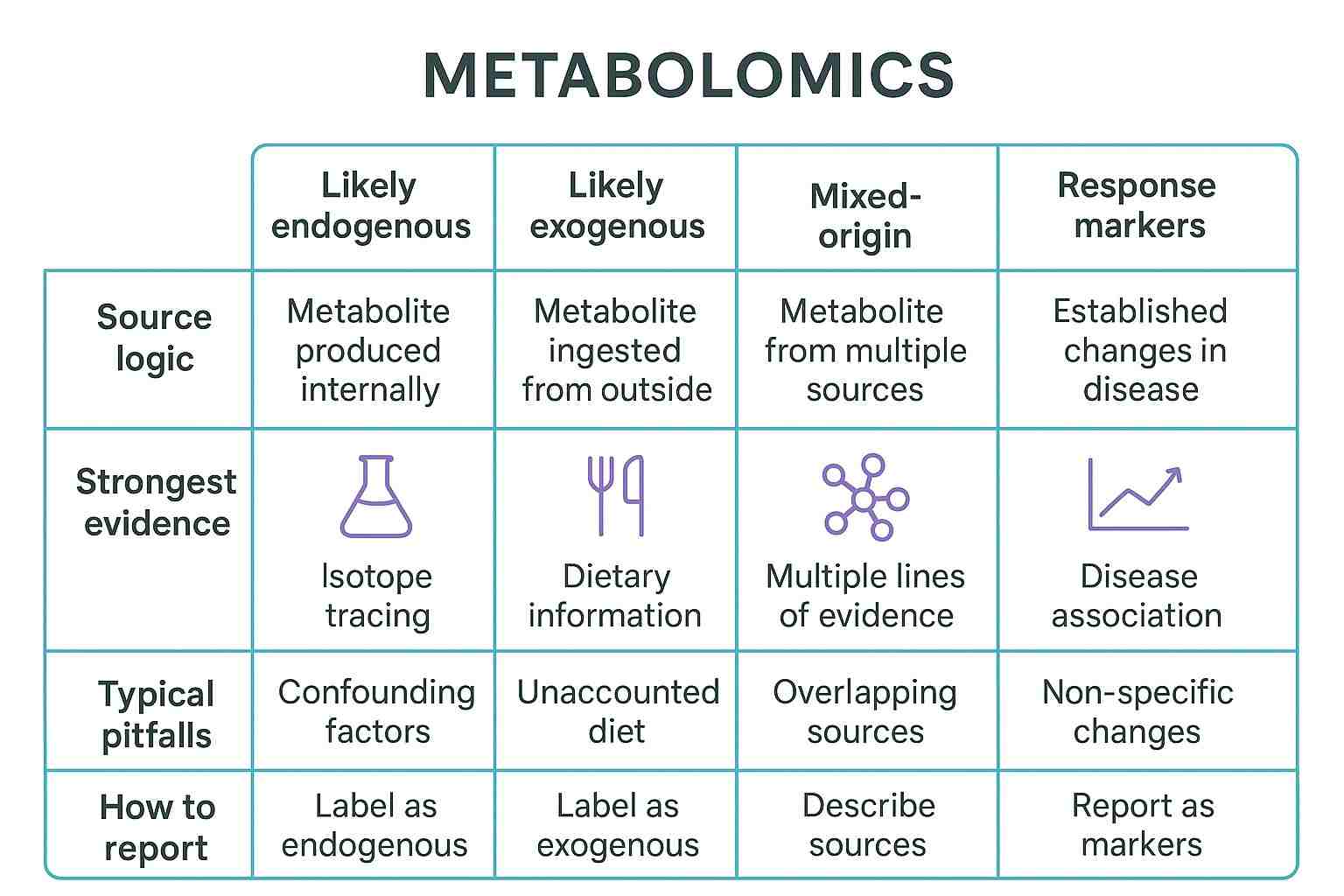
The table below is a practical "first-pass" way to map origin logic to matrices and common failure modes:
| Interpretation category | Common origin logic | Matrix clues (plasma/urine/stool) | High-risk failure mode |
|---|---|---|---|
| Likely endogenous | Fits core host pathways; coherent with physiology and cohort context | Plasma: regulated pools; Urine: consistent endogenous clearance; Stool: lower relevance unless host-derived | Confounding by diet/meds or response-to-exposure misread as intrinsic biology |
| Likely exogenous | Parent xenobiotic or near biotransformation product; aligns with exposure metadata | Urine: strong for exposure clearance; Plasma: transient windows; Stool: dietary residue common | Lab background or carryover misclassified as true exposure |
| Mixed-origin | Host–microbiome axis or shared molecule with multiple plausible sources | Stool: common; Urine/plasma: downstream microbial metabolites possible | Overstating a single-source narrative |
| Source-uncertain | ID or context evidence incomplete or contradictory | Any matrix when metadata/QC/annotation is weak | Forcing a binary label that won't replicate |
What Evidence Is Strongest for Source Attribution
When origin is a key claim, not all evidence types carry the same weight. It's worth being explicit about what's "strong" versus "supportive."
Study Design and Experimental Context
Intervention, dosing, feeding, washout, and time-course designs often provide the strongest clues about origin. Comparative group structure also helps distinguish constitutive metabolites from exposure-related signals.
If you only have a single timepoint and weak metadata, your source claims should be correspondingly conservative.
Stable Isotope Tracing and Direct Tracking
Labeling strategies can provide stronger evidence for source and metabolic fate than annotation alone. These approaches are especially valuable when origin is central to the study question.
Even without full tracing, targeted confirmation of key metabolites can make the interpretation more defensible—especially when results will be used for mechanism claims.
Matrix-Specific and Temporal Evidence
The same metabolite can have very different interpretive meaning depending on sample type and collection timing. Temporal alignment with exposure or intervention strengthens source attribution.
For example, a putative dietary metabolite that appears only in urine shortly after meals is a different interpretive object than the same molecule appearing persistently in fasting plasma.
MS/MS, Libraries, and Database Support
These tools are essential for identity confidence and annotation quality. They support interpretation, but they don't by themselves fully resolve biological source.
Treat libraries as "identity evidence" and design/context as "origin evidence."
Pathway Context and Biological Plausibility
Pathway mapping can support interpretation when combined with stronger experimental evidence. On its own, it's weaker than direct source tracking for assigning origin.
A pathway shift can be a response to exposure rather than proof that an exogenous compound is present.
How to Distinguish Exposure Markers From Response Markers
Direct exposure markers indicate the presence of exogenous compounds or their close transformation products. Response markers reflect endogenous metabolic changes triggered by diet, drugs, pollutants, or other external inputs.
Both are valuable, but they shouldn't be reported as the same type of evidence. A strong interpretation makes clear whether a signal is evidence of exposure, evidence of response, or source-uncertain.
A reporting-friendly way to separate these classes is to write a "two-layer" results narrative:
- Exposure layer: parent compounds and close biotransformation products (where plausible).
- Response layer: endogenous pathway shifts consistent with known biology.
This approach is consistent with exposome framing described in The metabolome: A key measure for exposome research in environmental health (2019) and integrated exposure/effect measurement in Integrated Exposomics/Metabolomics for Rapid Exposure and Effect Analysis (2022).
Common Interpretation Mistakes to Avoid
A few mistakes recur across labs and study designs, especially in untargeted discovery.
Treating tentative annotation as proof of origin is the most common failure mode. Closely related is assuming that dietary or microbiome-related metabolites are purely endogenous (or purely exogenous) when mixed-origin is the more defensible default.
Other frequent problems include interpreting pathway shifts as direct evidence of external compounds, ignoring contamination/background signals, and overstating biological conclusions when source assignment remains uncertain.
Key Takeaway: If a source claim can't survive a skeptical reviewer asking "what else could this be?", it's safer to report the feature as mixed-origin or source-uncertain and focus on what the data can support.
How to Report Endogenous, Exogenous, and Source-Uncertain Features
Clear reporting helps reviewers and future readers understand what was measured, what was inferred, and what remains uncertain.
Separate annotation confidence from source confidence in figures, tables, and text. Use conservative language when origin isn't directly demonstrated. Distinguish clearly between likely endogenous, likely exogenous, mixed-origin, and source-uncertain metabolites.
When you classify a feature, report the supporting evidence used for that classification. That evidence can include study context (diet/meds/exposure metadata), QC filters (blanks, pooled QCs), databases and MS/MS matching, and orthogonal validation.
If your conclusions depend on a small number of metabolites, consider confirmatory quantification and structural support rather than relying only on untargeted annotation. For many studies, a combined workflow— Untargeted Metabolomics Service for discovery plus Targeted Metabolomics Service for confirmation—matches how results are ultimately defended in manuscripts.
When Source Attribution Matters Most
Some study types can tolerate "likely endogenous" shorthand, while others require explicit origin logic.
Biomarker Discovery
Misassigned origin can produce weak or misleading biomarkers. Dietary and medication confounding are particularly dangerous here because they can appear as strong case-control differences.
Exposome and Environmental Health Studies
Source-aware interpretation is essential when linking external exposures to internal molecular signals. In these studies, the distinction between exposure markers and response markers is not a nuance—it's the result.
Nutrition and Microbiome Research
Many features lie at the boundary between diet, microbial transformation, and host metabolism. Stool and urine are especially rich in mixed-origin metabolites, and plasma can carry systemic products downstream of gut metabolism.
Translational and Clinical Studies
Correctly separating endogenous biology from medication-, diet-, or exposure-related signals improves interpretability and downstream decisions.
Frequently Asked Questions
Can metabolomics directly distinguish endogenous from exogenous metabolites?
Not from signal identity alone in most cases. Untargeted metabolomics can tell you that a compound-like feature is present, but source attribution usually needs context (diet/meds/exposure), matrix and timing information, and QC evidence.
Is a metabolite still exogenous after host or microbial transformation?
Often yes in an "exposure lineage" sense, but you should define the rule up front. A practical compromise is to label parent and near biotransformation products as exposure markers, and label downstream pathway shifts as response markers.
Are all diet- or drug-related metabolites exogenous?
No. Many downstream metabolites overlap with endogenous pathways or reflect mixed host–microbiome metabolism. If you can't establish lineage (e.g., through timing, intervention, or tracing), mixed-origin or source-uncertain labeling is usually more defensible.
What should I do when metabolite origin remains unclear?
Report uncertainty explicitly and avoid forcing binary labels. A good pattern is to keep a "source confidence" column in your results table (likely endogenous / likely exogenous / mixed / uncertain) and document the evidence used for each call.
What's the most common reason labs overcall exogenous exposure in untargeted LC–MS?
Insufficient blank/QC filtering. Background features from solvents, plasticware, carryover, and in-source artifacts can look like real xenobiotics unless you gate them out early.
Which matrix is best for exposure markers: plasma, urine, or stool?
It depends on the question, but the logic is consistent: urine often emphasizes clearance/excretion signals; stool emphasizes gut and dietary residue plus microbiome activity; plasma emphasizes circulating pools and can be timing-sensitive for transient exposures.
References
- The metabolome: A key measure for exposome research in environmental health
- Integrated Exposomics/Metabolomics for Rapid Exposure and Effect Analysis
- Current Practices in LC-MS Untargeted Metabolomics
- moving toward consensus on best QA/QC practices in LC-MS-based untargeted metabolomics
- Dietary Polyphenol, Gut Microbiota, and Health Benefits
- The Chemistry of Gut Microbial Metabolism of Polyphenols

 Contact Us