

How to Increase Metabolite Identification Confidence Without Ion Mobility
Submit Your InquiryMetabolite identification is where untargeted LC–MS/MS workflows often stop being "high-throughput" and start becoming "high-friction." In preclinical programs, that friction shows up in very practical ways: a feature looks significant, but the MS/MS is ambiguous; isomers sit under a single peak; a library match seems plausible until retention behavior contradicts it; or the annotation cannot be defended in a paper, an internal review, or a regulatory-style audit.
Ion mobility (IM) can add an extra, orthogonal dimension of separation and collision cross section (CCS) evidence—but it's not the only route to higher confidence. In many studies, you can materially improve LC-MS/MS metabolite identification confidence by tightening chromatography, acquiring more informative MS/MS, and enforcing a disciplined, multi-layer evidence model that separates "annotation" from "identification."
Key Takeaway: If your bottleneck is mixed spectra, unstable retention, or overconfident library scoring, you can often improve metabolite identification without ion mobility by optimizing the conventional workflow first—and reserving IM-MS for the subset where ambiguity still changes decisions.
Why Metabolite Identification Remains Challenging in Conventional LC-MS/MS
Even with modern high-resolution instruments and robust software, conventional LC-MS/MS metabolite identification is constrained by chemistry and physics—not just databases.
Structural isomers and isobaric compounds are the most common "confidence traps." Isomers can share the same exact mass and produce overlapping or near-overlapping fragment sets; isobars can land close enough in m/z that they compete for isolation or complicate isotope/adduct interpretation. When the precursor is not cleanly isolated, the downstream MS/MS spectrum may reflect a mixture, and a strong library score can become a false sense of certainty.
Co-eluting background components make this worse. Complex matrices (biofluids, tissues, cell media, formulation excipients) can add ions that overlap chromatographically, suppress signal, and generate chimeric fragmentation. In practice, the "best match" in a library may be the best match to a mixture, not to a single analyte.
MS/MS library matches alone are often insufficient for confident structural assignment. The same nominal fragmentation pattern can be produced by multiple plausible structures, especially within common metabolite families. In addition, public libraries are incomplete, vary by collision energy and instrument type, and often lack the exact adduct forms or ion species observed in a specific method.
Finally, limited access to authentic standards slows confirmation of priority metabolites. Many metabolites of interest do not have readily available standards. Yet the metabolomics community has repeatedly emphasized that fact-based identification requires orthogonal confirmation—typically including retention behavior and reference material when the call is decision-critical (Schymanski et al., 2023).
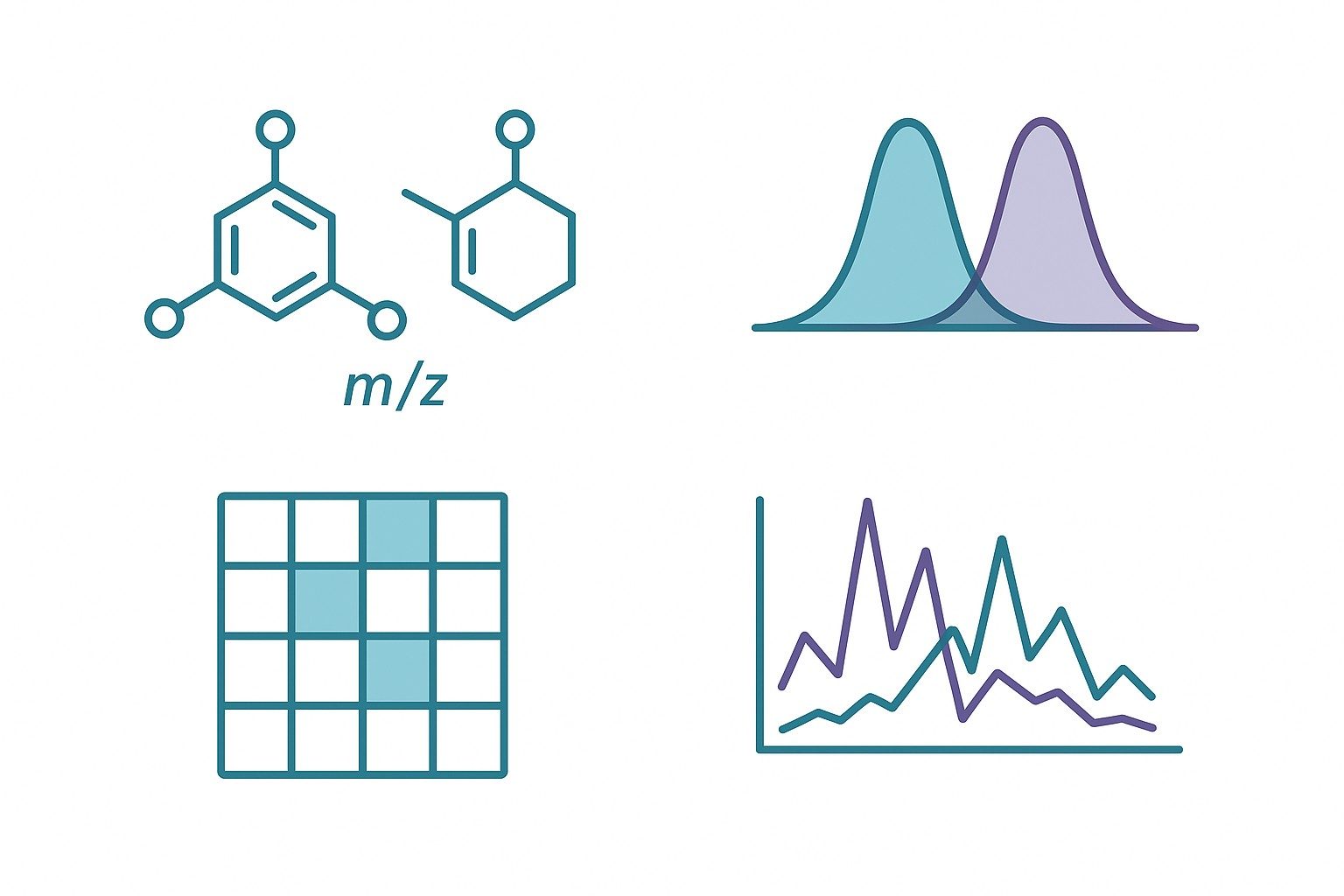
How Much Can Be Improved Without Ion Mobility?
Ion mobility can add an orthogonal separation dimension and CCS-based evidence, which is particularly helpful when structural ambiguity persists after LC separation and when co-elution makes precursor isolation unreliable. Reviews of IM-MS in metabolomics highlight how drift-time separation and CCS can strengthen identification when used alongside LC-MS/MS (Paglia & Astarita, 2018).
However, many identification bottlenecks can still be reduced through workflow optimization in conventional LC-MS/MS. The largest gains often come from preventing failure modes upstream: reducing co-elution, increasing precursor purity, acquiring MS/MS that truly corresponds to the feature of interest, and using annotation logic that demands converging evidence (not a single score).
The key question is whether ion mobility would materially change candidate ranking or interpretation in the specific study.
- If IM-MS would only reinforce what your LC and MS/MS already make obvious, it may not be the highest-leverage next step.
- If IM-MS would reorder candidate structures, separate critical isomers, or disentangle mixed spectra for the handful of metabolites that drive biological conclusions, then it can be worth considering.
A useful way to keep this decision grounded is to evaluate what each evidence layer can and cannot resolve.
| Evidence layer (conventional LC-MS/MS) | What it helps you rule in/out | What it often cannot resolve on its own |
|---|---|---|
| Accurate mass (HRMS) | Candidate formulas within ppm tolerance; gross interferences | Most structural isomers; many isobars in complex matrices |
| Isotope pattern + adduct logic | Formula plausibility; ion species consistency | Definitive structure; co-eluting interferents |
| Retention behavior (within your method) | Physicochemical plausibility; consistency across runs | Isomers with similar polarity; cross-lab comparability without standards |
| MS/MS fragments (quality-controlled) | Substructure evidence; class-level confirmation | Closely related isomers; mixed spectra when isolation is poor |
| Authentic standard (same method) | High-confidence confirmation (RT + MS/MS match) | N/A—this is the confirmation step |
Improve Chromatographic Resolution First
For many teams, this is where the biggest gains happen—because better separation improves everything downstream: precursor isolation, fragment interpretability, library match stability, and the reproducibility of any follow-up confirmation.
(If you're looking for chromatographic resolution for isomeric metabolites specifically, treat this section as your first-line playbook before adding ion mobility.)
Chromatography determines whether your "feature" is a single analyte with interpretable MS/MS or a co-eluting cluster that cannot be cleanly identified no matter how strong the library score looks.
Optimize Separation for Difficult Metabolite Classes
Different metabolite classes stress different aspects of LC selectivity. If you repeatedly see ambiguous annotations within a class—bile acids, steroids, positional isomers of amino-acid derivatives, sugar phosphates, acylcarnitines, oxidized lipids—treat that pattern as a signal that your chromatographic selectivity is the bottleneck, not your database.
In a conventional LC-MS/MS workflow, the most practical lever is to adjust column chemistry and gradient design to improve selectivity. In plain terms: if your method was chosen for broad coverage and speed, it may not provide the resolution you need for a few high-value structural families.
A staged approach often works well in preclinical settings:
- Keep the global, discovery LC method for screening.
- For the subset of statistically and biologically important features that remain ambiguous, run a follow-up method that is optimized for that class (or for the polarity range where ambiguity clusters).
This is also where service workflows can become useful. For example, a discovery study designed for broad coverage may naturally align with broad untargeted profiling, while confirmation for a constrained panel and method-specific validation can align with targeted metabolomics—both as a way to operationalize the staged workflow rather than replace scientific judgment.
Improve Retention Reproducibility
Retention time (RT) is not just a convenience; in a disciplined identification workflow, RT becomes supporting evidence.
Strengthen peak consistency across runs to support annotation review and follow-up confirmation. When RT shifts unpredictably, two things happen:
- MS/MS acquisition becomes less reliable because the feature may not be sampled consistently at peak apex.
- Annotation review becomes less auditable because you can't tell whether changes in fragments reflect biology, chromatography drift, or interference.
Use stable chromatographic behavior as supporting evidence when comparing candidate metabolites. The logic is straightforward: if two candidates have very different physicochemical properties, but your observed retention behavior consistently matches only one of them (within the constraints of your method), that is valuable filtering evidence. The metabolomics community has emphasized that ignoring retention behavior can lead to biologically implausible calls and downstream misinterpretation (Schymanski et al., 2023).
Acquire More Informative MS/MS Data
In many LC-MS/MS datasets, the limiting factor isn't the number of MS/MS spectra—it's whether those spectra are clean enough to be trusted.
Improve Fragment Quality Rather Than Feature Count
If you're trying to improve metabolite identification confidence, prioritize cleaner precursor isolation and better fragmentation conditions over maximizing how many features get some MS/MS. In practice, that often means making your MS/MS acquisition more selective and more intentional.
The failure mode to avoid is mixed spectra: fragments from co-eluting ions get assigned to the wrong precursor, library matches become unstable, and downstream interpretation becomes a "best guess" problem.
A small operational checklist (method-agnostic) to reduce mixed MS/MS spectra:
- Use isolation windows that prioritize precursor purity for the features you care about most.
- Acquire MS/MS nearer to peak apex when possible (where the target dominates relative abundance).
- Consider additional targeted MS/MS for priority ions rather than relying on a single global run.
- When using DIA-style data, ensure your deconvolution strategy is validated for your matrix complexity.
These steps are not glamorous, but they often produce a disproportionate improvement in "usable MS/MS," especially for the features that matter most.
Review Fragment Evidence in a More Targeted Way
Preclinical decision-makers typically do not need perfect identification for every detected feature. They need high confidence for the metabolites that drive conclusions: biomarkers, mechanism-of-action signals, safety flags, or pathway-level interpreters.
Prioritize statistically significant or biologically relevant features, then review fragment-level evidence with intent. A practical review discipline looks like this:
- Start from the biological question (e.g., pathway perturbation, exposure response, toxicity signal).
- Rank features by effect size, reproducibility, and pathway coherence.
- For the top tier, evaluate whether the fragment evidence genuinely supports the proposed structure, not just the class.
This is where "reduce mixed MS/MS spectra" becomes an actionable objective: you are not improving MS/MS quality for its own sake; you're increasing the fraction of priority features whose MS/MS can withstand scrutiny.
Strengthen Annotation Confidence With Orthogonal Evidence
A practical way to reduce false positives is to explicitly separate metabolite annotation vs identification in your reporting and internal decision-making. Annotation is a hypothesis supported by evidence; identification is a defensible structural claim that can withstand review. Keeping that boundary clear makes it easier to prioritize where you truly need stronger evidence.
Without CCS, the strongest move you can make is to enforce a multi-layer evidence model. This is where teams close the gap between "a plausible annotation" and "a defensible identification claim."
Combine Multiple Evidence Layers
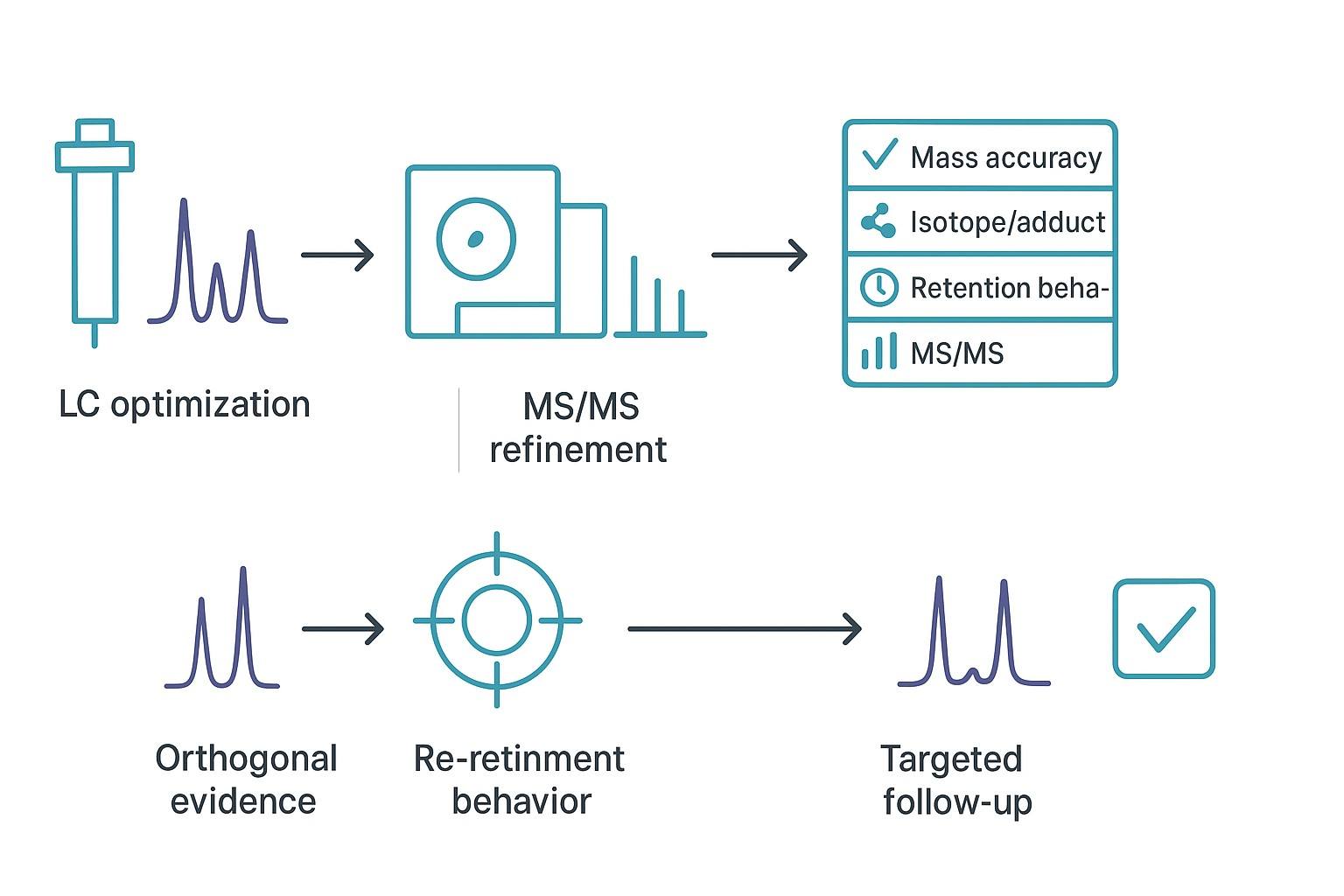
Integrate accurate mass, isotope pattern, adduct consistency, retention behavior, and MS/MS evidence into a single, auditable decision.
(That combination—orthogonal evidence for metabolite annotation—doesn't eliminate ambiguity entirely, but it does make your candidate ranking far more stable and defensible.)
A practical way to operationalize this in a team is to treat each evidence layer as a gating criterion—not as a score you average.
| Evidence question | What you're checking | Typical decision outcome |
|---|---|---|
| Does the accurate mass support a plausible formula? | ppm error; formula candidates; instrument performance | Rule out incompatible formulas early |
| Do isotope/adduct patterns make chemical sense? | expected adducts by mode; isotope ratios; in-source fragments | Flag likely artifacts or wrong ion species |
| Does retention behavior fit the chemistry? | polarity vs RT; consistent RT across QCs/batches | Down-rank implausible candidates |
| Do MS/MS fragments support the structure? | diagnostic ions; neutral losses; substructure logic | Promote candidates with specific fragment support |
| Is the ID biologically plausible in context? | matrix + organism + experimental design | Avoid "alien metabolite" false positives |
This approach maps naturally to how preclinical decisions are defended: you can show why a candidate was promoted or rejected at each gate.
When you need support to interpret multi-layer evidence—especially to turn discovery into pathway-level conclusions— Metabolic Pathways Analysis can be used as an extension of that evidence model, because pathway coherence is often the difference between "many plausible hits" and "a small set that fits the biology."
Avoid Overreliance on a Single Matching Metric
A recurring cause of low-confidence metabolite annotations is treating a single metric as proof of identity—most commonly accurate mass matching or a library score. The literature has repeatedly cautioned that mass-only identification leads to false positives, including biologically implausible calls that pass unnoticed when reviewers cannot audit the evidence chain (Schymanski et al., 2023).
A disciplined workflow treats accurate mass as an entry point, not a conclusion. The same is true for MS/MS library scoring: it's useful, but it should not be the final arbiter when isomers, co-elution, and matrix-specific ionization artifacts are in play.
Use Standards Strategically for High-Value Metabolites
Authentic standards are still the most defensible route to high-confidence confirmation when the metabolite identity changes the interpretation.
Reserve authentic standards for metabolites that are biologically important, publication-critical, or decision-driving. This is not about "confirm everything"; it's about confirming what moves the project.
Confirm retention time and fragmentation behavior where definitive identification is required. Standards enable you to validate the two dimensions that are hardest to fake: retention behavior in your exact LC method and an MS/MS spectrum acquired under your acquisition conditions.
Apply standards-based confirmation as part of a staged validation workflow rather than an all-or-nothing approach:
- Stage 1 (discovery): broad screening with clear labeling of annotation confidence.
- Stage 2 (prioritization): narrow down to the subset that affects biological claims.
- Stage 3 (confirmation): standards-based checks for the small set that must be reported as identified.
This staged approach is aligned with community reporting expectations around annotation vs identification (Sumner et al., 2013).
Resolve Ambiguous Features With Targeted Follow-Up
If you want to improve metabolite identification without ion mobility, the highest-impact "advanced move" is usually targeted follow-up—not more global discovery.
This is also where deciding when to use authentic standards in metabolomics becomes operational: you don't need standards for everything, but you often do need them for the handful of metabolites that anchor conclusions, biomarker claims, or decision gates.
Reanalyze Priority Features
Reinject unresolved but high-value features with focused acquisition settings. The goal is not more coverage; it's more discriminating evidence.
Focused reacquisition can include:
- More selective MS/MS targeting for the specific precursor/adduct that is ambiguous.
- Alternative fragmentation energies to reveal diagnostic fragments.
- Slight chromatographic adjustments to separate the critical co-eluting pair.
Because these follow-up runs are narrow in scope, they can be designed to maximize precursor purity and interpretability.
Convert Discovery Into Confirmation
Use targeted follow-up to move from broad untargeted screening toward higher-confidence metabolite calls. This is where your workflow becomes publication- and decision-ready: you concentrate effort on the subset of features most likely to affect biological interpretation.
In practice, the discipline here is to explicitly label which features remain "putatively annotated" versus "confirmed," and to avoid over-interpreting lower-confidence hits.
What Ion Mobility Adds to Metabolite Identification
Ion mobility can help separate ions that remain difficult to distinguish by LC-MS/MS alone, especially when co-elution persists and when structural isomers share overlapping fragments.
CCS measurements can provide an additional filter for candidate structures. Conceptually, CCS acts like an orthogonal descriptor of ion shape in the gas phase, complementing retention behavior in the liquid phase. This is one reason CCS libraries have been proposed as a practical reference layer (Stow et al., 2017).
Its value is highest when structural ambiguity persists after chromatographic and MS/MS optimization. In other words, ion mobility is most impactful when it changes what you would otherwise conclude—not when it only confirms what the conventional evidence already makes clear.
When Conventional LC-MS/MS Is Usually Enough
Conventional optimization is often sufficient when the study's interpretive unit is higher-level than a single definitive structure.
Broad profiling studies focused on pathway-level interpretation can tolerate some ambiguity at the individual-metabolite level, provided the workflow is transparent about confidence and uses orthogonal checks to prevent obvious false positives.
Projects prioritizing throughput, robustness, and cost control often benefit more from improving LC stability, MS/MS quality, and annotation discipline than from adding another analytical dimension.
Workflows where the main ambiguity can be addressed through separation, data quality, and annotation discipline typically do well without IM-MS—particularly when standards are used strategically for the small set of metabolites that must be confirmed.
When Ion Mobility May Be Worth Considering
Ion mobility becomes more compelling when the bottleneck is structural discrimination that refuses to yield to conventional improvements.
A simple rule of thumb: consider when ion mobility adds value in metabolomics when it would change a decision you have to defend—by separating an isomeric pair, by deconvoluting persistently mixed MS/MS, or by providing CCS evidence that meaningfully narrows the candidate list for a priority feature.
Persistent isomeric interference limits interpretation when two candidate structures imply different biological mechanisms (or when a biomarker claim hinges on the correct isomer).
Complex matrices routinely produce ambiguous spectra, even after chromatographic tuning, especially when co-eluting background ions repeatedly contaminate MS/MS.
Critical decisions depend on stronger structural discrimination for a small set of metabolites. In these cases, the extra evidence layer (drift time/CCS) may reduce residual uncertainty enough to make the call defensible.
A compact decision matrix can help teams decide whether to invest effort in further conventional optimization or to evaluate IM-MS.
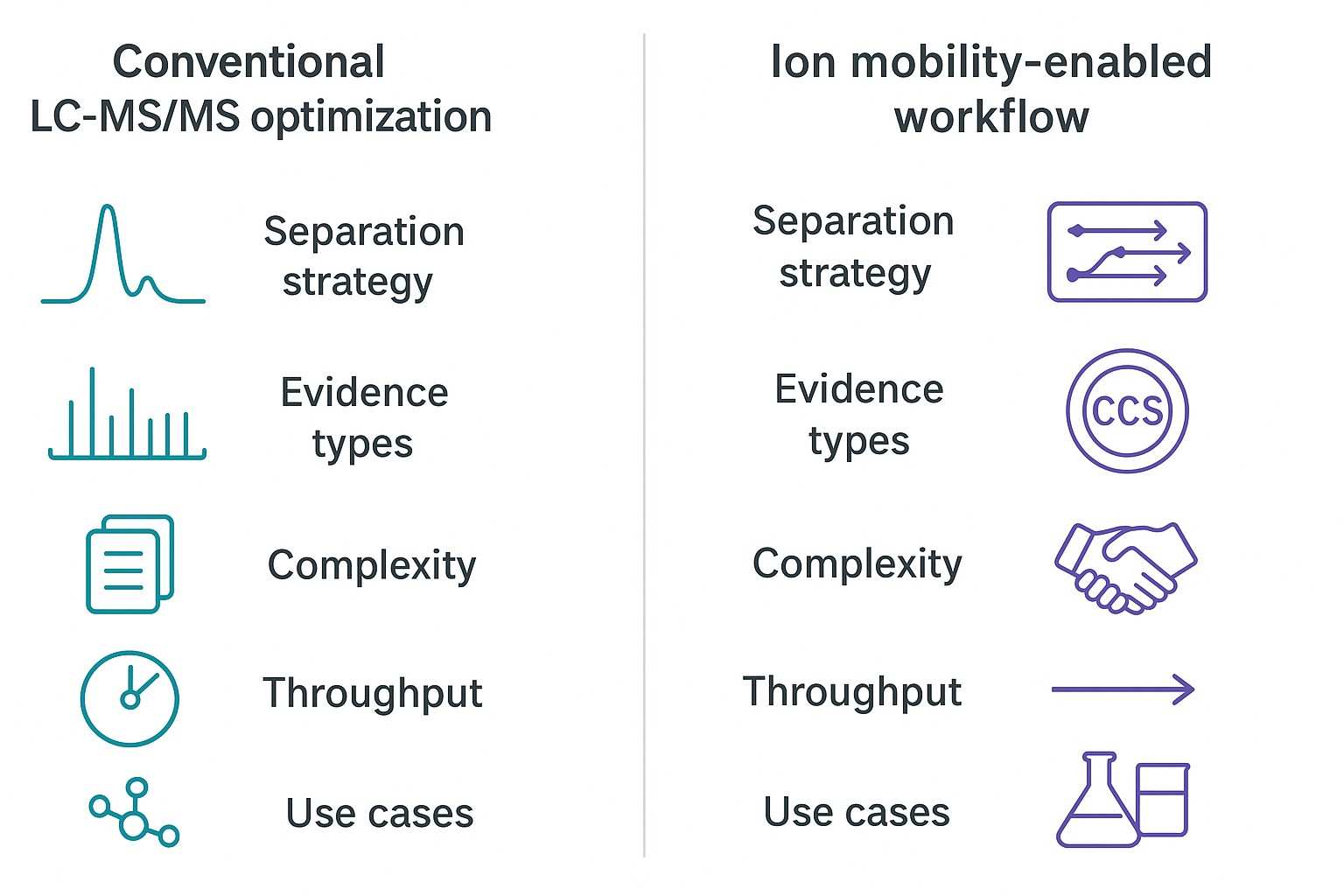
| If your dominant pain point is… | Conventional LC-MS/MS optimization usually helps most when… | Ion mobility is more likely to add value when… |
|---|---|---|
| Isomer ambiguity | You can change selectivity or run targeted follow-up for the class | Isomers persist under optimized LC and MS/MS remains non-diagnostic |
| Mixed spectra / co-elution | Narrow isolation + targeted reacquisition can clean spectra | Co-elution is unavoidable and drift-time separation can disentangle ions |
| Low reproducibility (RT drift) | Method/QC improvements stabilize RT and acquisition timing | Your RT is stable but ambiguity remains structural, not operational |
| Library insufficiency | Orthogonal filters + standards for key metabolites close the gap | Candidate list remains large even after strong orthogonal filtering |
Common Reasons Metabolite Annotations Remain Low Confidence
Most low-confidence outcomes come from repeatable workflow failure modes rather than a lack of advanced instrumentation.
Overreliance on accurate mass matching is the most common. Exact mass is necessary, but it is rarely sufficient for structure-level claims.
Poor chromatographic separation turns a chemically meaningful problem into a data problem: once features co-elute, precursor isolation and fragment interpretation become uncertain.
Mixed or low-quality fragment spectra undermine every downstream step, from library scoring to pathway interpretation.
Weak distinction between annotation and confirmed identification creates credibility risk. When "putatively annotated" features are written up as confirmed metabolites, the work becomes difficult to reproduce and easy to challenge. Community discussions around reporting standards emphasize that confidence levels must be explicit to keep interpretation honest (Sumner et al., 2013).
Frequently Asked Questions
Is Ion Mobility Necessary for Metabolite Identification?
No—ion mobility is not necessary for many metabolomics studies, but it can be decisive for a subset of hard-to-resolve cases.
Ion mobility is most helpful when isomers remain unresolved after chromatographic optimization and when co-elution repeatedly contaminates MS/MS. If your primary bottlenecks are mixed spectra, inconsistent retention, or overconfident mass-only annotation, conventional LC-MS/MS workflow discipline often yields larger gains before you add CCS.
How Can LC-MS/MS Identification Confidence Be Improved Without CCS?
Improve precursor purity and enforce a multi-layer evidence model that integrates mass accuracy, isotope/adduct logic, retention behavior, and MS/MS fragments.
Practically, that means (1) improving chromatographic resolution for the class where ambiguity clusters, (2) reducing mixed MS/MS spectra via more selective acquisition for priority features, and (3) using retention behavior and biological plausibility as explicit filters—not optional "nice-to-haves."
When Should Authentic Standards Be Used?
Use authentic standards when the metabolite identity is publication-critical, decision-driving, or required for high-confidence reporting.
A staged strategy works best: confirm a small, prioritized set rather than attempting to standard-confirm every annotated feature. Standards are particularly valuable when two candidate structures imply meaningfully different biology, or when a biomarker claim depends on the exact structure.
Why Do Untargeted Metabolomics Studies Produce Ambiguous Annotations?
Direct answer: Because untargeted LC-MS/MS detects many more features than it can uniquely identify, and multiple compounds can share similar masses and fragments.
Ambiguity increases when co-elution produces mixed spectra, when libraries lack matrix- and method-matched references, and when teams treat a single matching metric as proof of identity. Clear separation between "annotation" and "confirmed identification" is what keeps interpretation defensible.
What is the difference between metabolite annotation and metabolite identification?
Annotation is a best-available assignment based on evidence; identification is a confirmed structural claim supported by orthogonal confirmation (often including standards).
Many workflows can generate high-coverage annotations, but only a subset of metabolites can be confirmed at the highest confidence level in a given project. Using explicit confidence labels protects downstream interpretation and improves reproducibility.
Can retention time be used to confirm a metabolite?
Retention time can strongly support confirmation, but only when compared to an authentic standard analyzed under the same LC conditions.
RT is highly method-dependent, so RT "from the literature" is usually not definitive. Within a single method, however, stable retention behavior is a powerful orthogonal filter to reject implausible candidates.
Why do I get a high library match score but the identification still feels wrong?
High scores can occur for mixed spectra, for closely related isomers, or when the library spectrum was acquired under different conditions.
Treat the score as a starting point, then check precursor purity, retention plausibility, and diagnostic fragments. If the spectrum appears chimeric or the RT behavior contradicts the candidate's chemistry, down-rank the match and re-acquire targeted MS/MS.
Build a Fit-for-Purpose Strategy for Higher-Confidence Metabolite Identification
Start by identifying the main source of ambiguity in the workflow. If ambiguity clusters around a metabolite class, it's often a selectivity problem; if ambiguity appears as unstable MS/MS, it's often a precursor purity problem; if ambiguity is "too many plausible candidates," it's an evidence-model and reporting problem.
Strengthen separation, MS/MS quality, and annotation logic before adding analytical complexity. This not only improves LC-MS/MS metabolite identification confidence, it also makes any later addition of ion mobility more productive—because you will have already removed the avoidable sources of uncertainty.
Use ion mobility selectively when it provides decision-relevant structural resolution. When it does, it can be a powerful addition. When it doesn't, conventional optimization plus staged standards confirmation is often the faster route to defensible results.
If you're planning a study where identification confidence is likely to be the limiting factor—especially in preclinical decision-making—consider a staged workflow that pairs discovery profiling with targeted confirmation and transparent evidence reporting. Creative Proteomics supports this end-to-end approach through broad profiling ( Untargeted Metabolomics Service ), confirmation-oriented panels ( Targeted Metabolomics Service ), and interpretation support ( Metabolomics Data Analysis ) to connect molecular calls to pathway interpretation.
References
- Ensuring Fact-Based Metabolite Identification in Liquid Chromatography–Mass Spectrometry-Based Metabolomics
- The application of ion mobility mass spectrometry to metabolomics
- Collision Cross Section as a Molecular Descriptor in Ion Mobility Spectrometry–Mass Spectrometry
- The role of reporting standards for metabolite annotation and identification in metabolomics
- Metabolite identification and quantitation in LC-MS/MS-based metabolomics
- Prioritization of putative metabolite identifications in LC-MS metabolomics
- Towards a More Reliable Identification of Isomeric Metabolites in Untargeted Metabolomics
Note: Citations are provided in the References section; in-text mentions use author-year for readability.

 Contact Us