

Longitudinal Multi-omics Study Design: When It’s Worth It and How to Pick Timepoints, Controls, and Statistics
Submit Your InquiryIntroduction
Longitudinal multi-omics means repeatedly measuring two or more omics layers from the same experimental units across time to capture trajectories, not just snapshots. Done well, it separates baseline heterogeneity from true temporal change, reveals early versus late responses, distinguishes transient spikes from sustained shifts, and clarifies rebound or recovery phases. For R&D, this matters because mechanistic interpretation, exposure–response inference, and go/no-go decisions often hinge on the shape of change, not a single endpoint. Put simply, a rigorous longitudinal multi-omics study design helps you decide when dynamics are worth the additional complexity.
This guide provides decision criteria for when longitudinal designs pay off, a biology-anchored strategy for selecting timepoints, a control and replication plan fit for RUO/translational settings, QC and batch-mitigation practices, and time-series statistics that support publication-ready and audit-ready outputs.
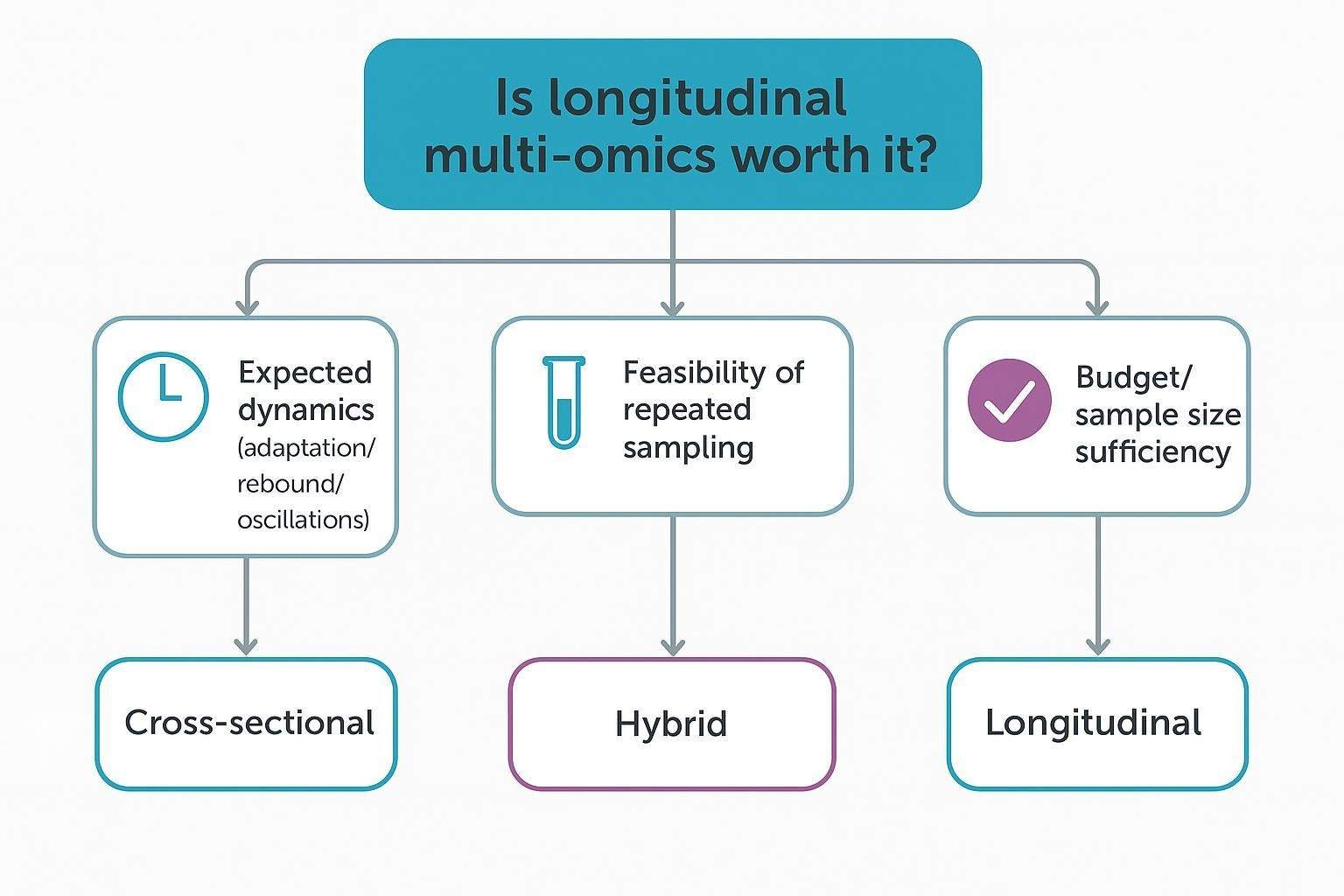 Figure: Quick decision aid to determine whether to pursue cross-sectional, hybrid, or longitudinal designs.
When longitudinal multi-omics study design is worth it
- You expect time-dependent biology such as adaptation, rebound, delayed toxicity, recovery, oscillations (e.g., circadian), or detailed treatment trajectories.
- Within-subject change is the main signal because baseline heterogeneity across subjects or sample units is high.
- You need trajectory shape, not just an endpoint difference—for example, distinguishing an early spike from a gradual drift or a biphasic response.
- Longitudinal improves inference for intervention/exposure–response questions in non-clinical and translational R&D , where group×time interactions are often the primary effect of interest.
- If baseline heterogeneity is high and repeated sampling is feasible, then a within-subject longitudinal design is often the most efficient way to isolate biology from person-to-person noise.
- If the decision hinges on when effects emerge (onset/peak/recovery) rather than whether an endpoint differs, then treat trajectory shape as the primary endpoint and plan timepoints accordingly.
When cross-sectional is enough (and safer)
- The biology is likely near steady-state, and only one window is decision-relevant.
- Repeated sampling is invasive, unreliable, or introduces stress artifacts that could dominate the signal.
- Batch control is weak (fragmented runs, uncontrolled drift, limited per-batch balance), making longitudinal comparability fragile.
- Budget limits would force too few subjects or timepoints for interpretable modeling or QC balancing.
- If you can't realistically balance batches across groups and timepoints, then cross-sectional (or a phased design) is usually safer than a fragile longitudinal dataset.
- If repeated sampling changes the biology (stress, blood loss, anesthesia, handling), then reduce frequency or switch to terminal cross-sectional sampling at decision-relevant windows.
Hybrid and phased designs (often highest ROI)
- Two-phase strategy: run a cross-sectional pilot to localize informative windows, then follow up with a focused longitudinal cohort.
- Sparse longitudinal: fewer timepoints and more subjects to improve generalizability and power for mixed models.
- Dense longitudinal: more timepoints with fewer subjects when trajectory shape mapping is the primary goal and sampling is low-burden.
- Minimal viable multi-omics: make one omics layer longitudinal and add a second layer at key timepoints for interpretation and verification.
- If uncertainty is mostly about which windows matter, then pilot cross-sectional first and reserve longitudinal sampling for the narrowed windows.
- If you need a publishable trajectory but can't afford full multi-layer density, then keep metabolomics longitudinal and add targeted verification at a subset of timepoints.
Picking timepoints
Anchor to biology
Start by writing the event model: exposure/intervention triggers signaling, which influences transcription, then protein abundance/activity, then metabolite levels and phenotype. Define windows for baseline stabilization, early response, peak, resolution, and rebound/compensation. Account for layer-specific lags—transcriptome changes can arrive earliest; proteome and metabolome often lag; microbiome changes may take even longer.
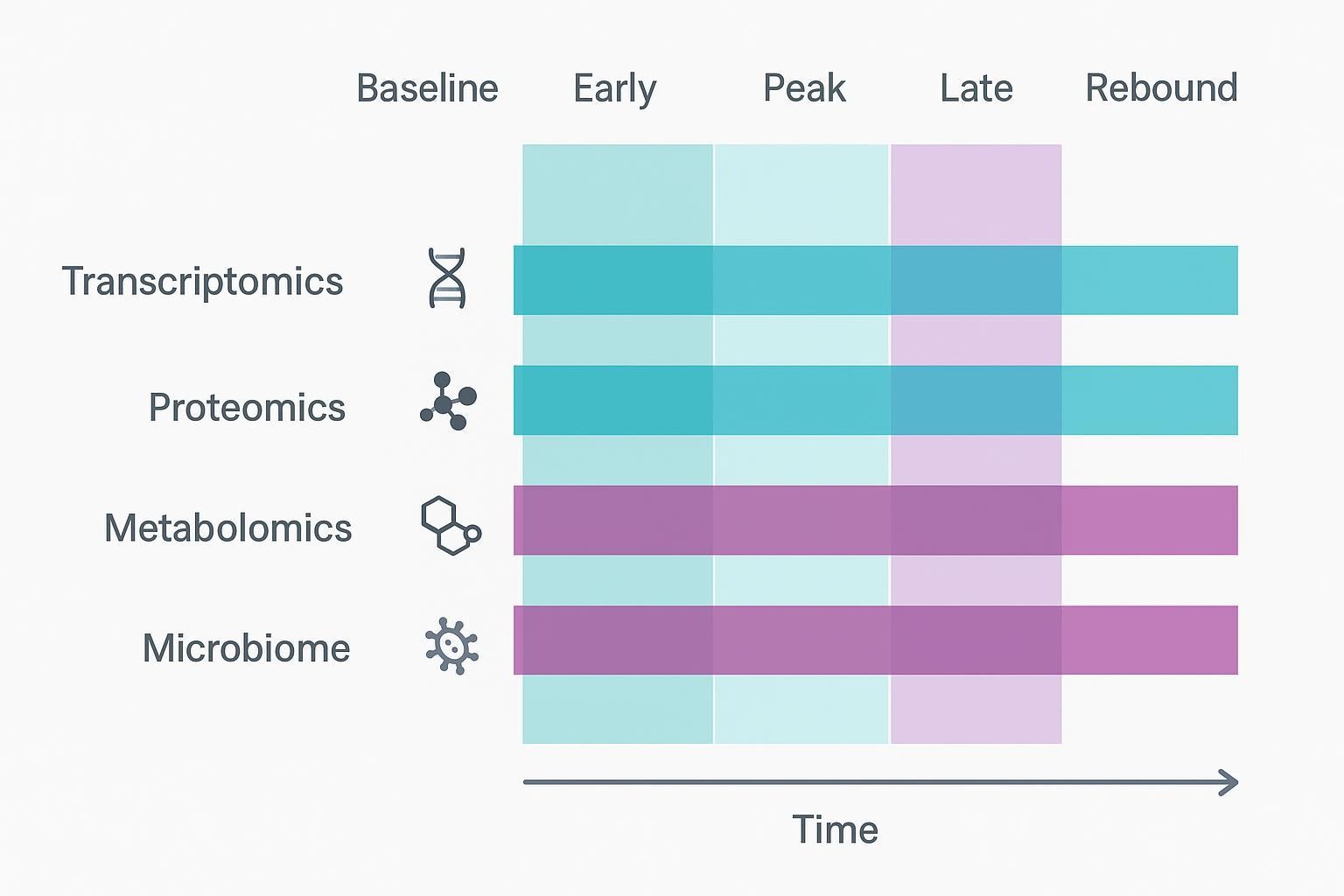 Figure: Layered kinetics guide sampling windows across omics—front-load early windows for fast layers and extend later windows for slower layers.
Cadence and spacing
- Use non-uniform spacing if early kinetics matter: more points early, fewer later.
- Choose cadence based on expected rate of change; avoid oversampling that cuts subject N or increases missingness.
- Predefine allowable timing windows (e.g., ± tolerance around nominal times) and targets for handling latency to contain preanalytical variance.
Align cases and controls over time
- Match collection clock-time to reduce circadian confounding.
- Standardize fed/fasted state, or—at minimum—record it as structured metadata for modeling.
- Keep collection-to-stabilization intervals consistent across all timepoints and groups.
Controls and replication
Baselines and shams
- Capture a per-subject baseline to enable within-subject inference.
- Add sham/vehicle controls where procedures themselves may shift omics readouts.
- Use run-in periods when baseline stabilization is uncertain.
If your design relies on frequent blood draws, plan for consistent matrices and handling (plasma vs serum, anticoagulant choice, processing time) to keep time-course variation biological rather than preanalytical; blood/plasma/serum metabolomics services for repeatable time-course sampling can be a useful reference point for matrix-specific considerations.
Covariates and matching (including human-origin RUO cohorts)
- Record key covariates: medication exposure, diet, circadian timing, activity, BMI/weight, and sample quality flags (e.g., hemolysis for blood).
- Prefer limited matching plus statistical adjustment; heavy matching can shrink feasible recruitment and generalizability.
Replicates, holdouts, and validation
- Distinguish technical QC replicates (instrument/process) from biological replication (subjects).
- If prediction is a goal, keep a subject-level holdout set (not timepoints from the same subjects) to avoid leakage.
- Plan verification: discovery → targeted verification → orthogonal validation (research context, non-diagnostic).
For many longitudinal programs, the cleanest way to operationalize "verification" is to move from discovery-grade profiling to a pre-specified targeted panel for key metabolites and timepoints.
QC and batch mitigation
Run design and QCs
Balanced, randomized run design and layered QC assets protect longitudinal comparability:
- Balance each batch with a proportional mix of groups and key timepoints.
- Randomize sample order; interleave pooled QCs and procedural blanks to monitor drift, carryover, and contamination.
- Track drift and missingness trends continuously; predefine rerun/re-extraction rules anchored to QC outcomes.
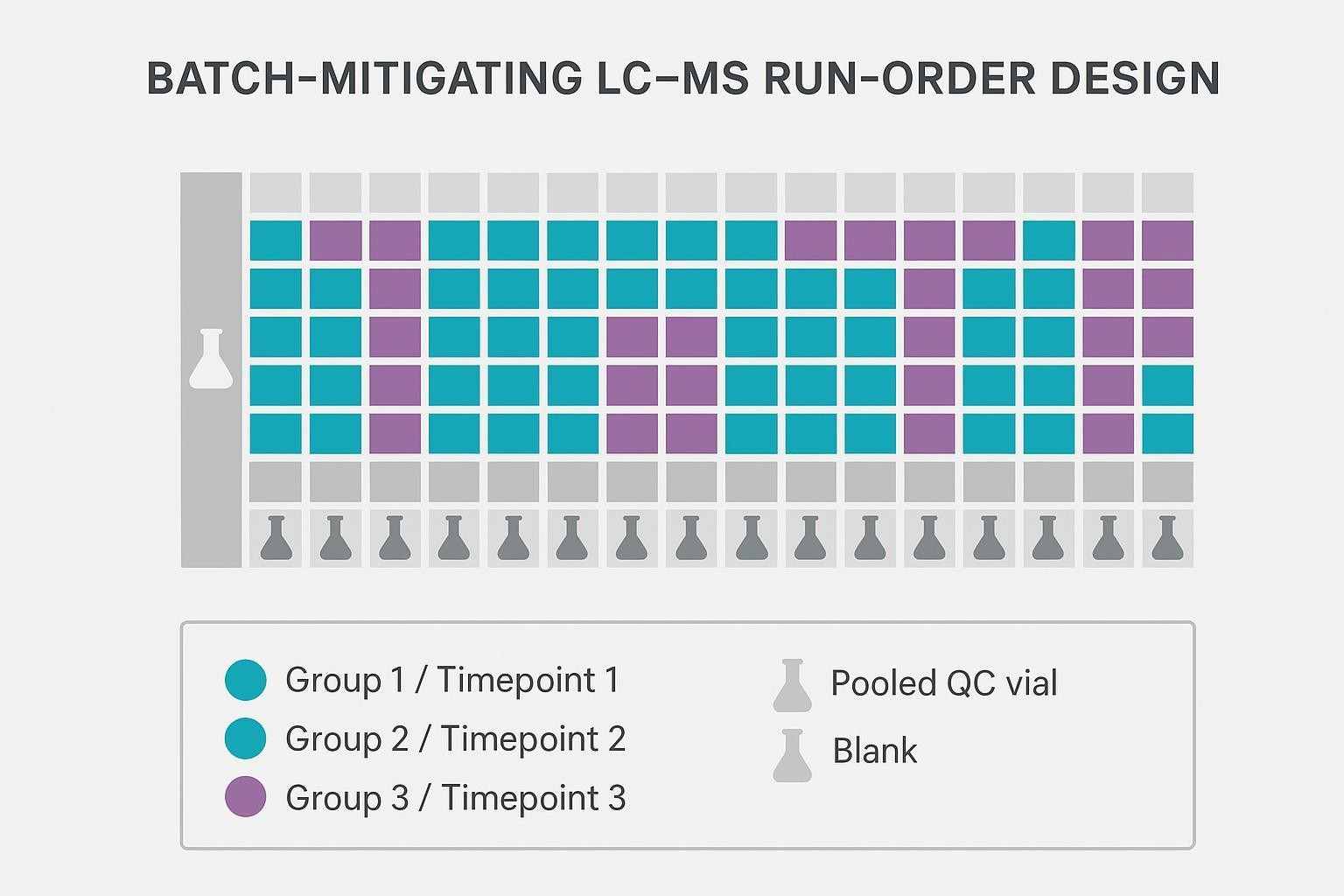 Figure: Batch-mitigating run design with balanced representation of each timepoint/group in every batch and interleaved pooled QCs/blanks.
Acceptance thresholds (principles, not rigid promises)
Set acceptance rules before data review and apply them consistently. Document every decision in an audit log.
| Category | Principle for acceptance rules (examples, not hard promises) |
|---|---|
| QC precision | Specify expected precision bands for pooled‑QC variability; investigate features exceeding expectations. |
| Drift tolerance | Define allowed instrument drift patterns and triggers for correction, rerun, or exclusion. |
| Missingness | Set limits for feature- and sample-level missingness and predefine handling paths (e.g., down-weighting, imputation eligibility). |
| Exclusion/rerun | Predefine criteria for re-extraction or rerun and for final exclusion; justify and log each action. |
| System suitability | Use check samples/ISTDs to confirm stability in mass accuracy, retention time, and sensitivity prior to and during runs. |
Normalization and correction
Prefer prevention through balanced design over aggressive post‑hoc correction. When correction is justified, apply guardrails to avoid removing biology:
- QC‑anchored normalization (e.g., LOESS- or SVR‑based schemes) calibrated on interleaved pooled QCs.
- Batch‑effect correction methods with covariate awareness; assess whether drift models risk absorbing true group×time signals.
- Cross‑omics consistency checks: sample identity alignment, plausible correlation structure, and stability of pathway‑level signals before and after correction.
When preprocessing and batch correction become a dominant part of the effort (e.g., high missingness, strong run drift, multi-batch expansion), it helps to align on an analysis plan early; metabolomics preprocessing, missing values, and batch correction summarizes common decision points.
Statistics for time series
Mixed-effects models (default workhorse)
Model longitudinal features with fixed effects for group, time, and their interaction (group×time), plus random effects for subjects. Treat time as categorical to capture nonlinear patterns or as continuous with splines for smooth trajectories. Control multiplicity with FDR and report effect sizes with uncertainty.
Example model structures (feature-wise):
| Modeling choice | When to use | Notes |
|---|---|---|
| Time as categorical + random intercept | Unknown/nonlinear patterns; modest number of timepoints | Robust to shape assumptions; tests group×time contrasts directly. |
| Time as continuous + spline + random intercept | Smooth trajectories expected | Choose knots by biology or information criteria; inspect residuals. |
| Random slope (time) | Heterogeneous individual slopes | Improves fit if subjects differ in rates of change; watch convergence. |
Integration methods for longitudinal multi-omics
- Pathway-level integration for interpretability and publication-ready narratives.
- Network/module approaches to detect coordinated programs over time.
- Joint latent-factor methods to capture shared trajectories across layers; state assumptions and interpretability limits explicitly.
- Avoid complex ML unless sample size and validation plan support it; run generalization checks.
If your end goal is an integrated, audit-ready package (multi-layer QC summaries, harmonized metadata, pathway narratives, and deliverable files), it can help to define the workflow and outputs up front; a multi-omics integration workflow and typical deliverables is a useful checklist-style reference.
Missingness and confounding
Characterize missingness and choose principled handling; run sensitivity analyses. For reporting and stakeholder alignment, time-course plots that separate subjects and summarize uncertainty are often the fastest way to spot dropout, LOD effects, and drift.
| Missingness pattern | Typical causes | Handling options |
|---|---|---|
| LOD-related (left-censoring) | Low abundance, matrix effects | Model-aware imputation or censoring models; avoid naive zero-filling. |
| Dropout over time | Burden, degradation, protocol deviations | Mixed models tolerate MAR; document reasons; consider joint models if informative. |
| Batch-linked gaps | Instrument downtime, block failures | Batch-aware normalization; reruns per SOP; exclude only with documented rationale. |
Deliverables and compliance (RUO)
Validation summaries (research verification)
- Candidate trajectories tagged for stability across time and batches.
- Suggested targeted verification panels and follow-up experiments (non-diagnostic framing).
For longitudinal verification, a targeted panel is often the most practical way to reduce drift sensitivity and tighten interpretability around pre-specified hypotheses; targeted metabolomics for longitudinal verification provides a concrete example of how targeted workflows are typically positioned.
QC dashboards and transparency
- Drift plots, QC CV tables, missingness heatmaps, batch composition confirmation.
- Exclusion/rerun log with reasons and impact summary.
Reproducibility records
- Metadata schema and data dictionary.
- Analysis provenance (software versions, parameters, normalization choices, model formulas).
- "Re-run ready" checklist for future cohorts or added batches.
Practical templates readers can reuse
If you're scoping vendors or deciding which capabilities you need (targeted vs untargeted, data analysis support, and longitudinal comparability), metabolomics service options for longitudinal study designs can serve as a quick inventory of common service configurations.
- Timepoint planning worksheet
| Window | Nominal time(s) | Biological rationale | Layer focus (Tx/Pr/Mm/Mb) | Allowable window | Notes |
|---|---|---|---|---|---|
| Baseline | 0 h | Stabilize pre-intervention variability | All | ±X h | Run-in if unstable |
| Early | 6–24 h | Acute signaling/transcription | Tx | ±Y h | Denser if rapid |
| Peak | 48–96 h | Max effect window | Tx/Pr/Mm | ±Y h | Confirm with pilot |
| Late | 1–2 w | Resolution/adaptation | Pr/Mm | ±Z h | Sparser cadence |
| Rebound | 2–4 w | Compensation/oscillation | Mb/Mm | ±Z h | Optional by biology |
- Batch balancing checklist
| Item | Yes/No | Notes |
|---|---|---|
| Per-batch mix of all groups/timepoints | ||
| Randomized order within batch | ||
| Pooled QCs interleaved at regular cadence | Define cadence range in SOP | |
| Procedural blanks at start and between blocks | Carryover check | |
| System suitability checks logged | Mass accuracy/RT/sensitivity | |
| Rerun/re-extraction rules pre-specified | Linked to QC outcomes |
- Minimal metadata checklist (human-origin cohorts included)
| Domain | Fields |
|---|---|
| Subject | ID, age, sex, BMI/weight, medications, diet notes |
| Timing | Clock-time, sleep/wake alignment, fed/fasted status |
| Preanalytical | Collection time, stabilization time, centrifugation, freeze time, storage conditions |
| Quality | Hemolysis/hematuria flags, volume, deviations |
| Chain of custody | Sample IDs, transfers, operator IDs |
- Statistical analysis plan (SAP) template (summary)
| Section | Contents |
|---|---|
| Objectives | Primary and secondary hypotheses; endpoints |
| Models | Fixed: group, time, group×time; Random: subject (± slope) |
| Contrasts | Planned pairwise/time-slice and trajectory contrasts |
| Multiple testing | FDR control strategy and reporting |
| Missingness | MAR assumptions; imputation rules; sensitivity analyses |
| Normalization | QC-anchored plan; batch-effect correction guardrails |
| Provenance | Versions, parameters, seeds, notebooks, containers |
FAQs
What sample size tradeoffs matter most in longitudinal multi-omics design?
Prioritize subjects over excessive timepoints when heterogeneity is high. Use pilots to localize informative windows, then run sparse longitudinal designs with adequate N for mixed models.
How to choose timepoints for longitudinal omics studies without guessing?
Anchor to biology using layered kinetics: dense early sampling for transcriptional responses, then sparser later windows for proteome/metabolome; extend further for microbiome when justified.
Which repeated-measures statistics are most robust for multi-omics?
Linear mixed-effects with group, time, and group×time, plus random subject intercepts (± slopes). Treat time as categorical for nonlinear responses or continuous with splines for smooth trends; control FDR.
What's a practical QC strategy for longitudinal LC‑MS studies?
Balance each batch by group/timepoint, randomize order, interleave pooled QCs and blanks, track drift and missingness, and predefine rerun/exclusion rules with an audit log.
How should I handle missing data in longitudinal multi-omics?
Diagnose the pattern (LOD, dropout, batch-linked), use mixed models that tolerate MAR, apply justified imputation or censoring models if needed, and report sensitivity analyses.
How do I avoid overcorrection in batch adjustment for omics?
Prefer prevention through balanced design; when correcting, use QC‑anchored models, inspect pathway-level stability, and validate on held-out QCs to ensure biological signal preservation.
References
- Hoffman GE, Roussos P. dream: powerful differential expression analysis for repeated measures. Bioinformatics. 2021;37(2):192–201. https://academic.oup.com/bioinformatics/article/37/2/192/5878955
- Murphy JI, et al. Accessible analysis of longitudinal data with linear mixed models. PLoS Comput Biol. 2022;18(5):e1009985. https://pmc.ncbi.nlm.nih.gov/articles/PMC9092652/
- da Silveira LTY, et al. Mixed-effects model: a useful statistical tool for longitudinal data. J Vasc Bras. 2023;22:e20230061. https://pmc.ncbi.nlm.nih.gov/articles/PMC10171296/
- Kirwan JA, et al. Quality Assurance and Control Reporting in Untargeted Metabolomics. Metabolites. 2022;12(9):844. https://pmc.ncbi.nlm.nih.gov/articles/PMC9420093/
- Dunn WB, et al. Metabolomics 2022 workshop report: QA/QC best practices. Metabolomics. 2023;19:64. https://pmc.ncbi.nlm.nih.gov/articles/PMC11463686/
- Broeckling CD, et al. Current Practices in LC–MS Untargeted Metabolomics. Anal Chem. 2023;95. https://pubs.acs.org/doi/10.1021/acs.analchem.3c02924
- Rodríguez JD, et al. Normalizing and Correcting Variable and Complex LC–MS Data. J Proteome Res. 2022;21(6):1461–1476. https://pmc.ncbi.nlm.nih.gov/articles/PMC9144304/

 Contact Us