
Why Metabolomics Data Analysis Pipelines Fail and How to Fix Them
Submit Your InquiryMetabolomics looks deceptively straightforward on paper: acquire data, detect features, normalize, run statistics, annotate metabolites, interpret pathways. In practice, a metabolomics data analysis pipeline is a chain of dependencies. If early steps introduce instability—especially in QC structure, preprocessing, or batch handling—later steps can turn that instability into very convincing (and very wrong) biology.
This resource walks through the most common pipeline failure modes and, more importantly, how to fix them at the stage where they occur. The goal isn't to maximize feature counts or produce the longest metabolite list. It's to build a feature table you can defend in peer review: reproducible, QC-stable, interpretable, and auditable.
Why Metabolomics Pipelines Break More Often Than Researchers Expect
Most pipeline failures don't come from a single bad decision. They come from small weaknesses that reinforce each other: a run design that bakes in drift, a peak picking configuration copied from a different matrix, a batch correction method applied after the feature table has already been distorted, or an annotation workflow that inflates confidence beyond what the evidence supports.
A reliable pipeline is better judged by what it can withstand than what it can output. Four practical criteria are more informative than "how many metabolites did we identify?"
- Reproducibility: do technical replicates and QC replicates behave consistently?
- QC performance: do pooled QCs cluster tightly, and do internal standards remain stable?
- Interpretability: do results align with known chemistry and plausible biology?
- Reporting transparency: can another analyst audit parameters, filters, and decision points?
When those criteria are met, downstream modeling becomes meaningful. When they aren't, downstream modeling becomes a story generator.
What a Metabolomics Data Analysis Pipeline Is Supposed to Deliver
At a minimum, a metabolomics data analysis pipeline should convert raw analytical output into a technically stable feature table and then preserve real biological variation while minimizing technical noise. That stability is what makes downstream differential analysis, multivariate modeling, metabolite annotation, and pathway analysis defensible.
In other words, the pipeline is supposed to produce publication-ready evidence, not just plots. For many labs, this is exactly what they expect from a dedicated workflow such as Metabolomics Data Analysis —clear deliverables, explicit QC documentation, and traceable processing decisions that stand up to scrutiny.
Early Warning Signs That a Pipeline Is Failing
Pipeline failures often show up early, but they're easy to miss if you only look at end-stage statistics. The most reliable warning signs are QC- and structure-related.
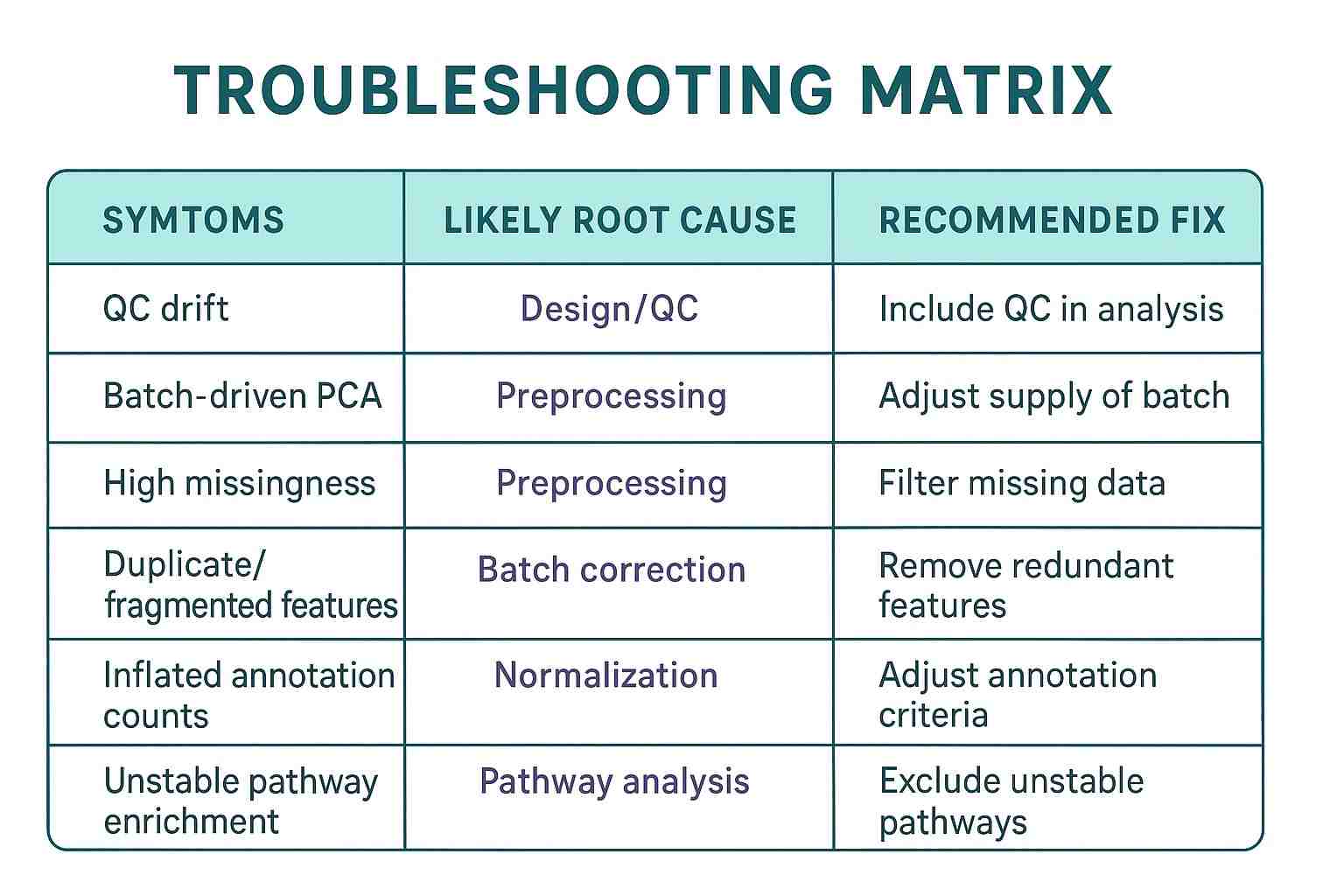
| Early warning sign | What it often indicates | What to check first |
|---|---|---|
| QC samples drift or scatter instead of clustering tightly | Instrument drift, unstable preprocessing, or run-order bias | QC placement, drift plots, feature RSD in pooled QCs |
| PCA separates samples by batch rather than biology | Strong batch structure or acquisition artifacts | Batch layout, run order, correction diagnostics |
| Missing values are excessive or unevenly distributed | Weak peak detection, misalignment, or overly aggressive filtering | Peak picking thresholds, RT alignment, gap-filling rules |
| Same analytes appear as duplicated/fragmented features | Mis-grouping of isotopes/adducts/fragments; misalignment | Feature grouping, adduct rules, alignment windows |
| Annotation counts look high, but confidence remains weak | Library overmatching, insufficient MS/MS support, isomers unresolved | MSI confidence tiering, MS/MS coverage, naming discipline |
| Pathway conclusions don't reproduce or clash with known biology | Unstable quantification + weak IDs amplified by enrichment | ID confidence, background definition, duplicate feature handling |
Key Takeaway: If QCs don't behave, don't trust the biology—fix the technical structure first.
Experimental Design and QC Problems That Break the Pipeline Before Analysis Starts
Weak Randomization and Run Design
Injection order bias is a quiet pipeline killer. If cases are injected early and controls late (or if one group concentrates in a single batch), drift can masquerade as biology. Once that happens, no downstream correction can fully recover the truth because the data are confounded: the pipeline cannot separate "group effect" from "time-on-instrument effect."
Anchored designs reduce this risk. In practice, that means randomizing injection order within constraints, spreading groups across batches, and using QC and system suitability samples as anchors to expose drift. The fix is not a statistical tweak—it's run architecture.
Inadequate QC Strategy
A fragile pipeline often starts with QC being treated as optional. Pooled QCs, internal standards, blanks, and system suitability checks are not "nice-to-haves"; they are the measurement framework that tells you whether the feature table is even trustworthy.
A useful mental model is that QC samples are your instrument's narrative—they tell you what the instrument did over time. Without them, your pipeline will still output numbers, but you won't know whether those numbers are chemistry or context.
For a widely cited, practical discussion of system suitability and QC samples in MS-based metabolomics, see Guidelines and considerations for the use of system suitability and quality control samples in mass spectrometry assays applied in untargeted clinical metabolomic studies (Reference).
Missing Acceptance Criteria
Even with QCs, pipelines break when teams never define "acceptable." If you don't predefine thresholds for drift, reproducibility, missingness, and feature stability, it becomes psychologically easy to keep analyzing a run that already failed.
Acceptance criteria don't have to be universal. They should be predefined and justified for your study type and platform. Examples include:
- pooled QC clustering and drift behavior (visual + metric-based)
- internal standard stability across the run
- feature-level reproducibility in pooled QCs (e.g., RSD targets that fit your assay)
- missingness thresholds by feature and by group
These criteria create a hard stop: if the run fails, you fix acquisition and preprocessing before you interpret biology.
Preprocessing Errors That Distort the Feature Table
Preprocessing is where raw chromatograms become a feature table. This is also where a pipeline can quietly manufacture instability—especially when parameters are transferred across instruments, matrices, or acquisition modes.
Peak Detection and Feature Extraction Problems
Peak picking is not a "set it and forget it" step. Noise thresholds, peak width windows, and signal-to-noise rules determine whether you are measuring metabolites or measuring the baseline.
A common failure mode is parameter mismatch: settings that worked for plasma fail in tissue; settings tuned for one LC gradient fail on another; settings tuned for positive mode fail in negative mode. The result is a feature table full of peaks that are not consistently detected, not linear across dilution behavior, or not reproducible in pooled QCs.
One robust takeaway from method-focused literature is that data processing parameters should be optimized rather than copied. A classic example is Strategy for Optimizing LC-MS Data Processing in Metabolomics (Reference), which emphasizes systematic parameter tuning to improve feature reliability.
Retention Time Alignment and Gap-Filling Errors
Misalignment does more than move peaks—it changes what a "feature" is. When alignment is poor, the same analyte can fragment into multiple features across samples, or distinct signals can be merged as if they were one. Either way, downstream statistics become unstable because the features no longer represent consistent chemical entities.
Gap filling can also create false reassurance. If gap filling is used aggressively, you can end up with a matrix that looks complete but is populated by noise-level estimates for samples where the signal was never truly present. That kind of artificial completeness is a fast route to false positives.
Adduct, Isotope, Fragment, and Feature Grouping Errors
A metabolomics feature table is often inflated by redundant representations of the same underlying metabolite: adducts, isotopes, in-source fragments, and multimers. If grouping is weak, a single biological change can appear as five or ten "independent" features, which can distort both statistics (multiple testing burden) and pathway mapping (duplicate hits).
Reducing redundancy before interpretation is not about losing information—it's about restoring the correct unit of inference.
Missing Audit Trails
When preprocessing is opaque, troubleshooting turns into guesswork. If you can't answer "what parameters produced this feature table?" you can't reliably reproduce it, review it, or fix it.
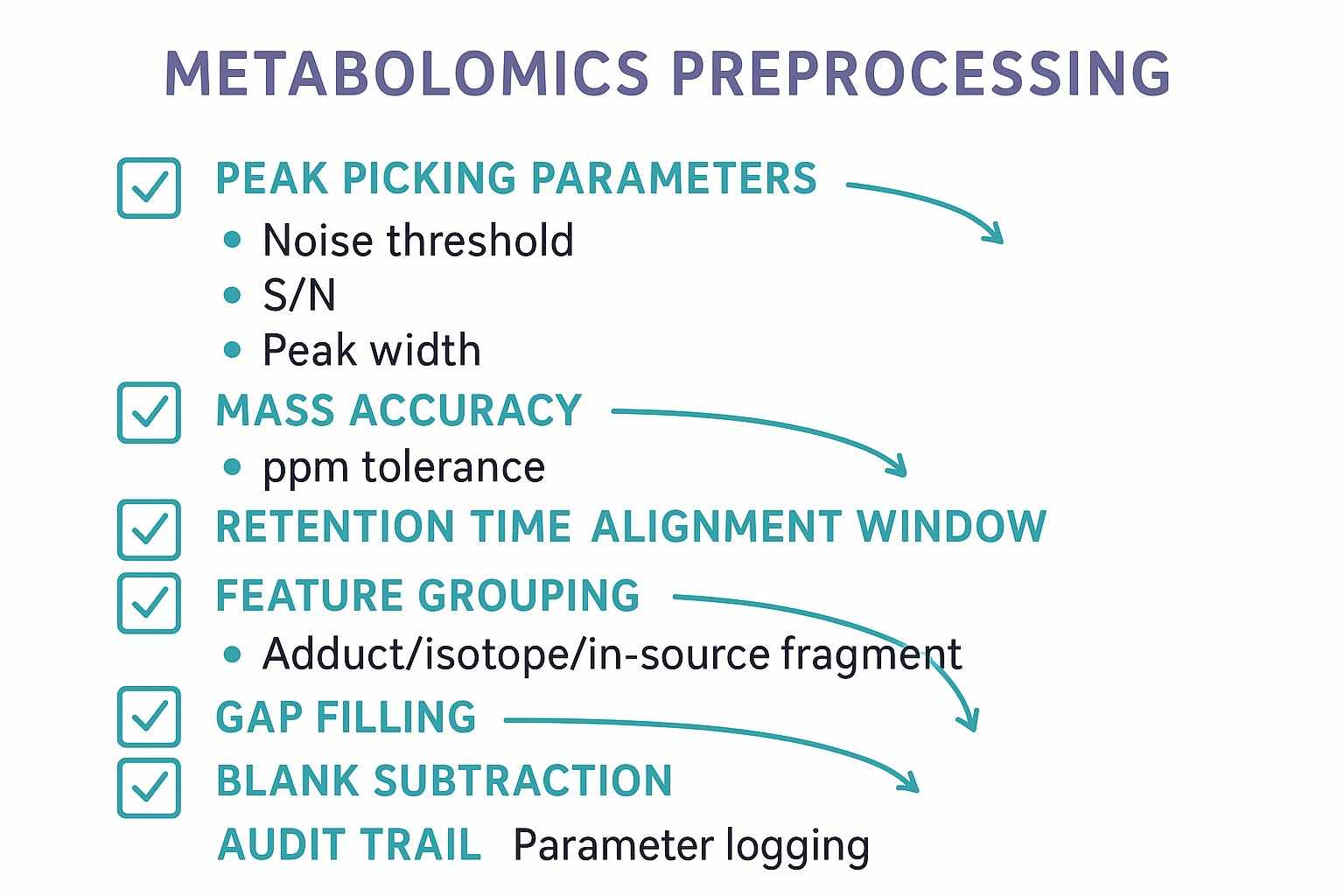
At minimum, preprocessing should leave a traceable record of:
- software and version
- key parameter settings (ppm tolerance, RT windows, S/N thresholds)
- filtering and blank subtraction rules
- feature grouping logic
- gap-filling rules and any imputation downstream
Batch and Drift Problems That Pipelines Often Mis-handle
When Batch Effects Are Treated Too Late
A common workflow mistake is treating batch as a downstream statistical nuisance. But batch structure is introduced during acquisition and reinforced during preprocessing. If early steps produce batch-specific feature fragmentation, later correction can only partially repair the damage.
This is one reason it's risky to "fix batch in the stats step" without first checking whether feature identity is consistent across batches.
How to Diagnose Whether Correction Worked
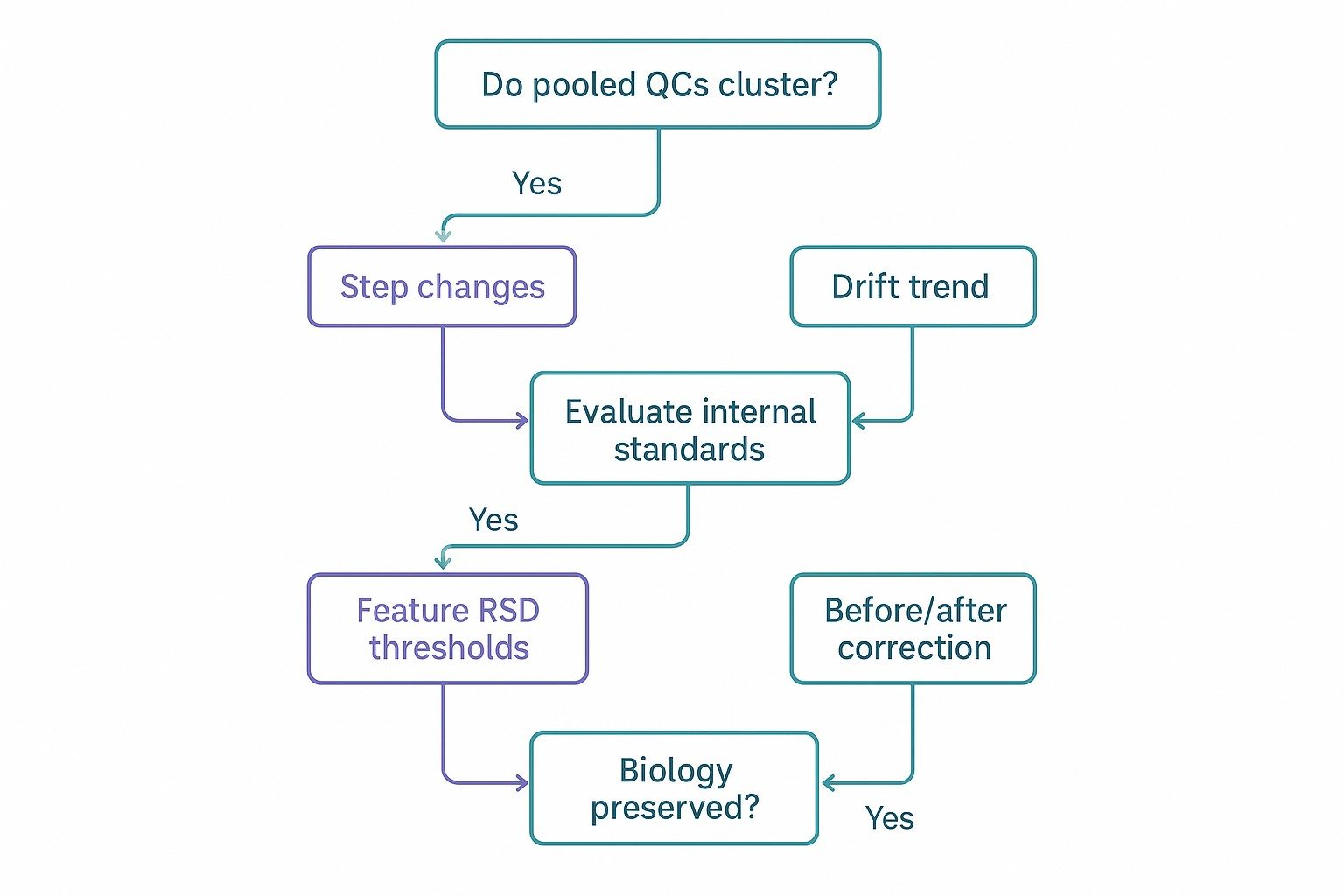
Batch correction should be treated like a controlled intervention with before/after evaluation. A correction that improves batch metrics while erasing biology is not a success—it's an overcorrection.
Practical diagnostics include:
- pooled QC clustering before vs after correction
- drift trends by injection order (global and feature-level)
- internal standard trajectories across the run
- feature variability in QCs (is reproducibility improved?)
- preservation of expected biological separation (do known contrasts still appear?)
A useful starting point for thinking about large-scale run troubleshooting is Troubleshooting in Large-Scale LC-ToF-MS Metabolomics Analysis (Reference), which discusses practical issues that show up in real multi-batch studies.
Safeguards for Preserving Biology Across Batches
A pipeline fails when correction is applied mechanically. Safeguards help you avoid the two extremes: leaving batch effects untreated, or "correcting" the biology away.
Correction choices should match:
- study design (are groups balanced across batches?)
- QC structure (do you have sufficient pooled QCs to model drift?)
- the biological contrast (large effect vs subtle differences)
If the study design is unbalanced, no correction method will magically create information that wasn't collected. In those cases, the fix may be to redesign the experiment (or to interpret results as exploratory).
Normalization, Transformation, and Scaling Errors That Distort Interpretation
Normalization and scaling are sometimes treated as "standard." They aren't. These choices reshape your data and can change what your models emphasize.
Poor Normalization Choices
Inappropriate normalization can amplify dilution effects, compress real differences, or introduce artificial group structure. A method that works for one matrix may fail in another.
The right question isn't "what normalization do people usually use?" It's "what unwanted variation dominates my data, and what evidence shows this method reduces it without harming biology?"
A practical way to keep this disciplined is to pair each normalization method with a falsifiable check: does pooled QC clustering improve, and do internal standards behave more consistently?
Transformation and Variance Stabilization Issues
Log transformation and related methods can make distributions more comparable and stabilize variance, but they also interact with missingness and zeros. If you apply a log transform without thinking about how zeros were created (true absence vs non-detection), you can encode detection limits as biology.
Treat transformation as an analytical decision with explicit assumptions. Check the distribution and the missingness structure before and after.
Scaling Choices That Reshape the Biology
Scaling affects clustering, feature ranking, model performance, and pathway emphasis. For example, unit variance scaling can elevate noisy low-abundance features; Pareto scaling can be a compromise but still changes what is "important."
The easiest way to avoid self-deception is to predefine what you're optimizing for (classification accuracy, interpretability, biomarker stability) and then verify that your scaling choice supports that goal.
| Choice | When it helps | When it harms |
|---|---|---|
| Sample-sum / total signal-type normalization | Helps when overall signal differences reflect dilution/amount | Harms if biology genuinely changes global metabolite load |
| Internal standard normalization | Helps when standards track drift and extraction variability | Harms if standards are unstable or not representative of the chemistry |
| Log transform | Helps when variance increases with intensity | Harms when zeros/non-detects dominate and are not handled explicitly |
| Unit variance scaling | Helps when you want equal weighting for features | Harms when it overweights noisy low-abundance features |
Statistical and Annotation Failures That Amplify Upstream Errors
Statistical Overreach
A fragile feature table can still produce impressive-looking models. Multivariate plots and machine learning classifiers often "work" because they capture structure—unfortunately, that structure is frequently batch, drift, or preprocessing artifacts.
Signs of statistical overreach include unstable cross-validation performance, dramatic changes in feature ranking after small preprocessing tweaks, and results that disappear when batches are analyzed separately.
Good statistics cannot rescue bad measurement. They can only hide it.
Annotation Inflation and Misidentification
High annotation counts are not automatically good news. Annotation can be inflated by permissive mass tolerances, weak MS/MS matching, failure to resolve isomers, or naming conventions that imply certainty where none exists.
If you're serious about interpretation, build annotation discipline into the pipeline: require evidence appropriate to the claim. A helpful overview of identification pitfalls in modern LC–MS/MS workflows is Navigating common pitfalls in metabolite identification and interpretation in non-targeted LC-MS/MS metabolomics (Reference).
Identification Confidence and Reporting Discipline
A defensible pipeline makes identification confidence explicit. The Metabolomics Standards Initiative (MSI) reporting guidance is still widely used as a baseline for confidence tiers; see Proposed minimum reporting standards for chemical analysis (Reference).
| MSI-style level | What evidence it implies | How far interpretation should go |
|---|---|---|
| Level 1 (confirmed ID) | Authentic standard measured under matching conditions with orthogonal evidence | Strongest claims; candidate biomarkers and precise pathway mapping are most defensible |
| Level 2 (putative annotation) | Library/literature match without in-lab standard confirmation | Use careful language; interpret as hypothesis-supporting, not definitive |
| Level 3 (compound class) | Class-level assignment (e.g., phosphatidylcholine) | Pathway-level discussion must be conservative |
| Level 4 (unknown feature) | m/z and RT only | Treat as signal patterns; avoid metabolite-specific biological claims |
The point isn't bureaucracy. It's aligning claims with evidence so reviewers can trust the story.
Pathway Analysis Pitfalls That Make Bad Data Look Biological
Pathway enrichment is powerful—and dangerous. It can turn a noisy feature table and weak annotations into an apparently coherent mechanism.
Three issues commonly cause pathway stories to drift away from reality:
- Background definition: an inappropriate background set can inflate significance.
- Mapping quality: putative IDs and unresolved isomers can map to multiple pathways.
- Duplicate feature handling: redundant adducts/fragments can create repeated "hits."
Treat pathway analysis as downstream evidence, not as proof that upstream processing was valid. If you want pathway results to be robust, tighten feature-table stability and ID confidence first.
If readers need deeper context on how pathway mapping and interpretation is performed as a deliverable, Metabolic Pathways Analysis provides a relevant overview.
Fix the Pipeline at the Stage Where It Fails
A reliable repair strategy is stage-matched. If you fix the wrong stage, you may improve visuals without improving truth.
Fix Design and QC Before Downstream Modeling
If QCs drift, don't start by changing p-value thresholds. Start by fixing:
- run randomization and batch layout
- pooled QC placement density (enough to model drift)
- internal standard selection and monitoring
- acceptance criteria and stop/go rules
In practice, that may mean rerunning part of the experiment. It's painful, but it's often cheaper than publishing irreproducible conclusions.
Rebuild Preprocessing Before Adjusting Statistics
If missingness is high, features are duplicated, or analytes fragment into multiple features, revisit preprocessing before you "normalize harder." Focus on:
- peak picking parameter tuning (matrix-appropriate thresholds)
- retention time alignment quality checks
- feature grouping (adduct/isotope/fragment consolidation)
- blank subtraction and contaminant filtering
- missing-value logic (non-detect vs true absence)
If you're struggling to stabilize the feature table in a discovery context, it can help to re-evaluate whether the question is better served by an untargeted or targeted design. For discovery-style global profiling, Untargeted Metabolomics Service is often the appropriate category; for confirmation and robust quantification of selected metabolites, Targeted Metabolomics Service can be a better fit.
Correct Batch and Drift Without Erasing Biology
Use QC-aware diagnostics to validate that correction improves technical structure and preserves meaningful biological separation. If biological contrasts disappear after correction, treat that as a red flag—not a success.
A disciplined approach is:
- evaluate before/after QC clustering and drift plots
- check internal standard trajectories
- confirm that expected biology is preserved
- document the correction method and parameters
Tighten Annotation Before Telling a Biological Story
When annotation is weak, the fix is not to "get more names." The fix is to tighten confidence:
- separate putative vs probable vs higher-confidence identifications
- prioritize MS/MS evidence quality over the volume of annotated features
- treat isomer ambiguity explicitly
This is where many biomarker and pathway claims live or die. If the evidence is Level 2/3, write the biology accordingly.
Use QC Metrics to Decide Whether the Data Table Is Trustworthy
QC metrics are your gatekeeping layer. Before differential analysis or machine learning, review:
- pooled QC clustering (e.g., PCA)
- drift behavior over injection order
- internal standard stability
- feature-level reproducibility in QCs
- missingness patterns (overall and by group)
If those checks look good, your feature table is more likely to support both technical consistency and biological plausibility. If not, treat the downstream analysis as exploratory at best.
For labs that need pipeline outputs structured for peer review and reuse (data dictionary, QC summary, and traceable parameterization), Metabolomics Data Analysis is a relevant reference point for what "auditable deliverables" can look like.
Why More Features and More Annotations Do Not Mean Better Analysis
It's easy to confuse output volume with pipeline quality. Bigger tables can reflect:
- noise retention (weak filtering)
- redundant features (adducts/fragments not consolidated)
- misalignment-induced splitting
- overly permissive annotation rules
A robust pipeline prioritizes consistency, interpretability, and evidence-backed annotation. The goal isn't maximum signal retention—it's defensible insight.
How to Prioritize Pipeline Repairs
When multiple things look wrong, prioritization matters. A practical order is:
- Fix experimental design and QC structure before downstream modeling.
- Repair preprocessing and feature-table instability before relying on normalization or batch correction.
- Confirm annotation quality before drawing biomarker or pathway conclusions.
- Rebuild the workflow when multiple failure modes appear at once rather than patching symptoms.
When to Rebuild the Pipeline Instead of Tweaking It
If QC instability, poor feature structure, batch-dominated separation, and weak annotation appear together, local fixes often aren't enough. These combined failures typically indicate that the underlying workflow logic is mismatched to the study design, analytical platform, or sample type.
Rebuilding can be more efficient than repeatedly tuning thresholds because a rebuilt pipeline forces you to re-validate each stage: run design, QC anchors, preprocessing parameters, batch modeling strategy, and identification/reporting discipline.
Transparent Reporting That Prevents Hidden Pipeline Failure
Transparent reporting is not paperwork—it's how you prevent hidden pipeline failures from surviving into manuscripts.
At minimum, report:
- software and versions
- preprocessing parameters (peak picking, alignment, filtering, grouping)
- QC thresholds and acceptance criteria
- normalization and batch correction choices (including diagnostics)
- imputation rules and missingness handling
- annotation criteria and confidence tiers
- pathway background assumptions and mapping rules
A useful framing is to separate "technical repair steps" from "biological findings" in both figures and narrative. Reviewers should be able to see that the pipeline is stable before they evaluate your mechanistic claims.
What a Reliable Metabolomics Analysis Pipeline Should Deliver
A reliable metabolomics data analysis pipeline is not defined by the number of outputs, but by the trustworthiness of its core table and the transparency of how it was produced.
It should deliver:
- reproducible feature extraction and stable QC performance
- transparent handling of drift, batch effects, missing data, and normalization
- annotation confidence that matches the strength of the underlying evidence
- statistical outputs that reflect biology rather than acquisition artifacts
- reporting that supports reproducibility, peer review, and downstream reuse
Frequently Asked Questions
Why do metabolomics data analysis pipelines fail so often?
They fail because the workflow is a dependency chain: weaknesses in design/QC, preprocessing, drift handling, normalization, annotation, or interpretation accumulate. Later steps can smooth plots, but they can't reliably reconstruct information that wasn't measured correctly in the first place.
Can batch correction rescue a poor metabolomics dataset?
Sometimes, but not reliably. Batch correction can reduce systematic drift when QCs are structured to model it, but it cannot fully fix feature fragmentation from misalignment, inconsistent peak picking, or missingness driven by weak detection.
What is the most common cause of unreliable metabolomics results?
It's usually not one tool choice. More often, unreliable results come from a combination of weak QC design, unstable preprocessing, and overconfident interpretation—especially when putative IDs are treated as confirmed metabolites.
How do I know whether my pipeline needs repair or a full rebuild?
If multiple warning signs appear together—drifting QCs, batch-dominated PCA, high missingness, duplicated/fragmented features, and weak annotation confidence—a rebuild is often safer than incremental fixes because it forces stage-by-stage re-validation.
What is a "good" QC frequency for LC–MS metabolomics?
A good frequency is one that can model drift, not just "check a box." Many labs place pooled QCs at regular intervals and include system suitability checks at batch boundaries, then verify that this density is sufficient by inspecting drift trends and QC reproducibility.
Should I impute missing values in metabolomics?
Impute only after you've diagnosed why values are missing. Non-detects caused by weak peak picking or misalignment should be fixed upstream; imputation should be reserved for controlled missingness patterns where assumptions are explicit and sensitivity analyses show conclusions are stable.
Why does pathway enrichment look significant when individual metabolites are not robust?
Because pathway methods aggregate signals and can amplify weak or duplicated evidence—especially when background sets are misdefined, annotations are low confidence, or redundant features create repeated "hits." Treat pathway results as hypothesis-generating unless identification and quantification are solid.
References
- Guidelines and considerations for the use of system suitability and quality control samples in mass spectrometry assays applied in untargeted clinical metabolomic studies
- Proposed minimum reporting standards for chemical analysis
- A decade after the metabolomics standards initiative it's time for a revision
- Troubleshooting in Large-Scale LC-ToF-MS Metabolomics Analysis
- Strategy for Optimizing LC-MS Data Processing in Metabolomics
- Navigating common pitfalls in metabolite identification and interpretation in non-targeted LC-MS/MS metabolomics

 Contact Us