

Acetyl-CoA Assay Kit vs. LC-MS/MS: Quantification in Biological Samples
Submit Your InquiryAcetyl-CoA occupies a uniquely central position in cellular metabolism. It represents the mandatory entry point of carbon into the tricarboxylic acid (TCA) cycle and serves as the universal acyl donor for histone acetylation and other regulatory modifications. As a result, acetyl-CoA abundance directly links cellular energy state with transcriptional regulation.
Across oncology, neurodegeneration, cardiovascular biology, and clinical metabolism, accurate acetyl-CoA quantification is therefore foundational rather than optional.
Yet despite its importance, a persistent reproducibility gap exists in the literature. In many cases, this gap does not originate from biology but from methodological limitations. Researchers are frequently faced with a practical decision:
Is a commercial acetyl-CoA assay kit sufficient, or is LC-MS/MS required for reliable data?
This resource provides a technical, decision-oriented comparison between enzymatic assay kits and liquid chromatography–tandem mass spectrometry (LC-MS/MS), explaining why LC-MS/MS has become the reference standard for high-confidence acetyl-CoA quantification in complex biological matrices.
The Stability Factor: Preserving the High-Energy Thioester Bond
The defining analytical challenge of coenzyme A esters is the intrinsic fragility of the thioester bond. In acetyl-CoA, the sulfur–carbon linkage is significantly more reactive than conventional oxyester bonds. This vulnerability is universal and applies to cells, biofluids, and tissues alike.
Thermodynamics of Thioester Hydrolysis
The thioester bond of acetyl-CoA is a high-energy linkage, with a standard Gibbs free energy of hydrolysis (ΔG°') of approximately −31.5 kJ/mol. This energetic property underlies acetyl-CoA's biological utility as an acyl donor but also explains its pronounced chemical instability during sample handling.
Once a biological sample is disturbed:
- In tissues and cells: endogenous acyl-CoA thioesterases (ACOTs) are released.
- In serum or plasma: circulating esterases and pH fluctuations contribute to rapid degradation.
Technical note: Under neutral pH and non-quenched conditions, the effective half-life of acetyl-CoA can fall within the tens-of-minutes range, often shorter than the incubation steps required by standard enzymatic assays.
The pH Stability Constraint
Chemical stability studies show that acetyl-CoA is most stable under acidic conditions (pH 2.0–4.0). At neutral or mildly alkaline pH, thioester hydrolysis accelerates dramatically.
- Limitation of assay kits: Most enzymatic kits require near-neutral pH (typically 7.5–8.5) to maintain reporter enzyme activity. These conditions inadvertently promote acetyl-CoA degradation during the assay itself.
- Advantage of LC-MS/MS: Professional workflows employ immediate acidic quenching, denaturing enzymes and preserving acetyl-CoA in its most chemically stable state.
This distinction alone explains a large fraction of the variability observed in kit-based measurements.
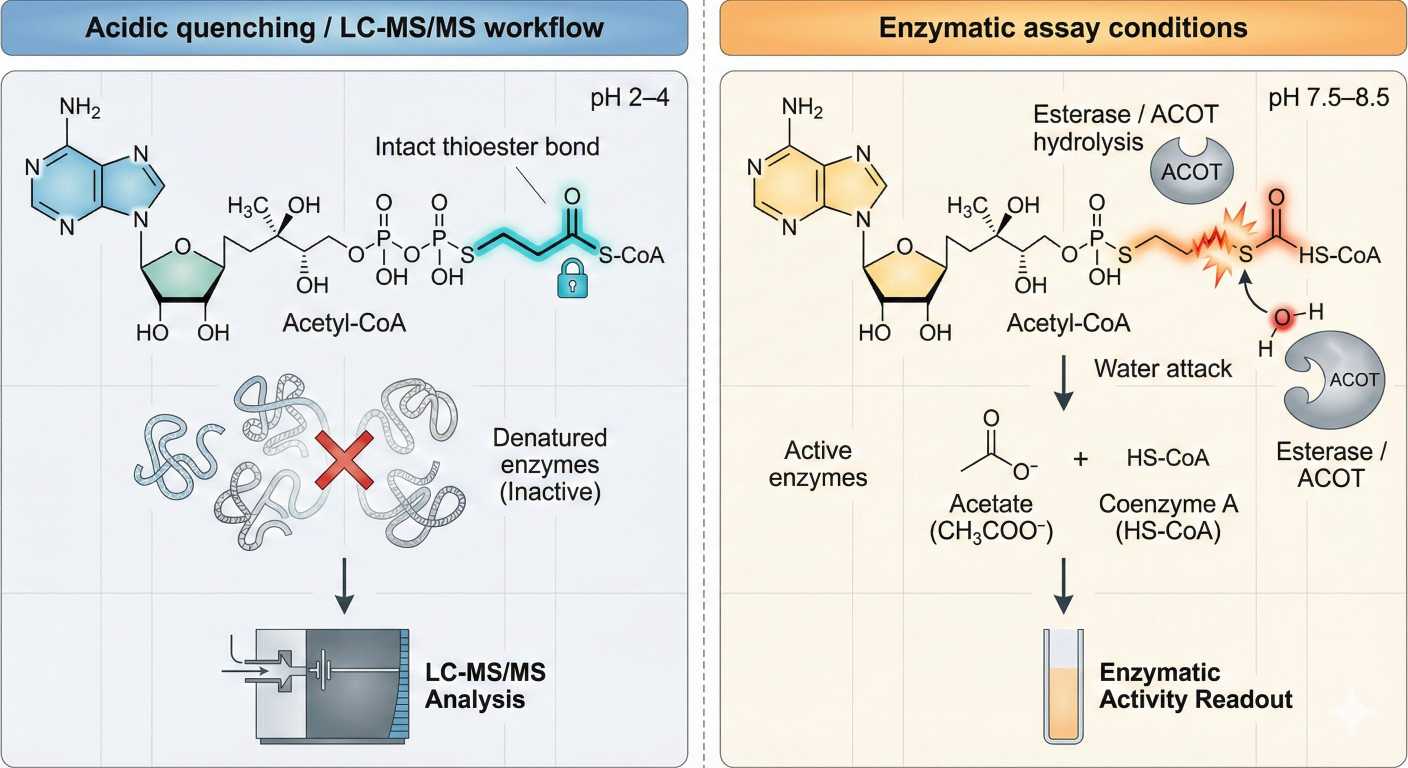 Acetyl-CoA thioester stability under acidic vs assay-kit pH. Acidic quenching (pH 2–4) preserves acetyl-CoA, while neutral–alkaline kit conditions accelerate hydrolysis.
The Matrix Factor: Challenges Across Different Sample Types
The matrix effect refers to interference from non-target components present in biological samples. Each matrix introduces distinct analytical challenges that often exceed the tolerance of plate-based enzymatic assays.
Matrix-Dependent Interference by Sample Type
| Sample Type | Primary Analytical Challenge | Impact on Assay Kits |
|---|---|---|
| Cell culture pellets | Low biomass; media carryover | Signals often near detection limits |
| Serum / plasma | High protein load; esterase activity | Elevated background and variability |
| Solid tissue | Pigments (heme, myoglobin, lipofuscin) | Optical masking and false signals |
| Plant tissue | Phenolics and secondary metabolites | Chemical quenching of reporters |
Why LC-MS/MS Resolves Matrix Effects
Optical assays are easily masked by pigments, turbidity, or redox-active molecules such as glutathione. By contrast, LC-MS/MS physically separates acetyl-CoA from interfering salts, proteins, and pigments prior to ionization. This principle underlies dedicated workflows such as the Acetyl-CoA Analysis Service.
The Specificity Factor: Resolving Molecular Analogs
In biological systems, acetyl-CoA coexists with structurally related CoA esters, including propionyl-CoA, malonyl-CoA, and succinyl-CoA. Analytical specificity is therefore critical.
Limitations of Enzymatic Assays
Most kits rely on releasing free CoA-SH, which is then detected colorimetrically or fluorometrically. This approach has two inherent limitations:
- Relative enzyme specificity: Kit enzymes typically exhibit relative, not absolute, specificity, allowing partial processing of other short-chain acyl-CoAs.
- Background subtraction error: Endogenous CoA-SH must be mathematically subtracted from total CoA, effectively compounding analytical variance.
Mass-Resolved Detection by LC-MS/MS
LC-MS/MS achieves molecular specificity using multiple reaction monitoring (MRM):
- Acetyl-CoA precursor ion: [M+H]⁺ at m/z 810.1
- Characteristic fragment ion: m/z 303.1
- Internal standard: ¹³C₂-acetyl-CoA at m/z 812.1
This mass-resolved strategy enables unambiguous discrimination between acetyl-CoA and other CoA esters, a distinction discussed in greater depth in Acyl-CoA vs. Acetyl-CoA.
The Comparability Factor: Absolute Quantification via Isotope Dilution
For publication-grade data, absolute quantification and cross-batch comparability are essential.
- Kit limitation: External calibration curves prepared in clean buffer cannot correct for matrix-dependent extraction losses.
- LC-MS/MS advantage: Isotopically labeled internal standards are added before extraction, correcting for recovery loss and ion suppression simultaneously.
This isotope-dilution principle provides true absolute quantification across different sample types, batches, and laboratories.
When Is an Acetyl-CoA Assay Kit Still Acceptable?
Assay kits may still be appropriate for:
- Very high-abundance samples
- Cell-free enzymatic systems
- Relative comparisons in simplified models
- Preliminary screening experiments
However, for tissues, biofluids, low-input samples, or mechanistic studies, assay kits introduce uncontrolled risk rather than merely reduced sensitivity.
Typical LC-MS/MS Acetyl-CoA Workflow
- Immediate sample quenching (liquid nitrogen or acidification)
- Addition of isotopically labeled internal standard
- Acidified extraction (pH < 4)
- Chromatographic separation
- MRM-based mass spectrometric quantification
Beyond Static Levels: Flux and Pathway Context
Static metabolite pools alone often fail to resolve mechanism. LC-MS/MS enables integration with Metabolic Flux Analysis using ¹³C-labeled substrates, allowing researchers to distinguish altered production from altered consumption.
In studies of fatty acid β-oxidation or deficiencies in the Acyl-CoA Dehydrogenase (ACAD) family, acetyl-CoA must be interpreted alongside chain-length–resolved acyl-CoAs to localize metabolic bottlenecks accurately.
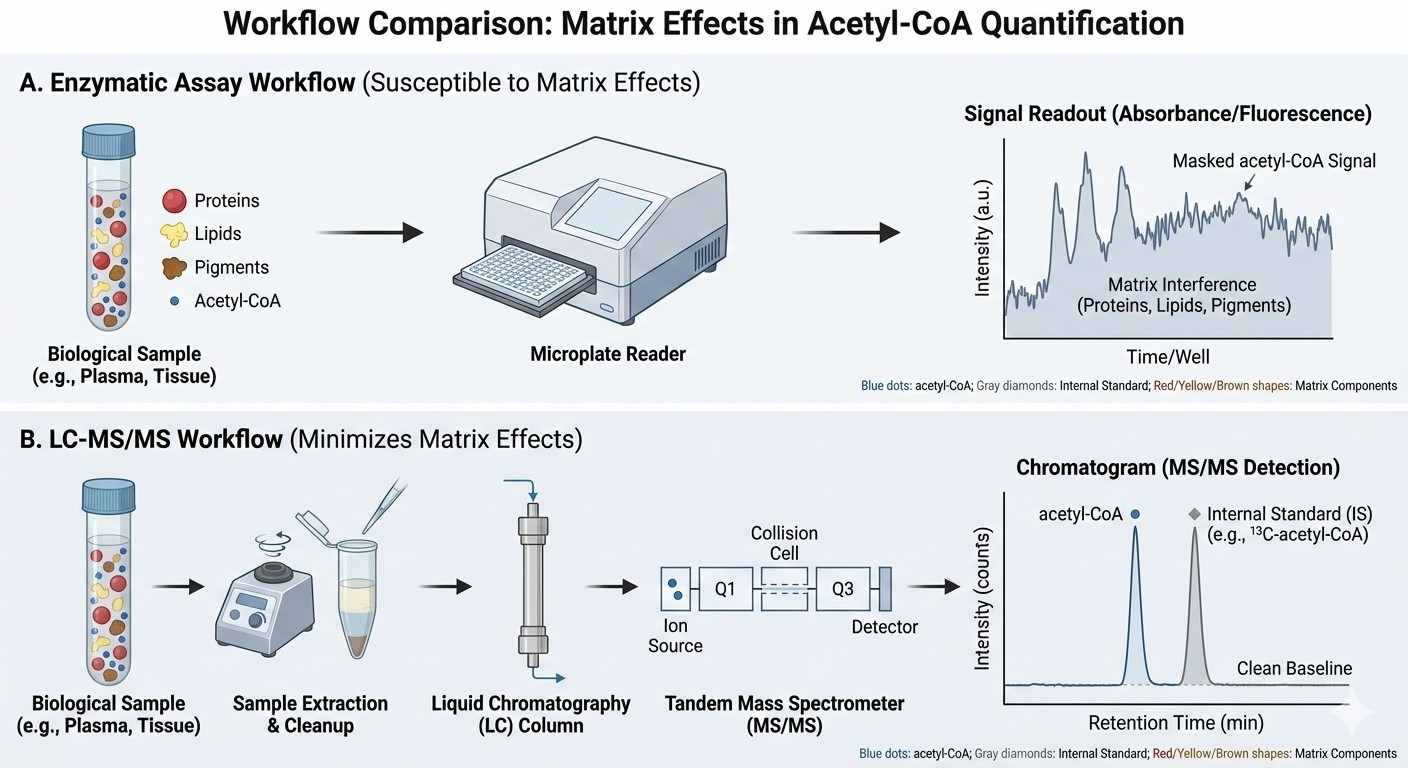 Matrix effects: assay kits vs LC-MS/MS. Complex matrices distort kit signals; LC separation and MS/MS detection yield clean acetyl-CoA quantification.
Technical Benchmarks: Assay Kits vs. Targeted LC-MS/MS
| Evaluation Metric | Enzymatic Assay Kits | Targeted LC-MS/MS |
|---|---|---|
| Chemical stability control | Limited | Strong (acid quenching) |
| Molecular specificity | Indirect | Mass-resolved |
| Quantification | Relative | Absolute (isotope dilution) |
| Matrix tolerance | Low | High |
| Sensitivity | Low nM range | High pM to low nM |
| Minimum sample input | 50–100 mg tissue | ~5 mg tissue or ~10⁵ cells |
Practical Protocol Considerations
To maximize data quality across biological samples:
- Immediate quenching (liquid nitrogen or acidification)
- Acidified extraction (pH < 4)
- Minimal sample input to preserve material
- Strict cold-chain handling and dry-ice shipment
- Reserve remaining material for complementary analyses such as lipidomics analysis
Moving beyond assay kits is not a matter of convenience but of data integrity. While kits may suffice for exploratory screening in simplified systems, the chemical instability of acetyl-CoA and the complexity of biological matrices demand the specificity, sensitivity, and quantitative rigor of LC-MS/MS.
When mechanistic interpretation, reproducibility, and cross-study comparability matter, LC-MS/MS represents the appropriate analytical standard.
Frequently Asked Questions (FAQs)
Q: Why do my kit results show high variability between identical tissue replicates?
A: This is usually due to uneven matrix interference. Small differences in blood (heme) or fat content in tissue replicates can change the optical background of a kit assay. LC-MS/MS eliminates this by using internal standards to normalize every individual sample.
Q: Can LC-MS/MS distinguish between Acetyl-CoA and other short-chain CoAs like Propionyl-CoA?
A: Yes. While they are structurally similar, their masses differ by exactly 14 Da ($CH_2$ unit). A kit enzyme may "confuse" the two, but a mass spectrometer separates them with absolute certainty. This is critical for studies involving Acyl-CoA chain length specificity.
Q: Is it necessary to use isotopically labeled internal standards for every project?
A: For tissue samples, yes. The "Matrix Effect" in tissues is unpredictable. Without an internal standard added at the start of the extraction, there is no way to know if a low signal is due to low biology or poor recovery.
Q: How does the sensitivity of LC-MS/MS compare to a standard plate reader?
A: LC-MS/MS is roughly 1000 times more sensitive. This allows you to detect subtle metabolic shifts that are literally "invisible" to a colorimetric assay, especially when working with low-abundance intermediates in small brain regions or biopsies.
Q: What is the primary cause of Acetyl-CoA loss during shipping?
A: The primary cause is thawing. Even a few minutes at temperatures above $-80^\circ C$ can activate endogenous thioesterases. Always ship on a generous amount of dry ice and ensure samples remain deep-frozen until the moment of extraction.
References
- Neubauer, Stefan, et al. "LC-MS/MS-based analysis of coenzyme A and short-chain acyl-coenzyme A thioesters." Analytical and Bioanalytical Chemistry 407 (2015): 6681–6688.
- Gilibili, Ravindra Reddy, et al. "Development and validation of a highly sensitive LC-MS/MS method for simultaneous quantitation of acetyl-CoA and malonyl-CoA in animal tissues." Biomedical Chromatography 25 (2011): 1352–1359.
- Wang, Shuangyuan, et al. "Comprehensive Analysis of Short-, Medium-, and Long-Chain Acyl-Coenzyme A by Online Two-Dimensional Liquid Chromatography/Mass Spectrometry." Analytical Chemistry 89.23 (2017): 12902–12908.
- Basu, Sankha S., and Ian A. Blair. "SILEC: a protocol for generating and using isotopically labeled coenzyme A mass spectrometry standards." Nature Protocols 7 (2012): 1–11.
- Pearce, Ryan W., et al. "A liquid chromatography tandem mass spectrometry method for a semiquantitative screening of cellular acyl-CoA." Analytical Biochemistry (2022): 114430.

 Contact Us