

ATP and AMP in Food Science: Hygiene Monitoring vs Quantitative Profiling
Submit Your InquiryFood teams often need signals that move faster than sensory checks and are easier to standardize across sites. At the same time, the term "ATP" is used in two distinct contexts: atp testing in food industry for hygiene verification, and targeted chemical quantification of ATP/AMP to study freshness, processing effects, and product stability.
This resource clarifies both pathways and shows how to choose the right approach for your project. You'll learn What is ATP in food safety?, how ATP/AMP fit into established freshness chemistry, and how to design studies that support real decisions rather than isolated measurements.
Common Food Use Cases for ATP/AMP (Choose Your Path)
If you searched for ATP in food workflows, you are usually in one of these situations:
- Sanitation verification and audit readiness: You need a rapid check after cleaning to support consistent hygiene routines and trend tracking.
- Freshness and shelf-life studies: You want objective biochemical markers that shift before major sensory changes.
- Processing and formulation decisions: You want to compare process variants, storage conditions, or packaging options using quantitative chemistry.
- Fermentation and microbial process understanding: You want to connect production conditions with metabolic state and product consistency.
The rest of this article helps you select the right method, interpret results correctly, and avoid common pitfalls that can undermine confidence in ATP-related data.
What Is ATP in Food Safety?
In many facilities, "atp food safety" refers to ATP bioluminescence hygiene monitoring. Teams swab a surface and measure light output as a rapid proxy for residual biological material after cleaning. In practice, it's used to verify cleaning performance and sanitation consistency—not to identify specific contaminants.
ATP hygiene monitoring does not identify specific organisms or hazards. It is best used to answer, "Did cleaning remove residue to a consistent standard?" rather than, "Is a specific microbe present?" Results can be influenced by surface type, product soils, sampling technique, and residue chemistry.
When used with clear SOPs and training, ATP hygiene checks support consistency and documentation. When used as a substitute for organism-specific methods, it can lead to false confidence or unnecessary rework.
How To Interpret ATP Hygiene Results in Food Facilities
ATP hygiene monitoring is most reliable when treated as a trend tool with disciplined sampling and clear action rules.
- Prioritize repeatability over one-off numbers. Use defined sampling points and consistent swabbing pressure and coverage.
- Separate "cleaning verification" from "microbial risk questions." ATP is not organism-specific and should not be framed as a direct microbial count.
- Expect matrix effects from soils. Sugar-rich residues, fats, and certain additives can influence readings and cleaning performance.
- Use baselines and improvement targets. Establish internal benchmarks for each zone and surface type, then monitor drift over time.
- Pair ATP with root-cause thinking. When results spike, investigate process steps and equipment design features before drawing conclusions.
If your search intent is primarily hygiene verification, ATP bioluminescence is often the right starting point. If your intent is to understand freshness chemistry or processing effects, you typically need a different measurement approach.
ATP/AMP in Food R&D Is a Different Measurement
When ATP, ADP, and AMP are quantified in food matrices using chromatography (often paired with mass spectrometry), the goal is usually biochemical interpretation. The questions are different:
- How quickly does nucleotide chemistry shift under different storage conditions?
- Which packaging or handling option slows the change in ATP breakdown products?
- Does a process change alter energy-related metabolites in a way that explains stability differences?
- Do fermentation conditions reshape energy pathways and downstream metabolites?
This is not a "pass/fail" hygiene test. It is quantitative analytical chemistry for R&D, shelf-life science, and process optimization.
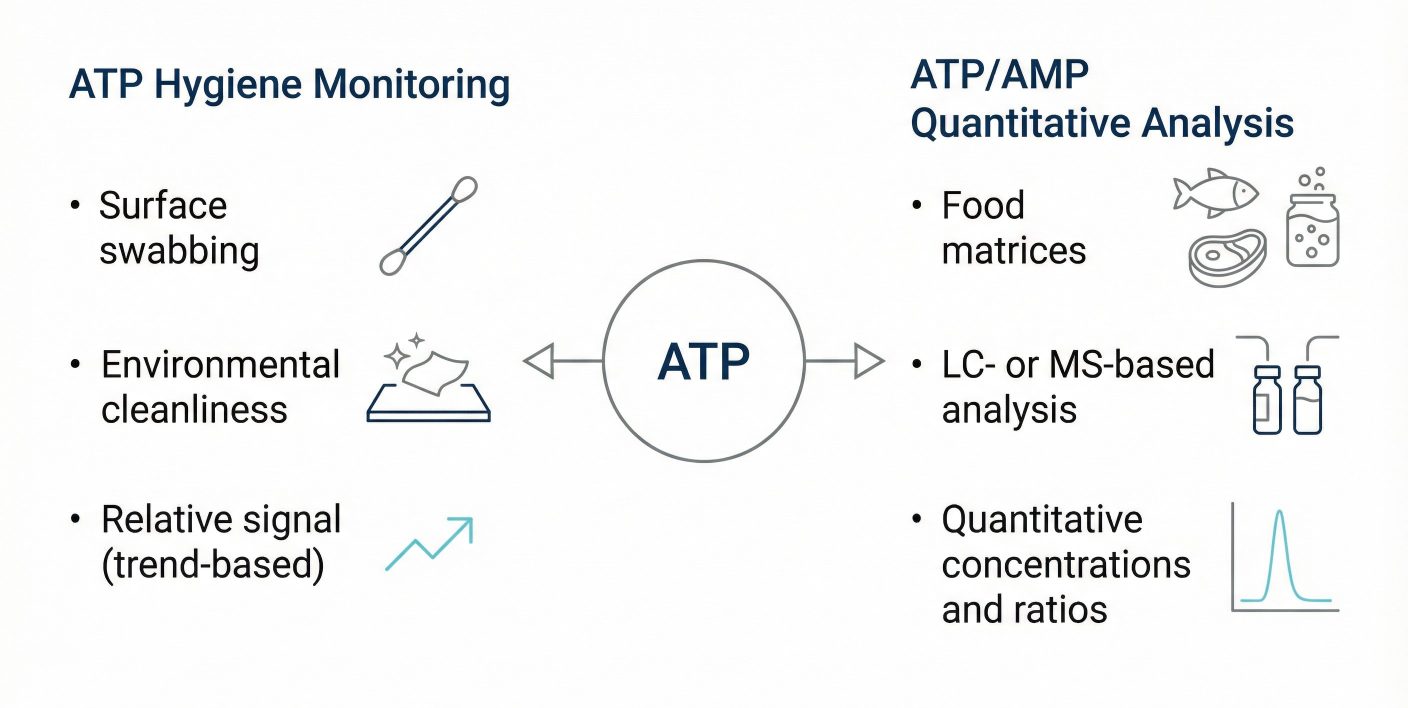
Distinct Uses of ATP in the Food Industry
Conceptual comparison of two distinct applications of ATP in the food industry: surface-based hygiene monitoring versus quantitative ATP/AMP analysis in food matrices.
Hygiene ATP vs. Targeted ATP/AMP Quantification: A Quick Comparison
| Aspect | ATP Hygiene Monitoring (Swab + Bioluminescence) | Targeted ATP/AMP Quantification (LC-Based, Often MS) |
|---|---|---|
| Primary goal | Verify cleaning effectiveness | Quantify nucleotides and interpret biochemical change |
| Typical sample | Environmental surfaces | Food tissue/extracts, ingredients, fermentation samples |
| Output | Relative signal for trends | Concentrations, ratios, and QC metrics |
| Best for | Sanitation consistency, training feedback | Freshness, shelf-life, processing comparisons |
| Key limitation | Not organism-specific | Requires controlled handling to preserve nucleotides |
Why ATP and AMP Matter in Foods
ATP is the cell's energy currency. When tissue is no longer metabolically active, ATP is gradually converted through a well-known pathway:
ATP → ADP → AMP → IMP → inosine → hypoxanthine
In many fish and meat systems, this sequence moves in a direction that aligns with freshness decline. That is why ATP-related compounds and their degradation products appear frequently in shelf-life studies and freshness chemistry discussions.
AMP is informative because it sits at a key junction. It reflects depletion of high-energy phosphates and connects to downstream compounds that are often easier to interpret over storage.
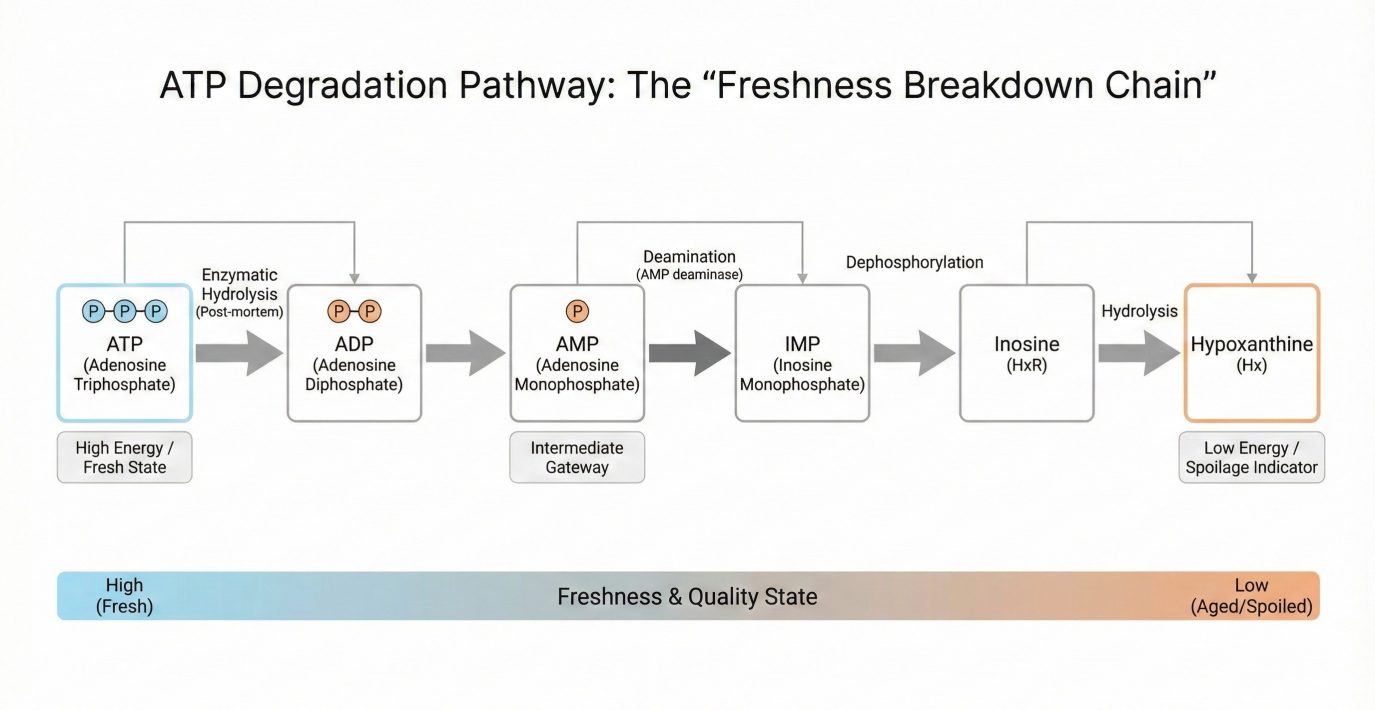 ATP Degradation Pathway in Food Tissues
K-Value: A Practical Freshness Concept Built From ATP Breakdown Products
K-value is a ratio-based index that relates later-stage breakdown products (often inosine and hypoxanthine) to the broader pool of ATP-related compounds. It is widely referenced in seafood freshness research because ATP degradation chemistry often tracks freshness decline in fish flesh.
K-value can be useful when you want:
- A chemistry-based indicator to compare storage conditions.
- A marker that complements sensory scoring and other chemical readouts.
- A structured way to interpret why one condition deteriorates faster than another.
K-value is not a universal single-number label. Species, handling, and storage conditions can change the pattern of ATP breakdown. In practice, it performs best when supported by good sampling design and interpreted alongside other relevant markers.
Which Nucleotide Panel Should You Choose for Food Projects?
Many projects underdeliver because ATP is measured in isolation. ATP is often a starting point, but freshness and stability are usually pathway stories, not single-metabolite stories.
A Practical Panel Selection Guide
| Your decision question | Recommended panel | Why it improves interpretability |
|---|---|---|
| Compare shelf-life under storage condition A vs. B | ATP/ADP/AMP + IMP/inosine/hypoxanthine | Captures both early depletion and downstream accumulation |
| Evaluate a processing change (heat, pressure, drying) | ATP/ADP/AMP + a targeted stability panel | Separates energy-state change from broader chemistry shifts |
| Choose packaging that best preserves biochemical quality | ATP-related compounds + oxidative/stability markers | Links nucleotide breakdown with stability mechanisms |
| Investigate pathway-level shifts | Expanded nucleotide metabolism profiling | Supports richer pathway interpretation beyond adenylates |
ATP is a useful starting point for adenylate studies, but pairing it with ADP and AMP often improves interpretability across storage or process comparisons. You can explore dedicated assays:
- Adenosine Triphosphate (ATP) Analysis Service
- Adenosine Monophosphate (AMP) Analysis Service
- Adenosine Diphosphate (ADP) Analysis Service
If you need a broader, fit-for-purpose panel (for example, freshness-related breakdown products or additional stability markers), Targeted Metabolomics Analysis Service is typically the most direct way to design and report the panel.
How Targeted ATP/AMP Quantification Works
ATP, ADP, and AMP are polar and can shift during handling. The technical challenge is straightforward: preserve the in-sample state so the measured profile reflects biology and processing—not sample preparation artifacts.
A robust workflow typically includes:
- Rapid quenching to stop enzymatic turnover.
- Tight temperature control during sampling and homogenization.
- Extraction conditions optimized for nucleotide recovery in complex matrices.
- Internal standards and QC checks to support confident comparisons across batches.
For food matrices, the method is as important as the measurement. If the study goal is to compare conditions, consistent handling and QC are what turn numbers into conclusions.
Where ATP/AMP Profiling Fits Inside Food Metabolomics
ATP/AMP data becomes more actionable when it is connected to the wider chemistry of quality, stability, and processing. Nucleotides can act as an "anchor signal," while other metabolites explain drivers such as microbial activity, oxidation, or fermentation dynamics.
Common pairings include:
- Organic acids for fermentation trajectories and acidification patterns.
- Redox-related metabolites for oxidative stability hypotheses.
- Amino acids and small peptides related to taste development and breakdown chemistry.
If your broader goal is shelf-life marker discovery, ingredient impact, or product differentiation, a food metabolomics approach can provide a more complete picture
For projects that require pathway-level nucleotide interpretation beyond ATP/ADP/AMP, consider nucleotide metabolism profiling.
Published, Peer-Reviewed Examples: What Food Teams Can Learn
ATP/AMP discussions are most useful when they connect to published study designs that readers can verify. The examples below are peer-reviewed and open access, and they illustrate how nucleotide profiling is used in real food research workflows.
What These Studies Measured
| Study | Food Context | What Was Measured | Why It Matters in Practice |
|---|---|---|---|
| Chen et al., Foods (2024) | Vacuum-packed, refrigerated large yellow croaker | TVC + ATP-related compounds; enzyme activities; inoculated groups vs control | Shows why time-series sampling improves freshness interpretation |
| Konoplev et al., Metabolites (2024) | Freshly prepared and canned ready-to-eat meat/fish | ATP, ADP, AMP, IMP, inosine, hypoxanthine; indices (K, K1) and AEC; multiple analytical techniques | Explains how thermal processing changes nucleotide profiles |
| Kuznetsov et al., Chemosensors (2023) | Meat/fish freshness and aging monitoring | Chromatography-based approach emphasizing ATP metabolites; highlights links between key metabolites (e.g., Hx, IMP) and aging | Reinforces why downstream markers can outperform ATP alone |
Chilled Storage in Vacuum Packaging: Spoilage Ecology Can Shift Nucleotide Trajectories
A Foods study examined vacuum-packed refrigerated large yellow croaker inoculated with different bacteria and tracked TVC plus ATP-related compounds over storage.
What this shows
- ATP-related chemistry can shift differently depending on microbial ecology under the same storage format.
- Time-resolved profiles often explain more than a single measurement point.
How to use this in industry
- Design freshness studies as a trajectory (multiple time points), especially when comparing packaging or cold-chain conditions.
- Capture storage metadata (packaging type, temperature control, handling steps) so differences remain interpretable.
Ready-To-Eat Products: Heating Can Change How Adenylates Behave
A Metabolites study investigated thermal processing and cold storage effects in ready-to-eat meat and fish foods, quantifying ATP, ADP, AMP, IMP, inosine (Ino), and hypoxanthine (Hx) and calculating freshness indices (K, K1) and adenylate energy charge (AEC).
What this shows
- Processed products may not follow the same nucleotide patterns as raw products.
- Index-only interpretation can be less robust after heating; panels are safer.
How to use this in industry
- Separate raw vs processed study logic.
- Prioritize controlled comparisons (process A vs process B; packaging A vs B) over universal cutoffs.
Freshness Ranking: Downstream Metabolites Often Carry the Interpretation
A Chemosensors paper described a rapid chromatography-based freshness approach and reported strong alignment between freshness/aging and key ATP metabolites—especially hypoxanthine (Hx) and inosine monophosphate (IMP) in their workflow.
What this shows
- ATP alone often under-explains shelf-life ranking when early depletion is rapid.
- Downstream products can be more stable and decision-useful in muscle foods.
How to use this in industry
- For shelf-life ranking or storage comparisons, include "interpretation anchors" such as IMP and hypoxanthine (and often inosine), alongside ATP/ADP/AMP.
- Report trajectories and ratios to support decisions across conditions.
Practical Considerations for Interpretable ATP/AMP Data in Food Matrices
Standardize What You Can Control
Matrix variability can overwhelm subtle biological signals. Standardize:
- Sampling location and tissue portion.
- Homogenization approach and equipment.
- Time-to-quench and storage handling.
- A repeatable QC material where feasible.
Avoid Single-Number Conclusions
For most foods, ATP and AMP are best interpreted as:
- Trajectories across storage or process steps.
- Ratios that reflect energy nucleotide balance.
- Panels that connect early depletion to downstream accumulation.
Keep Hygiene ATP and Chemical ATP/AMP Separate in Communication
Cross-functional teams can confuse hygiene ATP with biochemical ATP/AMP. Clear language prevents misaligned expectations:
- Hygiene ATP supports sanitation consistency.
- Targeted ATP/AMP supports freshness, processing, and stability science.
What You Can Expect From a Service-Grade ATP/AMP Study
Well-designed ATP/AMP projects should deliver more than a table of concentrations. Typical deliverables that support food R&D decisions include:
- Quantified ATP/ADP/AMP (and optional downstream products) with QC summaries.
- Condition-to-condition comparisons with clear normalization and reporting conventions.
- Ratio-based interpretation for adenylate balance and degradation patterns.
- Study notes that document sample handling assumptions and key limitations.
This output structure helps teams use results in internal discussions about shelf-life strategy, packaging selection, process change justification, and experimental follow-up.
Next Steps: Turning ATP/AMP Measurement Into a Decision Tool
ATP and AMP analysis can be a strong fit when you need to compare conditions with biochemical clarity:
- Select a packaging condition based on slower ATP breakdown and downstream accumulation patterns.
- Compare process variants using interpretable nucleotide trajectories rather than single endpoints.
- Add mechanistic evidence to shelf-life discussions when sensory results are ambiguous.
If you're unsure whether your project is best served by hygiene ATP, targeted ATP/AMP quantification, or a broader food metabolomics strategy, a short scoping discussion focused on your matrix and decision question is often the fastest way to select the right panel and avoid avoidable reruns.
FAQs
What is ATP in food safety?
ATP in food safety usually means ATP bioluminescence hygiene monitoring. It is used to verify cleaning effectiveness by detecting residual biological material on surfaces.
What does ATP swab testing actually measure?
ATP swab testing measures a broad signal linked to biological residues. It does not identify a specific organism, toxin, or contamination source.
Is ATP testing in the food industry the same as a pathogen test?
No. ATP hygiene monitoring is not organism-specific. It is best used for sanitation trend tracking, not microbe identification.
How reliable is ATP hygiene monitoring in a food factory?
It is reliable for consistency when sampling is standardized and interpreted as trends. It is less reliable for inferring microbial counts or specific hazards.
When should I measure ATP/AMP by LC–MS instead of using swab ATP?
Use LC–MS ATP/AMP profiling for freshness, shelf-life, processing comparisons, and fermentation studies. Swab ATP is primarily for post-cleaning hygiene verification.
What compounds should be measured with ATP for seafood freshness studies?
ATP is often paired with ADP, AMP, and downstream products such as IMP, inosine, and hypoxanthine. Panel-based profiling supports clearer freshness interpretation than ATP alone.
What causes unexpectedly high ATP readings on clean surfaces?
Common drivers include inconsistent swabbing, surface texture, and residues that are hard to remove. Establishing surface-specific baselines improves interpretability.
Can ATP/AMP profiling help compare packaging or storage options?
Yes. ATP-related compound trajectories can show whether one condition slows biochemical degradation relative to another, supporting comparative decisions.
What sample handling steps matter most for ATP/AMP measurement in foods?
Fast quenching and consistent temperature control matter most. ATP-related compounds can change during handling, so standardized workflows reduce bias.
What deliverables should I expect from a targeted ATP/AMP project?
Expect quantified analytes with QC summaries and clear comparisons between conditions. The most actionable reports include ratio-based interpretation and pathway context.
References
- Chen, B., Yan, Q., Xu, T., Li, D., & Xie, J. "Effect of Specific Spoilage Organisms on the Degradation of ATP-Related Compounds in Vacuum-Packed Refrigerated Large Yellow Croaker (Larimichthys crocea)." Foods 13.13 (2024): 1989.
- Konoplev, G., Sünter, A., Kuznetsov, A. I., et al. "Adenosine Triphosphate and Adenylate Energy Charge in Ready-to-Eat Food." Metabolites 14.8 (2024): 440.
- Kuznetsov, A., Frorip, A., Sünter, A., et al. "Fast Protein and Metabolites (Nucleotides and Nucleosides) Liquid Chromatography Technique and Chemical Sensor for the Assessment of Fish and Meat Freshness." Chemosensors 11.1 (2023): 69.

 Contact Us