

Metabolomics + Microbiome Integration: From Functional Prediction to Metabolite Validation (16S vs Shotgun)
Submit Your InquiryDesigning a gut microbiome study that truly connects microbial changes to host metabolism is hard enough; doing it on a tight budget is even harder. This guide shows you exactly how to choose between 16S rRNA amplicon sequencing and shallow shotgun metagenomics when paired with metabolomics, so you can maximize power, control batch effects, and deliver auditable findings in nutrition and metabolic‑syndrome cohorts. Throughout, we'll call this end‑to‑end approach microbiome metabolomics integration and spell out how to do it without wasting samples or budget.
Key takeaways
- Choose 16S plus metabolomics for larger sample sizes and robust compositional trends; choose shallow shotgun plus metabolomics when functional resolution matters most and the budget can support read depth and host‑DNA handling.
- Treat 16S‑based functional prediction as hypothesis generation; validate with targeted metabolomics and, where critical, confirm functions with shotgun profiling.
- Lock in QC and batch strategy up front: randomized plates, pooled QCs, blanks, and pre‑specified metrics such as PERMANOVA R² reduction after batch correction.
- Anchor microbiome metabolomics integration on transparent transforms and alignment: compositional methods for microbiome data, retention‑time alignment for LC/GC‑MS, mapping rates for HUMAnN, and clear FDR control across modalities.
- Run a pilot to set depth and power: simulate beta‑diversity power from pilot data, then finalize N, covariates, and validation tiers before scaling.
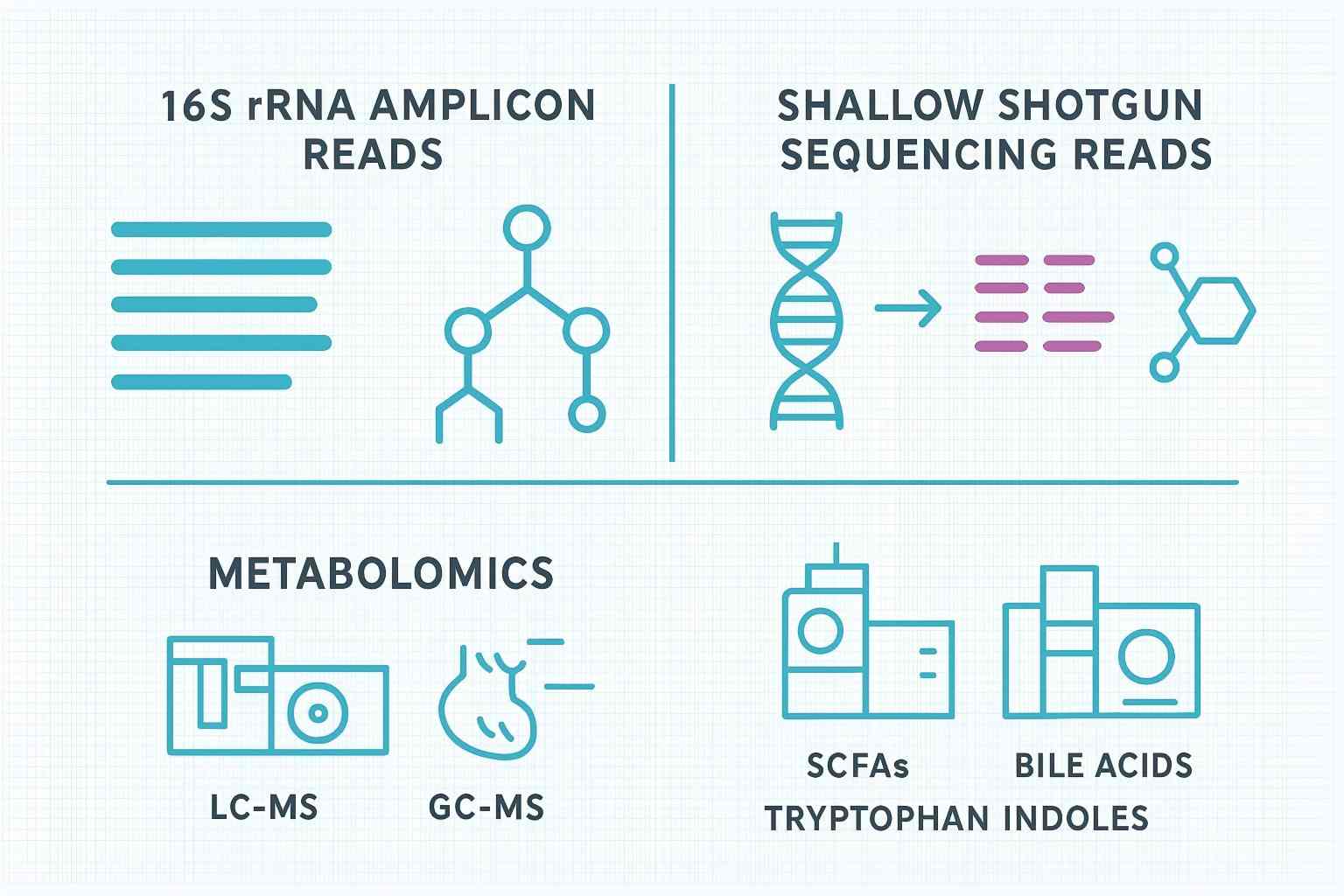
The decision framework for sequencing with metabolomics
When budgets are finite, the best design is the one that delivers the highest probability of a trustworthy answer per dollar. Here's the practical way to decide.
Think of two axes: what biological question you must answer, and how much resolution you need to answer it. If your hypothesis hinges on strain‑level functions or pathway abundance differences, shallow shotgun plus metabolomics is usually the better bet. If the goal is to capture broad compositional shifts across diet or metabolic strata, 16S plus metabolomics can buy you more participants and more statistical power. In either case, remember the destination is rigorous microbiome metabolomics integration that cleanly links taxa/genes to quantified metabolites.
Below is a concise trade‑off view you can reference during planning.
| Study goal | 16S + metabolomics | Shallow shotgun + metabolomics |
|---|---|---|
| Primary readout | Composition at genus/ASV level; predicted functions for hypotheses | Species/strain resolution; direct gene/pathway profiles |
| Cost per sample | Lower; enables larger N | Higher; depth and host depletion drive costs |
| Functional analysis | Prediction via PICRUSt2/Tax4Fun; use carefully | Direct profiling via HUMAnN with MetaPhlAn/Kraken inputs |
| When it shines | Discovery of broad trends; longitudinal scaling; pilot screens | Function‑driven questions; mechanism mapping to metabolites |
| Typical pitfalls | Over‑interpreting predicted functions; primer bias | Insufficient depth; host DNA; library prep batch drift |
The field consensus remains that shotgun outperforms 16S for species/strain and direct function in gut studies, while 16S is more cost‑effective for composition and high‑level trends. Representative discussions include a 2023 comparative analysis noting superior resolution with shotgun in human cohorts and reviews of method performance across pipelines; see the comparative perspective in the open‑access analysis of 16S versus shotgun for diversity and function in gut samples in 2023 (PMCID: PMC10629391). For a caution on treating 16S function as predictive rather than definitive, recent work highlights how tools like PICRUSt2 support hypothesis generation but may miss cohort‑specific functional shifts, as discussed in a 2025 application paper using PICRUSt2 in pediatric gut research (PMCID: PMC11878042).
Study design essentials for paired stool and metabolomics
Start with the cohort, not the tools. In metabolic‑syndrome‑oriented studies, the most common sources of confounding are diet, medications, age, sex, BMI, and time‑of‑day. Randomize sample processing order across these variables and balance plate layout by case–control or exposure strata. Predefine inclusion/exclusion and freeze aliquots at −80 °C to avoid repeated thaw cycles. If ambient shipping is required, preservative buffers matter: a 2024 review reported that RNAlater and PSP buffers preserved both microbial diversity and metabolomic stability better than many alternatives for multi‑omic designs, with OMNIgene‑GUT stronger for microbiome but not always optimal for metabolomics and 95% ethanol favorable for metabolites but weaker for nucleic acids according to the comparative analysis in 2024 by Gemmell and colleagues.
Power is about effect sizes and variability. For community differences, PERMANOVA‑based simulations from pilot data remain practical: the micropower family of approaches uses your pilot distance matrices to estimate required N for 80–90% power. A distance‑matrix power overview from 2020 explains how sample size scales with effect size and heterogeneity in microbiome cohorts; plan to re‑estimate after your pilot to avoid underpowered expansion. For multi‑omics associations, power needs grow quickly with feature space; narrow to a priori pathways and run FDR‑aware modeling to protect interpretability.
Sequencing workflows that pair well with metabolomics
For 16S, choose a well‑validated region such as V3–V4, document primers, and track amplification controls. Treat predicted function as just that—predicted. Practical applications continue to use PICRUSt2 to infer KEGG or MetaCyc pathways from 16S, but it should inform hypotheses rather than stand in for functional quantification. A 2025 pediatric cohort paper illustrates this pattern by using PICRUSt2 outputs cautiously while acknowledging their inferential nature.
For shotgun, couple taxonomic profiling with direct function. MetaPhlAn 4 improved human gut coverage relative to v3 and integrates with HUMAnN for functional profiles, but versions and databases must match. The bioBakery forum emphasizes aligning MetaPhlAn and HUMAnN database releases to avoid low explained‑reads and mapping issues and notes practical memory guidance for HUMAnN 4 on clusters. Because there's no single 2023–2026 consensus paper on the ideal shallow read depth for stool, start with a pilot at approximately three to five million reads per sample and adjust based on mapping rates, complexity, and target pathways.
Two operational guardrails help both modalities. First, document software versions and database snapshots to keep results auditable. Second, quantify mapping or classification performance: percent reads mapped and species explained in shotgun; read counts and rarefaction behavior in 16S. These metrics function as the equivalent of retention‑time and mass‑accuracy checks in metabolomics.
Metabolomics workflow from discovery to targeted validation
In nutrition and metabolic‑syndrome studies, three metabolite families frequently connect microbiota and host physiology: short‑chain fatty acids, bile acids, and tryptophan‑derived indoles. In practice, discovery often starts with untargeted LC‑MS or GC‑MS to cast a wide net, followed by targeted panels to quantify leading candidates with calibration curves and stable‑isotope standards.
- SCFAs such as acetate, propionate, butyrate, isobutyrate, and valerate are volatile and generally quantified after derivatization by GC‑MS. Analytical Chemistry methods published in 2024 survey derivatization strategies and detection settings for robust quantitation, while endocrinology reviews synthesize the links between SCFAs and metabolic signaling.
- Secondary bile acids like deoxycholic acid and lithocholic acid, along with ursodeoxycholic acid, are typically measured by LC‑MS/MS with class‑specific internal standards, supporting pathway analysis of microbial bile salt hydrolase activity and host FXR/TGR5 signaling.
- Tryptophan pathway metabolites—indole‑3‑propionic acid, indole‑3‑acetic acid, indole‑3‑aldehyde, and the kynurenine to tryptophan ratio—are commonly confirmed by LC‑MS/MS in targeted mode. A 2024 review of metabolomics quantification workflows outlines QC choices and reporting norms that are applicable across these panels.
For readers who need a primer on turning features into biology, see the overview on pathway data analysis and bioinformatics for metabolomics, which explains how to map features to KEGG or MetaCyc and report pathway‑level effects. For teams ready to validate indole and kynurenine markers in stool or plasma, an example of a targeted tryptophan analysis service from Creative Proteomics provides coverage context for LC‑MS/MS quantification without prescribing a single platform or kit.
- Learn more: Pathway data analysis & bioinformatics for metabolomics
- Example targeted panel: Tryptophan pathway LC-MS/MS targeted analysis service
Microbiome Metabolomics Integration, Batch, and Alignment
Microbiome and metabolomics data need different preprocessing choices, yet they must meet in the same model. Use compositional methods for microbiome features—CLR or alternative log‑ratios after zero handling—and intensity normalization with retention‑time alignment for LC/GC‑MS data. Keep integration methods aligned with assumptions: sparse canonical correlation or DIABLO when you expect a small, interpretable set of cross‑omic links; latent‑factor models like MOFA when you expect shared low‑rank structure; kernel methods such as MiRKAT when you care about group‑level association patterns rather than feature‑level links. Recent integrative methods reviews discuss the strengths and trade‑offs of these approaches in multi‑modal microbiome contexts.
Batch effects are inevitable and must be managed transparently. A 2023 preprocessing review highlights strategies such as ComBat and removeBatchEffect for microbiome features and cautions about imputation and normalization choices. A 2024 multi‑batch study at the ASV level reported that ComBat and removeBatchEffect reduced batch clustering effectively, with PLSDA‑batch adding value for unbalanced designs. For multi‑study aggregation, evaluate MMUPHin to reconcile batch structure during meta‑analysis.
Below is a compact checklist of metrics and targets that make cross‑platform QC auditable in microbiome metabolomics integration studies.
| QC focus | Practical target | How to report |
|---|---|---|
| Microbiome batch | PERMANOVA R² for batch reduced substantially after correction; stable biological R² | PCoA colored by batch and phenotype; R² table pre/post |
| 16S sequencing | Rarefaction curves plateau; negative controls low biomass; consistent ASV richness across plates | Read depth distribution; control sample summary |
| Shotgun mapping | High percent reads mapped; species explained in HUMAnN stable across batches | Mapping and explained‑reads rates by batch |
| Metabolomics LC‑MS | Pooled QC RSDs within panel targets; retention‑time drift within tolerance | RSD histogram; RT drift plots per batch |
| Alignment across omes | Clear transform notes and feature dictionaries; harmonized sample IDs | Data dictionary and pipeline schematic |
For each metric, define acceptance criteria during planning and revisit after the pilot. Being explicit here can save weeks of back‑and‑forth during manuscript review.
Running case in metabolic syndrome
Imagine you're testing whether a high‑fiber dietary intervention improves insulin sensitivity through microbial fermentation and bile acid remodeling. You have funds for 160 participants across two batches and need a result within a semester.
You begin with an untargeted LC‑MS workflow on stool and plasma to characterize broad metabolic shifts, coupled to 16S sequencing on stool to unlock a larger N at fixed cost. Your pilot on 24 participants suggests moderate separation by diet in beta‑diversity; micropower simulations estimate that 70 per arm will deliver 85% power at the observed effect size. Untargeted signals highlight increased butyrate and propionate features and shifts in conjugated bile acids.
For the scaled run, you pre‑register a validation plan: confirm SCFAs by GC‑MS and bile acids by LC‑MS/MS with isotope‑labeled internal standards; verify tryptophan‑derived indoles and the kynurenine to tryptophan ratio by targeted LC‑MS/MS to probe AHR‑linked pathways. You also specify that, if predicted functions suggest differential butyrate synthesis routes or bile salt hydrolase activity, you'll select a 40‑sample subset for shallow shotgun to confirm pathway abundance by HUMAnN. Plate layouts are randomized by arm, age, and BMI; pooled QCs and blanks are embedded every ten injections.
After batch correction and alignment, SCFA increases correlate with the relative abundance of known butyrate producers on 16S; targeted panels confirm absolute concentration shifts with acceptable pooled QC precision. In the shotgun subset, genes associated with butyrate production are enriched in the intervention arm, supporting a mechanism consistent with the metabolite data. You document mapping rates, HUMAnN pathway coverage, pooled QC RSDs, and PERMANOVA R² pre/post correction in the supplement. The integration model prioritizes a small set of cross‑omic links that replicate in a 12‑week follow‑up, providing a coherent, auditable narrative from microbe to metabolite to phenotype.
If your team lacks in‑house targeted quant capacity for these panels, a neutral example is to engage Creative Proteomics as a specialty provider for LC‑MS/MS confirmation of tryptophan‑related metabolites or to support pathway‑level reporting; this kind of collaboration can accelerate validation without dictating a specific instrument or protocol.
Budgeting and timeline planning under constraints
Budgets change quickly and vary by provider, so treat costs as scenario‑based rather than absolute. Three knobs dominate spend: shotgun read depth, the need for host‑DNA depletion or removal, and the breadth of targeted validation panels. Pilot sequencing and a short targeted panel can de‑risk both spend and power. In many stool studies, a shallow shotgun design can approach the per‑sample cost of deep amplicon plus extensive targeted panels; at that point, functional priorities should drive the choice. Always request quotes from multiple cores and vendors and time your batches to avoid instrument maintenance windows and holiday slowdowns.
Timelines depend on batch size and validation breadth. For 100–200 samples across two batches, a realistic arc is two to three weeks for pilot plus design freeze, six to eight weeks for data generation and QC, and four to six weeks for integration, validation, and manuscript‑grade figures—assuming team availability and no major re‑runs. Building slack for re‑injections or library rebuilds pays off.
Reproducibility and audit checklist
- Pilot dataset with documented software versions and database snapshots; code notebooks for preprocessing, HUMAnN or PICRUSt2 steps, and integration models.
- Data dictionary with harmonized sample IDs, feature metadata, and transform notes for both omes; raw and processed data delivery with pooled QC summaries.
- Pre‑specified QC metrics and acceptance thresholds, including PERMANOVA R² pre/post, mapping rates, pooled QC RSDs, and retention‑time drift limits.
- Validation plan from untargeted signals to targeted quantification and any orthogonal checks, with justification for each assay and internal standards.
References
- Douglas, Gavin M., et al. "PICRUSt2 for prediction of metagenome functions." Nature Biotechnology 38.6 (2020): 685–688. https://doi.org/10.1038/s41587-020-0548-6
- Franzosa, Eric A., et al. "Species-level functional profiling of metagenomes and metatranscriptomes." Nature Methods 15.11 (2018): 962–968. https://doi.org/10.1038/s41592-018-0176-y
- Rohart, Florian, et al. "mixOmics: An R package for ‘omics feature selection and multiple data integration." PLOS Computational Biology 13.11 (2017): e1005752. https://doi.org/10.1371/journal.pcbi.1005752
- Gloor, Gregory B., et al. "Microbiome Datasets Are Compositional: And This Is Not Optional." Frontiers in Microbiology 8 (2017): 2224. https://doi.org/10.3389/fmicb.2017.02224
- Ma, Siyuan, et al. "Population structure discovery in meta-analyzed microbial communities and inflammatory bowel disease using MMUPHin." Genome Biology 23.1 (2022): 208. https://doi.org/10.1186/s13059-022-02753-4

 Contact Us