

Sample Type & Handling for Multi-omics: Plasma/Serum/Tissue/Cells/Stool — Feasibility, Storage, Shipping
Submit Your InquiryMulti-omics studies live or die on pre-analytics. This guide distills what actually works for multi-omics sample handling—across plasma, serum, tissue, cells, and stool—so your data reflect biology, not logistics. We emphasize harmonized SOPs, the "three clocks" (collection→stabilization, ambient processing, freeze–thaw count), and cold-chain integrity. If your primary matrix is blood for cohort work, think of this as your operational playbook for reproducible, review-proof results.
Key takeaways
- Pick one matrix and one SOP per sample type, then enforce it across all sites and timepoints.
- The biggest wins in multi-omics sample handling: shorten time-to-stabilization and control freeze–thaw.
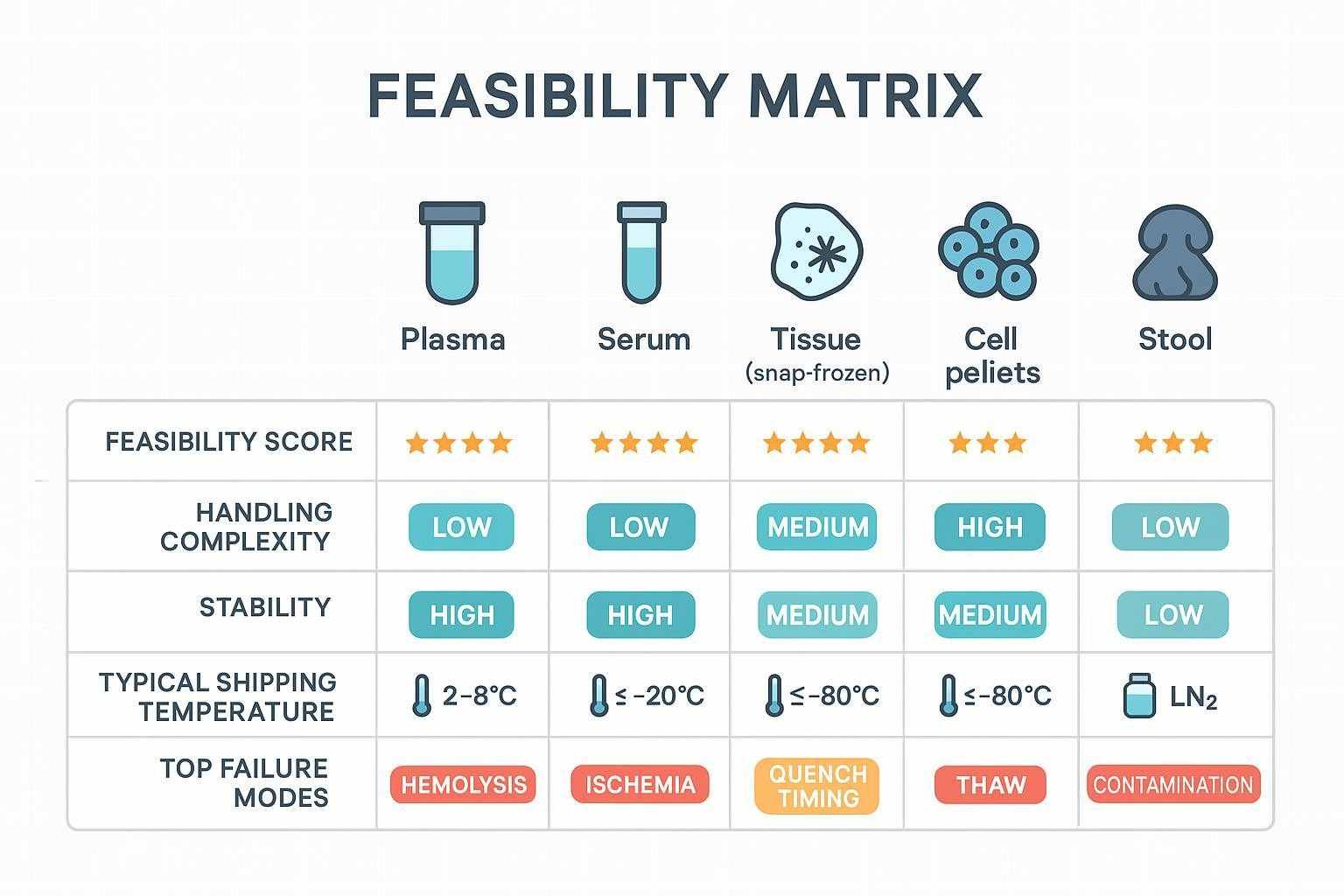
- Plasma (with a single anticoagulant), snap-frozen tissue, and cell pellets are robust when SOPs are tight; stool has the highest variability.
- Document everything in a single source of truth: sample manifest plus a deviation log.
- Plan shipments for worst-case transit; avoid partial thaw events; aliquot once, early.
Fast feasibility overview (what works, what breaks)
- Most operationally robust: plasma/serum, tissue (snap-frozen), cell pellets
- Highest variability / most failures: stool (time-to-stabilization + temperature excursions)
- If you only fix one thing: standardize time-to-stabilization and freeze–thaw control
Non-negotiables for multi-omics sample handling (apply to every sample type)
- One SOP per sample type; identical handling across groups/timepoints/sites
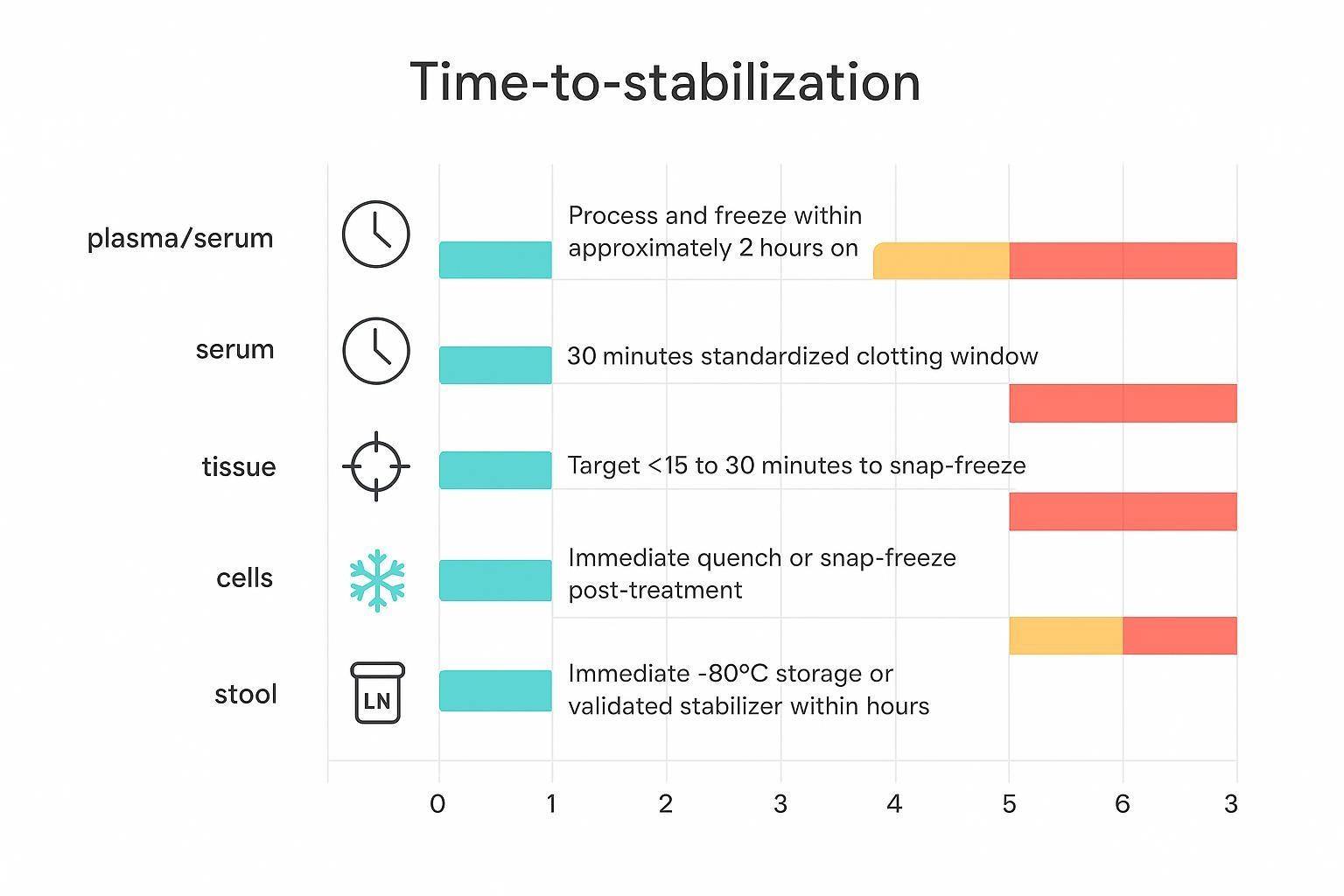
- Control three clocks:
- collection → stabilization/freezing
- time at ambient temperature during processing
- freeze–thaw count (aliquot early)
- Keep a single source of truth: sample manifest + deviation log
Sample-type playbooks (what to do + what to avoid)
Plasma vs Serum
Choose plasma or serum (then stick to one)
- Don't mix tube types or anticoagulants within the same study
- If using serum: standardize clotting time (big variance driver)
For combined metabolomics and proteomics, many teams favor plasma to avoid clotting-driven artifacts seen in serum—platelet activation can shift both metabolite and protein levels. This direction aligns with peer-reviewed assessments urging consistency in matrix and anticoagulant across cohorts because pre-analytics can overshadow real biology.
To harmonize cross-site blood workflows and QC packages, some teams use partners such as Creative Proteomics for plasma/serum metabolomics study alignment. Use as an optional reference to align tube types, processing windows, and reporting conventions.
Handling checklist
- Record: collection time, processing start time, tube type, centrifugation settings
- Keep processing window consistent across all samples
Storage & shipping
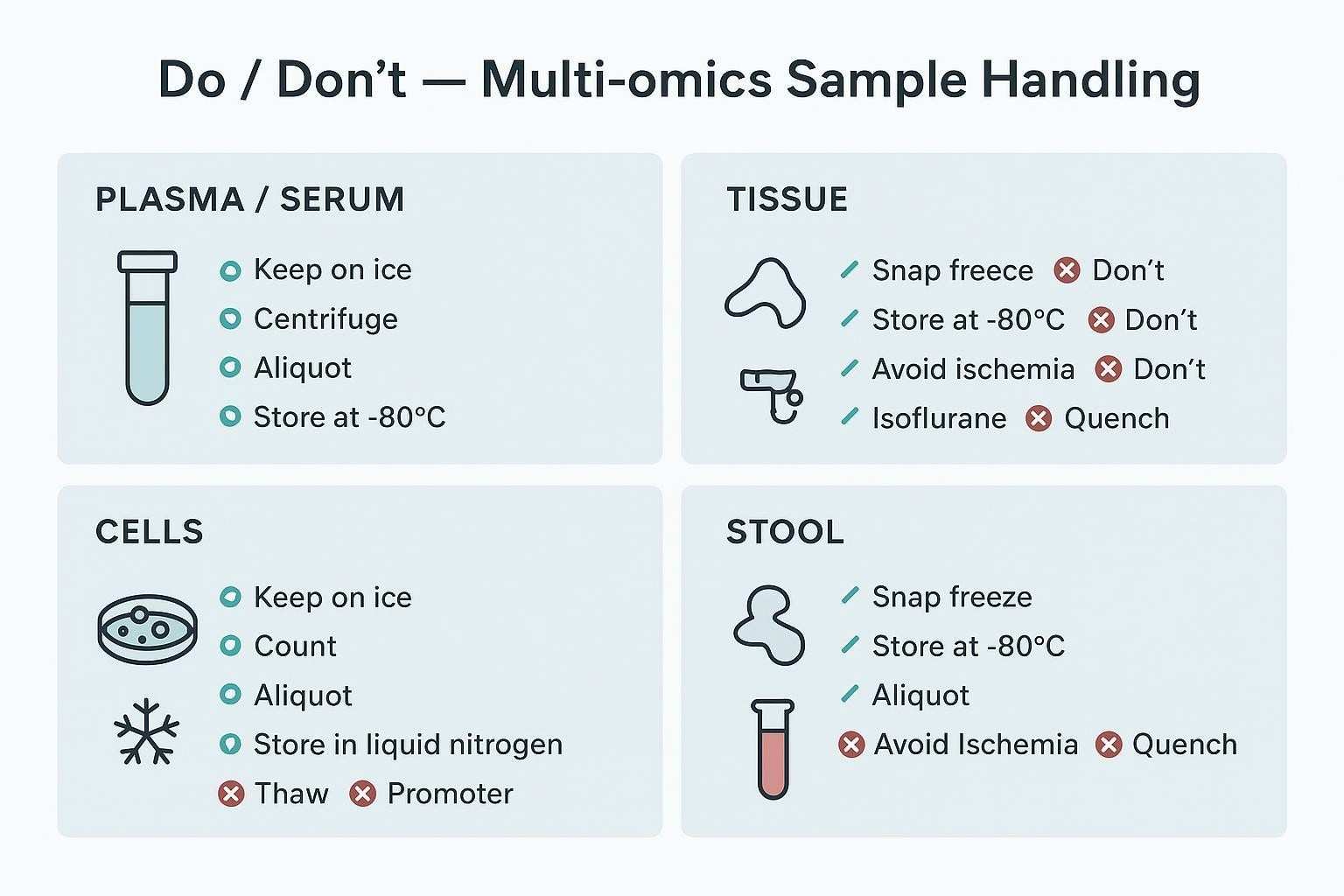
- Aliquot immediately; minimize freeze–thaw
- Ship with stable cold chain; avoid partial thaw events
Common failure modes (and quick checks)
- Hemolysis, processing delays, inconsistent clotting time, tube-type mixing
- Checks: hemolysis flagging + deviation log review + batch label sanity check
Tissue
Feasibility rules
- Tissue is vulnerable to ischemia time and region heterogeneity
- Define and enforce: sampling location + time-to-freeze target
Handling checklist
- Standardize tissue mass/size and collection-to-freeze timing
- Record: region, mass, collection time, freeze time, handling deviations
Storage & shipping
- Deep-frozen storage; ship with robust cold chain
- Temperature monitoring recommended for long transit
Common failure modes
- Variable ischemia time, inconsistent region, thaw during shipping
- Fix: strict SOP + rejection/rescue rules + documented deviations
Cells (adherent vs suspension)
Feasibility rules
- Culture conditions are confounders: media, serum lot, confluency, passage, oxygen, timing
- Define one culture SOP and lock down batch records
Handling checklist
- Record: cell count, viability, confluency, passage, time since media change, treatment timing, media composition
- Rapid quenching/processing consistency is critical
Storage & shipping
- Prefer stabilized pellets/extracts; avoid shipping live cells unless validated logistics exist
- Aliquot where possible to reduce repeated thawing
Common failure modes
- Variable density, inconsistent quench timing, media lot differences
- Fix: culture SOP + batch log + internal controls
Stool
Feasibility rules
- Stool failures are dominated by time-to-stabilization and temperature excursions
- Multi-site stool collection requires: identical kits + clear instructions + strict logging
Handling checklist
- Define a single stabilization approach (freeze or stabilizer kit) and keep it consistent
- Record: collection time, stabilization time, storage temp, shipment conditions, deviations
Storage & shipping
- "Almost frozen" is a failure mode; avoid partial thaw
- Aliquot early for multi-omics splits; avoid repeat thaw cycles
Common failure modes
- Variable stabilization time, oxygen exposure, thaw during shipping, inconsistent aliquoting
- Fix: collection kit + temperature monitoring + reject/rescue rules
Stool stabilization options (pilot and lock one method):
| Approach | Handling complexity | Typical stability window | Notes |
|---|---|---|---|
| Immediate −80 °C freezing | Medium (requires cold chain) | Best baseline | Gold standard when infrastructure allows; minimizes drift |
| Validated RT stabilizer kit | Low–Medium | Hours to days | Enables remote/home collection; validate for target analytes |
| 2–8 °C hold then freeze | Medium | Short buffer only | Risk of drift if prolonged; document times rigorously |
Storage & shipping (operational rules that prevent most failures)
Packaging & cold chain
- Match temperature to sample stability; plan for worst-case transit duration
- Use sufficient insulation and coolant; protect against delays
- Keep shipment-level temperature notes in the deviation log
Coolant comparison (quick reference):
| Use case | Target temp band | Typical coolant | Notes |
|---|---|---|---|
| Refrigerated assays | 2–8 °C | Gel/phase-change packs | Pre-condition packs; avoid direct contact with primary tubes |
| Frozen | ≤ −20 °C | Dry ice (partial) or active cooling | Validate hold time; avoid direct pellet contact |
| Ultra-low | −60 to −80 °C | Dry ice (replenished) | Vent CO2; follow UN1845 labeling; add extra for delays |
| Cryogenic | ≤ −150 °C | LN2 dry shipper (vapor phase) | Condition shipper; ensure upright; training required |
Aliquoting & labeling
- Aliquot once, early; separate aliquots per assay/omics layer
- Labeling must support reconciliation: ID, sample type, timepoint, site/batch
Documentation (what to include every shipment)
- Sample manifest: ID, type, volume/mass, timepoint, storage history
- Deviation log: delays, processing exceptions, temperature excursions, missing metadata
Acceptance on receipt: reject vs rescue
Receipt checks
- Verify shipment temperature status and sample count vs manifest
- Confirm volume/mass sufficiency and container integrity
- Confirm metadata completeness (especially timing fields)
Predefined rescue actions
- Controlled re-aliquoting and immediate re-freeze when appropriate
- Exclude compromised samples with documented rationale
- Run sensitivity checks to ensure conclusions aren't driven by compromised samples
Minimal metadata (the fields you can't analyze without)
- Sample ID, sample type, group, timepoint, site/batch
- Collection time; stabilization/freezing time; processing start time
- Key handling parameters:
- blood: tube type, clot time (if serum), centrifugation settings
- tissue: region, mass, ischemia/time-to-freeze
- cells: count, viability, passage, media, treatment timing
- stool: stabilization method, time-to-stabilization, storage/shipping notes
- Storage temperature and freeze–thaw count
FAQ
Q: Plasma vs serum for multi-omics: which should I pick?
A: For most multi-center studies combining metabolomics and proteomics, choose one matrix and keep it consistent; many teams pick plasma to avoid clotting-induced artifacts seen in serum. If you select serum, enforce a fixed clotting window and uniform tube type.
Q: How fast should tissue be frozen after collection?
A: As fast as operationally feasible. Aim for snap-freezing within minutes; many programs target under 15–30 minutes and document ischemia time and deviations for transparency.
Q: What handling mistakes create batch effects that look like biology?
A: Mixing matrices or anticoagulants, variable clotting times, delayed stabilization, inconsistent quench timing for cells, partial thaw during shipping, and poorly documented deviations.
Q: Can I ship samples on ice packs instead of dry ice?
A: Use gel packs for 2–8 °C. For ≤ −20 °C or −80 °C requirements, use dry ice (and follow UN1845 labeling) or validated active/cryogenic systems; avoid "almost frozen" conditions.
Q: How do I split samples for multiple omics without adding variability?
A: Aliquot once, early, into single-use vials per omics layer; record freeze–thaw counts; avoid repeated thaw cycles by planning assay-specific aliquots.
Q: What should I do if some samples had delayed processing?
A: Document delays in the deviation log, consider predefined rescue actions (e.g., exclude from primary endpoints), and run sensitivity analyses to test robustness.
References
- Gegner HM, et al. Pre-analytical processing of plasma and serum samples for combined proteome and metabolome analysis. Frontiers in Molecular Biosciences (2022). https://pmc.ncbi.nlm.nih.gov/articles/PMC9808085/
- Hagn G, et al. Plasma instead of serum avoids critical confounding in clinical metabolomics. Clinical Chemistry and Laboratory Medicine (2024). https://pmc.ncbi.nlm.nih.gov/articles/PMC11301681/
- Thachil A, et al. Pre-analytical factors impacting metabolomics analyses of blood samples. Metabolites (2024). https://pmc.ncbi.nlm.nih.gov/articles/PMC11433674/
- Buchanan JL, et al. Effects of freezing and thawing on plasma metabolomics profiles. Analytical and Bioanalytical Chemistry (2022). https://pmc.ncbi.nlm.nih.gov/articles/PMC9693613/
- Neumeister VM, et al. Biomarker research: pre-analytical variables and tissue handling. Biomarker Insights (2018). https://pmc.ncbi.nlm.nih.gov/articles/PMC6290693/
- Sanderson-November M, et al. Best practices for research and clinical biobanking. Biopreservation and Biobanking (2021). https://pmc.ncbi.nlm.nih.gov/articles/PMC9275522/
- Sumner LW, et al. Proposed minimum reporting standards for chemical analysis (MSI). Metabolomics (2007). https://pmc.ncbi.nlm.nih.gov/articles/PMC3772505/

 Contact Us