
How to Choose Multi-omics: A Decision Tree for Metabolomics + Proteomics / Transcriptomics / Microbiome
Submit Your InquiryModern DMPK and translational teams don't need more data—they need the right data, arranged so decisions are obvious. This guide offers a practical multi-omics decision tree that starts from your biological question and ends with a pairing you can execute. We anchor the narrative in a DMPK/PD storyline—drug intervention → metabolic pathway response → mechanism localization/PD readout—so every branch translates to study design choices and verification.
Key takeaways
- Start from the question, not the technology. Use this multi-omics decision tree to choose the second layer that fits your decision goal.
- Prefer pathway/module-level integration over fragile feature-level matching; plan targeted verification early.
- When the claim is enzyme-level mechanism, pair metabolomics with proteomics; when it's regulatory programs upstream of metabolism, pair with transcriptomics; for diet/exposure and host–microbe loops, add microbiome.
- Minimal viable options exist: metabolomics-only discovery plus targeted verification, or add one extra layer only at key timepoints. That's how to choose multi-omics under real constraints.
- Guard against pitfalls: confounding batch with group, underpowered designs, and over-interpreting 16S functional predictions.
- Demand decision-ready deliverables: reconciled manifest, QC dashboards, pathway-level integration table, prioritized candidates, and a verification roadmap.
What this guide helps you decide
- Which second layer to pair with metabolomics (proteomics vs transcriptomics vs microbiome)
- What the "minimal viable" multi-omics plan looks like under budget or sample constraints
- How to avoid mismatches that produce expensive but uninterpretable data
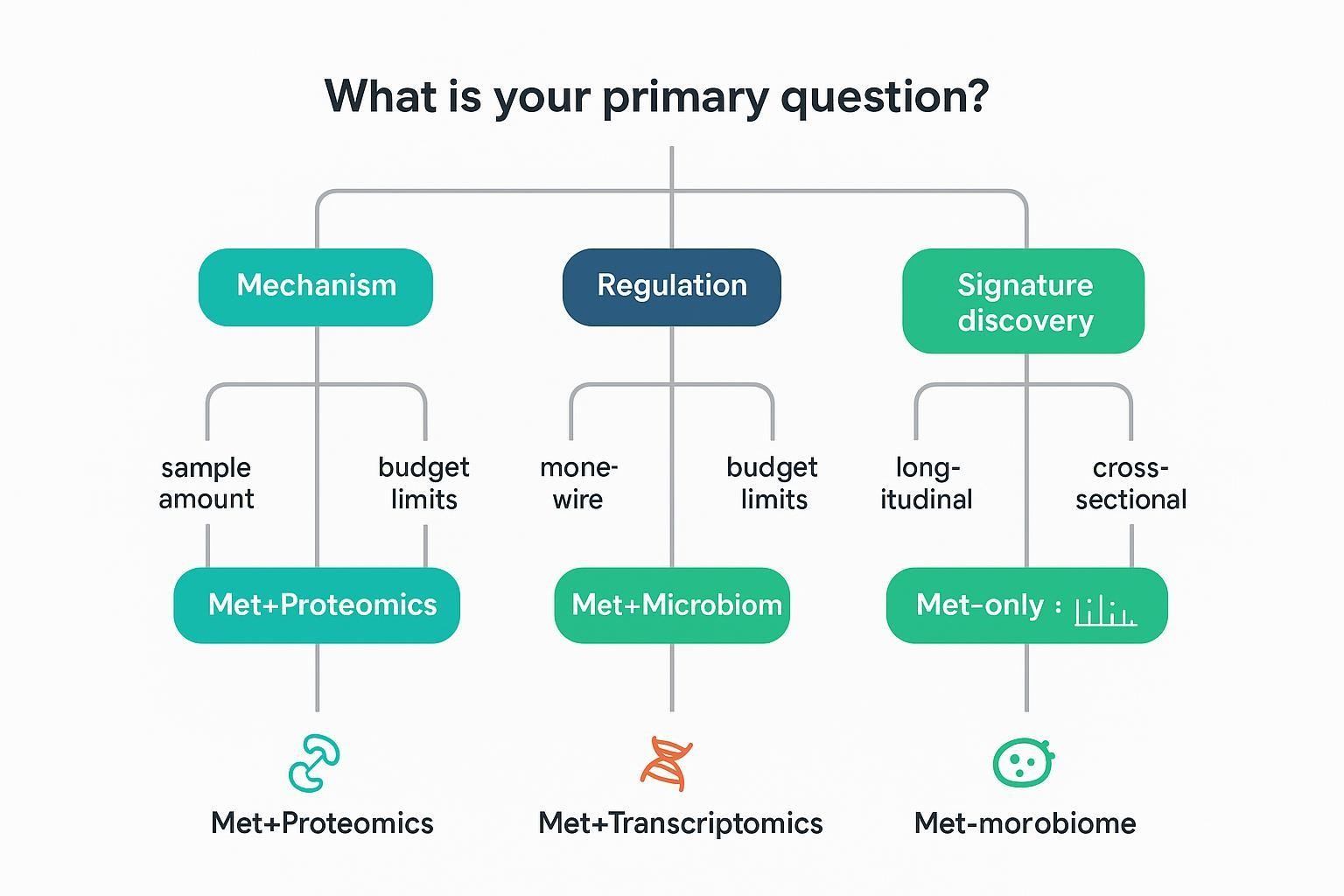
Start with the question (the only input that matters)
Mechanism and pathway positioning
- Goal: identify the likely constrained step(s) and link enzymes to metabolite shifts.
- Typical best-fit: metabolomics + proteomics.
- Rationale: Proteins (and their post-translational states) execute flux control; mRNA can be decoupled from protein abundance and activity. Multi-omics reviews advise pathway-level mapping with proteomic evidence to localize constrained steps alongside metabolite readouts, rather than expecting one-to-one concordance across omes—see the integrative perspective summarized by the Strategies for Comprehensive Multi-Omics Integrative Data Analysis review (2024) and complementary guidance in Approaches to Integrating Metabolomics and Multi-Omics Data (2021).
Regulation and signaling-driven programs
- Goal: connect upstream transcriptional regulation to downstream metabolic state.
- Typical best-fit: metabolomics + transcriptomics.
- Rationale: If your primary question is "what regulatory programs drive this metabolic state?", transcriptomics provides upstream signals. Interpretation must be time-lag aware, because transcripts, proteins, and metabolites change on different clocks, as shown in temporal multi-omics studies of immune activation (2024) and related temporal frameworks (2022).
Host–microbe functional hypotheses
- Goal: move from microbial functional capacity to measured metabolites and verification.
- Typical best-fit: metabolomics + microbiome (16S or shotgun).
- Rationale: 16S offers taxonomy; shotgun metagenomics directly profiles functional genes and typically outperforms 16S-based functional inference. Either way, metabolic claims should be verified by measuring the metabolites of interest.
Signature discovery for stratification
- Goal: derive a robust multi-layer signature (often pathway/module level).
- Best-fit depends on constraints; prioritize an integration-ready design and predefine how you will verify top candidates.
Decision inputs you should define upfront
Below is a compact checklist to align study attributes with the right branch of the multi-omics workflow selection.
| Decision input | Options to define early | Why it matters |
|---|---|---|
| Primary endpoint | Mechanism vs Regulation vs Host–microbe vs Signature | Drives pairing choice (Met+Prot, Met+RNA, Met+Microbiome, or Met-only + verification) |
| Sample type(s) | Plasma/serum, tissue, cells, stool | Dictates preanalytics, stability, and feasible omics layers |
| Sample availability | Per timepoint and total N | Determines whether longitudinal designs and paired layers are realistic |
| Expected effect size & heterogeneity | Small/medium/large; cohort variability | Powers integration stability and influences module vs feature endpoints |
| Budget & timeline | Tight/moderate/flexible | May require minimal viable multi-omics on a budget (tiered plan) |
| Study design | Cross-sectional vs longitudinal | Time-lag planning; informs which layer to collect at which timepoint |
| Interpretability vs prediction | Decision-ready mechanism vs black-box accuracy | Prefers pathway-level evidence and verification for translational use |
The decision tree (walkthrough with common branches)
Branch: Do you need enzyme-level evidence to support pathway claims?
- Yes → metabolomics + proteomics (enzyme–substrate–pathway logic). Prioritize matched sampling and pathway-level integration; avoid treating protein abundance as flux without metabolite context.
- No → consider transcriptomics (regulatory programs) or microbiome (functional capacity) depending on the biology.
Branch: Is your question primarily "regulation upstream of metabolism"?
- Yes → metabolomics + transcriptomics (time-lag aware interpretation with planned timepoints that capture early mRNA changes and later protein/metabolite shifts).
- No → consider proteomics for capacity constraints or microbiome for diet/exposure-driven loops.
Branch: Is the biology dominated by diet/exposure and microbial metabolism?
- Yes → metabolomics + microbiome (validation-first loop: infer capacity, measure metabolites, confirm on a second cohort or timepoint).
- No → choose based on mechanism vs regulation.
Branch: Are you budget- or sample-limited?
- Yes → pick from the "minimal viable multi-omics" options below; structure sampling to maximize information at key decision points.
- No → proceed with the best-fit combination and plan verification.
Combination deep dives (what you get, what you risk, what to verify)
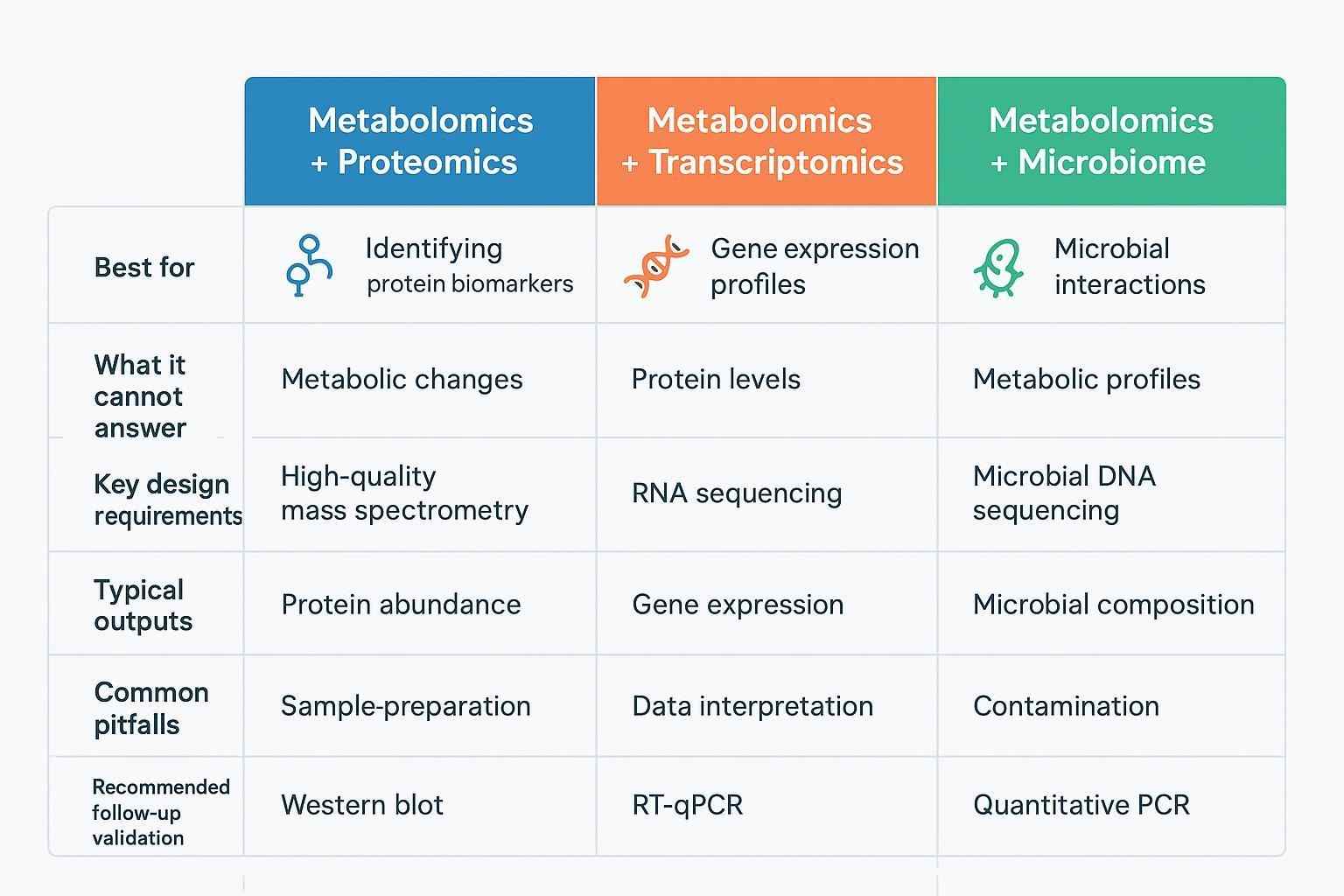
Metabolomics + Proteomics
- Best for: pathway positioning, enzyme/transport constraints, mechanism hypotheses.
- Key design needs: matched samples, batch balance, protein group consistency, metabolite ID confidence; timepoints that bracket expected PD windows.
- Typical outputs: step-level evidence table, pathway summaries, candidate constrained steps supported by both metabolite shifts and protein changes.
- Common risks: interpreting protein abundance as flux without metabolite support; mapping ambiguity between protein groups and enzymes; ignoring post-translational modifications.
- Verification strategy: targeted metabolite verification for key substrates/products; add a short time-course if lag is suspected; consider orthogonal enzyme activity assays when feasible.
Practical DMPK/PD example: Suppose a hepatocyte model shows elevated lactate and reduced TCA intermediates after a compound. Proteomics indicates reduced abundance of PDH E1 subunit and increased PDK. The integration points to a PDH bottleneck. Verification measures include an absolute panel for pyruvate, lactate, acetyl-CoA surrogates, and TCA intermediates using a validated targeted workflow aligned to ICH M10 principles. At this point, commissioning a neutral, external absolute-quant panel—e.g., the Creative Proteomics targeted metabolomics service —can support decision-grade verification without changing your discovery design.
Metabolomics + Transcriptomics
- Best for: regulatory programs and upstream drivers of metabolic state.
- Key design needs: timepoint planning (capture early transcriptional responses and later metabolic settling), confounder capture (media/dose/exposure), stable handling for metabolites.
- Typical outputs: pathway concordance summaries (e.g., glycolysis up at mRNA with supporting lactate/pyruvate shifts), discordance classification (transcripts up, proteins/metabolites not yet aligned), and a validation roadmap.
- Common risks: forcing feature-level agreement; missing time windows; over-interpreting single-gene effects without pathway context.
- Verification strategy: time-course sampling around the suspected regulatory window; targeted verification for sentinel metabolites in the implicated pathway; perturbation aligned to the pathway step (e.g., kinase inhibitor challenge).
Practical DMPK/PD note: In early PD windows where transcription spikes quickly, plan dense early sampling (e.g., 0 h, 6 h, 24 h) for RNA and slightly later points (e.g., 24 h, 72 h) for metabolites to observe convergence.
Metabolomics + Microbiome (16S vs Shotgun)
- Best for: host–microbe functional loops and metabolite validation, especially when diet/exposure may dominate.
- Key design needs: stool handling consistency and temperature control, diet/exposure capture, negative controls, and compositional-aware analysis; choose 16S for taxonomy surveys and shotgun for functional gene profiling.
- Typical outputs: pathway capacity → metabolite evidence table; shortlist of microbially produced or modified metabolites with validation status.
- Common risks: treating predicted function as confirmed metabolism; diet dominating signal; overfitting correlations without accounting for compositional data structure.
- Verification strategy: targeted metabolite panels for microbial metabolites (e.g., SCFAs, bile acids, tryptophan catabolites); replicate cohorts/timepoints where possible; if starting from 16S, plan a follow-up shotgun or targeted verification before making functional claims.
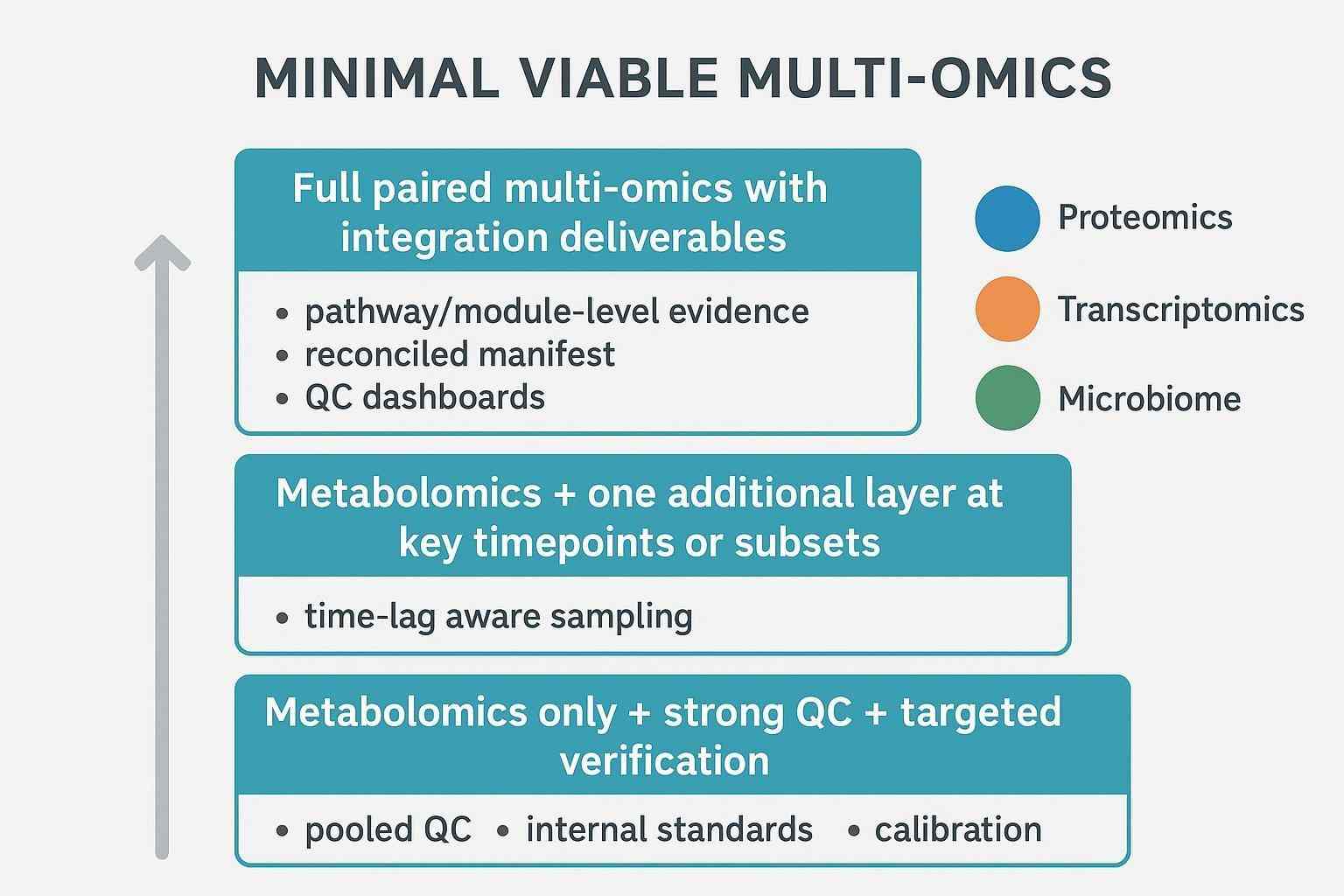
Minimal viable multi-omics (budget- or sample-limited plans)
- Metabolomics-only discovery + targeted verification of key pathways/metabolites: Begin with untargeted or broad profiling, then verify a small, decision-relevant panel with absolute quantitation under ICH M10-aligned practices.
- Add a second layer only at the most informative timepoints or subsets: For example, add proteomics at the PD peak or transcriptomics during the early regulatory window; for microbiome, pair peak diet/exposure windows with metabolite readouts.
- Focus on pathway/module-level integration instead of fragile feature-level linking: Use pathway scoring and topology-aware methods to summarize concordant evidence.
- Predefine what "success" means: Document deliverables and decision criteria (e.g., pathway-level evidence with at least two orthogonal signals and verified metabolite shifts).
Pitfalls that cause expensive failures (and how to avoid them)
| Pitfall | Why it breaks interpretation | Preventive action | Verification check |
|---|---|---|---|
| Choosing a combination that doesn't match the primary question | Layer misalignment yields weak or contradictory evidence | Start with the decision tree; state the endpoint explicitly in the SOW | Pathway-level evidence aligns with the endpoint (enzyme vs regulation vs microbe) |
| Confounding group with batch/site/time-of-day | Spurious differences overshadow biology | Block and randomize; include pooled-QC and reference materials; document batch composition | QC dashboard shows stable pooled-QC CVs and drift within limits |
| Underpowered designs that can't support integration stability | Noisy, irreproducible module signals | Size for expected effect; prioritize module-level endpoints | Replication shows consistent pathway scores across folds/batches |
| Over-interpretation of feature-level mapping | False concordance across omes | Aggregate to pathways/modules; use topology-aware scoring | Concordant pathway signals across layers outperform feature pairs |
| Treating 16S functional predictions as facts | Functional inference is limited | Prefer shotgun for function or validate with metabolites | Measured metabolites match predicted functions in follow-up |
| Skipping verification planning | Discovery cannot translate to decisions | Define targeted panels and orthogonal tests up front | Absolute-quant panels confirm direction and magnitude |
What to ask for in deliverables (to keep the project decision-ready)
- One reconciled sample manifest across modalities (IDs, timepoints, batches, exclusions). Ensure consistent primary keys and explicit handling notes.
- QC summary per modality + batch composition confirmation. Include pooled-QC stability, internal standard checks, missingness, and drift metrics.
- Integration summary at pathway/module level with evidence columns showing contributions from each layer.
- A prioritized candidate list + verification roadmap (what to measure next and why). Align targeted quantification with bioanalytical validation principles (e.g., selectivity, calibration model, accuracy/precision expectations).
- Reproducibility notes (parameters, mapping assumptions, versions) so future cohorts can be aligned or extended.
Small manifest excerpt (illustrative):
| Sample_ID | Subject | Matrix | Timepoint | Batch | Layer(s) | Notes |
|---|---|---|---|---|---|---|
| S001 | Rat_01 | Plasma | 0 h | B1 | Met, RNA | Fasted 8 h; freeze ≤30 min |
| S045 | Rat_09 | Plasma | 24 h | B1 | Met, Prot | Dose 10 mg/kg; matched aliquots |
| S102 | Rat_20 | Stool | 72 h | B2 | Met, Micro | Diet A; cold chain confirmed |
FAQ
Which is better: metabolomics + proteomics or metabolomics + transcriptomics?
Choose based on the decision goal. For enzyme-level mechanism and pathway positioning, pair with proteomics. For upstream regulatory programs, pair with transcriptomics and plan time-lag-aware sampling. Use pathway-level integration, not feature-by-feature matching.
When is microbiome sequencing necessary, and should I use 16S or shotgun?
Use microbiome sequencing when diet/exposure or host–microbe metabolism likely drives PD signals. Choose shotgun when you need functional gene profiles; use 16S for taxonomy screens and follow with metabolite verification before making functional claims.
What is the minimum sample size for multi-omics to be interpretable?
There's no universal number. Power depends on effect size, heterogeneity, and design. When constrained, favor pathway/module endpoints and targeted verification; add a second omics layer only at the most informative timepoints.
How do I choose timepoints for a longitudinal multi-omics study?
Stage timepoints around biology and suspected lags: early windows for transcripts, later points for proteome/metabolome alignment. In DMPK/PD, bracket expected PK peaks and downstream metabolic settling.
What's the best "budget-limited" multi-omics plan that still works?
Adopt a tiered approach: start with metabolomics-only discovery plus targeted verification; add one extra layer at key timepoints or subsets; reserve full paired multi-omics for confirmatory phases.
What should I request in deliverables to avoid rework?
Ask for a reconciled manifest, QC dashboards per modality, pathway/module-level integration with evidence columns, a prioritized candidate list, and a verification roadmap with targeted panels and orthogonal assays.
References
- Sanches PHG et al. Strategies for Comprehensive Multi-Omics Integrative Data Analysis (2024). https://pmc.ncbi.nlm.nih.gov/articles/PMC11592251/
- Jendoubi T. Approaches to Integrating Metabolomics and Multi-Omics Data (2021). https://pmc.ncbi.nlm.nih.gov/articles/PMC8003953/
- Weerakoon H et al. Integrative temporal multi-omics reveals uncoupling of transcriptome and proteome during T-cell activation (2024). https://pmc.ncbi.nlm.nih.gov/articles/PMC10901835/
- Snead AA et al. The Biological Hierarchy, Time, and Temporal 'Omics (2022). https://academic.oup.com/icb/article/62/6/1872/6691691
- Matchado MS et al. On the limits of 16S rRNA gene-based functional inference (2024). https://pmc.ncbi.nlm.nih.gov/articles/PMC10926695/
- Liao F et al. Comparative analysis of shotgun metagenomics and 16S amplicons (2023). https://pmc.ncbi.nlm.nih.gov/articles/PMC10629391/
- Mesnage R et al. Shotgun metagenomics and metabolomics evaluate glyphosate effects (2021). https://pmc.ncbi.nlm.nih.gov/articles/PMC7839352/
- FDA. M10 Bioanalytical Method Validation and Study Sample Analysis (Final, 2022). https://www.fda.gov/media/162903/download
- González-Domínguez A et al. QComics: Robust Untargeted Metabolomics QC (2024). https://pubs.acs.org/doi/10.1021/acs.analchem.3c03660
- Yu Y et al. Correcting batch effects with ratio-based scaling (2023). https://pmc.ncbi.nlm.nih.gov/articles/PMC10483871/
- Yu Y et al. Assessing and mitigating batch effects in large-scale omics (2024). https://pmc.ncbi.nlm.nih.gov/articles/PMC11447944/

 Contact Us