

Glycolysis vs Oxidative Phosphorylation: How Cells Make ATP—and How to Measure the Difference
Submit Your InquiryCells must continuously balance speed, efficiency, and biosynthetic needs to maintain energy homeostasis. Two fundamental biochemical pathways drive ATP production: glycolysis and oxidative phosphorylation (OXPHOS). Research teams often ask: Which pathway dominates under my conditions? But relying on a single marker rarely gives a clear answer.
Instead, a more reliable strategy is to track coordinated patterns across pathway intermediates, energy cofactors like ATP/ADP/AMP, and redox status. This resource explains how these two pathways differ, when they overlap, and how to design a study that accurately captures their contributions.
Why Comparing Glycolysis and Oxidative Phosphorylation Matters
In many experiments, glycolysis is inferred from increased lactate or glucose uptake, while oxidative phosphorylation is assessed via oxygen consumption. While these markers provide directional hints, they often miss the full picture—especially when carbon is diverted into biosynthetic pathways or when redox conditions affect flux.
A better approach begins by asking: What is the cell's ATP production strategy under these conditions? Understanding that requires looking at both pathway flux and energy state. Measuring ATP/ADP/AMP alongside metabolite profiling can help determine whether a system is fast, efficient, or compensating.
One example of this measurement strategy is the Adenosine Triphosphate (ATP) Analysis Service, which supports energy charge–based interpretation across metabolic states.
What Is Glycolysis?
Glycolysis is a cytosolic pathway that converts glucose into pyruvate through enzyme-catalyzed steps. It can produce ATP without requiring oxygen, and it generates intermediates that feed biosynthesis.
A simple quantitative anchor helps keep expectations realistic. Glycolysis yields a net gain of 2 ATP per glucose under standard accounting, because ATP is invested early and produced later.
What Glycolysis Is Good At
Glycolysis is especially useful when cells need:
- fast ATP generation
- flexible energy production under constraints
- carbon intermediates for nucleotides, amino acids, and lipids
Glycolysis is also often emphasized in rapidly proliferating systems because intermediates can be rerouted into anabolic pathways.
What Glycolysis Looks Like in Metabolite Data
If you want to move beyond lactate-only conclusions, look for coordinated changes across:
- early sugar phosphates (e.g., glucose-6-phosphate, fructose-6-phosphate)
- triose phosphates and downstream intermediates
- pyruvate and lactate
- energy cofactors (ATP/ADP/AMP) and, when relevant, redox cofactors (NADH/NAD⁺)
When the project question is pathway-level glycolytic regulation (rather than only glucose and lactate), targeted quantification of glycolytic intermediates is usually the most interpretable approach. For example, a workflow like the Glycolysis Metabolomics Service can help standardize measurement and reduce ambiguity around "glycolysis up vs. down."
If you want a quick conceptual refresher on how glycolysis connects to neighboring pathways (and why single-marker interpretations can fail), the matrix explainer Decoding Glycolysis and Metabolic Interactions is a useful companion read.
What Is Oxidative Phosphorylation?
Oxidative phosphorylation is a mitochondrial process that generates ATP using the electron transport chain (ETC) and chemiosmosis. As electrons move through the ETC, a proton gradient is established across the inner mitochondrial membrane. ATP synthase then uses this gradient to phosphorylate ADP into ATP.
OXPHOS can yield over 30 ATP per glucose when fully coupled with the TCA cycle. However, it requires oxygen, intact mitochondria, and a steady supply of NADH and FADH₂.
Clarifying Search Confusion: Is There Oxidative Phosphorylation in Glycolysis?
No—oxidative phosphorylation is not part of glycolysis. Glycolysis ends with pyruvate production in the cytosol. OXPHOS begins in mitochondria, using electrons derived from glycolysis and the TCA cycle to generate large amounts of ATP.
Projects focused on mitochondrial performance or respiratory shifts benefit from targeted panels like the Oxidative Phosphorylation Analysis Service, which measure relevant intermediates and energy outputs.
Glycolysis vs. Oxidative Phosphorylation: Key Differences
Two frequent questions arise in research discussions:
- What is the difference between oxidative phosphorylation and glycolysis?
Glycolysis is a fast, anaerobic pathway in the cytosol. Oxidative phosphorylation is a high-yield, oxygen-dependent process in mitochondria. - Which is faster, glycolysis or oxidative phosphorylation?
Glycolysis is faster but less efficient. OXPHOS is slower but produces more ATP per glucose molecule.
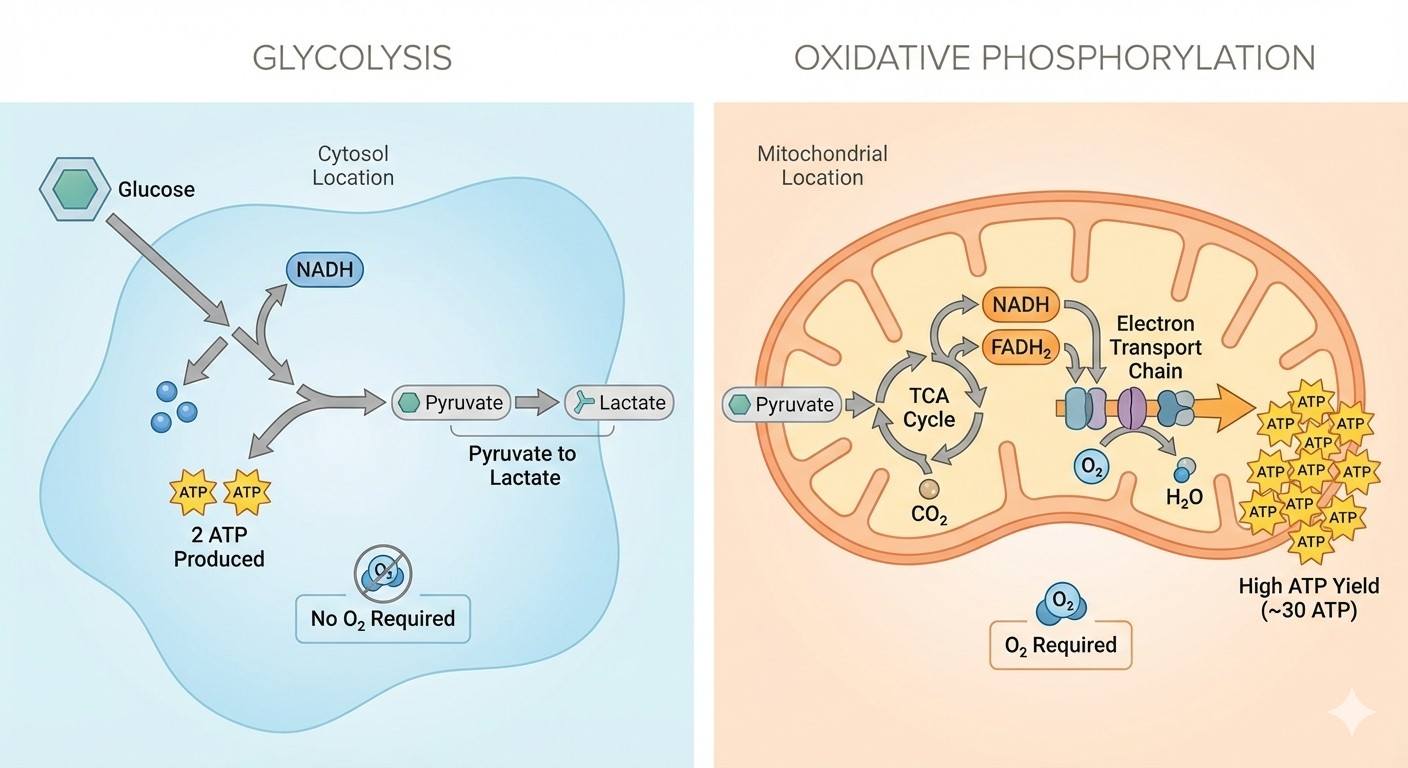 A schematic comparison of glycolysis and oxidative phosphorylation, showing differences in cellular location, oxygen dependence, ATP yield, and metabolic flow.
Comparison Table
| Dimension | Glycolysis | Oxidative Phosphorylation (OXPHOS) |
|---|---|---|
| Primary location | Cytosol | Mitochondria |
| Oxygen requirement | Not required | Typically depends on oxygen availability (mammalian context) |
| ATP production mode | Substrate-level phosphorylation | Electron transport–coupled ATP synthesis |
| Typical role | Rapid ATP + biosynthetic intermediates | Sustained, high-yield ATP production |
| Common "trap" readout | Lactate alone | Oxygen consumption alone |
The Critical Control Point: Pyruvate Routing
Much of the interplay between glycolysis and OXPHOS occurs at the pyruvate branch point. Pyruvate can:
- enter mitochondria and convert to acetyl-CoA, feeding the TCA cycle
- convert to lactate, regenerating NAD⁺ under anaerobic or redox-limited conditions
- be transaminated to alanine or enter other biosynthetic routes
This makes pyruvate routing a key interpretation layer. For deeper insight into this control point, see How Pyruvate-to-Acetyl-CoA Conversion Regulates TCA Cycle Flux.
When to Study One Pathway vs Both
When Glycolysis-Focused Data Can Be Enough
A glycolysis-focused strategy can be sufficient when:
- the perturbation clearly targets a glycolytic enzyme
- the question is narrow and proximal to glycolysis
- you mainly need comparative patterns across conditions
Even in these cases, pairing intermediates with ATP/ADP/AMP often makes the conclusion more defensible.
When You Need a Dual-Pathway View
A combined glycolysis + mitochondrial view is usually important when:
- you need a mechanism-of-action narrative
- compensation is likely (one pathway rises as the other is constrained)
- the phenotype could be driven by redox limits rather than ATP shortage
- you want to separate "flux change" from "energy state change"
A practical workflow for this combined view is to measure glycolysis + TCA + PPP intermediates as a connected system. A panel such as Central Carbon Metabolism Profiling & Flux Analysis is designed for exactly this type of interpretation problem.
How to Measure Each Pathway Effectively
To distinguish glycolysis-driven effects from mitochondria-driven effects, focus on three measurement layers:
- Pathway intermediates
- Energy cofactors (ATP/ADP/AMP)
- Redox cofactors (often NADH/NAD⁺, depending on design)
Measurement Map for Common Study Questions
| Research Question | High-Value Readouts | Why It Helps |
|---|---|---|
| Is glycolytic throughput changing? | Sugar phosphates + pyruvate/lactate | Separates pathway engagement from downstream bottlenecks |
| Is the cellular energy state changing? | ATP/ADP/AMP | Distinguishes flux shifts from energy deficits |
| Is redox balance driving adaptation? | NADH/NAD⁺ (when feasible) | Helps interpret electron-handling constraints |
| Is carbon entering mitochondria differently? | Pyruvate routing markers + TCA intermediates | Supports or refutes a mitochondria-centered mechanism |
| Is glucose diverted into PPP? | PPP intermediates + branch-point context | Explains NADPH demand and redox management |
Analytical Approaches That Fit Different Study Stages
Choosing the right analytical workflow depends on your research goals and how deeply you need to probe energy metabolism. Here are three commonly used strategies:
Targeted Pathway Panels for Hypothesis Testing
When you're testing a specific perturbation—such as a drug inhibiting glycolysis or an upregulated mitochondrial process—targeted LC–MS/MS panels offer focused and interpretable results.
- Use when you already know the pathway of interest and need to quantify key intermediates.
- Ideal for confirming ATP shifts, glycolytic reprogramming, or mitochondrial inhibition.
Try: Glycolysis Metabolomics Service or Oxidative Phosphorylation Analysis Service
Energy Metabolism Profiling for Broader Bioenergetic Questions
If you expect shifts in multiple pathways or fuel sources, a system-wide energy profiling approach is more suitable.
- Supports investigations involving glucose, amino acids, fatty acids, or redox state.
- Recommended for cancer metabolism, bioprocess optimization, and multi-pathway compensation studies.
Central Carbon + Flux Panels for Pathway Mapping
When you're mapping how carbon flows, not just how much accumulates, use central carbon profiling and flux analysis.
- Critical for understanding glycolysis–TCA–PPP branching and pyruvate routing.
- Supports dynamic metabolic modeling and flux shift interpretation.
Practical Design Tips to Improve Interpretability
- Use rapid quenching: ATP, NADH, and glycolytic intermediates degrade quickly. Immediate sample stabilization is essential for preserving true metabolic state.
- Avoid whole-pool overinterpretation: Cytosolic and mitochondrial signals can cancel each other out. Be mindful of compartmentalization, especially in total extracts.
- Don't rely on single proxies: Oxygen consumption ≠ mitochondrial ATP production; lactate ≠ glycolytic flux. Always interpret through multiple layers.
- Validate energy and redox signals together: Pair ATP/ADP/AMP data with NADH/NAD⁺ ratios to understand whether cells are energy-limited or redox-constrained.
- Match sampling protocols to pathway kinetics: Synchronize sample handling to ensure timing consistency, especially in time-course or flux-sensitive designs.
Application Example: Detecting a Glycolysis to OXPHOS Shift in Tumor Cells Under Stress
To demonstrate how coordinated metabolic profiling enables detection of energy pathway transitions, this case draws on a well‑characterized tumor cell model undergoing metabolic adaptation under genotoxic stress. The researchers assessed whether cells that typically rely on glycolysis could shift toward oxidative phosphorylation in response to stress‑related signaling.
Study Setup and Model System
The experiment involved three human tumor cell lines (MCF‑7, HCT116, and U87) exposed to ionizing radiation to induce DNA damage and stress. To explore the mechanism of metabolic adaptation, the team used rapamycin to inhibit mTOR, a central regulator of nutrient sensing, energy metabolism, and mitochondrial function.
Key Measurements and Readouts
To capture the metabolic shift, the study used a multi‑layered measurement design:
- Lactate production — as a readout of glycolytic output
- Oxygen consumption rate — reflecting mitochondrial respiratory engagement
- Mitochondrial ATP production — as a functional outcome of OXPHOS
- Subcellular localization of mTOR — to assess regulatory involvement
- Hexokinase II (HK II) activity — a control point in glycolysis
Principal Findings
Following radiation exposure:
- Lactate production decreased, while
- Oxygen consumption and mitochondrial ATP production increased — together indicating a metabolic shift toward oxidative phosphorylation
- mTOR translocated to mitochondria, where it interacted with HK II and appeared to reduce HK II enzymatic activity
- Rapamycin treatment suppressed the increase in mitochondrial respiration, supporting a regulatory role for mTOR in enabling the metabolic switch
These observations indicate a coordinated reprogramming of energy metabolism — not simply isolated flux changes — in response to stress.
Practical Insights for Metabolomics‑Driven Projects
This study exemplifies several points that are directly relevant to experimental design and data interpretation:
- Metabolic states are dynamic: A phenotype characterized by high glycolysis under baseline conditions does not preclude engagement of oxidative phosphorylation under stress.
- Multi‑layer data improve confidence: Single markers such as lactate or oxygen consumption can be ambiguous without supporting evidence from pathway intermediates and energy cofactors.
- Energy state anchors interpretation: Changes in ATP/ADP/AMP ratios provide quantitative context for pathway shifts, helping distinguish between increased flux and changes in energy efficiency.
Translating the Case Into a Targeted Measurement Strategy
When your question involves detecting or validating a metabolic switch between glycolysis and oxidative phosphorylation, the following measurement design supports robust interpretation:
| Research Question | Targeted Measurements | Interpretation Outcome |
|---|---|---|
| Is glycolytic throughput changing? | Glycolytic intermediates (e.g., G6P, F6P, pyruvate) + lactate | Confirms whether glycolytic flux is truly shifting |
| How is the cellular energy state responding? | ATP/ADP/AMP ratio | Indicates whether changes affect usable cellular energy |
| Is mitochondrial oxidation compensating? | TCA intermediates + OCR (where available) | Supports increased OXPHOS engagement |
By integrating pathway intermediates, energy cofactor dynamics, and functional readouts, you strengthen mechanistic interpretation and avoid misattributing compensatory or parallel responses to primary pathway changes.
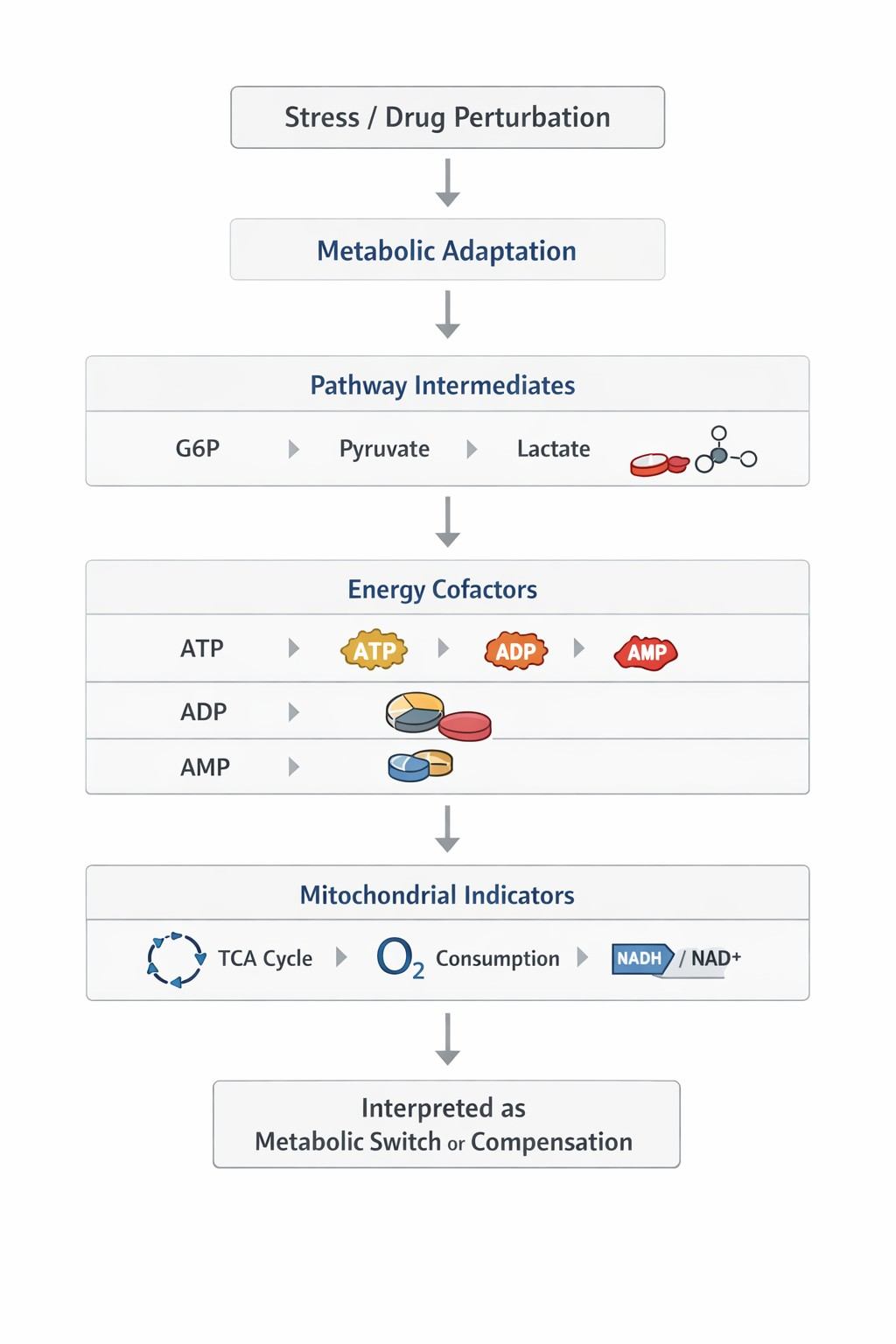 Layered analytical framework for detecting a metabolic switch from glycolysis to oxidative phosphorylation. Inputs are assessed across pathway intermediates, energy cofactors, and mitochondrial indicators.
FAQs
What is the difference between oxidative phosphorylation and glycolysis?
Glycolysis produces ATP in the cytosol through direct phosphate transfer reactions and does not require oxygen. Oxidative phosphorylation produces ATP in mitochondria by coupling electron transport to ATP synthesis, typically yielding more ATP per glucose under aerobic conditions.
Which is faster, glycolysis or oxidative phosphorylation?
Glycolysis is generally faster in ATP production rate. Oxidative phosphorylation is usually more efficient in ATP yield per glucose. Which one dominates depends on constraints such as mitochondrial capacity, substrate routing, and redox balance.
Is there oxidative phosphorylation in glycolysis?
No. Oxidative phosphorylation is not part of glycolysis. Glycolysis occurs in the cytosol and ends with pyruvate production. Oxidative phosphorylation occurs in mitochondria and uses electron transport to generate ATP.
What is the difference between the glycolytic system and the oxidative system?
The glycolytic system prioritizes rapid ATP generation and supplies intermediates for biosynthesis in the cytosol. The oxidative system prioritizes higher-yield ATP generation in mitochondria through oxidative metabolism and electron transport.
What should I measure to distinguish glycolysis-driven effects from mitochondrial-driven effects?
A strong approach combines glycolytic intermediates with ATP/ADP/AMP, and adds redox cofactors (such as NADH/NAD⁺) when the hypothesis involves electron-handling constraints. This reduces misinterpretation from single markers like lactate.
How do I tell whether glucose is being diverted into the pentose phosphate pathway instead of glycolysis?
Look for PPP intermediates increasing alongside changes at early glycolysis branch points around glucose-6-phosphate. This pattern often reflects NADPH demand and redox management rather than a direct need for ATP.
References
- Lu, C.‑L., Qin, L., Liu, H.‑C., Candas, D., Fan, M., & Li, J.‑J. (2015). Tumor Cells Switch to Mitochondrial Oxidative Phosphorylation under Radiation via mTOR‑Mediated Hexokinase II Inhibition – A Warburg‑Reversing Effect. PLoS ONE, 10(3): e0121046.
- Cheng, Q., et al. (2023). Modulating Glycolysis to Improve Cancer Therapy. International Journal of Molecular Sciences, 24(3): 2606.
- Zheng, J. (2012). Energy Metabolism of Cancer: Glycolysis versus Oxidative Phosphorylation. Oncology Letters, 4(6): 1151–1157.
- Frezza, C., & Gottlieb, E. (2024). Altered Metabolism in Cancer: Insights into Energy Pathways and Therapeutic Targets. Molecular Cancer, 23(1): 11919–11928.
- Chan, D. A., & Giaccia, A. J. (2010). Choosing between glycolysis and oxidative phosphorylation: A tumor's dilemma. Biochimica et Biophysica Acta (BBA) – Bioenergetics, 1797(6–7): 933–937.

 Contact Us