

Acyl-CoA vs Acetyl-CoA: What’s the Difference and When to Measure Each?
Submit Your InquiryA common study-design question in metabolic research is straightforward but consequential: Should you measure acetyl-CoA alone, or do you need broader acyl-CoA profiling? The answer often determines whether results support a clear mechanism or remain ambiguous due to missing biological resolution.
Acetyl-CoA is a central hub linking carbohydrate metabolism, fatty acid oxidation (FAO), and the TCA cycle. By contrast, acyl-CoA refers to a family of CoA thioesters spanning multiple chain lengths, which can reveal fatty acid activation, transport handling, β-oxidation intermediates, lipid remodeling, and acyl-donor availability.
This resource explains acyl coa vs acetyl coa, highlights common research scenarios, and provides a practical framework for choosing the most defensible readouts.
For background definitions and context, see: Acyl-CoA Explained: Definition, Types, and Research Relevance.
Acyl-CoA vs Acetyl-CoA: The Practical Difference That Matters in Study Design
At the chemical level, acetyl-CoA is a specific acyl-CoA species: a two-carbon (C2) acyl group attached to coenzyme A via a thioester bond. At the biological level, the difference is functional:
- Acetyl-CoA is a central hub that reflects carbon convergence and energetic integration. It feeds the TCA cycle, supports biosynthesis (e.g., lipogenesis and cholesterol synthesis), and contributes to regulatory acetylation reactions.
- Broader acyl-CoA profiling captures chain-length–resolved fatty acyl-CoA species that reflect fatty acid activation, mitochondrial entry/handling, stepwise β-oxidation intermediates, and remodeling states.
A useful way to think about it is:
Acetyl-CoA tells you what the system is doing at the "central carbon hub." Acyl-CoA profiling tells you what the system is doing upstream in lipid handling and oxidation—often where the bottleneck lives.
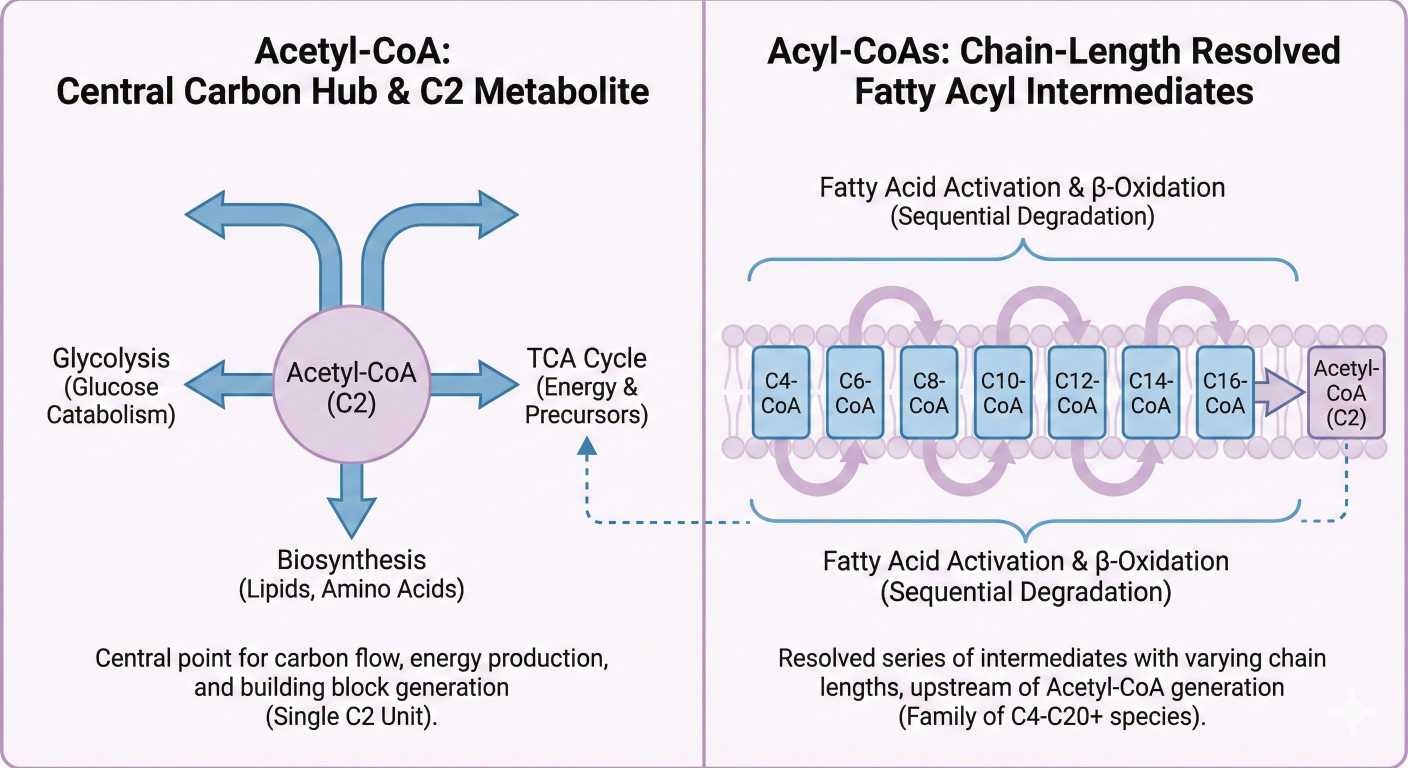 Conceptual comparison of acetyl-CoA as a central carbon hub versus broader acyl-CoA species as upstream, chain-length–resolved metabolic intermediates.
Quick Comparison
| Dimension | Acetyl-CoA (C2) | Acyl-CoA Profiling (Multiple Species) |
|---|---|---|
| Biological resolution | Central carbon integration | Chain-length–specific lipid handling |
| Best for | Energy context, carbon entry, regulation support | FAO bottlenecks, activation mechanisms, lipid stress signatures |
| Typical pitfall | Used as proxy for all acyl-CoAs | Over-measuring without a hypothesis |
| Interpretation style | Single anchor + context | Pattern recognition across chain lengths |
| "Signal" type | Hub-state indicator | Pathway-node and bottleneck signatures |
This framing helps avoid a common mistake: treating acetyl-CoA as interchangeable with "acyl-CoA biology." It is not—unless your question truly centers on acetyl-CoA specifically.
When Measuring Acetyl-CoA Alone Can Be Sufficient
There are well-defined cases in which measuring acetyl-CoA alone is reasonable and efficient—especially when the hypothesis is narrow and mechanistically proximal to the acetyl-CoA node.
Acetyl-CoA is often sufficient when:
- Your hypothesis is central-carbon–focused.
Examples include questions about pyruvate entry into mitochondria, PDH regulation, central energetic stress, or carbon allocation into citrate/TCA-linked processes. - You do not need chain-length specificity.
If your conclusions do not depend on distinguishing medium-chain vs long-chain behavior—or on diagnosing β-oxidation step constraints—acetyl-CoA may provide adequate resolution. - Acetyl-CoA is used as a contextual anchor rather than the sole mechanistic claim.
For instance, acetyl-CoA may support a narrative about energy availability or acetyl-donor plausibility when paired with orthogonal evidence (enzyme activity, protein modification status, transcript/protein markers, etc.).
In these cases, interpretability improves significantly when acetyl-CoA is paired with an energy-state readout. Energy charge markers (ATP/ADP/AMP) help distinguish "carbon availability" from "usable energy state." A quantitative option for this anchor is the Adenosine Triphosphate (ATP) Analysis Service.
Important caveat: acetyl-CoA integrates inputs from multiple sources (glycolysis-derived pyruvate, fatty acid oxidation, amino acid catabolism). If the study requires attributing acetyl-CoA changes to a specific substrate source, consider complementary pathway anchors or tracer-informed designs.
When Broader Acyl-CoA Profiling Is Required
Many studies require more than a central hub readout. If your hypothesis involves lipid handling, mitochondrial oxidation steps, chain-length selectivity, or activation mechanisms, broader acyl-CoA profiling is typically warranted.
FAO and Mitochondrial Function: Locating Bottlenecks
β-oxidation proceeds in sequential cycles, shortening fatty acyl-CoAs by two carbons each round and producing acetyl-CoA. When FAO is partially impaired, acetyl-CoA can remain stable—especially if compensatory pathways contribute—while upstream intermediates accumulate in diagnostic chain-length patterns.
Common FAO interpretation goals that benefit from acyl-CoA profiling include:
- Distinguishing upstream activation/handling constraints from downstream oxidation bottlenecks
- Identifying chain-length selectivity (e.g., medium-chain vs long-chain constraints)
- Detecting compensatory signatures reflected in related metabolite classes
Because transport/handling can be a major confounder, FAO studies often benefit from pairing acyl-CoA information with chain-length–resolved acylcarnitines. For this complementary layer, see the Carnitine and Acylcarnitine Analysis Service.
When the study claim depends on directionality or throughput (flux), static pool sizes alone are not sufficient. In such cases, flux-enabled strategies can strengthen inference, such as the β-Oxidation Flux Panel Analysis.
For chain-length–focused mechanistic reading related to β-oxidation enzymes, you may also reference the broader family-level guide: ACAD Family in β-Oxidation: What to Measure.
Fatty Acid Activation and ACSL Mechanism Validation
In ACSL-related studies (inhibition, knockout, overexpression, or fatty acid loading), downstream lipid endpoints can shift for multiple reasons—synthesis, remodeling, storage—making them indirect validators of activation.
A more direct strategy is to evaluate fatty acyl-CoA distributions aligned to the manipulated fatty acid inputs or pathway perturbations. This provides proximal evidence that activation products change in the expected direction and chain-length range.
For a focused mechanism-oriented guide, see: Validating Acyl-CoA Synthetase (ACSL) Activity: Key Acyl-CoA Readouts and Metabolic Evidence.
Lipid Remodeling, DNL, and Substrate Reprogramming
In lipid synthesis and remodeling contexts (including stress-adaptation models), the key question is often not simply "did lipids change," but why:
- Is the phenotype driven by increased substrate supply or altered enzyme activity?
- Is oxidation reduced, synthesis increased, or both?
- Are changes compartment- or tissue-specific, altering acyl-donor availability?
In these scenarios, acyl-CoA profiling can clarify substrate handling, especially when integrated into a hypothesis-driven panel that includes central carbon anchors. When your project requires customized, reproducible quantification across selected pathways, a targeted strategy may be appropriate via the Targeted Metabolomics Analysis Service.
Common Pitfalls in Acyl-CoA vs Acetyl-CoA Interpretation
Even well-designed studies can lose interpretability if common assumptions go unchecked. The following pitfalls appear frequently in mechanistic and translational work.
Pitfall 1: Using Acetyl-CoA as a Proxy for All Acyl-CoA Biology
Acetyl-CoA is central, but fatty acyl-CoA dynamics can shift independently—especially in activation and FAO bottleneck contexts.
Mitigation: When chain-length specificity is part of your hypothesis, include representative fatty acyl-CoA species or a chain-length distribution rather than relying only on acetyl-CoA.
Pitfall 2: Over-Interpreting a Single Intermediate
A single acyl-CoA species can change due to synthesis, oxidation, transport, or compartment shifts.
Mitigation: Use a small "family set" spanning chain lengths aligned to the hypothesis (e.g., include short-, medium-, and long-chain representatives).
Pitfall 3: Inferring Flux from Pool Size
Higher intermediate levels can reflect downstream constraint rather than increased throughput.
Mitigation: If pathway rate is central to your claim, incorporate flux-oriented logic instead of inferring rate from concentration alone.
Pitfall 4: Ignoring CoA Pool Context
Acyl-CoA changes can be influenced by total CoA availability or redistribution between free CoA and esterified forms.
Mitigation: When CoA availability is biologically relevant, measure the broader CoA pool using the Coenzyme A (CoA) Analysis Service.
Pitfall 5: Relying on Kit-Based Signals in Complex Matrices
For tissue or high-matrix samples, specificity and stability can be limiting. In such cases, kit-based methods may not support cross-batch comparability.
For decision context, see the PPA-oriented resource: Why Acetyl-CoA/CoA Assay Kits Often Fail in Tissues.
A Decision Framework for What to Measure
The most defensible measurement strategy is the one that distinguishes between your most plausible competing explanations with minimal redundancy. Use the framework below to align readouts with intent.
Decision Table: Which Measurement Strategy Fits Your Question?
| Study Question | Value of Acetyl-CoA Alone | When Broader Acyl-CoA Profiling Adds Value | Recommended Companion Readouts |
|---|---|---|---|
| Central energy/carbon balance | High | Medium (only if lipid handling is implicated) | ATP/ADP/AMP |
| FAO impairment suspected | Low–Medium | High (chain-length patterns matter) | Acylcarnitines; optional flux |
| ACSL/fatty acid activation mechanism | Low | High (activation products are direct) | Acetyl-CoA or CoA pool anchor |
| Lipid remodeling/DNL vs FAO ambiguity | Medium | High (discriminates pathways) | Targeted central carbon anchors |
| Cross-batch comparability in tissues | Medium | High (needs robust specificity) | CoA pool context as needed |
| Exploratory screening with limited claims | Variable | Variable (risk of over-interpretation) | Keep panel hypothesis-aligned |
How to Use This Framework
- If your hypothesis depends on chain-length specificity or activation products, acetyl-CoA alone is typically insufficient.
- If your hypothesis is central-carbon–anchored and does not depend on lipid handling resolution, acetyl-CoA can be sufficient—especially when paired with energy state.
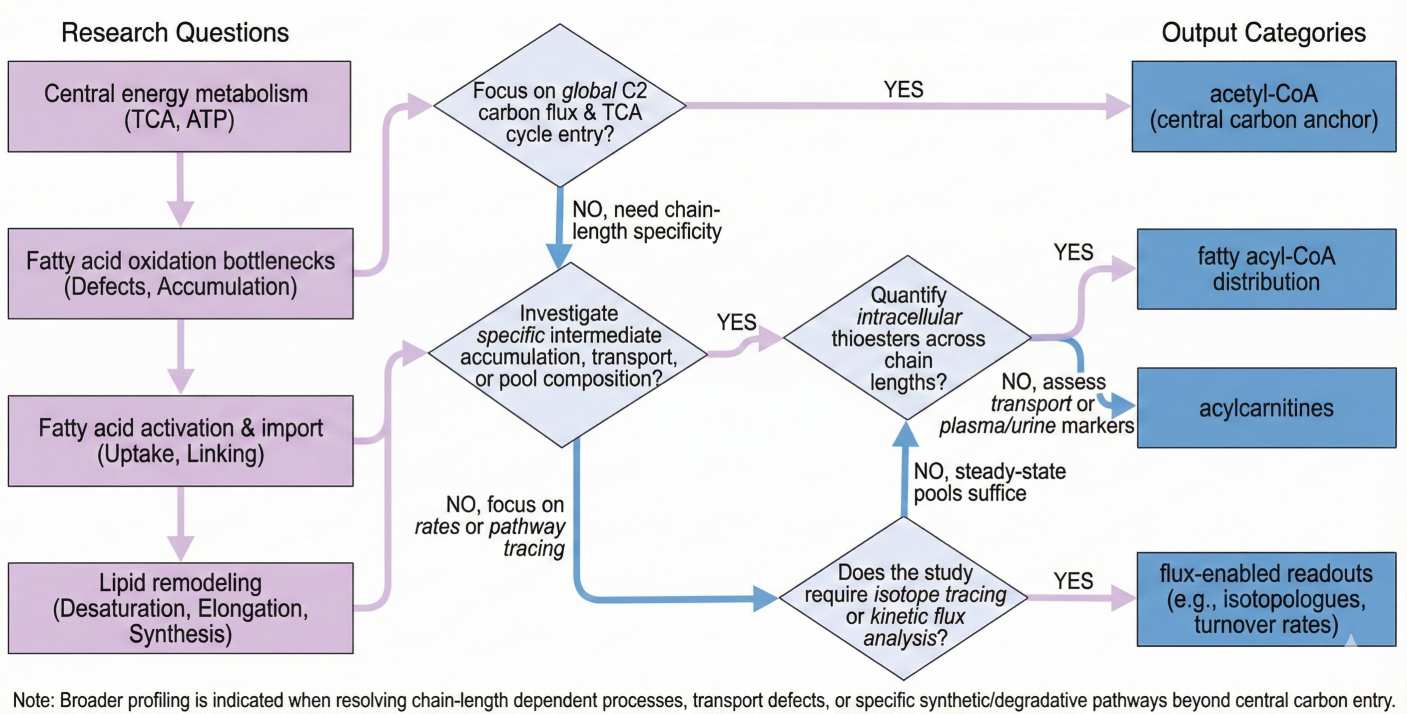 Decision framework for selecting acetyl-CoA, acyl-CoA profiling, or related readouts based on common metabolic research questions.
Minimal, Publishable Readout Packages (Examples)
A practical design rule is: select the smallest set of measurements that can discriminate between leading competing explanations. The goal is not maximal coverage, but interpretable conclusions.
| Research Aim | Minimal Readout Package | Why It Works |
|---|---|---|
| Localize FAO impairment | Acylcarnitines + selected fatty acyl-CoAs + ATP/ADP/AMP | Captures diagnostic chain-length patterns and adds energy context |
| Validate ACSL activation mechanism | Fatty acyl-CoA distribution + acetyl-CoA (or CoA pool) | Measures activation products directly and anchors interpretation |
| Separate energy stress from substrate handling | Acetyl-CoA + ATP/ADP/AMP + small targeted panel | Reduces ambiguity when multiple pathways could explain phenotype |
| Expand beyond CoA esters without losing interpretability | Targeted metabolomics panel + focused acyl-CoA subset | Maintains hypothesis-driven interpretation while adding context |
Frequently Asked Questions (FAQs)
What is the difference between acyl-CoA and acetyl-CoA?
Acetyl-CoA is one specific acyl-CoA (C2). “Acyl-CoA” refers to a family of CoA thioesters with different chain lengths that reflect fatty acid activation, transport handling, and oxidation steps upstream.
Is acetyl-CoA the same as acyl-CoA?
No. Acetyl-CoA is a subset of the acyl-CoA pool. Measuring acetyl-CoA alone does not capture chain-length–resolved fatty acyl-CoA behavior.
When should I measure acyl-CoA instead of only acetyl-CoA?
Measure broader acyl-CoA species when your hypothesis involves fatty acid activation (ACSL), FAO bottlenecks, chain-length specificity, lipid remodeling, or competing pathway explanations.
Should I measure acyl-CoA or acylcarnitines for FAO studies?
They are complementary. Acylcarnitines often reflect transport/oxidation balance signatures, while acyl-CoAs can be closer to activation products and pathway-node interpretation. Use both when bottleneck localization matters.
Can I infer FAO rate from acyl-CoA levels alone?
Not reliably. Acyl-CoA pool size reflects production and consumption balance and may increase due to downstream constraints. If rate (flux) is central, incorporate flux-oriented designs rather than relying on pool size alone.
Does a higher acetyl-CoA level mean higher metabolic flux?
Not necessarily. Acetyl-CoA may rise due to reduced consumption, altered routing, or compartment effects. Interpret acetyl-CoA with pathway context and energy-state anchors.
Is oxidative phosphorylation part of glycolysis?
No. Glycolysis occurs in the cytosol and ends with pyruvate production. Oxidative phosphorylation occurs in mitochondria and generates ATP through the electron transport chain and ATP synthase.
What is the fastest way to choose a readout package before outsourcing analysis?
Define the top two competing explanations for your phenotype, then choose the smallest measurement set that separates them—often a chain-length signature readout plus one or two anchors such as acetyl-CoA, CoA pool, or ATP.
References
- Neubauer, Stefan, et al. "LC-MS/MS-based analysis of coenzyme A and short-chain acyl-coenzyme A thioesters." Analytical and Bioanalytical Chemistry 407 (2015): 6681–6688.
- Blachnio-Zabielska, Agnieszka U., Christina Koutsari, and Michael D. Jensen. "Measuring long-chain acyl-coenzyme A concentrations and enrichment using liquid chromatography/tandem mass spectrometry with selected reaction monitoring." Rapid Communications in Mass Spectrometry 25.15 (2011): 2223–2230.
- Snyder, Nathaniel W., et al. "Production of stable isotope-labeled acyl-coenzyme A thioesters by yeast stable isotope labeling by essential nutrients in cell culture." Analytical Biochemistry 474 (2015): 59–65.
- Pietrocola, Federico, et al. "Acetyl Coenzyme A: A Central Metabolite and Second Messenger." Cell Metabolism 21.6 (2015): 805–821.

 Contact Us