

Validating Acyl-CoA Synthetase (ACSL) Activity: Key Acyl-CoA Readouts and Metabolic Evidence
Submit Your InquiryIn lipid metabolism, activation of long-chain fatty acids is the mandatory "toll booth" every fatty acid must pass before it can be used. This critical step is catalyzed by the Acyl-CoA Synthetase (ACSL) family (also called fatty acyl-CoA synthetases). Without conversion of a free fatty acid (FFA) into its CoA thioester (fatty acyl-CoA), the molecule remains metabolically inert—unable to enter β-oxidation, serve as a substrate for phospholipid/TAG synthesis, or participate in key lipid signaling processes.
If your study touches metabolic syndrome, NASH, ferroptosis, or tumor lipid addiction, ACSL isoforms often become mechanistic "suspects." But measuring ACSL mRNA or protein is usually not enough—mechanistic validation requires quantifying the enzyme's metabolic products.
Quick answer (what to measure):
To validate ACSL activity, quantify the isoform-matched long-chain fatty acyl-CoA species (e.g., ACSL4 → C20:4-CoA). Strengthen causality by pairing this with FFAs (substrate pool) and—if your hypothesis is about routing—adding acylcarnitines (FAO proxy) or lipidomics (partitioning/membrane remodeling).
For projects that need targeted quantification of CoA-related intermediates, you can choose our pantothenate & coA metabolism service.
The Biochemistry of Fatty Acid Activation
ACSL catalyzes an ATP-dependent ligation that converts R–COOH → R–CO–SCoA.
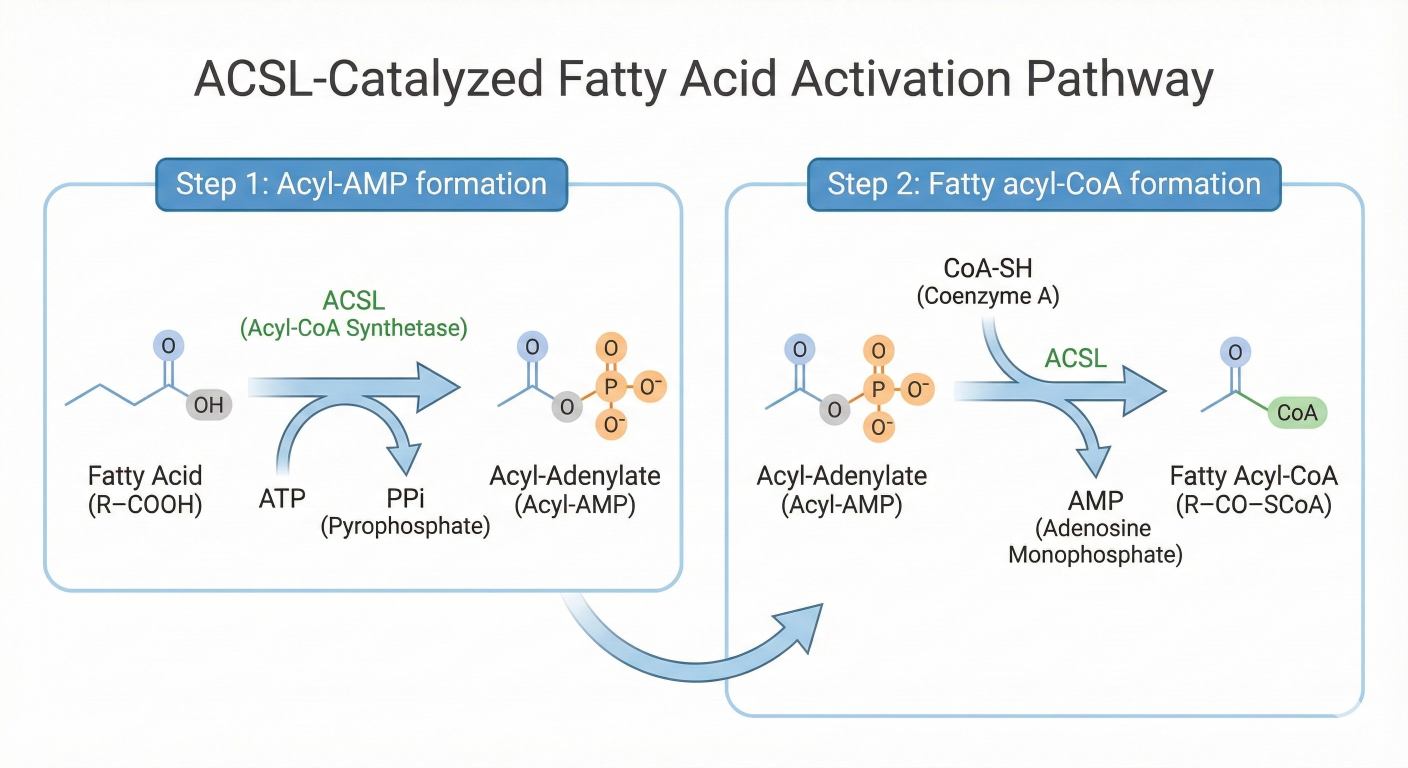 Two-step ACSL-mediated fatty acid activation. ACSL catalyzes fatty acid adenylation to form acyl-AMP, followed by CoA-dependent thioesterification to produce long-chain acyl-CoA.
Overall Reaction

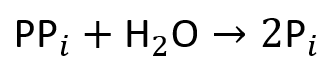
The reaction is driven forward because pyrophosphate is rapidly hydrolyzed:
Two-Step Mechanism
Step 1 — Acyl-Adenylate (Acyl-AMP) Formation

Step 2 — Thioester Formation

Practical implication: AMP is not a specific ACSL readout (it appears in many reactions). The fatty acyl-CoA product is the direct evidence of ACSL activity—yet it's also highly sensitive to sample handling and analytical method.
In some study designs, the research focus shifts from a specific ACSL isoform to the broader availability of Coenzyme A (CoA) itself. In these cases, quantifying total and free CoA pools—independent of specific fatty acid conjugates—can be more informative. For such objectives, consider using a dedicated Coenzyme A analysis to monitor CoA-related metabolic capacity across tissues or perturbations.
ACSL Isoforms: Substrate Preference Determines What You Measure
In humans, the ACSL family consists of five distinct isoforms (ACSL1, 3, 4, 5, and 6), each encoded by a different gene and exhibiting unique substrate preferences and tissue distributions. Validating an ACSL-related mechanism requires an understanding of which isoform is dominant in your model.
ACSL Isoform Characteristics
| Isoform | Primary Tissue Distribution | Substrate Preference | Biological Role |
|---|---|---|---|
| ACSL1 | Liver, Adipose, Heart | C16–C18 (e.g., Palmitate, Oleate) | FAO in heart/muscle; Lipogenesis in liver |
| ACSL3 | Brain, Prostate, Liver | C12–C16 (Saturated/Unsaturated) | Lipid droplet formation; Viral replication |
| ACSL4 | Adrenal Gland, Ovary, Breast | C20 (Arachidonate/Eicosapentaenoate) | Ferroptosis; Steroidogenesis |
| ACSL5 | Small Intestine, Liver | C16–C18 | Intestinal fat absorption; Pro-apoptotic signaling |
| ACSL6 | Brain, Nerve, Testis | C20–C22 (DHA/Arachidonate) | Brain phospholipid remodeling; Myelination |
When designing a study, it is crucial to measure the specific acyl-coA species that match the enzyme's substrate preference. For example, if you are knocking down ACSL4 in a cancer model, measuring total acetyl-coA is irrelevant; you must quantify arachidonyl-coA (C20:4-CoA) to validate the loss of enzyme activity.
Key Metabolic Readouts for Validating ACSL Activity
To mechanistically validate ACSL involvement in fatty acid metabolism, researchers should consider a two-tier readout strategy: (1) direct product quantification and (2) downstream metabolic routing, depending on the biological question.
Immediate Product: Long-Chain Acyl-CoA Profiling
The most direct evidence of ACSL activity is the quantification of isoform-specific long-chain acyl-CoA species. When ACSL activity is suppressed (e.g., via siRNA or pharmacological inhibitors), a typical pattern is the accumulation of free fatty acids (FFAs) alongside a drop in the corresponding acyl-CoA esters.
- What to measure: Long-chain acyl-CoAs covering C12 to C22, selected based on isoform substrate preference (e.g., C20:4-CoA for ACSL4).
- Enhanced interpretation: Rather than relying solely on absolute concentrations, calculating the FFA / acyl-CoA ratio provides a more sensitive indicator of enzymatic conversion efficiency and activation bottlenecks.
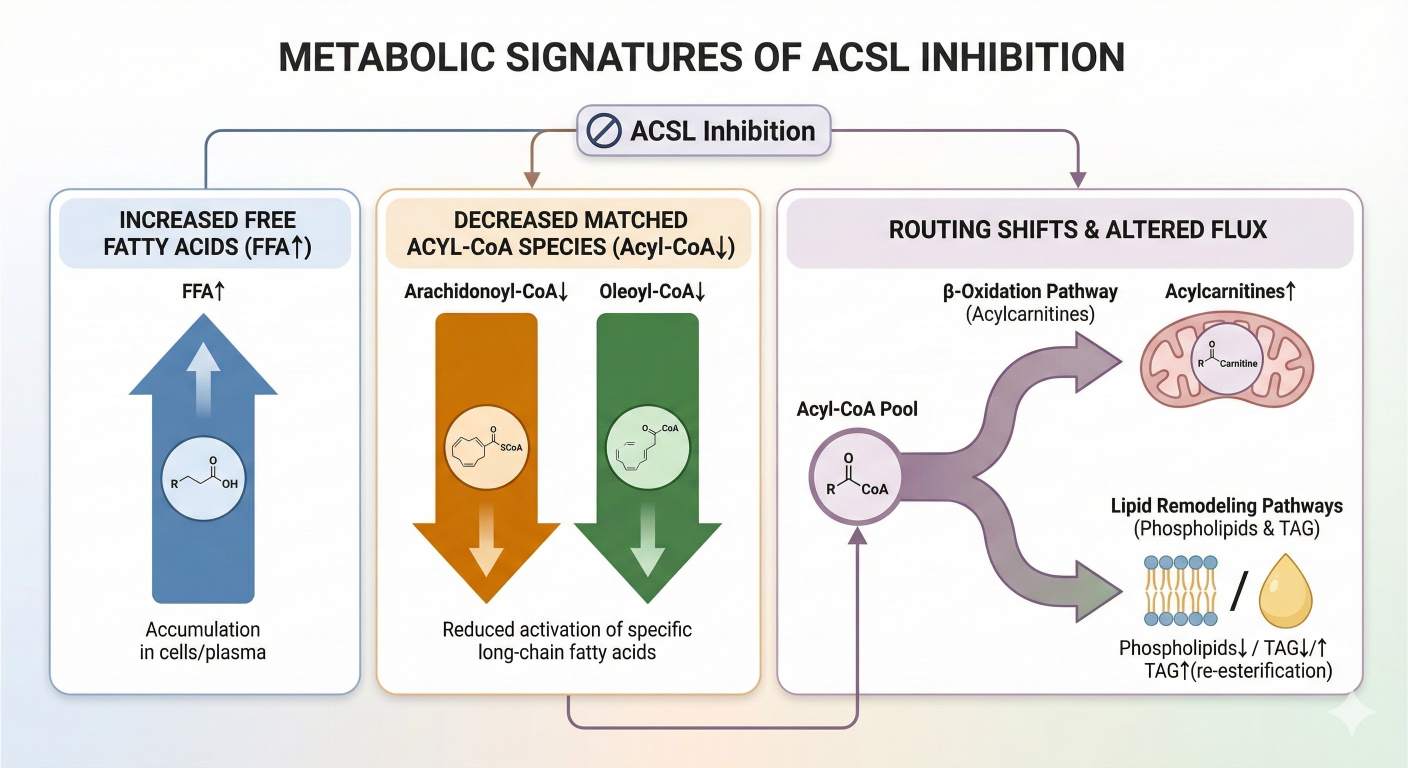 Metabolic signatures of ACSL inhibition. Characteristic changes include increased free fatty acids, reduced matched acyl-CoA species, and altered routing toward β-oxidation or lipid remodeling.
Routing Toward β-Oxidation: Acylcarnitines as Flux Indicators
In models where ACSL1 or ACSL5 is presumed to direct fatty acids into mitochondrial β-oxidation, secondary readouts such as acylcarnitines and downstream TCA intermediates become valuable. A reduction in activated acyl-CoAs is often mirrored by a decrease in acylcarnitine intermediates, particularly C16:0-carnitine, C18:1-carnitine, etc.
- What to measure: Chain-length-specific acylcarnitines, Acetyl-CoA, and TCA cycle metabolites (e.g., Citrate, Malate, Succinate) to demonstrate flux attenuation.
- Integrated approach: Combining CoA profiling with β-oxidation flux panels enables researchers to correlate activation defects with energy output deficits.
Lipid Partitioning: Phospholipids vs. Neutral Lipids
ACSL3 and ACSL4 frequently participate in lipid partitioning toward phospholipid remodeling, triacylglycerol synthesis, or PUFA enrichment in membranes. These processes can be indirectly validated by pairing acyl-CoA readouts with lipidomics.
- Ferroptosis context: ACSL4-mediated incorporation of arachidonate (C20:4) and docosahexaenoate (C22:6) into phosphatidylethanolamines (PEs) sensitizes cells to lipid peroxidation. A drop in these acyl-CoAs along with altered PUFA-PE levels suggests enzymatic impact.
- NASH/steatosis context: Decreased palmitoyl-CoA (C16:0-CoA) levels alongside reduced TAG accumulation can indicate defects at the activation step.
Creative Proteomics offers a customizable lipid metabolism profiling, enabling researchers to track how activated fatty acids are routed into structural and storage lipids.
Why LC–MS/MS Is the Practical Default for ACSL Validation
Validating fatty acyl-CoA synthetase activity via traditional enzymatic kits is notoriously difficult due to the "detergent-like" nature of the products.
Solubility and Adsorption
Long-chain acyl-CoAs (e.g., C16-CoA, C18-CoA) are amphipathic molecules with a highly polar CoA headgroup and a long hydrophobic acyl chain. Because of this dual character, they readily adsorb to plastic surfaces such as microcentrifuge tubes and chromatographic tubing. Unless the extraction and LC–MS setup is optimized for this class of analytes (including appropriate materials and additives), substantial and chain length–dependent recovery loss can occur, increasing the risk of underestimating true acyl-CoA levels.
Thioester Stability
As discussed in our previous technical deep-dive into why assay kits often fail, the thioester bond is unstable at neutral pH. Because ACSL enzymes require ATP and CoA, most "in-house" enzymatic assays operate at pH 7.5–8.0, which paradoxically accelerates the degradation of the product being measured. LC-MS/MS solves this by utilizing immediate acidic quenching (pH < 3.0) post-reaction.
ACSL in Disease: Research Applications
Ferroptosis and ACSL4
Ferroptosis is an iron-dependent form of regulated cell death driven by the peroxidation of polyunsaturated phospholipids (PUFA-PLs). Multiple studies have shown that ACSL4 is required for activating arachidonic acid (C20:4) and docosahexaenoic acid (C22:6) into their CoA thioesters. These PUFA-CoAs are then incorporated into membrane phosphatidylethanolamines (PEs), creating a PUFA-rich lipid environment that is particularly susceptible to oxidative damage.
Expert insight:
When ACSL4 is inhibited or knocked down, ferroptosis-prone models typically show:
- Decreased C20:4-CoA and C22:6-CoA, reflecting impaired activation
- Accumulation of free C20:4 and C22:6, reflecting substrate build-up
- A shift in PUFA-PE composition, even if total phospholipid levels change only modestly
This pattern helps distinguish a true activation defect from nonspecific changes in PUFA uptake or global lipid turnover.
Validation strategy:
- Primary readout – quantify C20:4-CoA and C22:6-CoA as the immediate ACSL4 products.
- Substrate/product pairing – measure free C20:4/C22:6 in parallel and interpret the FFA / acyl-CoA ratio.
- Downstream context (optional) – combine CoA profiling with phospholipid-focused lipidomics to assess PUFA incorporation into PE species associated with ferroptosis sensitivity.
Cancer Metabolism and ACSL3
In several tumor models, ACSL3 is upregulated to support lipid droplet biogenesis and remodeling, providing a buffer of fatty acids that can be mobilized for energy production or membrane synthesis under stress conditions. However, an increase in lipid droplets alone does not prove that ACSL3 is driving activation—similar phenotypes can arise from enhanced fatty acid uptake or de novo lipogenesis.
Expert insight:
To disentangle uptake from activation, stable isotope tracing is particularly informative:
- Supplying cells with [U-¹³C] oleic acid allows direct tracking of its conversion into ¹³C-oleoyl-CoA (C18:1-CoA).
- Following the label into ¹³C-tagged TAG species and ¹³C-labeled membrane lipids reveals whether ACSL3 preferentially routes activated fatty acids into storage or structural pools.
- Comparing labeling patterns under nutrient-replete and nutrient-stress conditions helps determine whether ACSL3-mediated activation is a key survival or adaptation mechanism.
Validation strategy:
- Confirm ACSL3-dependent activation by quantifying ¹³C-oleoyl-CoA levels in control vs ACSL3-perturbed conditions.
- Map routing by examining how the ¹³C label distributes between TAGs and membrane phospholipids, rather than relying solely on droplet microscopy.
- Integrate with phenotype by relating changes in labeled pools to cell growth, stress resistance, or drug sensitivity in your cancer model.
A Study Design Checklist for Successful ACSL Validation
Use this checklist to make ACSL validation reviewer-proof:
- Match substrate to isoform
Choose readouts aligned to isoform preference (e.g., ACSL4 → PUFA-CoAs such as C20:4-CoA). - Quench quickly and control handling
Minimize time-to-quench, keep samples cold, and avoid repeated freeze–thaw cycles. - Measure a panel, not a single analyte
Pool shifts across multiple acyl-CoAs are often more informative than one data point. - Use isotope-labeled internal standards for quantitation
This is essential to control recovery loss and matrix effects for long-chain CoAs. - Add downstream modules only if they serve your claim
- FAO routing claim → acylcarnitines
- Membrane/TAG routing claim → lipidomics
- Carbon-flow/energy phenotype claim → consider pairing with targeted TCA readouts
Frequently Asked Questions (FAQs)
What is the primary difference between ACSL and other acyl-CoA synthetases?
The acyl-CoA synthetase family is divided by chain-length preference. ACSL (Long-chain) focuses on C12–C20. There are also ACSS (Short-chain, C2–C4), ACSM (Medium-chain, C6–C12), and ACSVL (Very-long-chain, >C22). For most dietary fatty acid studies, ACSL is the relevant family.
Can I validate ACSL activity by just measuring AMP production?
While the reaction produces AMP, it is a non-specific readout. AMP is involved in hundreds of cellular reactions. To validate ACSL specifically, you must measure the Fatty Acyl-CoA product using LC-MS/MS.
Why do my ACSL4 levels not correlate with total Acetyl-CoA?
ACSL4 specifically activates long-chain PUFAs (like Arachidonic Acid). Acetyl-CoA is a 2-carbon product of \beta-oxidation. A defect in ACSL4 will impact membrane composition and ferroptosis sensitivity long before it significantly alters the total Acetyl-CoA pool. This is why isoform-specific profiling is essential.
How do I distinguish between ACSL activity and Fatty Acid Uptake?
Pair FFAs + matched acyl-CoAs and evaluate the FFA/acyl-CoA ratio. If uptake is unchanged but activation is impaired, FFAs rise while matched acyl-CoAs fall.
References
- Yang, Y., Zhu, T., Wang, X., Xiong, F., Hu, Z., Qiao, X., Yuan, X., & Wang, D. (2022). ACSL3 and ACSL4, Distinct Roles in Ferroptosis and Cancers. Cancers, 14(23), 5896.
- Hou, J., Jiang, C., Wen, X., Li, C., Xiong, S., Yue, T., Long, P., & Shi, J. (2022). ACSL4 as a Potential Target and Biomarker for Anticancer: From Molecular Mechanisms to Clinical Therapeutics. Frontiers in Pharmacology, 13, 949863.
- Doll, S., et al. (2017). ACSL4 dictates ferroptosis sensitivity by shaping cellular lipid composition. Nature Chemical Biology, 13(1), 91–98.
- Quan, J., Bode, A. M., & Luo, X. (2021). ACSL family: The regulatory mechanisms and therapeutic implications in cancer. European Journal of Pharmacology, 909, 174397.

 Contact Us