

Acyl-CoA: Definition, Types, and Why It Matters in Metabolic Research
Submit Your InquiryAcyl-CoA (acyl coenzyme A) is a central class of metabolic intermediates that connects fatty acid activation, mitochondrial fatty acid β-oxidation (FAO), lipid synthesis and remodeling, and multiple regulatory processes that depend on acyl-group transfer. Because "acyl-CoA" refers to a family of CoA thioesters rather than a single metabolite, study design often requires an explicit decision: which acyl-CoA species are informative for the biological question, and when is acetyl-CoA alone sufficient?
This resource provides a practical definition, a research-oriented type map, common study scenarios, and a decision checklist for selecting acyl-CoA-related readouts in mechanistic and translational metabolic research. For a focused comparison between acetyl-CoA and broader acyl-CoA profiling, please refer to: Acyl-CoA vs Acetyl-CoA: Differences & When to Measure Each.
What Is Acyl-CoA?
Acyl-CoA refers to a group of molecules in which coenzyme A (CoA) is covalently linked to an acyl group via a thioester bond. The acyl group can vary widely in carbon length and structure (e.g., saturated vs unsaturated, branched vs straight chain, hydroxy- or dicarboxylic forms). In biological terms:
- CoA functions as a universal carrier that "activates" carbon units.
- The acyl group represents the transferable carbon chain or carbon unit.
- Acyl-CoA intermediates are used as substrates for oxidation, synthesis, and acyl-transfer reactions.
A key point for interpretation is that "acyl-CoA" is not synonymous with acetyl-CoA. Acetyl-CoA is one specific acyl-CoA species (C2) and is highly informative for central carbon metabolism, but it does not capture chain-length–resolved fatty acyl-CoA behavior that is often critical for lipid activation and FAO-related questions.
When the research goal includes characterizing the overall CoA pool (e.g., free CoA and related forms) as part of pathway interpretation, a dedicated CoA quantification service may be relevant: Coenzyme A (CoA) Analysis Service.
Major Classes of Acyl-CoA and What They Indicate
For study design and mechanistic interpretation, acyl-CoA species are often better categorized by their biological roles rather than chemical structure alone. The table below summarizes a functional classification aligned with common research applications.
Practical acyl-CoA type map for study design
| Acyl-CoA class (research perspective) | Representative examples | Typical interpretation value | Common use cases |
|---|---|---|---|
| Central carbon–linked CoA esters | acetyl-CoA, succinyl-CoA, malonyl-CoA | Links carbon entry, energy state, and anabolic/catabolic balance | Mitochondrial biology, metabolic regulation, flux-oriented questions |
| Fatty acyl-CoAs (fatty acid activation products) | C16:0-, C18:0-, C18:1-CoA | Direct evidence of activation and substrate availability; chain-length pattern information | ACSL mechanisms, lipid stress, ferroptosis-adjacent studies |
| Medium-chain acyl-CoAs | C6–C12 CoA esters | Readouts aligned to mid-chain FAO steps and related bottlenecks | MCAD/ACADM-related hypotheses, FAO impairment studies |
| Very-long-chain–related acyl-CoAs | C22–C26 CoA esters (context-dependent) | Supports peroxisomal/mitochondrial partitioning questions | Peroxisomal metabolism, VLCFA handling and remodeling |
| Short-chain regulatory acyl donors | acetyl-, propionyl-, butyryl-CoA (context-dependent) | Donor availability for acyl-transfer and regulatory processes | Metabolism–epigenetics interface, nutrient signaling contexts |
How to use this map: if your hypothesis depends on chain-length specificity (e.g., medium-chain vs long-chain FAO), measuring only acetyl-CoA is typically insufficient because it removes the information contained in the chain-length distribution.
If the study focus is specifically acetyl-CoA (e.g., a narrow central carbon hypothesis), a targeted acetyl-CoA service may be appropriate: Acetyl-CoA Analysis Service.
Where Acyl-CoA Is Generated and Consumed
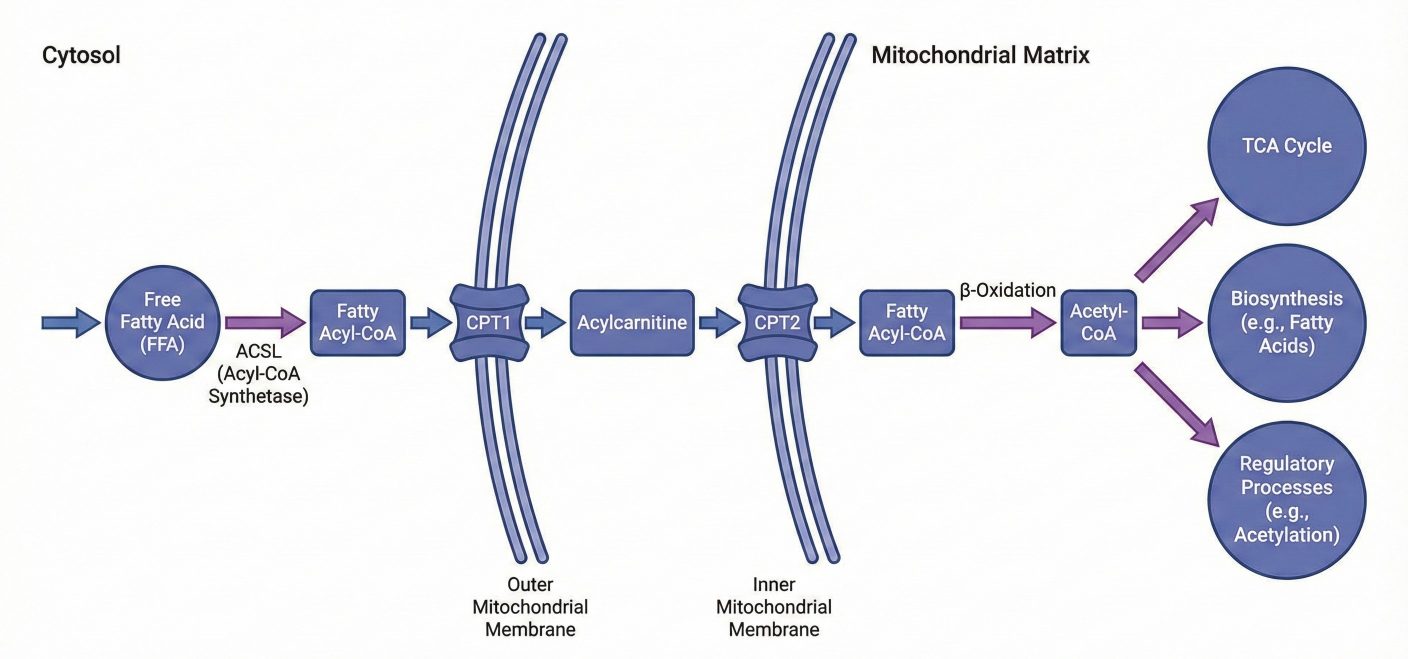 Overview of acyl-CoA metabolism from fatty acid activation and mitochondrial transport to β-oxidation and acetyl-CoA utilization.
Interpreting acyl-CoA dynamics is most effective when viewed through the lens of metabolic flux rather than static concentration snapshots. The following simplified pathway overview highlights key stages where acyl-CoA species are generated, transformed, and consumed:
- Fatty acids → fatty acyl-CoA (activation step)
Free fatty acids are converted into fatty acyl-CoA species via acyl-CoA synthetases (e.g., ACSL family), enabling their participation in downstream metabolic processes. This activation step is central to ACSL-related mechanisms and to many lipid stress models. - Intracellular transport and compartmental processing
Fatty acyl-CoAs require coordinated intracellular handling, often via the carnitine shuttle system, to enable mitochondrial import for β-oxidation. Analytical workflows that include both acyl-CoAs and chain-length–resolved acylcarnitines can help delineate transport vs oxidation constraints. - β-oxidation (FAO): stepwise cleavage and intermediate accumulation
Within mitochondria, acyl-CoA species undergo sequential degradation via β-oxidation, producing acetyl-CoA and chain-shortened acyl-CoAs. Incomplete processing or enzyme-specific impairments often lead to signature accumulation patterns reflective of chain length or oxidation step bottlenecks. - Acetyl-CoA utilization in central metabolism and regulation
The acetyl-CoA generated from FAO is further utilized in the TCA cycle, ketogenesis, biosynthesis of lipids and cholesterol, and as a substrate for protein acetylation and other regulatory modifications.
When a project requires connecting FAO capacity, pathway balance, and carbon flow (including chain-length–resolved acylcarnitines and CoA esters), an integrated approach that includes stable-isotope–enabled flux readouts may be relevant: β-Oxidation Flux Panel Service .
Research Scenarios Where Acyl-CoA Readouts Are Highly Informative
FAO and mitochondrial function studies
In FAO-centric studies, acyl-CoA and related readouts can help localize where the pathway shifts occur. Typical interpretation goals include:
- Distinguishing upstream changes (activation/handling) from downstream oxidation constraints
- Identifying chain-length selectivity (e.g., medium-chain vs long-chain behavior)
- Detecting compensatory pathways (e.g., ω-oxidation–associated patterns seen in related metabolite classes)
For chain-length–focused FAO biology, a dedicated MCAD/ACADM resource may be useful: MCAD/ACADM Readouts: Biomarkers and Study Design.
For broader enzymology and readout selection across β-oxidation dehydrogenases, see: ACAD Family in β-Oxidation: What to Measure.
Fatty acid activation and ACSL mechanism validation
In many ACSL-related studies, downstream lipid endpoints can shift for multiple reasons (synthesis, remodeling, storage), and may not directly validate the activation step. A more direct strategy is to evaluate fatty acyl-CoA distributions that correspond to the manipulated fatty acid inputs or pathway perturbations.
For mechanism-oriented guidance on readout selection in ACSL studies, please refer to: ACSL/Acyl-CoA Synthetase: What to Measure to Validate Fatty Acid Activation.
Lipid synthesis, remodeling, and substrate reprogramming
In DNL and lipid remodeling studies, the relevant question is often whether the observed phenotype reflects:
- Increased substrate supply vs altered enzyme activity
- Increased synthesis vs reduced oxidation
- Compartment- or tissue-specific rewiring that changes donor availability
In these scenarios, acyl-CoA profiling is most useful when integrated into a hypothesis-driven panel that includes central carbon anchors and related metabolite classes. When a project requires customized, reproducible absolute quantification across selected pathways, a targeted metabolomics approach may be relevant: Targeted Metabolomics Analysis Service.
Metabolism–regulation interface (acyl-donor availability)
Short-chain acyl-CoAs—particularly acetyl-CoA, propionyl-CoA, and butyryl-CoA—serve as acyl-group donors in protein acylation and epigenetic regulation. In these regulatory contexts, metabolite levels should not be interpreted as direct indicators of regulatory effect.
Instead, the key interpretive question is whether acyl-donor availability shifts in a direction consistent with the hypothesized regulatory mechanism, ideally supported by orthogonal readouts (e.g., enzyme activity, modification status, transcriptional response).
Why Acyl-CoA Measurements Support Mechanistic Conclusions
Acyl-CoA measurements are often informative because they are closer to the point of intervention than many downstream endpoints. Three properties are particularly relevant in mechanism-driven work:
- Pathway proximity
Acyl-CoAs often lie closer to key enzymatic steps than bulk lipid endpoints. This can reduce ambiguity when interpreting whether a pathway step is directly affected. - Pattern information (distribution, not only magnitude)
Many mechanistic signatures appear as family-level patterns (e.g., relative accumulation across chain lengths) rather than isolated single-metabolite changes. - Resolution of competing explanations
The same phenotype can reflect increased synthesis, reduced oxidation, altered transport/handling, or combined effects. An appropriately designed acyl-CoA readout set can separate these interpretations more effectively than expression-only readouts.
If a project involves tissue matrices where assay specificity and stability become decision points, a decision-focused resource on kit-based measurement limitations may be relevant: Why Acetyl-CoA/CoA Assay Kits Often Fail in Tissues.
When to Measure Acyl-CoA: A Decision Checklist
The following checklist is intended to support early study design decisions and to reduce the risk of selecting readouts that do not support the intended inference.
Decision table: Is acyl-CoA profiling justified for the question?
| Study question or constraint | Value of acyl-CoA profiling | Practical implication |
|---|---|---|
| FAO impairment is suspected and bottleneck localization is needed | High | Prefer chain-length–resolved intermediates; consider complementary acylcarnitines and/or flux logic |
| The hypothesis concerns fatty acid activation (ACSL) | High | Fatty acyl-CoA distributions are more direct than downstream bulk lipid endpoints |
| The goal is to quantify acetyl-CoA as a central hub indicator | Medium to high (context-dependent) | Acetyl-CoA can be a starting point; expansion may be required if chain-length specificity is relevant |
| Multiple pathways can explain the phenotype (e.g., DNL vs FAO changes) | High | Use a minimal panel that discriminates between competing explanations |
| Cross-batch comparability in tissue samples is required | High | Favor quantitative strategies designed for reproducibility and specificity |
| The goal is exploratory screening with limited mechanistic claims | Variable | A minimal, hypothesis-aligned subset may be sufficient; avoid over-interpretation |
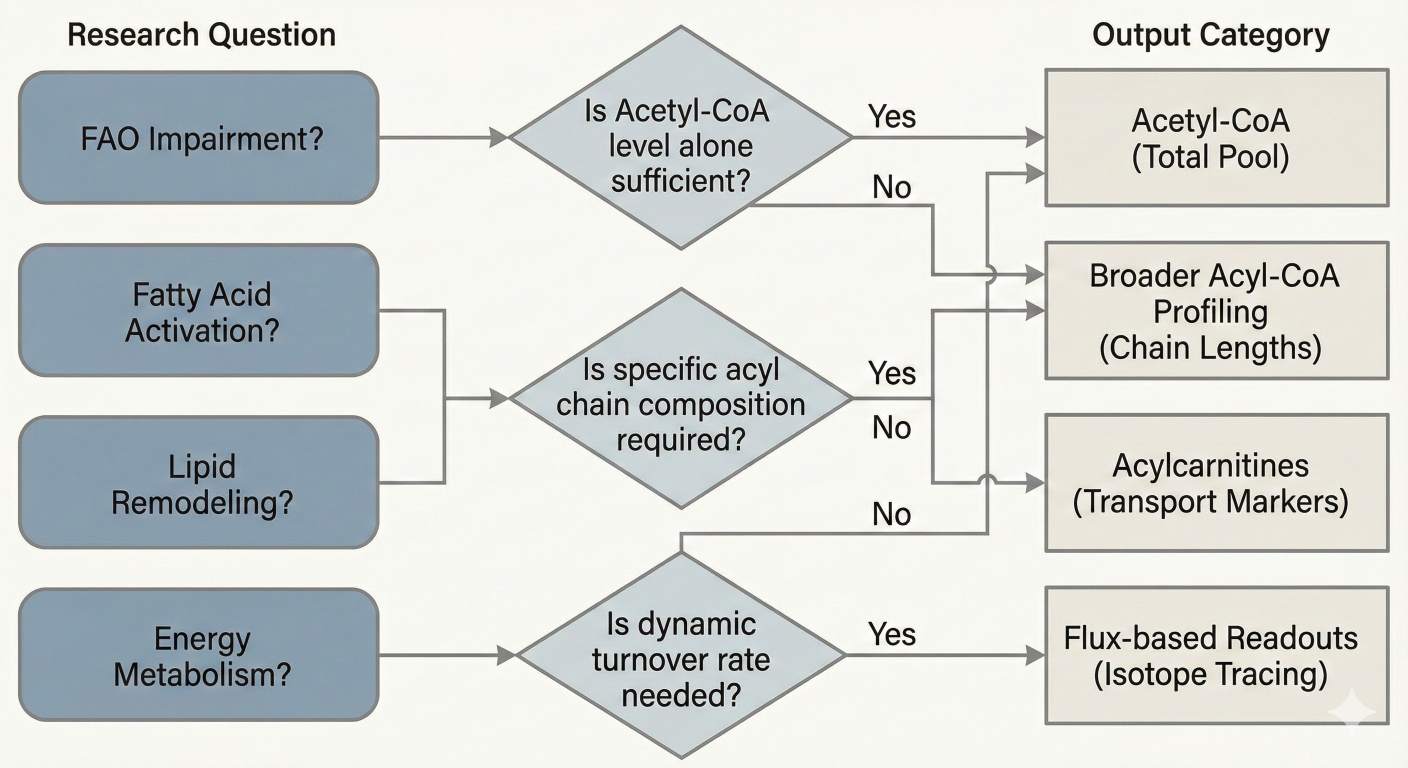 Decision framework for selecting acyl-CoA–related metabolic readouts based on common research questions.
When the biological question directly links vitamin B5 utilization, CoA availability, and downstream acyl-CoA intermediates, a pathway-focused service that quantifies pantothenate, CoA, and acyl-CoAs within a single targeted framework may be relevant: Pantothenate & CoA Metabolism Analysis.
Selecting Companion Readouts: Acyl-CoA, Acylcarnitines, and Energy Metrics
Acyl-CoA data are typically interpreted most effectively when paired with a small number of complementary readouts that address transport/handling and energetic context.
Comparison table: What each readout answers best
| Readout type | Best suited to answer | Typical misinterpretation to avoid |
|---|---|---|
| Acyl-CoA species | Activation products and pathway nodes; chain-length distributions | Generalizing from one species to all acyl-CoAs |
| Acylcarnitines | Transport/oxidation balance signatures; chain-length accumulation patterns | Treating acylcarnitines as universal substitutes for acyl-CoAs |
| ATP and related energy readouts | Energy context and cellular energetic state | Using ATP alone to infer a specific pathway step change |
| Targeted metabolomics panel | Separating competing pathway explanations; anchoring interpretation | Adding many metabolites without hypothesis-driven interpretation criteria |
For chain-length–resolved carnitine/acylcarnitine quantification (commonly used in FAO-related studies), see: Carnitine and Acylcarnitine Analysis Service.
When ATP is needed as an energy-state anchor in metabolic studies, a targeted ATP quantification option is available: Adenosine Triphosphate (ATP) Analysis Service.
Common Interpretation Pitfalls and Practical Mitigations
Pitfall 1: Using acetyl-CoA as a proxy for all acyl-CoA biology
Acetyl-CoA is central, but fatty acyl-CoA dynamics can shift independently, especially in lipid activation and FAO bottlenecks.
Mitigation: If chain-length specificity or lipid activation is central to the hypothesis, include representative fatty acyl-CoAs or a chain-length distribution rather than relying only on acetyl-CoA.
Pitfall 2: Over-reliance on a single intermediate
A single species can change due to altered synthesis, degradation, transport, or compartment shifts.
Mitigation: Include a small "family set" across chain lengths aligned to the hypothesis (e.g., short-, medium-, and long-chain representatives) to capture diagnostic patterns.
Pitfall 3: Interpreting accumulation as increased flux
Higher intermediate levels can reflect a downstream constraint rather than increased throughput.
Mitigation: Where directionality and rate are central to the claim, incorporate flux-oriented logic rather than inferring pathway rate from pool size alone.
Pitfall 4: Mechanistic claims based only on expression changes
Expression shifts can be supportive but do not necessarily represent pathway activity.
Mitigation: Use metabolite intermediates that are proximal to the hypothesized step, supported by orthogonal evidence when possible.
Building a Minimal, Publishable Readout Package
A practical design rule is: select the smallest set of measurements that can discriminate between the leading competing explanations. The goal is not maximal coverage, but sufficient interpretability.
| Research aim | Minimal readout logic | Why it is effective as a starting point |
|---|---|---|
| Localize FAO impairment | chain-length–resolved acylcarnitines + selected CoA esters as anchors | Captures diagnostic accumulation signatures and provides pathway context |
| Validate ACSL activation mechanism | fatty acyl-CoA distribution + one central anchor (free CoA or acetyl-CoA) | Tests the activation product directly and improves interpretability |
| Separate energy-state effects from substrate effects | acetyl-CoA + ATP + targeted subset panel | Reduces ambiguity when phenotypes can be explained by multiple pathways |
| Hypothesis-driven expansion beyond CoA esters | targeted metabolomics panel + focused acyl-CoA subset | Maintains interpretability while expanding pathway context |
FAQs
What is acyl-CoA in simple terms?
Acyl-CoA is a family of molecules where coenzyme A carries different acyl groups (carbon chains). It represents the activated form that enables fatty acids and related carbon units to be oxidized, used for synthesis, or transferred in acyl-group–dependent reactions.
Is acetyl-CoA the same as acyl-CoA?
No. Acetyl-CoA is one specific acyl-CoA (C2). It is highly informative for central carbon metabolism, but it does not capture chain-length–resolved fatty acyl-CoA patterns that are often required for lipid activation and FAO mechanistic interpretation.
When should I measure acyl-CoA instead of only acetyl-CoA?
Broader acyl-CoA profiling is typically warranted when the hypothesis involves fatty acid activation, chain-length specificity, FAO bottlenecks, or lipid remodeling, or when conclusions depend on distinguishing competing pathways (e.g., FAO decrease vs DNL increase).
Should I measure acyl-CoA or acylcarnitines for FAO studies?
They often provide complementary information. Acylcarnitines are widely used for chain-length–resolved signatures related to transport/oxidation balance, while acyl-CoAs can be closer to activation and pathway-node interpretation. The choice depends on whether the priority is bottleneck localization, transport/handling signatures, or donor-pool characterization.
Can I infer FAO rate from acyl-CoA levels alone?
Not reliably. Acyl-CoA pool size reflects the balance of production and consumption and can increase due to downstream constraints. If FAO rate (flux) is central to the claim, incorporate flux-oriented readouts or tracer-informed interpretation rather than relying on static pool size alone.
Why do medium-chain patterns matter in MCAD/ACADM-related contexts?
MCAD/ACADM biology is linked to processing of medium-chain substrates in β-oxidation. Medium-chain accumulation patterns (across related metabolites) can be consistent with impaired processing at mid-chain steps, but should be interpreted as patterns and supported by study design features that reduce confounding (e.g., perturbation consistency and pathway context).
How many acyl-CoA species are needed for a robust conclusion?
There is no universal number. A robust conclusion typically requires enough coverage to (1) capture the relevant chain-length range for the hypothesis and (2) distinguish between competing explanations. Many studies start with a minimal set spanning short-, medium-, and long-chain representatives and expand only when needed.
What is the fastest way to choose a readout package before outsourcing analysis?
Define the top two competing explanations for the phenotype (e.g., increased synthesis vs reduced oxidation). Then choose the smallest set of measurements that can discriminate between them—often a chain-length signature readout plus one or two pathway anchors (e.g., acetyl-CoA, CoA pool, or ATP).
References
- Basu, Sankha S., and Ian A. Blair. "SILEC: a protocol for generating and using isotopically labeled coenzyme A mass spectrometry standards." Nature Protocols 7 (2012): 1–11.
- Neubauer, Stefan, et al. "LC-MS/MS-based analysis of coenzyme A and short-chain acyl-coenzyme A thioesters." Analytical and Bioanalytical Chemistry 407 (2015): 6681–6688.
- Snyder, Nathaniel W., et al. "Production of stable isotope-labeled acyl-coenzyme A thioesters by yeast stable isotope labeling by essential nutrients in cell culture." Analytical Biochemistry 474 (2015): 59–65.
- Rivera, Luis G., and Michael G. Bartlett. "Chromatographic methods for the determination of acyl-CoAs." Analytical Methods 10 (2018): 5252–5264.
- Blachnio-Zabielska, Agnieszka U., Christina Koutsari, and Michael D. Jensen. "Measuring long-chain acyl-coenzyme A concentrations and enrichment using liquid chromatography/tandem mass spectrometry with selected reaction monitoring." Rapid Communications in Mass Spectrometry 25.15 (2011): 2223–2230.

 Contact Us