

Mitochondrial Toxicity Screening: Monitoring ATP Depletion and ADP/ATP Ratios in Drug Discovery
Submit Your InquiryMitochondrial liabilities often look "invisible" until late-stage profiling. A series can hit the target, show clean selectivity, and still fail because cells cannot keep up with energy demand. When that happens, the first measurable signal is usually simple: ATP drops and the ADP/ATP ratio rises.
This resource explains how to use drug-induced ATP depletion and an ADP/ATP ratio assay as practical, early readouts for mitochondrial stress in research models. The focus is decision-making in discovery and development workflows, not clinical testing.
Why ATP and ADP/ATP Are High-Signal Readouts for Mitochondrial Stress
ATP is the cell's spendable energy. Mitochondria supply much of it through oxidative phosphorylation. When that supply chain is disrupted, ATP falls.
ADP is the "spent" form of ATP. When ATP usage outpaces ATP regeneration, ADP accumulates. That is why the ADP/ATP ratio often changes earlier than ATP alone.
In screening terms, ATP and ADP/ATP answer two different questions:
- ATP Depletion: "Did energy availability collapse?"
- ADP/ATP Increase: "Is the system under energy pressure right now?"
For teams building a mitochondrial toxicity screening service strategy, these two numbers provide a fast triage layer. They also translate well into follow-up experiments when a series needs mechanistic clarity.
What ATP Depletion and ADP/ATP Ratio Assays Measure
ATP depletion is a strong signal, but it is not a mechanism by itself. A compound can lower ATP through mitochondrial disruption, but also through severe general cytotoxicity or assay artifacts.
The ADP/ATP ratio is more sensitive, but it can also be confounded. For example, changes in glycolysis, transport, or adenylate turnover can shift ratios without a primary mitochondrial lesion.
A useful way to frame interpretation is:
- ATP and ADP/ATP Are "Bioenergetic Symptoms."
- Mechanism Requires Context, Controls, and Orthogonal Measurements.
If your goal is simple hit triage, ATP-only screening can be enough. If your goal is to rank analogs and justify chemistry changes, ATP plus ADP is usually the better investment.
If you also quantify adenylates by targeted LC–MS/MS, ATP can be measured directly as part of an ATP-focused workflow such as the Adenosine Triphosphate (ATP) Analysis Service.
Common Mitochondrial Liabilities Reflected by ATP Depletion and ADP/ATP Elevation
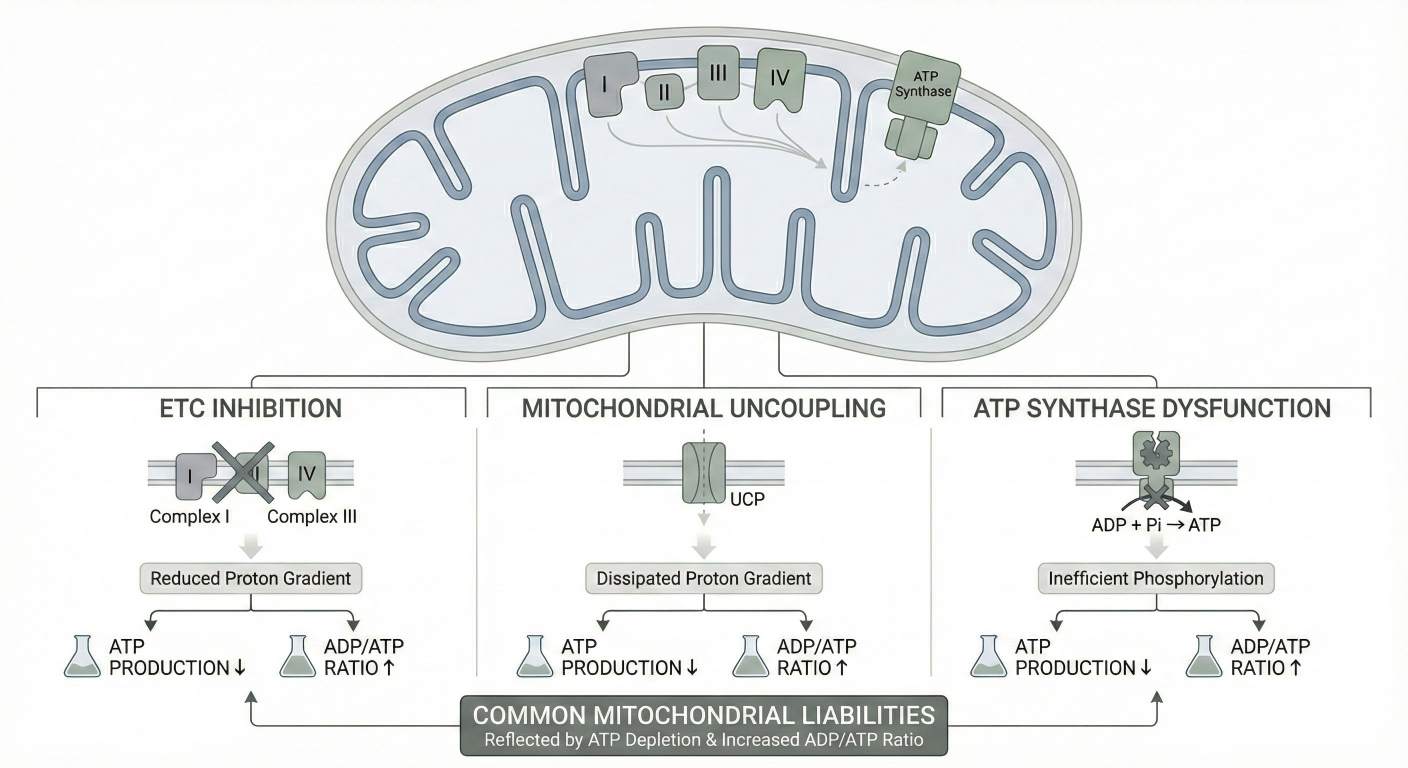 Mitochondrial liabilities that reduce ATP and increase the ADP/ATP ratio.
A comprehensive understanding of mitochondrial biology isn't necessary to apply these assays effectively. What matters most is a clear mapping between the class of mitochondrial impairment and the resulting cellular energy profile. The following are representative mechanisms that frequently lead to ATP depletion and/or elevation of the ADP/ATP ratio in preclinical screening:
Electron Transport Chain (ETC) Inhibition
Inhibition of ETC complexes disrupts proton gradient formation, thereby impairing oxidative phosphorylation. As cellular energy demand persists, ATP synthesis declines, leading to decreased ATP levels and a compensatory rise in the ADP/ATP ratio.
Mitochondrial Uncoupling
Uncouplers dissipate the mitochondrial membrane potential without directly inhibiting respiration. This uncoupling of substrate oxidation from ATP production results in reduced energy efficiency, typically manifesting as an increased ADP/ATP ratio even when ATP levels remain initially stable.
ATP Synthase Dysfunction
Direct inhibition of ATP synthase (Complex V) reduces ATP output regardless of upstream electron flow. This often leads to rapid ATP depletion and a marked shift in adenylate balance, signaling acute energetic compromise.
Secondary Mitochondrial Stress
Not all mitochondrial liabilities are primary. Some compounds may impair mitochondrial function indirectly—via oxidative stress, membrane destabilization, or metabolic overload. In such cases, ATP depletion often represents a downstream outcome. Experimental design and contextual data are essential to distinguish primary mitochondrial liabilities from secondary metabolic effects.
If your team needs a broader overview of metabolic energy flow—across ATP generation, substrate utilization, and redox balance—the Energy Metabolism Metabolomics Service offers a comprehensive pathway-level profiling solution.
Choosing an Assay Format That Fits Your Discovery Stage
Most teams face the same practical decision: run a fast luminescence screen, or quantify adenylates by LC–MS/MS for higher specificity.
A Practical Selection Guide
| Goal in the Pipeline | Recommended Readout | Why It Works | Common Watch-Outs |
|---|---|---|---|
| Triage a large library | ATP-only plate readout | Highest throughput; simple ranking | Compound interference; limited mechanistic depth |
| Rank close analogs | ATP + ADP (ratio) | More sensitive and comparative | Requires stronger controls and normalization |
| Explain borderline hits | ATP/ADP (± AMP) by LC–MS/MS | Chemical specificity; better artifact resistance | Handling and quench steps matter most |
| Connect energy to pathway shifts | Adenylates + central carbon + redox | Converts "symptom" into mechanism | More complex design; needs clear hypothesis |
When ADP quantification is central, a dedicated workflow such as the Adenosine Diphosphate (ADP) Analysis Service can support ratio-based interpretation.
If AMP is needed for a more complete energy charge picture, you can also add it once via the Adenosine Monophosphate (AMP) Analysis Service.
For teams deciding between luminescence-based ATP kits and LC–MS/MS workflows, the matrix article ATP/ADP/AMP Analysis: When LC-MS/MS Is a Better Choice Than ATP Kits provides a practical comparison focused on specificity, interference risk, and decision impact.
Study Design That Reduces False Positives in High-Throughput Screening
Bioenergetic assays are sensitive. That is a strength, but it also means weak design creates noisy signals.
1) Pick a Model That Matches Your Liability Question
Cells that rely heavily on glycolysis can mask mitochondrial stress. Cells with high oxidative reliance can amplify it.
Your model choice should reflect your decision point:
- "Will this chemotype stress energy homeostasis in our core cell system?"
- "Does the liability appear only under oxidative demand?"
- "Does it persist across relevant research models?"
2) Use Mechanism-Informative Controls
Controls should not be generic "toxic" compounds. They should represent energy mechanisms.
A simple control set can include:
- An ETC inhibitor control
- An uncoupler control
- A non-mitochondrial cytotoxic control
This control mix helps you distinguish "energy-specific" from "everything is dying."
3) Plan the Concentration Strategy to Separate Potency From Collapse
ATP collapse can occur only at high concentrations. That can still matter, but it changes the decision.
Use a range that supports:
- early warning at moderate exposure
- clear ranking at higher exposure
- a defined threshold for follow-up
4) Normalize in a Way That Matches Your Assay Risks
If ATP drops because cells detach, that is still real biology, but it is not mitochondrial specificity.
Common normalizers include:
- cell count proxy
- protein content
- DNA content
Pick one and use it consistently. Mixing normalizers across plates makes interpretation harder.
Sample Handling and Quenching for Accurate ATP/ADP Quantification
ATP and ADP turn over quickly in active lysates. Poor handling can erase true differences or create artificial depletion.
The operational goal is simple: stop metabolism fast and extract consistently.
A robust handling approach usually includes:
- rapid quenching under cold conditions
- a solvent system that stabilizes adenylates
- internal standards for LC–MS/MS workflows
- minimized freeze–thaw exposure
If your screening results look "flat" across all conditions, handling is a prime suspect. If your values are wildly variable within replicates, plate drift or extraction consistency is often the issue.
For a deeper, step-by-step discussion of assay selection, quenching strategies, and adenylate stability, ATP/ADP/AMP Targeted Metabolomics: Assay Choice, Experimental Design and Sample Preparation serves as a technical reference for experimental teams.
Interpreting Patterns: Turning Numbers Into Decisions
The most useful output is not a single ATP value. It is a pattern across ATP, ADP, and the ratio.
Common Interpretation Patterns
| Pattern | What You Often See | What It Suggests | Best Next Step |
|---|---|---|---|
| ATP down, ADP/ATP sharply up | Clear energy stress | Bioenergetic liability likely | Add redox + pathway context |
| ATP down, ratio modest change | Mixed or late-stage collapse | General cytotoxicity or artifact possible | Confirm with orthogonal method |
| ATP stable, ADP/ATP up | Early energy pressure | Compensation may be active | Add glycolysis + redox markers |
| ATP variable, ratio noisy | High technical noise | Plate drift or extraction inconsistency | Revisit QC and normalization |
A strong pattern does not require a mechanistic claim. It requires a clear decision. For example:
- "This series shows energy stress earlier than comparators."
- "Analog B reduces energy stress at matched exposure."
- "This hit needs mechanism follow-up before SAR expansion."
A Practical Decision Tiering Framework
To make next steps more consistent across teams, the signals above can be summarized into practical decision tiers. These tiers are intended for internal prioritization and experimental planning—not as definitive mechanism assignments.
| Decision Tier | Typical Energy Signature | Practical Next Step |
|---|---|---|
| Low Concern (Green) | ATP stable; ADP/ATP stable across relevant exposures | Continue screening or SAR expansion without energy-focused follow-up |
| Moderate Concern (Yellow) | ATP near baseline with reproducible ADP/ATP elevation | Confirm signal and add focused context (e.g., glycolysis or redox) before advancing |
| Higher Concern (Red) | ATP depletion with marked ADP/ATP increase, especially at lower or time-dependent exposure | De-prioritize or redesign unless a clear mitigation hypothesis exists |
The follow-up workflow below is most useful for Yellow and Red signals, where additional context helps separate compensation from primary mitochondrial impairment.
A Follow-Up Workflow to Convert Screening Flags Into Mechanism Hypotheses
ATP depletion and an increased ADP/ATP ratio tell you that cells are under energy stress. What they do not tell you is where the system is failing—mitochondrial ATP production, compensatory glycolysis, redox pressure, or pathway rerouting. The workflow below keeps follow-up tight and decision-driven, so you can move from a screening flag to a testable mechanism hypothesis.
Step 1: Check Glycolytic Compensation When ADP/ATP Shifts Before ATP Falls
Cells can buffer mitochondrial stress by increasing glycolytic throughput. In that situation, ATP may remain near baseline while ADP/ATP rises, especially at moderate compound exposure.
What to look for
- Accumulation or redistribution of key glycolytic intermediates
- Pyruvate/lactate patterns consistent with increased glycolytic output
If this pattern appears, the signal is often "mitochondrial stress with compensation," not a clean negative. A targeted Glycolysis Metabolite Panel helps confirm whether glycolysis is masking early mitochondrial liability.
Step 2: Add Redox Context When Energy Stress Suggests Electron Pressure
Mitochondrial liabilities frequently co-occur with redox imbalance. Electron handling stress can shift NAD(H), NADP(H), and glutathione systems, which may explain why energy collapses under stress conditions even when ATP changes are modest.
What to look for
- Ratio shifts consistent with altered electron flow
- Evidence of oxidative burden that could drive secondary ATP loss
This is most informative when ATP/ADP changes are reproducible but the mechanism is unclear. A single redox layer such as Redox Cofactor Analysis Service keeps interpretation focused without expanding the scope too broadly.
Step 3: Locate the Bottleneck Across Central Carbon Pathways When You Need "Where Did It Stall?"
ATP and ADP/ATP are outcome-level signals. Central carbon profiling can suggest where metabolism is constrained—glycolysis entry, TCA throughput, or stress rerouting through PPP.
What to look for
- Upstream buildup with downstream depletion (a bottleneck-like signature)
- Coordinated shifts across glycolysis/TCA/PPP consistent with rerouting
When you need pathway-level evidence to support SAR decisions, Central Carbon Metabolism Profiling & Flux Analysis is a logical next step because it contextualizes adenylates inside the core energy network.
Step 4: Use Flux Only When Static Metabolite Levels Cannot Explain the Phenotype
Sometimes metabolite pool sizes stay similar while turnover changes. That is when tracer-based flux becomes the shortest path to a mechanistic answer.
Use flux when
- ATP/ADP patterns are consistent, but pool-level changes are minimal
- You suspect rerouting or altered pathway activity rather than accumulation/depletion
In these cases, Metabolic Flux Analysis Service can test whether pathway activity shifted even when concentrations did not.
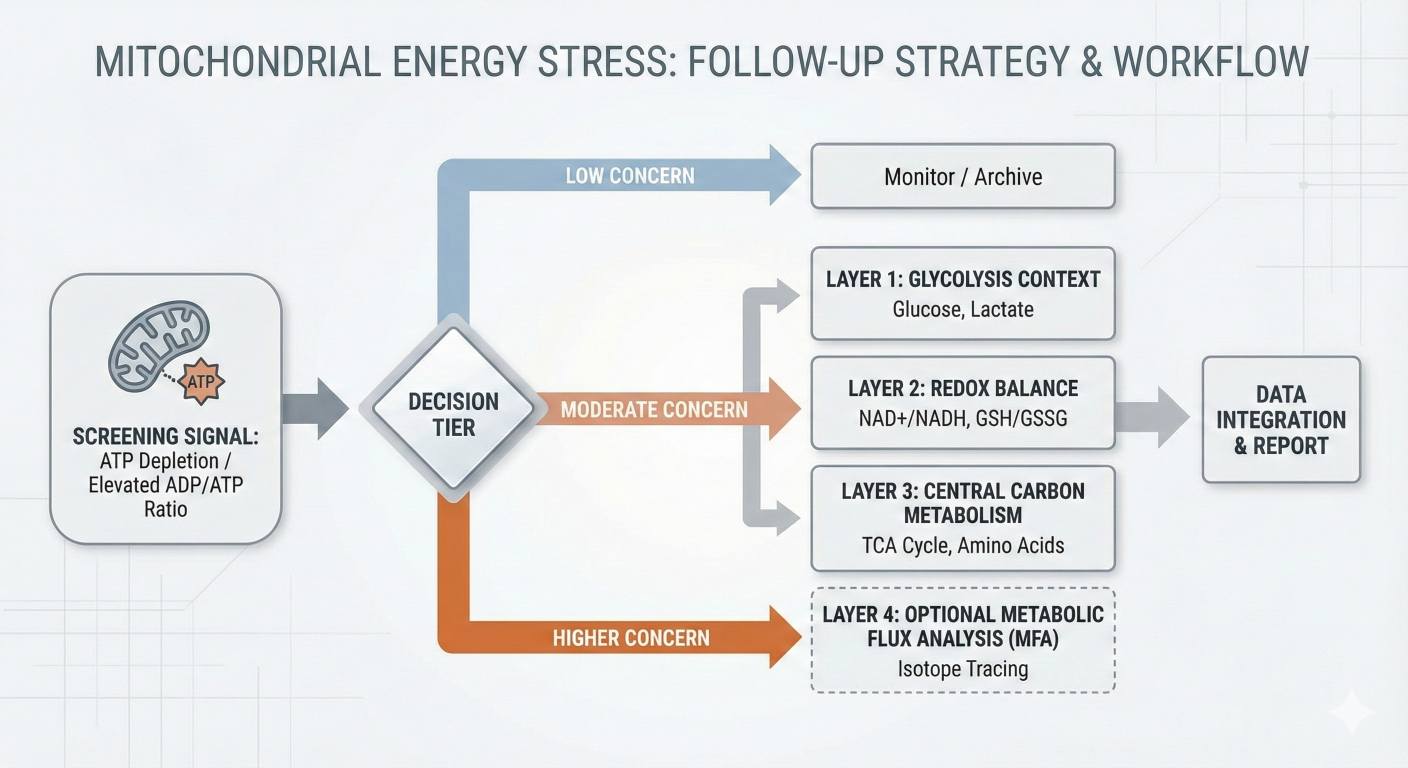 Follow-up workflow from ATP/ADP signals to targeted metabolic context.
What a Good Deliverable Package Looks Like for Project Teams
Teams move faster when deliverables match decisions. A useful package is not only raw numbers.
A decision-ready report typically includes:
- ATP, ADP, and ADP/ATP ratio tables with replicate statistics
- clear plate or batch QC summaries
- a ranked hit list with transparent flags for interference risk
- plots that show dose-response trends for top compounds
- optional pathway overlays when glycolysis, redox, or central carbon are included
If your project also tracks broader nucleotide pools beyond ATP/ADP/AMP, a complementary pathway option is the Nucleotide Metabolism Service.
Practical QC Checklist You Can Reuse Across Studies
| QC Element | Why It Matters | What to Check |
|---|---|---|
| Plate layout and drift control | Minimizes position effects | Randomization, edge control strategy |
| Signal window | Supports ranking confidence | Separation of controls vs vehicle |
| Replicate variability | Detects handling noise | CV/RSD trends across plate |
| Interference flags | Avoids false depletion signals | Known quenchers, colored compounds, detergents |
| Normalization strategy | Prevents misread toxicity | Consistent normalizer per experiment |
| Confirmatory run | Protects decisions | Re-test top hits with tighter QC |
This checklist is simple by design. It aligns with how screening teams actually work.
FAQs
Q1. What does a higher ADP/ATP ratio mean in cell-based screening?
A higher ratio usually indicates energy stress, meaning ATP demand exceeds supply. It is often an earlier signal than ATP depletion alone. Confirm with controls and replicate QC before assigning mechanism.
Q2. Can ATP depletion alone prove mitochondrial toxicity?
No. ATP depletion is a strong warning signal, but it can reflect general cytotoxicity or assay artifacts. Adding ADP/ATP and a mechanism-informative control set improves interpretability.
Q3. What are the most common causes of false positives in ATP assays?
The top causes are compound interference, inconsistent cell numbers, edge effects, and slow quenching. A confirmatory run with improved layout and normalization often clarifies borderline hits.
Q4. How do I distinguish mitochondrial toxicity from glycolysis changes?
Look for compensation. If glycolysis ramps up, ATP may stay stable while ADP/ATP increases. Adding glycolysis intermediates and redox cofactors helps separate compensation from primary mitochondrial disruption.
Q5. What controls should I include for an ADP/ATP ratio assay?
Include at least one control that disrupts oxidative phosphorylation, one uncoupling-type control, and a non-mitochondrial cytotoxic control. These create reference patterns for interpretation.
Q6. Should I measure AMP and energy charge for follow-up?
Measure AMP when ATP and ADP patterns are ambiguous, or when you suspect early stress with compensation. AMP can help contextualize whether the system is trending toward broader energy collapse.
Q7. When should I move from ATP/ADP screening to metabolic flux analysis?
Move to flux when static metabolite levels do not explain the phenotype, or when you need pathway activity rather than pool size. Flux is most helpful for mechanism confirmation and rational optimization.
References
- Bradbury, D. A., Simmons, T. D., Slater, K. J., & Crouch, S. P. "Measurement of the ADP:ATP ratio in human leukaemic cell lines can be used as an indicator of cell viability, necrosis and apoptosis." Journal of Immunological Methods 240(1–2) (2000): 79–92.
- Marroquin, L. D., Hynes, J., Dykens, J. A., Jamieson, J. D., & Will, Y. "Circumventing the Crabtree effect: replacing media glucose with galactose increases susceptibility of HepG2 cells to mitochondrial toxicants." Toxicological Sciences 97(2) (2007): 539–547.
- Swiss, R., Niles, A., Cali, J. J., Nadanaciva, S., & Will, Y. "Validation of a HTS-amenable assay to detect drug-induced mitochondrial toxicity in the absence and presence of cell death." Toxicology in Vitro 27(6) (2013): 1789–1797.
- Kamalian, L., Chadwick, A. E., Bayliss, M., French, N. S., Monshouwer, M., Snoeys, J., & Park, B. K. "The utility of HepG2 cells to identify direct mitochondrial dysfunction in the absence of cell death." Toxicology in Vitro 29(4) (2015): 732–740.
- Will, Y., & Dykens, J. "Mitochondrial toxicity assessment in industry— a decade of technology development and insight." Expert Opinion on Drug Metabolism & Toxicology 10(8) (2014): 1061–1067.

 Contact Us