Why Spermidine Matter
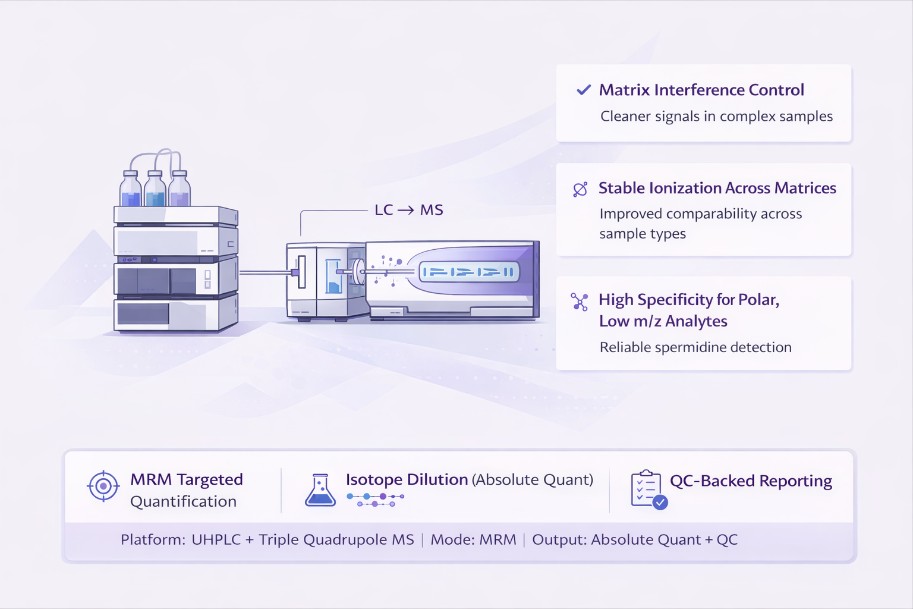
Spermidine is a small, highly polar polyamine. In real samples, that combination often makes measurement harder than expected: co-extractives can interfere, ionization can shift between matrices, and results may look "different" simply because the sample background is different. That's why many teams choose targeted LC-MS/MS for spermidine—especially when the readout will drive a decision.
Spermidine is also frequently interpreted in the context of related polyamines such as putrescine and spermine. Depending on your goal, a single-analyte measurement may be enough, or you may benefit from a polyamine panel to understand whether an intervention changes overall polyamine balance rather than spermidine alone.
What Problems This Service Helps You Solve
- Confirm whether spermidine truly changes across experimental groups
Support treatment/control comparisons, dose–response studies, and time-course designs.
- Reduce matrix-driven uncertainty
Apply matrix-aware preparation and QC so results remain comparable across sample types.
- Choose the right level of interpretation
Start with spermidine-only for a focused question, or use a panel for pathway context.
- Get outputs you can immediately use
Receive structured tables and QC documentation suitable for internal decision-making and reporting.
Precision Spermidine Quantification and Profiling Solutions
Creative Proteomics provides high-sensitivity, targeted analysis designed to overcome the specific chemical challenges of polyamine detection—such as high polarity and low molecular weight—ensuring your study yields definitive, high-integrity data.
Flexible Service Modules for Targeted Research
We offer adaptable testing protocols designed to align with your project's regulatory requirements and data depth needs:
- Targeted Spermidine Absolute Quantification: Precise molar concentration determination using isotope-labeled internal standards.
- Spermidine/Spermine Ratio Reporting: A critical assessment tool for monitoring cellular growth, senescence, and metabolic shifts.
- Acetylated Flux Profiling: Simultaneous detection of N1-Acetylspermidine and N8-Acetylspermidine to track metabolic degradation and enzymatic activity.
- Method Validation Services: Bespoke protocol development and validation following strict analytical guidelines for proprietary formulations.
Decision Matrix: Selecting the Right Analytical Scope
Use this guide to select the most informative service level for your study—ensuring you obtain the necessary data resolution without unnecessary complexity.
| Your Research Goal |
Recommended Choice |
Why This Works |
Typical Add-Ons |
| Confirm if spermidine changes between groups |
Single-Analyte Spermidine Quantification |
Focused, high-throughput answer when spermidine is your primary decision metric. |
Absolute quantification; matrix-fit QC |
| Interpret pathway direction or conversion balance |
Polyamine Panel |
Providing context for Putrescine/Spermidine/Spermine reduces risk of misinterpretation. |
Spermidine/Spermine ratio reporting |
| Track turnover and metabolic handling |
Polyamine Panel + Derivatives |
Acetylated forms add essential context when primary analyte changes are subtle. |
N1 / N8-Acetylspermidine profiling |
| Work with complex or multiple matrices |
Panel + Enhanced QC |
Improves comparability and data confidence across diverse sample types. |
Spike/recovery; matrix-effect checks |
| Link to functional readouts (e.g., autophagy) |
Either (Scope dependent) |
Single-analyte for focused correlation; panels to interpret broader systemic shifts. |
Correlation-ready reporting format |
Analytes We Can Quantify
| Tier |
Analytes |
Notes |
| Default (Core) |
Spermidine |
Single-analyte service includes this only |
| Panel Core |
Putrescine, Spermine |
Included in polyamine panel |
| Optional Derivatives |
N1-Acetylspermidine, N8-Acetylspermidine, N1-Acetylspermine |
Added when turnover/routing context is needed |
| Custom Add-Ons |
DAP and other pathway-related amines |
Availability depends on matrix and study design |
Advantages of Our Analysis Platform
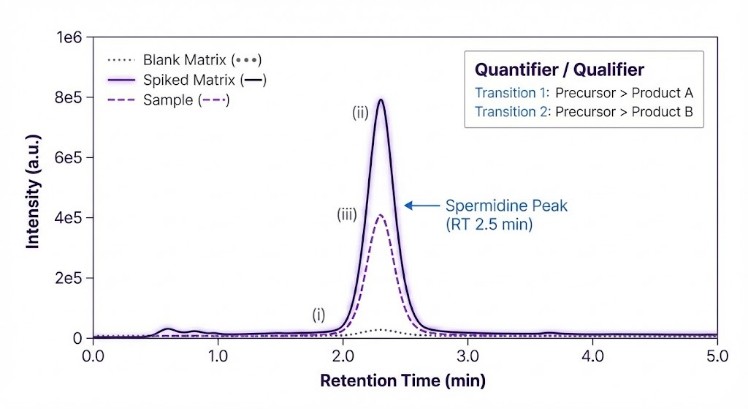
- High specificity in complex matrices using targeted LC-MS/MS with MRM transitions
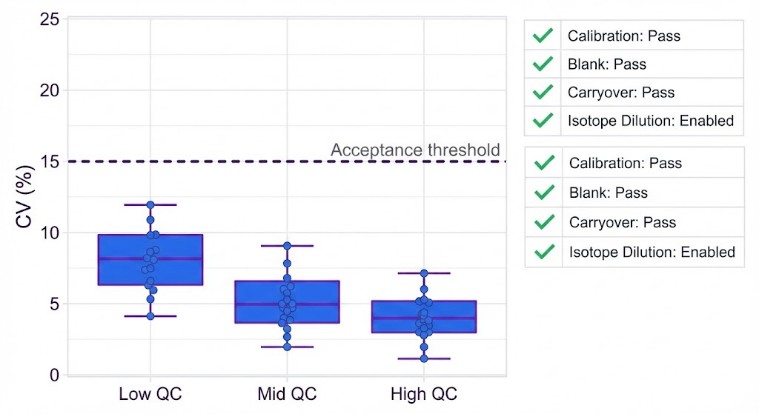
- Precision (repeatability): QC replicates typically achieve ≤10% CV (matrix-dependent)
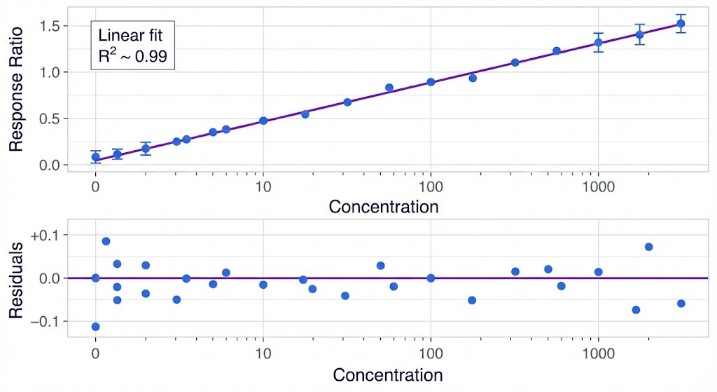
- Linearity: calibration curves typically achieve R² ≥ 0.99 across the working range
- Sensitivity tuned to your matrix: LOD/LOQ optimized per sample type and prep strategy
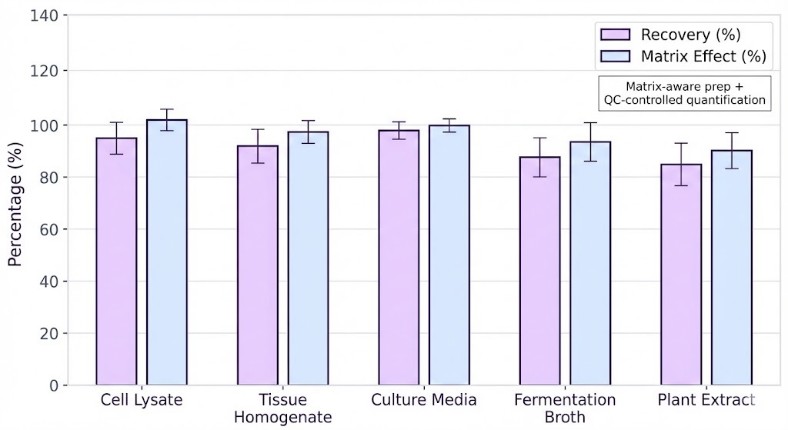
- Matrix-control options: spike/recovery and matrix-effect checks available when required
Our Spermidine Analysis Workflow
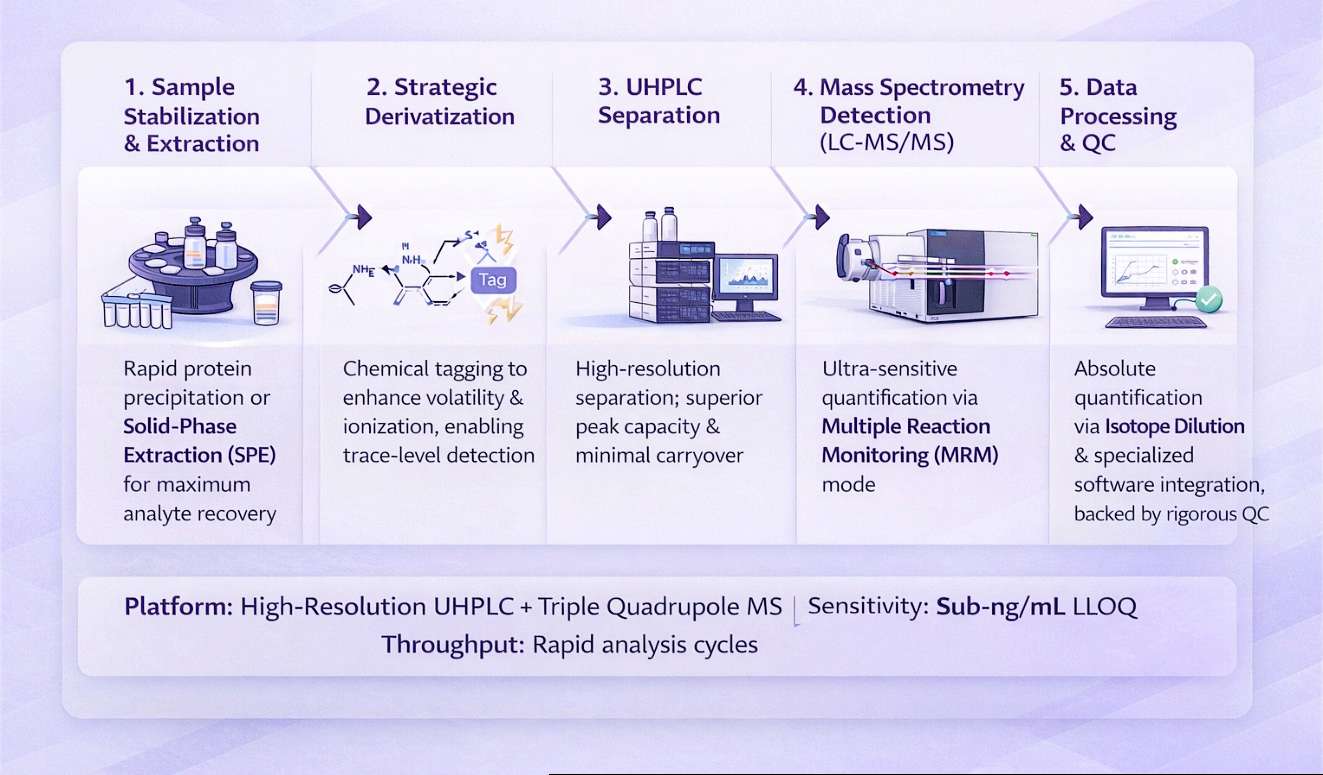
LC-MS/MS Platform for Spermidine Quantification
For reliable spermidine analysis in complex research matrices, we use a UHPLC–triple quadrupole LC-MS/MS setup optimized for targeted analysis.
Core Instruments (Most Common Setup)
- Agilent 1290 UHPLC System
- Agilent 6495C Triple Quadrupole LC/MS
Key Parameters For Spermidine Analysis
| Parameter |
TypicalSetting / Approach |
Why ItMatters |
| Ionization |
ESI (+) |
Strong fit for polyamines |
| Acquisition |
MRM (Multiple Reaction Monitoring) |
High specificity and quantification confidence incomplex matrices |
| Target Mass Range |
Optimized for low m/z analytes |
Matches spermidine's small-molecule profile |
| LC Strategy |
UHPLC separation tuned for polar compounds |
Improves retention and reduces interferences |
| Optional Enhancement |
Derivatization when appropriate |
Can improve retention/response for challenging samples |
Sample Submission & Preparation Guidelines
Proper sample handling is critical to preserving the stability of biogenic amines. Use the following table as a baseline for your submission. If you are working with limited material, mixed matrices, or proprietary solvents, please consult our technical team to adapt the preparation and QC plan.
| Sample type |
Recommended amount |
Container |
Storage & shipping (general) |
Notes |
| Cell pellet |
≥ 1–5 million cells |
Screw-cap tube |
Freeze; ship cold/frozen |
Avoid repeated freeze–thaw |
| Cell lysate |
≥ 100–200 µL |
Low-bind tube |
Freeze; ship cold/frozen |
Share protein conc. if available |
| Tissue |
≥ 20–50 mg |
Cryovial |
Freeze; ship cold/frozen |
Record wet weight |
| Culture media / supernatant |
≥ 200–500 µL |
Screw-cap tube |
Freeze preferred |
Note serum/medium type |
| Fermentation broth / microbial culture |
≥ 0.5–1 mL |
Screw-cap tube |
Freeze preferred |
Feasibility step recommended for challenging matrices |
| Plant tissue / extract |
≥ 50 mg or ≥ 200 µL extract |
Cryovial |
Freeze; ship cold/frozen |
Note solvent and extraction steps |
Expert Handling Note: Polyamines like spermidine are sensitive to enzymatic degradation. We recommend immediate acidification or flash-freezing in liquid nitrogen post-collection to ensure the most accurate metabolic snapshot.
What You Receive: Actionable Deliverables
- Executive Summary: A structured overview of analyte concentrations and significant findings.
- Quantitative Data Suite: Detailed Excel/CSV tables featuring absolute concentrations, standard curves, and R2 values.
- QC Documentation: Matrix spike recoveries, blank analysis, and internal standard performance to verify data integrity.
- Technical Methodology: A clear description of instrumentation and preparation steps for internal reporting or regulatory dossiers.
Research Applications for Spermidine and Metabolite Analysis
Polyamine metabolism impacts T cell dysfunction in the oral mucosa of people living with HIV
Mahalingam, S. S., Jayaraman, S., et al.
Journal: Nature Communications
Year: 2023
DOI: https://doi.org/10.1038/s41467-023-36163-2
Nutritional supplement containing a nuclear fraction of bovine thymus gland increases the circulating levels of spermidine
Surzenko, N., et al.
Journal: PLoS One
Year: 2025
DOI: https://doi.org/10.1371/journal.pone.0331813










 Contact Us