

How to Plan Bioactive Compound Quantification in Foods, Botanical Extracts, and Feed Samples
Submit Your InquiryResearchers analyzing bioactive compounds in foods, botanical extracts, or feed face a recurring challenge: the same compound measured in different matrices can produce entirely different results if the analytical strategy is not designed for the specific sample type and research question. Whether the goal is screening for novel phytochemicals, comparing extraction methods, or quantifying specific active ingredients, the decisions made before samples reach the instrument determine data quality.
This guide walks through the key decisions that shape a bioactive compound quantification project: choosing between targeted and untargeted analysis, building a compound list, matching compound chemistry to the analytical platform, managing matrix-specific extraction, navigating reference standard availability, and preparing samples for submission.
Targeted vs Untargeted: Which Approach Fits Your Research Question?
The first decision in a bioactive compound quantification project is defining what question the analysis should answer — because different goals require fundamentally different analytical approaches. If the goal is to identify which compounds are present in an extract, an untargeted screening approach that detects as many features as possible is appropriate. If the goal is to compare the relative abundance of known compounds across samples, a targeted or semi-targeted method using relative quantification is suitable. If the goal is determining the absolute concentration of specific compounds, targeted analysis with authentic reference standards and multi-point calibration is required.
Targeted Analysis
Targeted analysis focuses on a predefined list of compounds. Depending on reference-standard availability and calibration design, results may be reported as absolute concentrations, semi-quantitative estimates, or relative abundance values. Targeted methods using LC-MS/MS with multiple reaction monitoring provide the highest sensitivity and selectivity for known targets.
Untargeted Analysis
Untargeted analysis scans broadly for as many detectable compounds as possible without pre-selecting targets. It is used for discovery — identifying unknown compounds, characterizing overall chemical profiles, or comparing metabolic fingerprints across conditions. Untargeted data are typically reported as relative abundance and do not provide absolute concentrations without follow-up targeted validation.
In practice, many projects combine both: an initial untargeted screen to characterize the chemical profile and identify compounds of interest, followed by targeted quantification of prioritized compounds.
How to Build a Target Compound List
The compound list drives every subsequent decision: sample preparation, chromatography, detection, calibration, and project scope. A list of five compounds that the laboratory has previously validated in similar matrices requires relatively straightforward setup. A list of thirty compounds — some without commercial reference standards, in a matrix the laboratory has not previously tested — requires extensive method development.
When the laboratory has a validated panel covering the target compounds, the project moves efficiently. When the compound list extends beyond the standard panel, custom method development becomes necessary. The most practical approach is to provide the laboratory with a complete compound list and matrix description early, so the team can assess whether existing methods cover the scope or whether development work is needed.
Matching Compound Chemistry to the Analytical Platform
Not all bioactive compounds are amenable to the same analytical platform. The choice of separation and detection strategy depends on the chemical properties of the target compounds.
| Compound Class | Key Analytical Challenges | Common Analytical Strategies |
|---|---|---|
| Polyphenols and Flavonoids | Structural isomers, extensive glycosylation, matrix-dependent ionization | LC-MS/MS with MRM; HPLC-DAD for UV-active compounds |
| Carotenoids | Light and oxidation sensitivity, lipid-rich matrices | HPLC-DAD and/or LC-APCI-MS; protect samples from light, heat, and oxygen throughout extraction and analysis |
| Volatile Terpenes | Volatility, thermal lability | GC-MS with headspace or SPME sampling |
| Saponins | Structural diversity, weak UV absorption, surfactant properties | LC-MS/MS using positive or negative ESI depending on aglycone, glycosylation pattern, and target response |
| Fat-Soluble Vitamins | Oxidation, lipid matrix interference | LC-MS/MS or HPLC; lipid removal during extraction |
| Organic Acids | High polarity, poor retention on reverse-phase columns | HILIC-MS, ion chromatography, or GC after derivatization |
Providing the laboratory with compound structures and known chemical properties — polarity, stability, expected concentration range — helps the method development team select the most appropriate platform from the start.
Matrix-Specific Extraction and Clean-Up
The same compound extracted from a simple aqueous extract and a lipid-rich formulation can produce markedly different results if sample preparation does not account for matrix-specific interferents. Botanical extracts contain chlorophyll, waxes, and tannins that co-extract with target compounds and can cause ionization suppression in LC-MS. Oil-based samples require liquid-liquid extraction or solid-phase extraction to remove triglycerides before analysis. Feed samples combine plant fiber, protein meals, and mineral supplements — each contributing different interferences — and protein binding of polyphenols can reduce extraction recovery.
For products containing both hydrophilic and lipophilic actives, separate extraction protocols may be needed. Providing the laboratory with a full ingredient list and any known excipients or carriers helps the method development team select the appropriate clean-up strategy. Direct injection of untreated oil-rich samples can contaminate the injection pathway, column, and ion source, resulting in carryover, reduced chromatographic performance, and increased maintenance requirements.
Reference Standards and Internal Standards
Absolute quantification requires a reference standard of known purity for each target compound. For common bioactives such as quercetin, resveratrol, or chlorogenic acid, high-purity standards are widely available. For rarer compounds — specific ginsenosides, complex proanthocyanidins, or proprietary phytochemicals — pure standards may be available only in limited quantities or may not exist commercially.
When a pure standard is unavailable, several alternative approaches can still yield useful data. Relative quantification reports peak area ratios across samples, suitable for comparing formulations or extraction methods but insufficient for absolute concentration determination. Semi-quantitative analysis uses a structurally similar surrogate compound for estimation, reported in equivalents — for example, reporting individual flavonoid concentrations as quercetin equivalents, with the limitation clearly disclosed. Total class-level measurements, such as total phenolic content reported as gallic acid equivalents, provide an aggregate measure but do not report compound-specific concentrations. Discussing standard availability with the laboratory before finalizing the compound list avoids discovering that a key target cannot be absolutely quantified within the project scope.
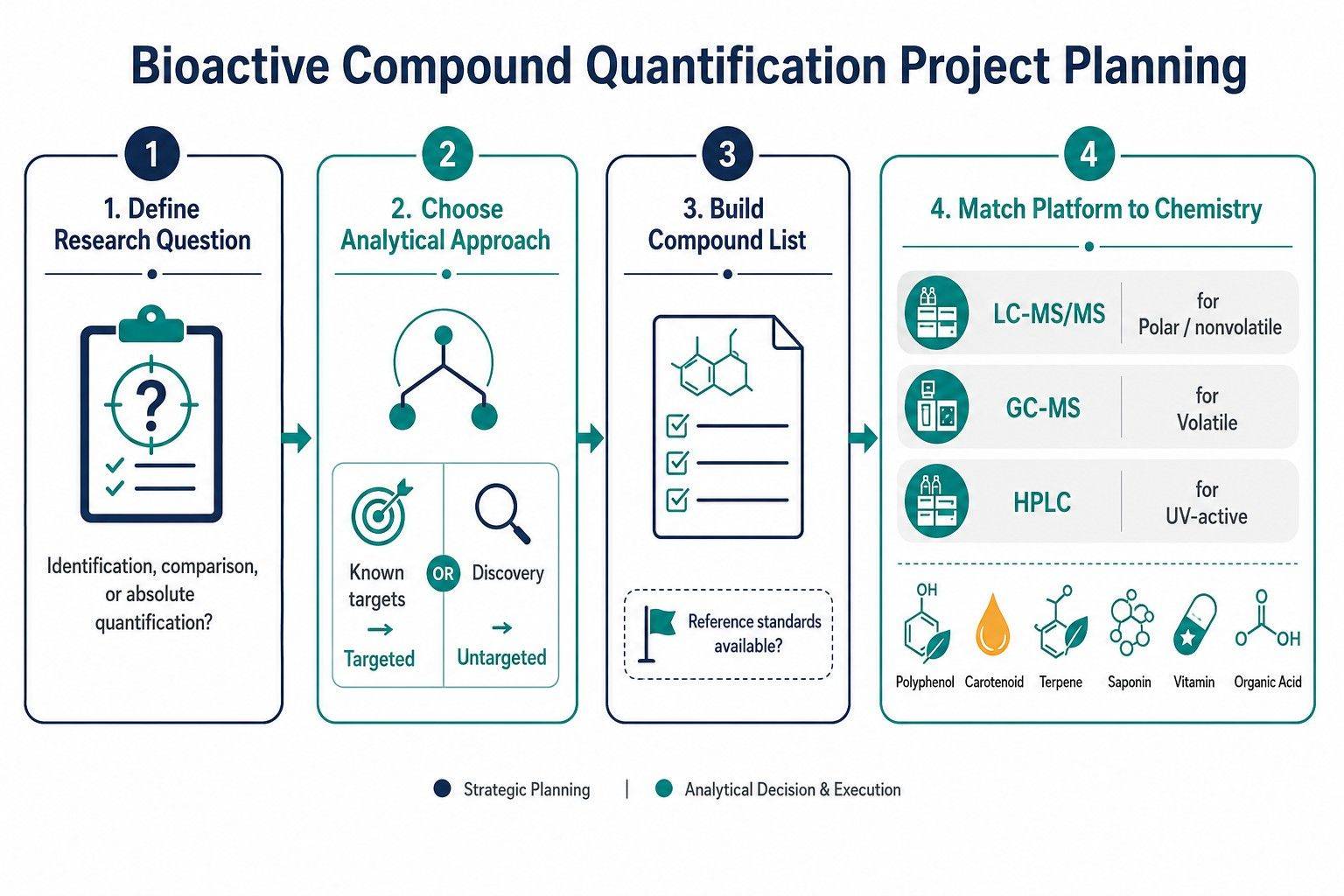 Project planning decision map: from research question to compound list, platform selection, and calibration strategy — the four decisions that shape every bioactive compound quantification project.
Calibration and Fit-for-Purpose QC
Reliable quantification depends on calibration and quality control practices appropriate for the research use. A well-designed calibration curve covers the expected concentration range with sufficient points to characterize the response function across the working range — six to eight levels are commonly used, but the final design should reflect method range, model complexity, and intended research use. An internal standard, ideally a stable-isotope-labeled analog of the target compound, corrects for extraction efficiency and ionization variability. Where labeled standards are unavailable, a structurally similar compound may serve as a surrogate internal standard.
Fit-for-purpose QC ensures that the analytical data support the intended research conclusions. Key QC elements may include extraction blanks to detect laboratory-introduced contamination, matrix-based QC samples at representative concentration levels, calibration verification standards, internal-standard monitoring, and, where appropriate, pooled samples used to assess batch stability. Acceptance criteria should be defined according to the analyte, matrix, concentration range, and method maturity — a single universal threshold across all compounds and matrices is not appropriate.
Handling Isomers and Related Compounds
Many bioactive compound classes — particularly flavonoids, carotenoids, and saponins — contain structural isomers that share the same molecular mass and produce similar fragmentation patterns. Chromatographic separation is essential for distinguishing these compounds; MS alone cannot differentiate co-eluting isomers. A method that resolves, for example, quercetin-3-O-glucoside from quercetin-4'-O-glucoside requires a chromatographic gradient optimized for isomer separation, not just a generic method.
When complete isomer resolution is not achievable, the limitation should be clearly reported — for example, stating that the reported concentration represents the sum of co-eluting isomers rather than a single compound. This is especially important when comparing results across studies or when the individual isomers have different biological activities.
What Results Can Be Reported?
The type of result that can be reported depends on the analytical approach, standard availability, and calibration design.
- Absolute concentration: reported in units such as mg/g or µg/mL, requires an authentic reference standard, multi-point calibration, and appropriate QC. Suitable for quantitative comparisons across studies and laboratories.
- Semi-quantitative estimate: reported in equivalents (e.g., µg quercetin equivalents/g), uses a surrogate calibrant when the authentic standard is unavailable. The surrogate relationship and its limitations must be disclosed.
- Relative abundance: reported as normalized peak area or intensity, suitable for comparing samples within a single study batch. Not directly comparable across laboratories or instruments without standardized normalization.
- Presence/absence or putative identification: supports detection based on accurate mass, isotope pattern, and fragmentation evidence. High-confidence confirmation may additionally require chromatographic retention-time matching against an authentic reference standard.
Understanding which result type aligns with the research question prevents receiving data that cannot support the intended conclusions. For projects requiring targeted quantification of specific bioactive compounds, our targeted metabolomics service provides LC-MS/MS methods with compound-specific calibration. For discovery-phase projects needing broad chemical profiling, our untargeted metabolomics service supports unbiased screening with downstream targeted validation of identified compounds.
Sample and Project Information Checklist
Providing the following information when submitting a project inquiry helps the laboratory evaluate feasibility and design an appropriate analytical strategy:
- Research question and intended data use
- Sample type, species, and matrix description
- Target compound list with structures, if available
- Expected concentration range, based on prior data or literature
- Available sample amount per sample
- Collection and storage conditions
- Reference standard availability for each target
- Any known matrix components that may interfere
Sample amount requirements are project-specific and depend on matrix complexity, target concentration, analyte count, extraction replicates, and the scope of QC work. Researchers should provide the available sample amount during feasibility review rather than relying on a universal minimum. For projects involving plant extracts, food matrices, or feed samples, our plant active ingredient analysis services provide matrix-specific extraction and quantification protocols.
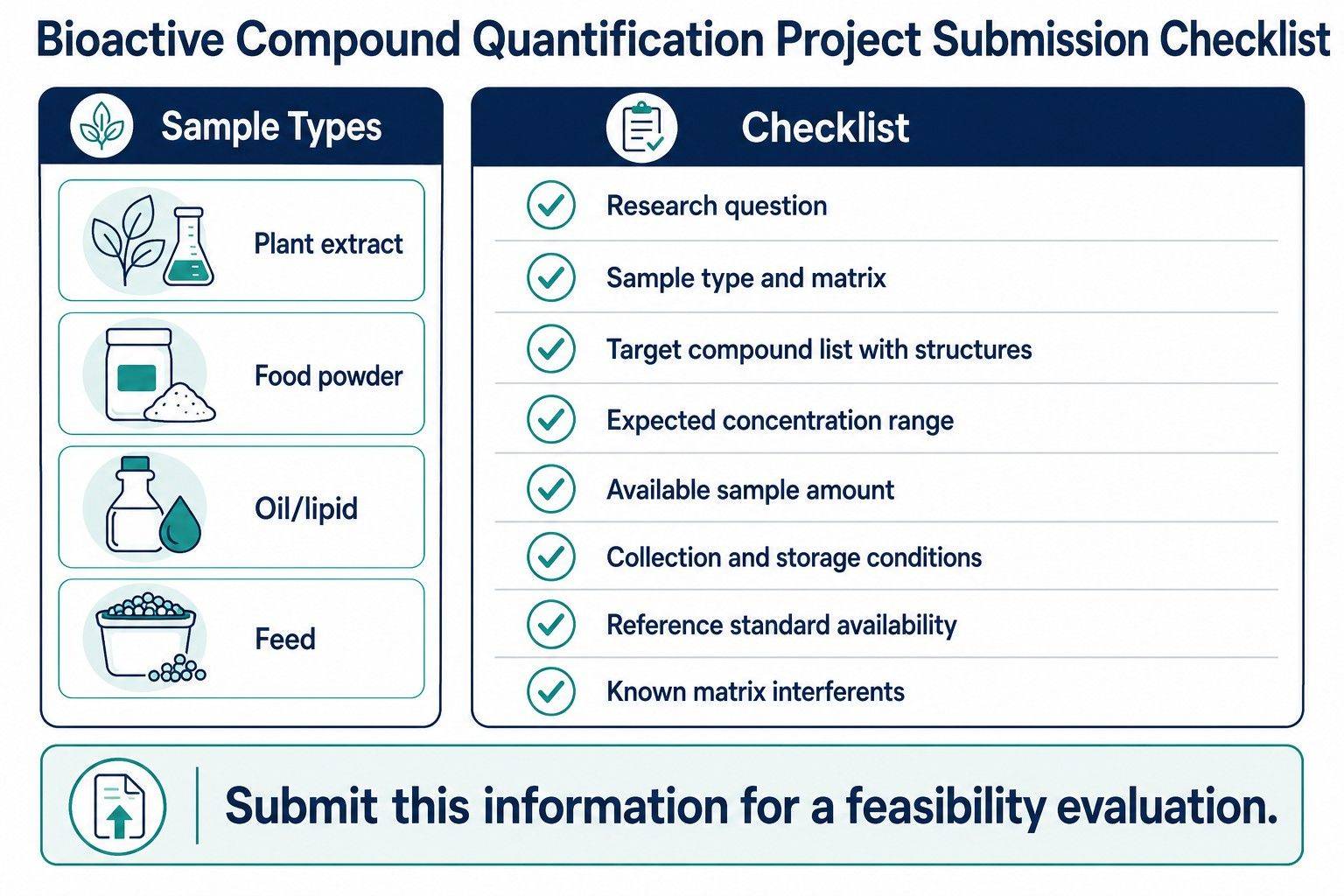 Sample and project information checklist: the key details the laboratory needs to evaluate feasibility and design an appropriate quantification strategy.
FAQs
1) Can multiple bioactive compounds from different chemical classes be analyzed together?
Compounds sharing compatible extraction, chromatographic, and ionization conditions can be analyzed in a single method. Compounds requiring different ionization modes or chromatography may need separate analytical protocols. Providing the full compound list early allows the laboratory to assess whether a single method can cover all targets.
2) What is the difference between absolute quantification, semi-quantitative estimation, and relative comparison?
Absolute quantification uses authentic reference standards and calibration to report concentration in mass or molar units. Semi-quantitative estimation uses a surrogate calibrant and reports results in equivalents with the limitation disclosed. Relative comparison reports normalized peak areas for within-study comparisons and is not directly comparable across laboratories.
3) What if no commercial reference standard exists for my target compound?
Relative quantification or surrogate-based semi-quantification can be used. The analytical strategy should be discussed with the laboratory before project initiation so the report clearly states the quantification approach and its limitations.
4) How are structural isomers distinguished in complex botanical extracts?
Isomers are separated chromatographically before MS detection. A method optimized for isomer resolution — with appropriate column selection and gradient — is required. When complete resolution is not achievable, results should report the sum of co-eluting isomers with the limitation noted.
5) What QC practices support reliable bioactive compound quantification?
Fit-for-purpose QC typically includes extraction blanks, pooled QC samples monitored throughout the analytical batch, calibration verification standards, and spike recovery experiments in the specific sample matrix. Acceptance criteria are defined according to the analyte, matrix, and research requirements.
References
- Wolfender, J. L., et al. (2015). Current approaches and challenges for the metabolite profiling of complex natural extracts. Journal of Chromatography A, 1382, 136–164. DOI: 10.1016/j.chroma.2014.10.091
- Steinmann, D., & Ganzera, M. (2011). Recent advances on HPLC/MS in medicinal plant analysis. Journal of Pharmaceutical and Biomedical Analysis, 55(4), 744–757. DOI: 10.1016/j.jpba.2010.11.015
- Aydoğan, C. (2020). Recent advances and applications in LC-HRMS for food and plant natural products: a critical review. Analytical and Bioanalytical Chemistry, 412, 1973–1991. DOI: 10.1007/s00216-019-02328-6

 Contact Us


