Microbial Metabolic Flux Tracing Across Strain Engineering Hosts
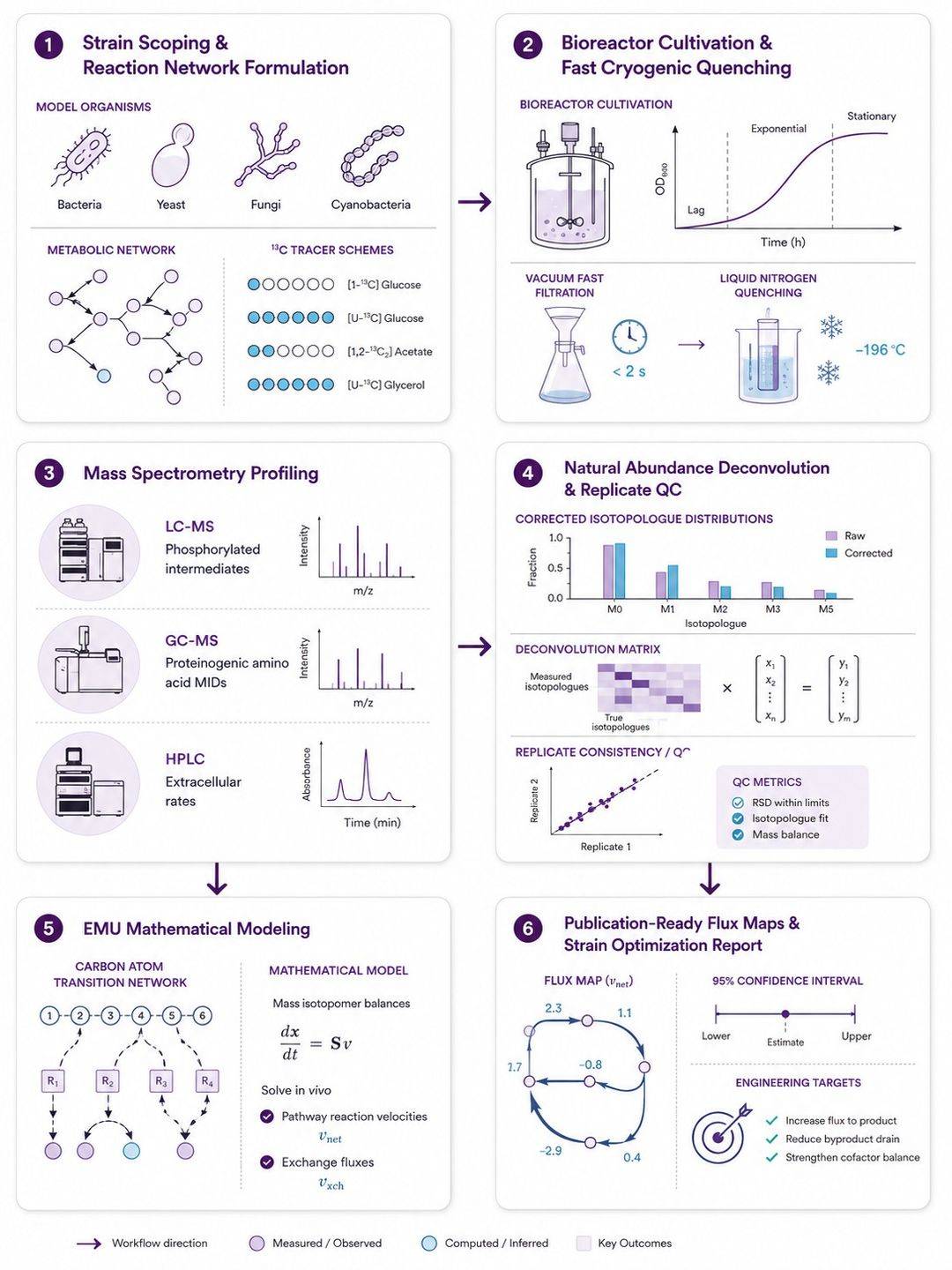
Microbial cell factories exhibit rapid metabolic turnover and flexible pathway routing to balance growth, redox maintenance, and target product synthesis. Because static biomass yields (OD600, gDW/L) and end-point fermentation titers cannot reveal internal pathway bottlenecks, futile cycles, or carbon diversion into competing overflow pathways, isotope flux analysis is essential. Our Microbial MFA service quantifies intracellular carbon traffic across bacteria, yeasts, filamentous fungi, and cyanobacteria—resolving central carbon partitioning across glycolytic pathway metabolic flux analysis and central carbon metabolic flux analysis to optimize carbon yield:
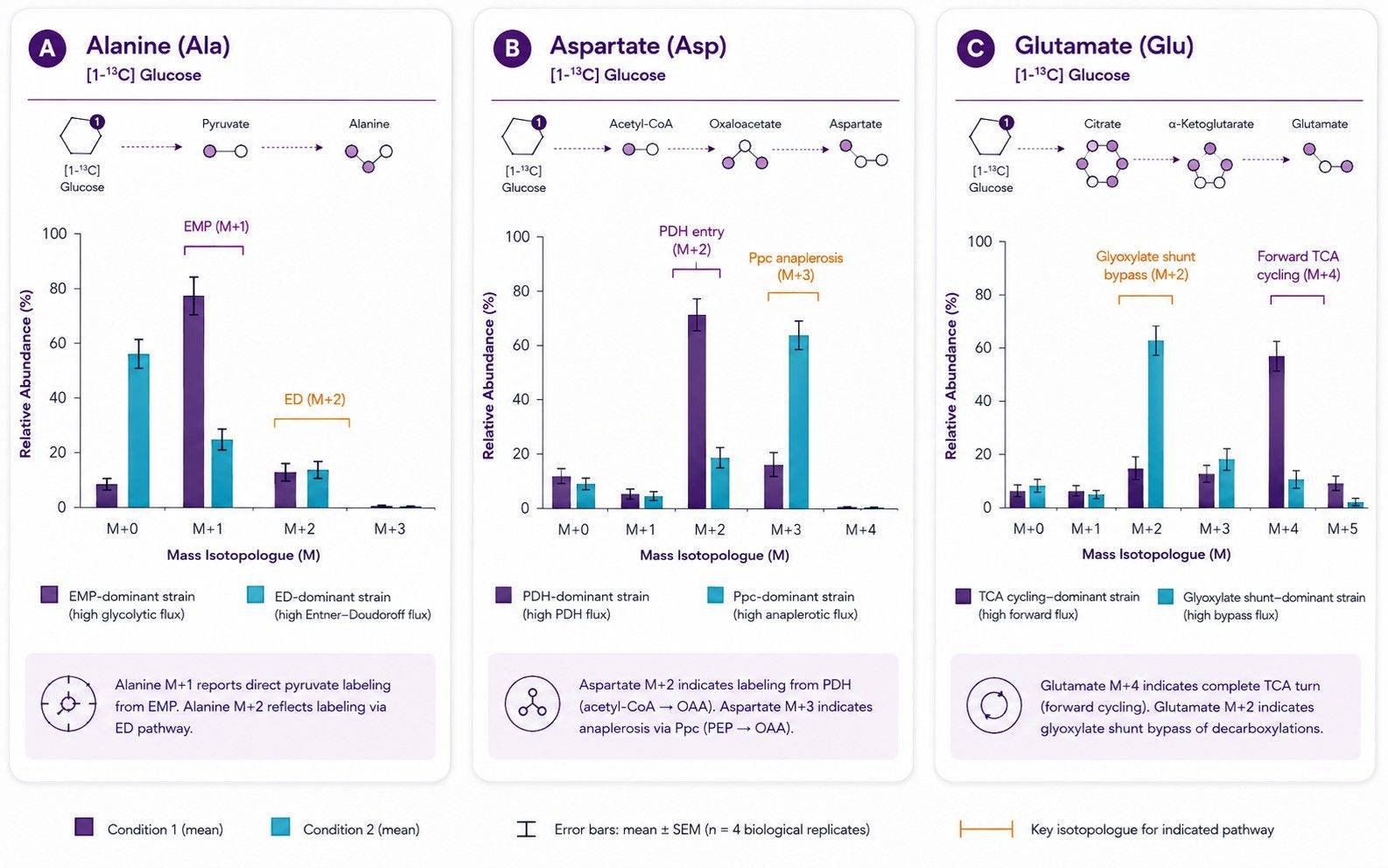
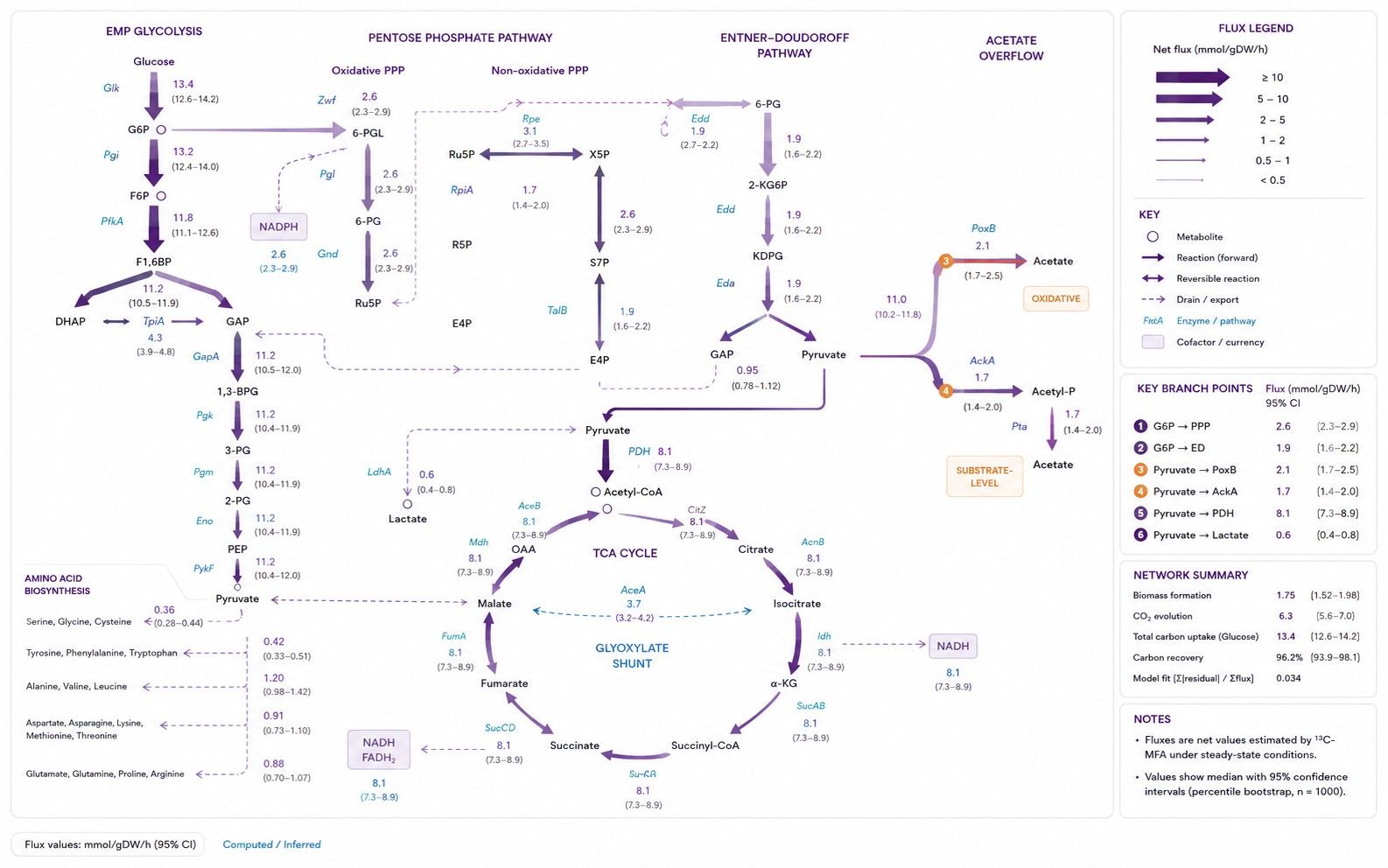
(i) Glycolytic Pathway Splits (EMP vs. ED vs. PPP): Estimating the carbon split between the Embden-Meyerhof-Parnas (EMP) pathway, Entner-Doudoroff (ED) pathway, and oxidative Pentose Phosphate Pathway (oxPPP) using position-sensitive fragments and model fitting.
(ii) Overflow Metabolism & Fermentation Byproducts: Quantifying carbon diversion into acetate (PoxB, Pta-AckA), ethanol (AdhE), and lactate (LdhA) under high-glucose batch or fed-batch bioreactor conditions.
(iii) TCA Cycle Architecture & Glyoxylate Shunt: Measuring the stoichiometric partitioning between oxidative TCA cycling, the isocitrate lyase (AceA) glyoxylate shunt bypass, and anaplerotic phosphoenolpyruvate carboxylase (Ppc) vs. carboxykinase (Pck) fluxes within the TCA cycle pathway metabolic flux analysis and associated anaplerotic network.
(iv) Autotrophic Carbon Fixation in Cyanobacteria: Resolving Calvin-Benson-Bassham (CBB) cycle throughput, photorespiratory 2-phosphoglycolate recycling, and day/night mixotrophic flux partitioning via time-resolved INST-MFA.
(v) Yeast & Fungal Precursor Allocation: Tracking precursor allocation into recombinant proteins, lipids, and secondary metabolites across S. cerevisiae, P. pastoris, and Aspergillus, with compartmental acetyl-CoA pools assessed when supported by compartment-specific measurements or sufficient model constraints.
Looking for microbial metabolite concentration measurements? If your study focuses on quantifying absolute or relative metabolite pool sizes (μmol/g dry cell weight or mg/L) without stable isotope tracing, please explore our Microbial Metabolomics Service.
Analytical & Quenching Considerations in Microbial Fluxomics
Microbial fluxomics requires specialized sampling strategies to capture fast-turnover intermediates while avoiding cold-shock leakage and spectral artifacts:
- Rapid Sampling & Low-Temperature Quenching: Rapid vacuum filtration or cold organic solvent quenching protocols are evaluated per host matrix to arrest fast-turnover central intermediates while minimizing cold-shock leakage and sampling artifacts.
- Metabolic & Isotopic Steady-State Verification: For studies targeting steady-state 13C-MFA, metabolic and isotopic steady states are experimentally verified during balanced exponential growth; non-steady-state fermentations or transient phases transition to dynamic modeling workflows.
- Dual LC-MS & GC-MS Orthogonal Profiling: High-resolution LC-MS resolves intact phosphorylated intermediates (G6P, 6PG, PEP, FBP), while GC-MS-based metabolic flux analysis provides fragment-specific carbon isotopologue constraints from hydrolyzed biomass proteinogenic amino acids, which offer high stability, high abundance, and time-integrated labeling information across biomass accumulation.
- Natural Abundance Deconvolution: Algorithmic matrix deconvolution (IsoCor, AccuCor) strips natural 13C, 15N, 2H, 18O, and silyl tag backgrounds across all measured fragments.
Tracer Selection Matrix for Microbial Host Systems
Tracer selection is customized based on microbial species, pathway topology, and metabolic engineering objectives:
| Microbial Host System |
Recommended Tracer Regime |
Target Pathway Node |
Diagnostic Flux Readout |
| Escherichia coli & Enterobacteria |
[1-13C]Glucose + [U-13C6]Glucose (80:20 ratio) |
EMP vs. ED vs. PPP split, acetate overflow, Ppc anaplerosis |
Fragment-specific amino acid isotopologues resolving EMP vs. ED partitioning, oxPPP throughput, and glyoxylate shunt bypass. |
| Saccharomyces cerevisiae & Yeasts |
[1,2-13C2]Glucose + [U-13C6]Glucose |
Crabtree ethanol overflow, PC vs. PDH bypass, glycerol shunt |
Fractional glucose shunted to ethanol (M+2), glycerol synthesis, and mitochondrial vs. cytosolic precursor allocation. |
Pichia pastoris (Komagataella)
(Subject to project-specific feasibility review) |
[U-13C6]Glucose + [13C]Methanol (co-feeding) |
Methanol dissimilation vs. assimilation, AOX promoter flux |
Formaldehyde dissimilation into CO2 vs. xylulose-5-P assimilation feeding recombinant protein synthesis. |
Filamentous Fungi (Aspergillus)
(Subject to project-specific feasibility review) |
[1-13C]Glucose + [U-13C6]Glucose |
Organic acid overflow (citrate, itaconate), secondary metabolites |
Cytosolic citrate cleavage, cis-aconitate decarboxylase flux, itaconate vs. TCA cycle partitioning. |
Cyanobacteria & Autotrophs
(Subject to project-specific feasibility review) |
NaH13CO3 (time-resolved pulse-chase) |
CBB carbon fixation, day/night mixotrophic flux switching |
Time-series Rubisco net fixation velocity, photorespiratory phosphoglycolate recycling, and glycogen accumulation requiring non-stationary INST-MFA. |
Technical Platform Capabilities for Microbial MFA
- EMU-Based Isotopomer Modeling: Mathematical Elementary Metabolite Unit (EMU) algorithms solving complex microbial reaction networks and parallel tracer combinations within our 13C metabolic flux analysis framework.
- Biomass Composition & Macromolecular Balance: Integrates strain-specific biomass equations (protein, RNA, DNA, lipid, carbohydrate fractions) to enforce strict precursor drains for cell growth.
- Dynamic and Non-Stationary INST-MFA: Supports steady-state metabolic flux analysis alongside rapid dynamic and INST metabolic flux analysis for autotrophic cyanobacteria, slow-growing hosts, and transient bioreactor shifts.
- Redox Demand & NADPH Pathway Evaluation: When supported by appropriate tracer design and network constraints, evaluates NADPH-producing pathway contributions (oxPPP, Isocitrate Dehydrogenase, Malic Enzyme) and cellular redox demands.
- Complementary Positional Validation: Orthogonal validation of position-specific carbon labeling via high-field NMR-based metabolic flux analysis.
End-to-End Microbial MFA Workflow
Sample Submission & Microbial Sampling Guidelines
Sampling protocols and biomass requirements are finalized during feasibility review based on microbial host, growth rate, and cultivation mode:
| Sample Type |
Typical Input Guidelines |
Harvesting & Quenching Principles |
Storage & Transport |
| Bacterial Cell Pellets (E. coli, Bacillus) |
0.5–2.0 mg dry cell weight (1–3 mL culture at OD600 = 1.0–2.0) |
Fast vacuum filtration on 0.45 μm membrane filters or direct −40 °C solvent quenching, immediate liquid nitrogen freeze. |
Store at −80 °C; ship on dry ice |
| Yeast Biomass (S. cerevisiae, Pichia) |
1.0–5.0 mg dry cell weight (2–5 mL culture) |
Rapid centrifugation (4 °C, 4,000 × g, 30 s) or fast filtration, aspirate supernatant, freeze pellet in liquid nitrogen. |
Store at −80 °C; ship on dry ice |
| Filamentous Fungi (Aspergillus, Trichoderma) |
5–20 mg dry mycelial biomass |
Filter mycelial mat through Miracloth/vacuum filter, rinse with cold saline, snap-freeze in liquid nitrogen. |
Store at −80 °C; ship on dry ice |
| Cyanobacteria & Microalgae |
2–10 mg dry biomass (5–10 mL culture) |
Fast filtration under active illumination to prevent dark shifts, instant liquid nitrogen immersion. |
Store at −80 °C; ship on dry ice |
| Spent Fermentation Broth |
≥ 500 μL matched supernatant |
Collect matched broth across sampling points, filter through 0.22 μm syringe filter, aliquot for extracellular rate profiling. |
Store at −80 °C; ship on dry ice |
Deliverables & Quantitative Reporting from Microbial MFA
- Deconvoluted Microbial MID Matrix: Natural-abundance-corrected fractional labeling (M+0 to M+n) across central intermediates, organic acids, and proteinogenic amino acids (.csv / Excel).
- Bioreactor Boundary Exchange Rates: Quantified specific substrate consumption, byproduct secretion, and specific growth rates (delivered when boundary rates are measured).
- Stoichiometric Model Specifications: Complete reaction definitions, carbon atom transition mappings, and project configuration files.
- Calculated Reaction Rates & Split Ratios: Net fluxes (vnet) and exchange velocities (vxch) with accompanying sensitivity analysis and 95% confidence intervals for identifiable fluxes (delivered when boundary rates are measured and parameters are identifiable).
- Statistical Fit Diagnostics: Sum of squared residuals (SSR), Chi-square goodness-of-fit evaluation, and residual diagnostic plots.
- Publication-Ready Pathway Maps: High-resolution vector diagrams (PDF/SVG) illustrating microbial carbon flux distribution with flux-scaled arrow widths.
How We Scope Microbial 13C-MFA for Strain Engineering and Fermentation
Study feasibility, tracer selection, and mathematical modeling strategies depend directly on microbial host physiology, cultivation mode, and target pathways. Rather than applying a uniform protocol, we evaluate projects against defined experimental scenarios:
| Project Scenario |
Recommended Strategy |
Required Inputs & Feasibility Constraints |
| Exponential-phase bacterial / yeast strain comparison |
Steady-state 13C-MFA |
Specific growth rate (μ), substrate uptake rate, product/byproduct secretion rates, dry cell weight (DCW), and isotopic steady-state biomass amino acid MIDs. |
| Fed-batch production phase |
Dynamic / non-stationary feasibility assessment |
Feed profile and nutrient feeding curves, residual substrate concentrations, dilution rate, time-series intermediate MIDs, and exhaust gas CO2/O2 (where available). |
| Filamentous fungi / fungal pellets |
Sampling and heterogeneity feasibility review |
Morphology assessment (pellet vs. dispersed mycelium), sampling representativeness, rapid biomass/broth separation protocol, and cell wall disruption validation. |
| Cyanobacteria / autotrophic systems |
Time-resolved INST-MFA |
Calibrated light regime, continuous 13CO2 or NaH13CO3 delivery, gas exchange rates, and rapid sub-minute time-series labeling data. |
| Non-model microbes or synthetic pathways |
Atom mapping & measurable node verification |
Host genotype/knockout annotations, complete medium carbon source composition, target pathway stoichiometry, and analytical coverage of target product bypasses. |


 Contact Us