Amino Acid Metabolic Flux Analysis — Beyond Static Pool Concentrations
Amino acids serve as essential precursors for protein synthesis, nucleotide biogenesis, glutathione redox
defense, and TCA cycle anaplerosis. While conventional metabolomics measures static amino acid pool
concentrations (μmol/g or μM), pool sizes alone cannot determine whether accumulation or depletion is
driven by altered de novo synthesis, protein turnover, extracellular uptake, or downstream transamination
and oxidation.
As a specialized pathway Spoke within our central
carbon metabolic flux analysis and broader metabolic
flux analysis service, Amino Acid MFA tracks stable isotopes (13C and 15N) to
resolve key amino acid reaction velocities:
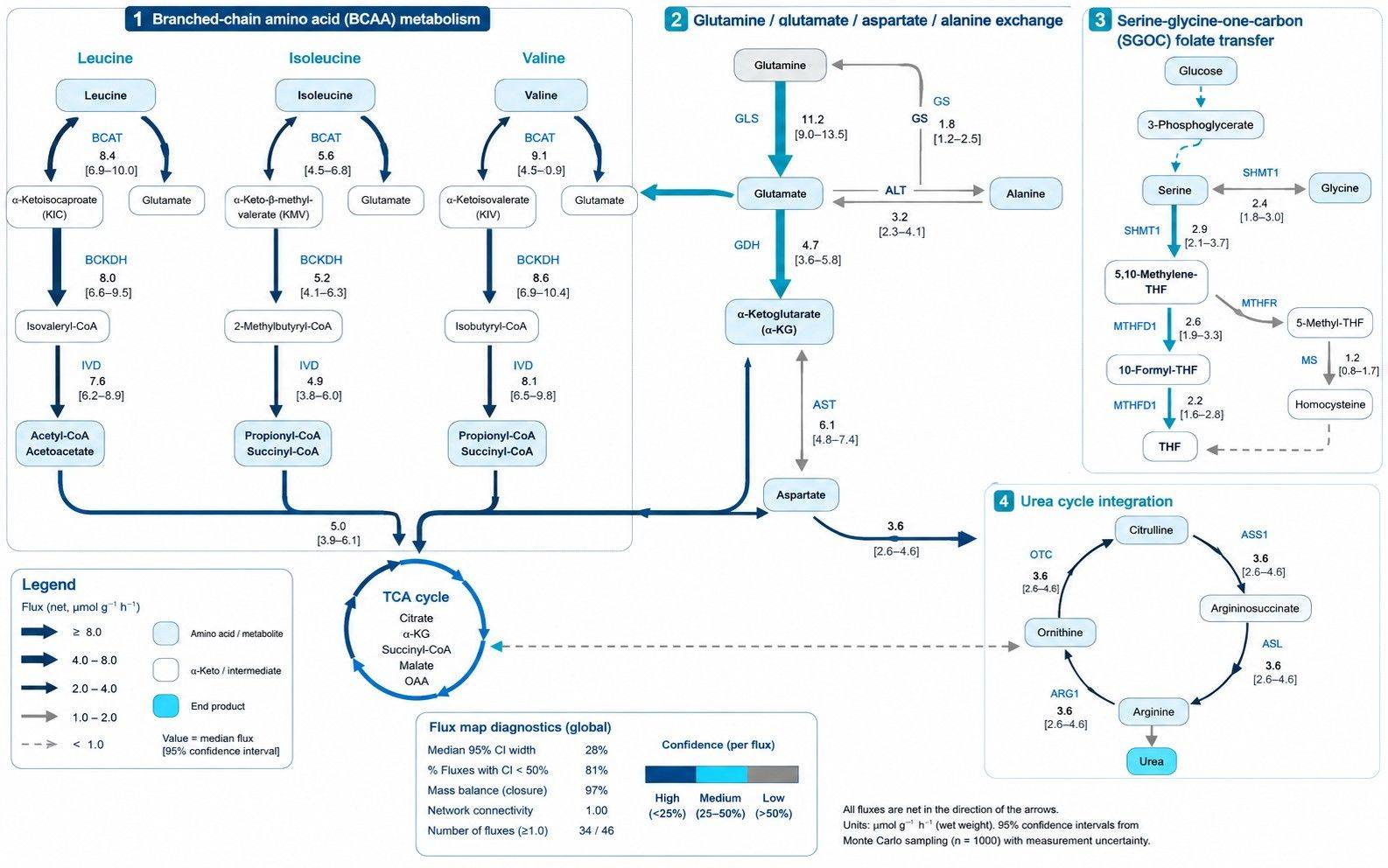
(i) Glutamine/Glutamate Hub & Transamination Flux: The rate of glutamine deamidation
via glutaminase (GLS) versus nitrogen transfer by transaminases (ALT/GPT, AST/GOT) and glutamate
dehydrogenase (GDH), connected to our TCA cycle metabolic flux
analysis.
(ii) Branched-Chain Amino Acid (BCAA) Kinetics: Reversible transamination of leucine,
isoleucine, and valine via BCAT1/2 yielding branched-chain α-keto acids (BCKAs) versus irreversible
oxidation via the BCKDH complex.
(iii) Serine-Glycine-One-Carbon (SGOC) Axis: De novo serine synthesis from glycolytic 3-PG
(PHGDH, PSAT1, PSPH) and its cleavage by SHMT1/2 to glycine, fueling one-carbon folate pools, purine rings,
and methylation.
(iv) Aspartate Shuttle & Urea Cycle Integration: Aspartate transamination and
condensation with citrulline via argininosuccinate synthetase/lyase (ASS1/ASL), balancing NADPH generation,
arginine synthesis, and nitrogen disposal.
(v) Glutathione Synthesis & Redox Balancing: Condensation fluxes of glutamate,
cysteine, and glycine through GCLC and GSS, quantifying antioxidant pool replenishment under oxidative
stress.
Looking for amino acid concentration measurements? If your research objective is
quantifying absolute or relative pool sizes (μmol/g, μmol/L, or ng/mL) of free amino acids without
stable isotope tracing, please explore our Amino Acids Analysis Service.
Analytical Considerations in Dual 13C/15N Amino Acid Fluxomics
Amino acid fluxomics requires robust analytical coverage across polar zwitterionic amino acids, labile
α-keto acids, and dual-isotope envelopes:
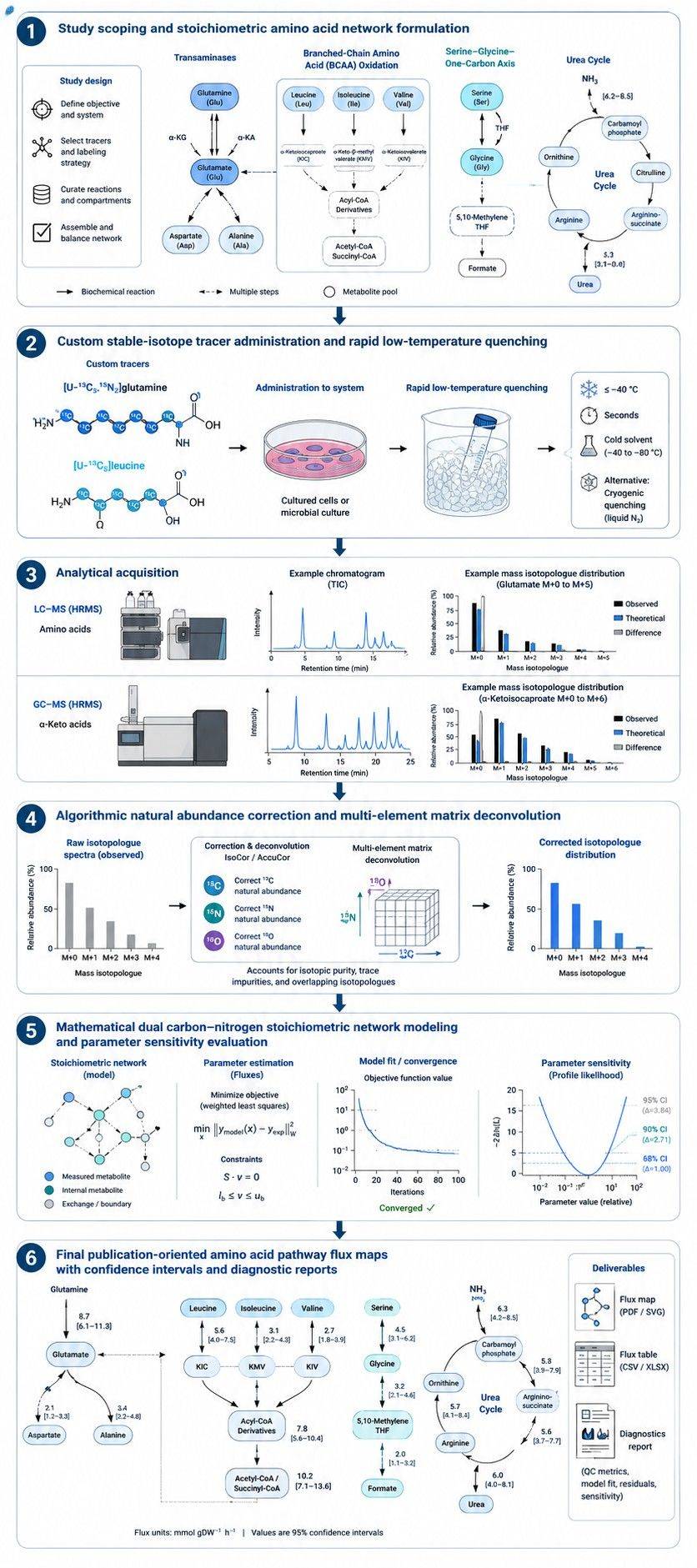
- Simultaneous Dual-Isotope (13C / 15N) Resolution: High-resolution
mass spectrometry resolves fine isotopic structures (e.g. distinguishing 13C from
15N mass shifts), enabling concurrent tracking of carbon skeleton transitions and amino
nitrogen transfer.
- Keto Acid Stabilization & Derivatization: Labile α-keto acids
(α-ketoglutarate, oxaloacetate, pyruvate, BCKAs) undergo fast oximation or silylation derivatization
to prevent decarboxylation and enable precise GC-MS or LC-MS measurement.
- Dual LC-MS & GC-MS Orthogonal Profiling: Underivatized HILIC and reversed-phase
LC-MS profile intact polar amino acids, while GC-MS-based metabolic flux analysis using
tert-butyldimethylsilyl (TBDMS) or chloroformate derivatization supplies fragment-specific carbon
constraints.
- Multi-Element Background Deconvolution: Algorithmic matrix deconvolution (IsoCor /
AccuCor) mathematically corrects raw isotopologue spectra for natural 13C, 15N,
18O, and silyl tag backgrounds.
13C and 15N Tracer Selection Matrix for Transamination & Amino Acid Flux
The choice of isotope tracer dictates which amino acid synthetic, transamination, and catabolic fluxes can
be mathematically resolved:
| Tracer Substrate |
Target Amino Acid Pathway Node |
Diagnostic Labeling Information & Readout |
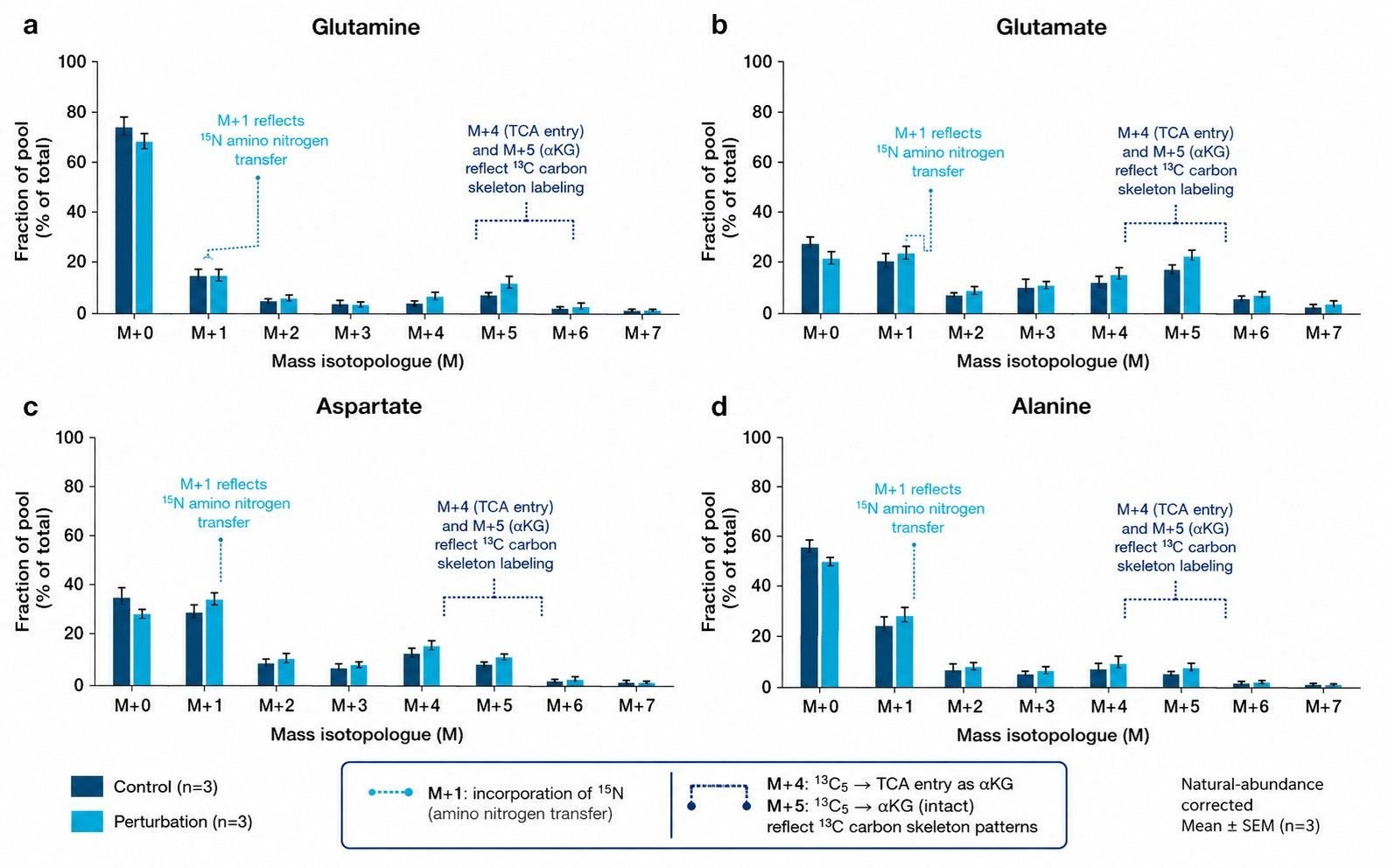
| [U-13C5, 15N2]Glutamine |
Glutamine carbon oxidation vs. amino/amide nitrogen transfer |
Tracks carbon backbone entry into the TCA cycle (M+4/M+5 α-KG, succinate, malate, citrate)
alongside nitrogen transfer: amide-15N into nucleotide rings and asparagine;
amine-15N (M+1) into transamination products (glutamate, alanine, aspartate). |
| [U-13C6]Glucose |
De novo Non-Essential Amino Acid (NEAA) synthesis |
Labels glycolytic and TCA precursors, yielding [U-13C3]serine (via 3-PG),
[U-13C2]glycine (via SHMT), [U-13C3]alanine (via
pyruvate), [U-13C4]aspartate (via oxaloacetate), and
[U-13C5]glutamate (via α-KG). |
| [U-13C6]Leucine / [U-13C5]Valine |
BCAA transamination (BCAT) vs. terminal oxidation (BCKDH) |
Transamination yields [U-13C]keto acids (KIC, KIV), while downstream oxidative
decarboxylation generates labeled acetyl-CoA and succinyl-CoA entering the TCA cycle. Distinguishes
reversible exchange from committed oxidation. |
| [U-13C3, 15N]Serine |
Serine-Glycine-One-Carbon (SGOC) and folate transfer |
SHMT cleavage releases M+2 glycine and a one-carbon unit ([13C]methylene-THF) feeding
the methionine cycle (M+1 methionine/SAM) and purine rings (M+1/M+2 adenine/guanine). |
| [15N]Ammonium Chloride / [15N]Amine |
Global nitrogen assimilation, GDH flux, and urea cycle disposal |
Directly quantifies GDH-mediated ammonia fixation versus transaminase distribution into glutamate,
glutamine, and urea cycle intermediates (citrulline, arginine, urea). |
Technical Capabilities for High-Resolution Amino Acid Flux Analysis
- Dual Carbon-Nitrogen Balance: Integrated stoichiometric modeling accounting for coupled
carbon backbone routing and nitrogen transaminase exchange networks.
- Sub-Cellular Compartmental Distinction: Resolves cytosolic (BCAT1, GOT1, SHMT1) from
mitochondrial (BCAT2, GOT2, SHMT2) isoforms through compartment-specific isotopologue signature
deconvolution.
- Isotopic Steady-State and Dynamic Kinetic Sampling: Supports steady-state fractional
contribution studies as well as time-course dynamic
and INST metabolic flux analysis to monitor acute enzyme inhibition or nutrient switches.
- Complementary Positional Validation: High-field NMR-based metabolic flux analysis available for
resolving position-specific carbon and nitrogen labeling in complex biofluids.
End-to-End Amino Acid MFA Workflow & Analytical Pipeline
Sample Preparation & Stabilization Guidelines for Amino Acid MFA
Sample amounts and extraction protocols are finalized during feasibility review based on amino acid pool
turnover and matrix type:
| Sample Type |
Typical Input Guidelines |
Harvesting & Quenching Principles
|
Storage & Transport |
| Adherent Cultured Cells |
Typically 1–5 × 10⁶ cells (60 mm dish), confirmed by pilot assessment |
Aspirate tracer medium rapidly, add pre-chilled organic extraction solvent, cell detachment on dry
ice/ice. Minimize wash duration. |
Store at −80 °C; ship on dry ice |
| Suspension Cultured Cells |
Typically 2–10 × 106 cells, adjusted to cell density |
Short, pre-cooled centrifugation (4 °C), aspirate supernatant, extract cell pellet immediately
in cold solvent. |
Store at −80 °C; ship on dry ice |
| Microbial / Fermentation Pellets |
Biomass volume determined by pilot extraction and target coverage |
Fast filtration or direct quenching into pre-chilled solvent to arrest fast-turnover pools. Retain
spent broth for extracellular rates. |
Store at −80 °C; ship on dry ice |
| Animal & Tumor Tissues |
20–50 mg wet weight, depending on metabolic activity |
Instant freeze-clamping or flash freezing in liquid nitrogen immediately upon collection;
cryo-pulverize without intermediate thawing. |
Store at −80 °C; ship on dry ice |
| Conditioned Culture Medium |
≥ 200 μL matched supernatant |
Sample matched culture supernatant across labeling time points; clarify by centrifugation (4
°C) to remove debris. |
Store at −80 °C; ship on dry ice |
Deliverables & Quantitative Datasets from Amino Acid MFA
- Deconvoluted Amino Acid MID Matrix: Natural-abundance-corrected fractional labeling
(M+0 to M+n) across all canonical amino acids and key α-keto acids (.csv / Excel).
- Extracellular Boundary Rates: Quantified amino acid uptake, consumption, and secretion
rates providing stoichiometric boundaries for flux calculation.
- Dual Carbon-Nitrogen Model Specifications: Reaction network definitions,
carbon/nitrogen atom transition mappings, and project configuration files.
- Calculated Reaction Rates & Split Ratios: Net (vnet) and exchange
(vxch) fluxes with accompanying sensitivity analysis and confidence intervals.
- Statistical Fit Diagnostics: Sum of squared residuals (SSR), Chi-square goodness-of-fit
evaluation, and residual diagnostic plots.
- Publication-Ready Pathway Maps: High-resolution vector graphics (PDF/SVG) illustrating
amino acid metabolic flux partitioning.
Research Applications of Amino Acid Pathway Flux Analysis & BCAA Tracing
- Oncology & Glutamine Addiction: Quantify glutaminase dependence, anaplerotic
feeding into the TCA cycle, and resistance mechanisms to GLS1 inhibitors.
- BCAA Catabolism in Diabetes & Heart Failure: Map BCAT/BCKDH flux rewiring in
insulin resistance, non-alcoholic fatty liver disease, and cardiac hypertrophy.
- One-Carbon Metabolism & Epigenetics: Measure de novo serine synthesis, SHMT flux,
and methyl-group donor rates (SAM/SAH) fueling DNA and histone methylation.
- Immunometabolism: Track arginine, tryptophan, and glutamine partitioning during
macrophage polarization and T-cell differentiation.
- Bioprocess & Recombinant Protein Production: Optimize amino acid feeding
strategies, eliminate toxic ammonia/urea accumulation, and maximize protein yields in CHO cell cultures.


 Contact Us