

Plant Metabolomics Sample Preparation: Managing Polyphenols, Pigments, and Enzymatic Oxidation for LC-MS
Submit Your InquiryPlant tissues can produce visually clean extracts and still generate unreliable LC-MS data. Chlorophylls and carotenoids accumulate on the column and ion source, polyphenol oxidation creates or removes features after harvest, starch and polysaccharides alter extraction and reconstitution, and incomplete cell-wall disruption makes recovery depend on tissue toughness. Cleanup can improve analytical performance, but it can also remove the specialized metabolites that the study was designed to measure.
Once the biological sampling plan has been defined, extraction and cleanup must be adapted to leaf, root, fruit, seed, woody, and polyphenol-rich plant matrices. The procedure should recover the intended metabolite classes reproducibly while controlling post-harvest enzymatic conversion, oxidation, pigment interference, and matrix effects.
Plant Matrix Composition and Extraction Solvent Selection
"Plant tissue" is not one analytical matrix. A young Arabidopsis leaf, a mature tea leaf, a starch-rich tuber, an oilseed, a lignified root, and a pigmented berry differ in water, structural carbohydrate, storage lipid, organic acid, phenolic, and pigment content. The same aqueous methanol protocol can therefore yield different extraction efficiencies and matrix effects.
A method-development intake should identify:
- tissue and anatomical fraction;
- fresh-frozen, freeze-dried, air-dried, or processed state;
- expected water, starch, lipid, fiber, pigment, and polyphenol burden;
- target classes and compounds that must not be removed during cleanup;
- whether free, conjugated, and cell-wall-bound metabolites must be distinguished;
- required output: untargeted discovery, relative profiling, or targeted concentration;
- available sample mass and whether parallel extractions are feasible.
The analyte list determines what constitutes interference. Chlorophyll is an unwanted matrix component in a polar amino-acid assay, but it is the analyte in pigment profiling. Polyphenols can cause oxidation and ion suppression in one method while representing the primary endpoint in a polyphenols analysis. A cleanup step cannot be labeled "selective" without testing recovery of the compounds the study needs to retain.
| Matrix characteristic | Likely analytical consequence | Method-development priority |
|---|---|---|
| High chlorophyll or carotenoid content | Source contamination, late-eluting background, ion suppression | Pigment load, dilution linearity, wash program, optional selective cleanup |
| High soluble polyphenols | Oxidation, adducts, broad matrix effect, analyte binding | Rapid enzyme arrest, oxidation check, target recovery through cleanup |
| High starch or soluble sugar | Viscous extract, incomplete precipitation, poor reconstitution | Solvent-to-mass ratio, centrifugation, dilution, orthogonal cleanup |
| High lipid or wax | Biphasic behavior, reversed-phase overload, suppression of mid/late analytes | Defatting or class-specific extraction if lipids are not targets |
| Fibrous, woody, or seed tissue | Incomplete disruption and heterogeneous recovery | Cryogenic milling, particle-size consistency, repeated extraction study |
| High organic-acid or salt content | pH shifts, adduct formation, ESI suppression | Buffer-free volatile additives, matrix effect and chromatographic selectivity |
Cryogenic Tissue Disruption and Metabolic Quenching
Plant cells compartmentalize enzymes and substrates. Cutting and grinding break vacuoles, plastids, and membranes, allowing polyphenol oxidases, peroxidases, glycosidases, esterases, and other enzymes to contact compounds that were separated in vivo. A tissue can therefore change chemically during homogenization even if it was frozen immediately after harvest.
Frozen material should remain below thawing temperature during size reduction and aliquoting. Liquid-nitrogen grinding or a pre-cooled cryogenic mill both aim to produce a homogeneous powder without creating a warm, partially thawed layer. The procedure must be scaled to the tissue: fibrous roots and dry seeds need more energy than soft leaf tissue, while excessive milling can warm small samples.
Particle size affects recovery. Large fragments expose less surface area and can leave cell-wall-bound or vacuolar metabolites underextracted. An extremely fine powder can absorb moisture rapidly and may be difficult to transfer quantitatively. A qualified workflow specifies milling time or frequency, load per vessel, bead material, number of cycles, cooling interval, and maximum time before extraction solvent is added.
Frozen powder also improves representativeness. A whole organ or composite can be cryomilled before subsampling, reducing the chance that one aliquot is enriched in peel, vascular tissue, starch granules, or seeds. The sampling hierarchy must still be preserved: splitting one powder into three tubes creates analytical aliquots, not three biological replicates.
Enzymatic and Nonenzymatic Oxidation During Sample Preparation
Polyphenol oxidase catalyzes oxidation of phenolic substrates to quinones after cellular compartments are disrupted. Peroxidases can drive related reactions in the presence of peroxide. Quinones can polymerize, react with nucleophiles, or covalently modify other molecules. The result is not merely lower "total phenolics"; individual metabolites can disappear while new features and unresolved background appear.
The first control is speed and temperature. Cryogenic grinding followed by immediate contact with cold organic solvent promotes protein precipitation and limits enzyme activity. A long interval in aqueous buffer, even on ice, may allow chemistry to continue. Exposure to air, warm sonication, repeated vortexing, and delayed centrifugation can increase oxidation for susceptible matrices.
Acidification can stabilize some phenolics and improve extraction of selected compounds, but it is not universally protective. Acid can promote hydrolysis, pigment conversion, or solvent-derived reactions and can alter electrospray response. Likewise, antioxidants, chelators, reducing agents, or polyvinylpolypyrrolidone may be valuable in a targeted method after validation, but they should not be added generically to an untargeted extract. They can introduce dominant ions, alter redox-sensitive analytes, bind phenolic targets, or create a treatment-dependent recovery bias.
A matrix-specific oxidation test is more informative than assuming an additive is beneficial. Prepare matched aliquots that differ only in extraction delay, temperature, headspace exposure, or stabilizer. Monitor authentic targets, suspected oxidation products, internal standards, total feature count, and pooled precision. The selected condition should preserve both abundance and profile over the full batch-processing time.
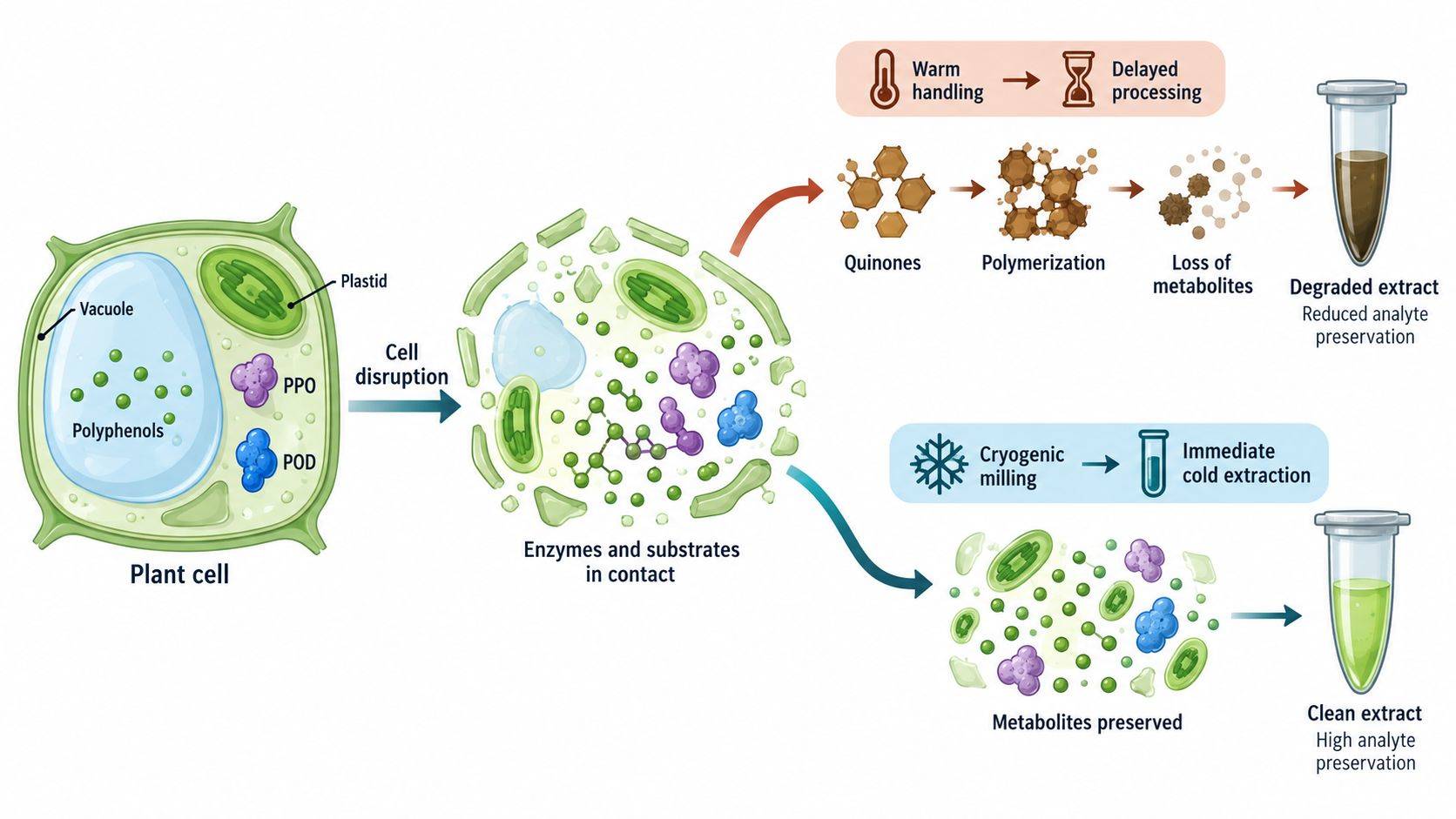 Figure 1. Disruption brings enzymes and substrates together. Cryogenic milling and immediate cold extraction reduce the reaction window, while stabilizing additives require analyte-specific validation because they can change recovery and ionization.
Extraction Solvent Polarity and Metabolite-Class Coverage
No single solvent recovers the complete plant metabolome. Aqueous organic mixtures are common because water releases polar metabolites and organic solvent precipitates proteins while extending coverage to moderately nonpolar compounds. The optimal ratio depends on tissue water content and the target classes.
For polar and semipolar profiling, methanol/water, acetonitrile/water, or mixed methanol/acetonitrile/water systems are common starting points. High organic content improves protein precipitation but may reduce recovery of very polar compounds or salts trapped in the residual pellet. More water can recover sugars, amino acids, and organic acids but coextracts larger amounts of matrix and can sustain enzyme activity if cooling and solvent strength are inadequate.
Neutral lipids, waxes, and pigments usually require a more nonpolar route. If lipid metabolism is part of the question, defatting is not cleanup—it is analyte removal. Parallel polar and lipid extractions, or a biphasic method with separate phase analysis, may provide better class coverage than forcing both fractions into one compromised injection.
Solvent volume should be based on dry or fresh tissue input and validated across the expected matrix range. Too little solvent produces saturation, incomplete protein precipitation, and high matrix burden. Excess solvent lowers analyte concentration and can push low-abundance features below detection. A tissue-mass series can reveal whether peak area remains proportional to input; nonlinearity may indicate incomplete extraction or increasing ion suppression.
Repeated extraction can increase recovery of strongly retained compounds, but later fractions may contribute mostly background. Analyze sequential fractions during method development instead of assuming that three extractions are better than one. If free and bound polyphenols are both relevant, solvent extraction and alkaline or enzymatic hydrolysis should be treated as separate analytical fractions. Hydrolysate cannot be merged with the soluble fraction without losing the distinction between extractable and cell-wall-associated pools.
Pigment Removal, Matrix Reduction, and Analyte Recovery
Green and deeply colored extracts can contaminate the LC path and electrospray source, elevate background, and suppress analytes that coelute with pigments. Visible color alone, however, is not a quantitative matrix-effect test. Some clear extracts suppress ions strongly, and some pigmented extracts perform acceptably after dilution and chromatography.
Before adding a cleanup step, determine whether the problem is:
- excessive total matrix load;
- coelution of pigments with target compounds;
- progressive source contamination across the batch;
- carryover into blank injections;
- column retention or pressure changes;
- detector saturation for abundant pigments;
- poor reconstitution of dried material.
Potential controls include smaller tissue input, higher solvent-to-mass ratio, extract dilution, a stronger needle and column wash, diversion of early or late matrix to waste, liquid-liquid partitioning, solid-phase extraction (SPE), dispersive SPE, or class-selective fractionation. Each changes chemical coverage.
Chlorophyll-removal sorbents and partitions can also retain hydrophobic flavonoids, phenolic acids, terpenoids, or lipids. PVPP deliberately binds phenolic compounds and is inappropriate when those compounds are endpoints. Graphitized or carbonaceous sorbents can remove pigments but also retain planar aromatic analytes. A cleanup should be evaluated using pre- and post-cleanup spike recovery, native extract comparison, dilution linearity, and LC-MS feature retention—not only percent color removal.
For untargeted profiling, the uncleaned and cleaned extracts can be compared by feature class and MS/MS annotation. If cleanup removes a consistent subset, that loss must be accepted as part of the method scope. For plant targeted metabolomics, analyte-specific recovery and matrix effect determine whether the step improves quantitative performance.
| Cleanup approach | When it can help | Principal selectivity risk | Evidence required |
|---|---|---|---|
| Dilution | Broad suppression with sufficient sensitivity | Low-abundance targets fall below quantification | Dilution integrity and analyte-to-standard stability |
| Liquid-liquid partition | Lipid/pigment separation from polar targets | Amphiphilic and mid-polar analytes distribute across phases | Mass balance or recovery in both phases |
| Reversed-phase or mixed-mode SPE | Concentration and class-based cleanup | Retention varies with pH and analyte chemistry | Loading, wash, elution, and breakthrough study |
| Dispersive SPE | Rapid removal of pigments, lipids, or acids | Nonspecific adsorption of plant secondary metabolites | Matrix-specific spike recovery and profile comparison |
| Defatting | Protects polar assay from high neutral-lipid load | Removes lipid and lipophilic metabolite biology | Explicit exclusion of those classes from study scope |
| Filtration/centrifugation | Removes particles and precipitate | Adsorption to membrane or pellet | Filter material comparison and analyte recovery |
Sample Preparation for High-Starch, Polysaccharide-Rich, and Fibrous Tissues
Tubers, seeds, fruits, bark, and woody roots can create problems not evident in leaf protocols. Starch-rich material swells in aqueous solvent and can trap extract. Soluble polysaccharides increase viscosity, impair phase separation, and produce poorly reproducible transfer volumes. Fibrous tissue may remain as large fragments that continue to release metabolites during repeated extraction.
For these matrices, control the ratio of tissue to solvent, mixing geometry, and centrifugation force rather than relying only on nominal extraction time. Cryomilled powder should disperse uniformly without forming an immobile paste. If the supernatant remains viscous, dilution or a staged extraction may improve transfer, but analyte recovery must be checked.
Precipitation at low temperature can remove macromolecular material, yet it may also precipitate or adsorb metabolites. Filtration protects the column but introduces a surface that can retain hydrophobic or charged analytes. Filter composition and pore size should be tested with native extract and spiked standards. Centrifugation is often less selective but may not remove colloidal particles.
High-starch and high-sugar samples can also dominate total-signal normalization. If a treatment changes storage carbohydrate broadly, using total ion current to equalize samples may erase real biology. Biological normalization should be based on an appropriate tissue denominator, while internal standards and pooled QC address extraction and instrument variation.
Extraction and Storage Artifacts in Plant Metabolomics
Solvents are reagents, not inert containers. Methanol can form methylated or methoxylated products from susceptible plant metabolites during extraction and storage. A stable-isotope labeling study in wheat leaf extracts detected numerous methanol-derived artifacts and showed that artifact formation continued during storage of diluted extracts at autosampler temperature, while colder storage reduced the reaction.
This does not mean methanol should be abandoned. It means that extraction solvent, acidity, storage temperature, and queue duration must be consistent and evaluated when methylated metabolites are interpreted. Long analytical batches should avoid leaving susceptible extracts for days at elevated autosampler temperature. Randomizing groups across the injection order helps separate run order from biology, but it does not prevent chemical degradation; bracketed QC and reinjection of stability samples are needed to detect it.
Other artifacts include hydrolysis of conjugates, oxidation of phenolics and lipids, deacylation of chlorophyll, adsorption to plastics or filters, and conversion during drying and reconstitution. Extracts should not be repeatedly dried and redissolved without evidence that the targets remain stable. Nitrogen drying, vacuum concentration, and lyophilization expose compounds to different temperature, oxygen, and time profiles.
Matrix Effects, Extraction Recovery, and Process Efficiency
Plant extracts vary in ion suppression across retention time and species. One internal standard cannot represent every feature. A practical panel contains labeled or nonendogenous standards covering relevant polarities, retention regions, and chemical classes, added before extraction. Their response across samples reveals whether one genotype or treatment produces systematically different matrix behavior.
For targeted work, compare standards added before extraction, after extraction, and in neat solvent. These experiments separate recovery from matrix effect. Matrix-matched calibration or standard addition may be necessary for difficult analytes when a blank plant matrix is unavailable. The appropriate calibration matrix should match tissue, maturity, and processing state as closely as possible.
Untargeted workflows need extraction blanks, solvent blanks, pooled study QC, and preferably a representative long-term reference. Plant untargeted metabolomics should assess blank-to-sample ratios, pooled-QC precision, feature response across a QC dilution series, carryover, and drift before biological modeling. Features that rise nonlinearly with tissue input may reflect ion suppression or detector response rather than concentration.
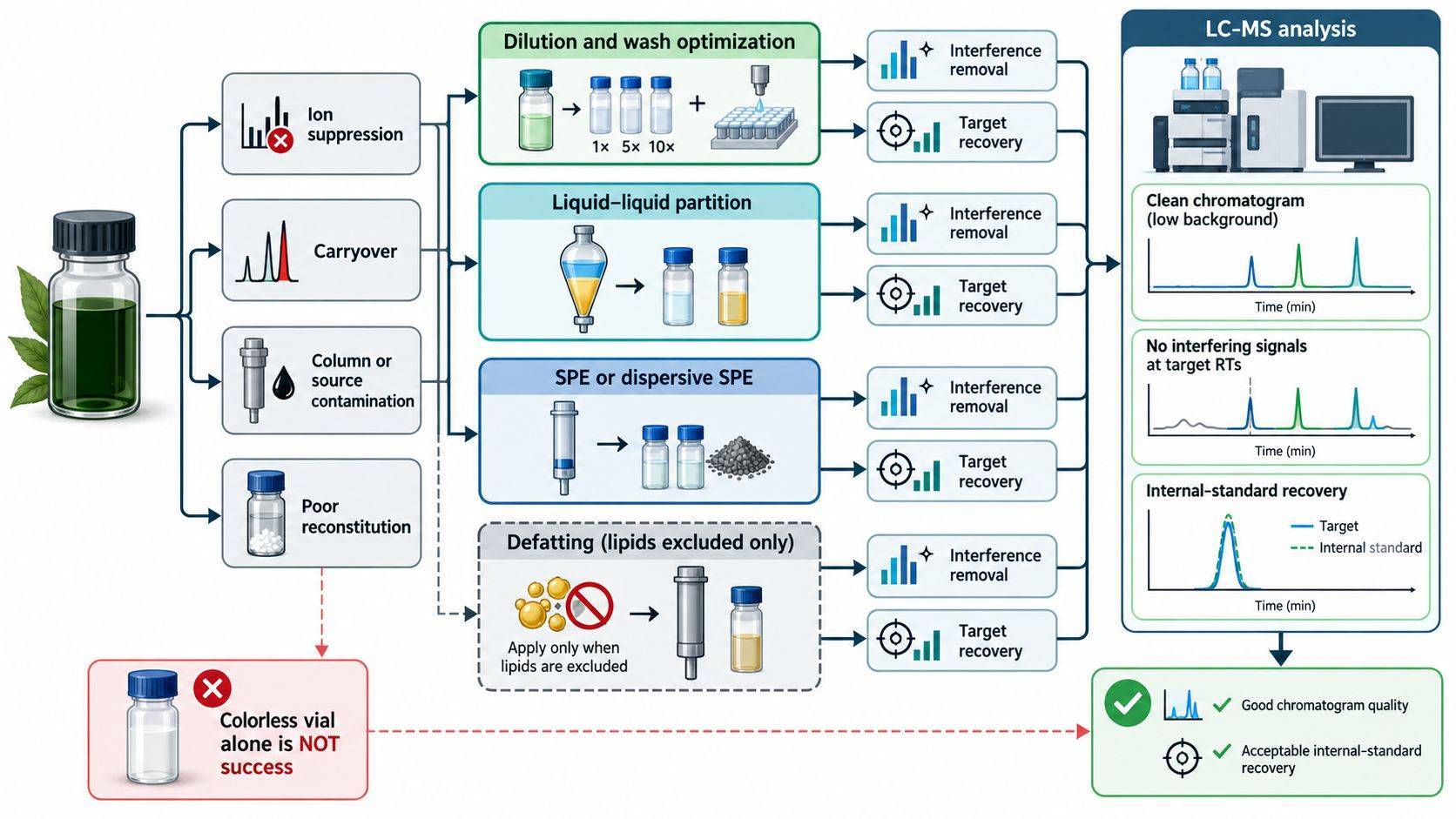 Figure 2. Cleanup is justified by a defined analytical failure, then evaluated for both interference removal and target retention. A colorless extract is not evidence of unbiased metabolite recovery.
Matrix-Specific Sample Preparation Qualification
A compact qualification study can prevent an unsuitable leaf protocol from being applied to fruit, seed, or woody tissue. Use a representative pooled matrix and include the biological extremes expected in the project. The test should compare only a limited set of variables at a time.
A useful sequence is:
- confirm cryogenic disruption and powder homogeneity;
- compare two or three solvent systems aligned to the target polarity;
- test the selected solvent-to-tissue ratio over the planned input range;
- compare immediate and delayed extraction to identify oxidation-sensitive features;
- evaluate a cleanup step only if dilution, chromatography, and wash conditions do not control the matrix problem;
- measure pre- and post-cleanup recovery for authentic or class-representative standards;
- assess pooled-QC precision, blank contribution, carryover, and dilution linearity;
- perform short-term extract stability testing under the intended autosampler conditions.
Method selection should balance target recovery, number of reproducible features, matrix effect, carryover, and sample throughput. The condition producing the largest feature count may also generate the most artifacts or missing values. Conversely, aggressive cleanup may improve precision by narrowing the measurable metabolome. The final scope should state which classes are well recovered and which are deliberately excluded.
Plant Metabolomics Sample Preparation Reporting Requirements
Plant metabolomics methods are difficult to reproduce when they report only "metabolites were extracted with methanol." A complete record should include tissue state and mass, milling procedure, particle-size handling, solvent composition and temperature, solvent-to-mass ratio, internal standards, mixing and sonication conditions, centrifugation, cleanup sorbent or partition, drying and reconstitution, storage time, and autosampler temperature.
The report should also distinguish:
- soluble metabolites from hydrolysis-released or bound pools;
- native pigments from pigment-removal fractions;
- target recovery from visual decolorization;
- extraction recovery from matrix effect;
- confirmed metabolites from library or accurate-mass annotations;
- biological normalization from LC-MS signal correction.
Plant sample preparation must preserve the intended analyte classes while limiting post-harvest conversion and matrix effects. The selected procedure should be qualified in the relevant matrix using recovery, process-blank, matrix-effect, and repeatability data. Visual decolorization alone is not a method-performance criterion.
References
- De Vos RCH, et al. LC-MS Metabolic Profiling of Arabidopsis thaliana Plant Leaves and Cell Cultures: Optimization of Pre-LC-MS Procedure Parameters. J Chromatogr B. 2008;871(1):37-43. https://doi.org/10.1016/j.jchromb.2008.06.039
- Doppler M, et al. Towards a Broader View of the Metabolome: Untargeted Profiling of Soluble and Bound Polyphenols in Plants. Anal Bioanal Chem. 2022;414:7421-7433. https://doi.org/10.1007/s00216-022-04134-z
- Sauerschnig C, Doppler M, Bueschl C, Schuhmacher R. Methanol Generates Numerous Artifacts during Sample Extraction and Storage of Extracts in Metabolomics Research. Metabolites. 2018;8(1):1. https://doi.org/10.3390/metabo8010001
- Kim SB, Bisson J, Friesen JB, Pauli GF, Simmler C. Selective Chlorophyll Removal Method to "Degreen" Botanical Extracts. J Nat Prod. 2020;83(6):1846-1858. https://doi.org/10.1021/acs.jnatprod.0c00005
- Pérez de Souza L, et al. Mass Spectrometry-Based Untargeted Plant Metabolomics. Curr Protoc Plant Biol. 2019;4:e20100. https://doi.org/10.1002/cppb.20100
- Kim L, et al. Simple Extraction Methods That Prevent the Artifactual Conversion of Chlorophyll to Chlorophyllide during Pigment Isolation from Leaf Samples. Plant Methods. 2013;9:19. https://doi.org/10.1186/1746-4811-9-19
- Souza LP, et al. A Metabolomic Platform to Identify and Quantify Polyphenols in Coffee and Related Species Using Liquid Chromatography Mass Spectrometry. Front Plant Sci. 2022;13:1057645. https://doi.org/10.3389/fpls.2022.1057645

 Contact Us


