

Chiral Amino Acid Quantification: Direct vs Derivatization Methods for D/L Enantiomers
Submit Your InquiryChiral amino acid quantification requires enantiomer-specific separation before detection because D- and L-amino acids have the same nominal mass and nearly identical non-chiral chemical behavior. Direct chiral LC is attractive for focused panels with compatible stationary-phase selectivity, while chiral derivatization is often preferable when trace D-enantiomers must be resolved from abundant L-forms across a broader panel or complex matrix.
Chiral Amino Acid Method Selection at a Glance
- Choose direct chiral separation when the target panel is small, standards demonstrate adequate enantiomeric resolution, and minimizing reaction-dependent variability is a priority.
- Choose chiral derivatization when sensitivity, reversed-phase compatibility, or multi-analyte D/L coverage is more important than minimizing sample-preparation steps.
- Do not select a method from instrument availability alone; define the amino acids, expected D:L abundance range, matrix, quantification level, and cohort size first.
- Validate each D- and L-enantiomer independently because a low-abundance D peak can be distorted by incomplete resolution, L-enantiomer tailing, carryover, or reagent-derived interference.
- For large studies, lock derivatization performance, enantiomeric resolution, calibration ranges, pooled QC, blank strategy, and batch randomization before analyzing study samples.
Why D/L Amino Acid Quantification Is Analytically Difficult
Standard amino acid assays can quantify total serine, alanine, aspartate, or other amino acids without determining configuration. That is insufficient when the research question concerns a D-enantiomer or a D:L ratio. Enantiomers share the same molecular formula and mass transitions, so tandem mass spectrometry cannot distinguish them unless the analytical workflow first introduces a chiral recognition step.
The concentration imbalance is often the larger problem. In many biological matrices, proteinogenic L-amino acids are abundant while the corresponding D-enantiomers occur one or two orders of magnitude lower. A small unresolved portion of the L peak can therefore appear larger than the true D signal. Reviews of D-amino acid bioanalysis identify this combination of trace D abundance, complex matrix, and limited peak capacity as a central quantitative challenge (Szökő et al., 2016).
Selectivity must also extend beyond the D/L pair. Leucine, isoleucine, allo-isomers, structural isomers, in-source fragments, and matrix components can create additional interferences. A chromatogram that visually shows two peaks is not automatically suitable for quantification. The method must demonstrate retention-time identity, adequate resolution at the relevant concentration ratio, suitable qualifier evidence where applicable, and negligible interference in the actual matrix.
Sample history matters. Free D-amino acid profiling is different from measuring amino acid stereochemistry after protein or peptide hydrolysis. Hydrolysis, prolonged exposure to extreme pH, heat, or uncontrolled processing can cause racemization and inflate the apparent D fraction. The project plan must state whether the analytes are endogenous free amino acids, released amino acids after hydrolysis, or D/L composition in a product. These are separate analytical claims and require different controls.
Direct Chiral Separation for D/L Amino Acid Analysis
Direct chiral analysis uses a chiral stationary phase or a chiral selector in the separation system so that native amino acid enantiomers interact differently and elute at distinct retention times. Chiral crown ether, macrocyclic glycopeptide, ligand-exchange, zwitterionic ion-exchange, and other selector chemistries have been applied to amino acids. The appropriate selector depends on amino-acid structure, mobile-phase compatibility, sample matrix, and detector requirements (Carenzi et al., 2020).
Its main advantage is the absence of a chiral derivatization reaction. This removes variation caused by reagent addition, reaction completion, derivative stability, and reagent optical purity. Direct analysis can also simplify traceability because the measured species remains the native amino acid. For a focused panel in which the selected stationary phase provides adequate separation, this can support a clean and defensible targeted assay.
Limitations of Direct Chiral Separation
The limitation is panel breadth. A single chiral phase may resolve some D/L pairs well and others poorly. Native amino acids are highly polar and can be difficult to retain and ionize consistently under one set of conditions.
Complex matrices also place demands on chemical selectivity beyond enantioselectivity. As a result, direct methods may require orthogonal separation, two-dimensional LC, or separate methods for different analyte groups when broad coverage is required (Szökő et al., 2016).
Direct separation should therefore be demonstrated under the expected D:L ratio, not only with a 1:1 racemic standard. A method that separates equal peaks may fail when the L-enantiomer is hundreds of times more abundant. Evaluate the low D calibrator beside the expected high L concentration and inspect peak tailing, integration boundaries, carryover, and matrix effects.
Choose direct chiral LC if the project targets a limited set of amino acids, the chiral phase resolves each target at the expected abundance ratio, and avoiding derivatization variability is the main priority. Choose another strategy if broad panel coverage or trace-D sensitivity cannot be achieved without multiple columns or unresolved interference.
Chiral Derivatization LC-MS/MS for D/L Enantiomers
Indirect chiral analysis reacts the amino acid with an optically pure chiral reagent. The D- and L-enantiomers form diastereomeric derivatives, which differ in ordinary chromatographic behavior and can often be separated on conventional reversed-phase LC. Reagents related to Marfey’s chemistry, including FDAA and FDLA, as well as other chiral tags, have been used to increase retention, selectivity, and MS response.
Derivatization can support wider panels because the same chiral tag creates a shared separation principle across many amino acids. A Marfey’s-reagent LC-MS/MS method resolved and quantified the common proteinogenic D/L stereoisomers in a complex bacterial extract, although reaction rates differed among amino acids and some targets required longer reaction completion (Ayon et al., 2019). FDLA-based approaches have also quantified selected D- and L-amino acids in complex tissue extracts (Ishii et al., 2021).
The extra sensitivity can be decisive when a trace D-enantiomer sits beside a large L pool. Derivatives may show better reversed-phase retention and ionization than native amino acids. The method can also exploit analyte-specific fragments and derivative retention to strengthen selectivity. In one validated application, D-enantiomers were quantified over ranges distinct from the more abundant L-enantiomers, illustrating why separate calibration design is often necessary (Li et al., 2015).
Derivatization introduces new error sources. Reaction yield may depend on amino-acid side chain, reagent excess, pH, water content, temperature, and sample matrix. Some amino acids can form multiple products. The reagent itself must have controlled enantiomeric purity because an optical impurity can create an apparent opposite-enantiomer signal. The workflow also needs evidence that derivatives remain stable through the analytical sequence.
For quantitative work, the reaction should be treated as part of the assay rather than as a generic sample-preparation step. Include derivatized calibration standards, reaction blanks, low-level D controls in high-L background, and pooled matrix QC. Where feasible, use stable-isotope-labelled internal standards that experience extraction and derivatization with the sample. If equivalent labelled standards are unavailable for every analyte, document which correction strategy applies to each compound.
Choose chiral derivatization if broad D/L coverage, sensitivity, or conventional reversed-phase compatibility is the main need and the reaction can be controlled across all batches. Choose direct separation if a focused native-analyte assay already provides sufficient resolution and the extra reaction would add more variability than value.
Direct Chiral LC vs Derivatization: Side-by-Side Comparison
| Decision criterion | Direct chiral separation | Chiral derivatization |
|---|---|---|
| Chiral recognition | Chiral stationary phase or selector | Optically pure reagent forms diastereomers |
| Sample preparation | Fewer reaction steps | Additional controlled reaction and cleanup |
| Panel breadth | Often selector-dependent and target-specific | Can support broader multi-amino-acid panels |
| Trace D beside abundant L | Strong when peak shape and resolution are validated | Often benefits from improved retention and sensitivity |
| Quantitative risks | Co-elution, limited chemical selectivity, column-dependent performance | Reaction yield, reagent purity, multiple products, derivative stability |
| Conventional RP-LC compatibility | Not inherent | Frequently compatible after tagging |
| Large-cohort control point | Column performance and retention selectivity | Reaction performance plus chromatography |
| Best-fit project | Focused panel with proven direct resolution | Broad or sensitivity-limited D/L panel in complex samples |
The choice is not a contest between a “simple” and a “complex” method. It is a risk allocation decision. Direct separation places more of the analytical burden on the stationary phase and chromatographic selectivity. Derivatization shifts part of that burden to reaction reproducibility and reagent control while often improving retention and detectability.
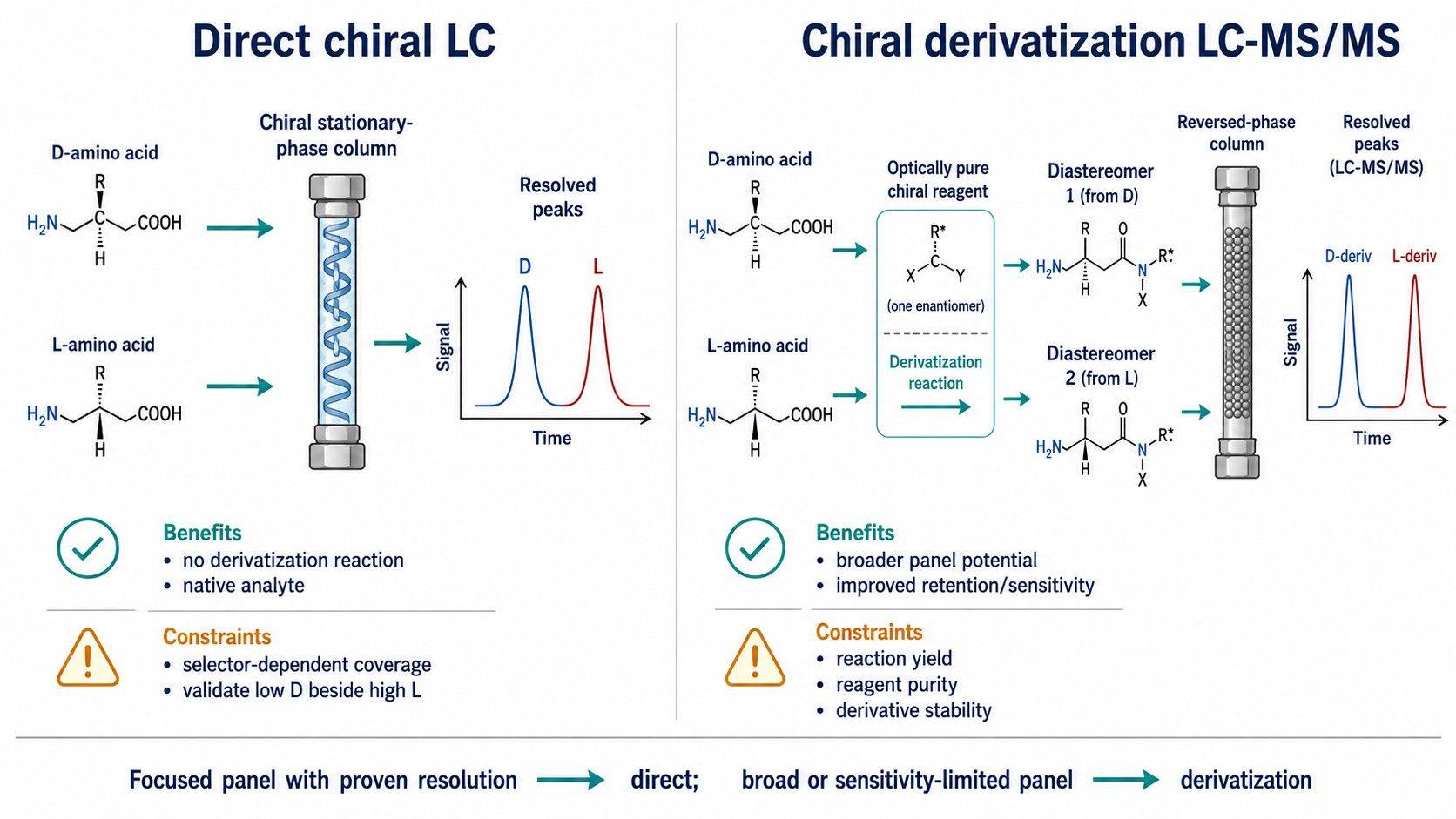 Direct chiral LC concentrates risk in stationary-phase selectivity, while chiral derivatization trades an added reaction for broader separation and sensitivity options.
Matching the Method to the Sample Matrix and Study Objective
Plasma, serum, urine, tissue, cells, microbial extracts, fermentation media, food matrices, and formulated products present different concentration ranges and interference patterns. A method validated in a neat standard or tablet cannot be assumed to quantify trace D-amino acids in tissue or culture supernatant. Matrix-specific recovery, suppression or enhancement, background peaks, and stability must be evaluated.
For endogenous free amino acids, rapid and consistent sample handling helps preserve the original pool. For culture media or fermentation samples, media blanks distinguish supplied amino acids from produced or consumed forms. For food or product matrices, extraction recovery and any processing-related racemization may be central. For hydrolysed proteins or peptides, the method must separate true composition from racemization introduced during hydrolysis.
Panel definition should be explicit. “D-amino acid analysis” may mean one target such as D-serine, a small mechanistic panel, or nearly all proteinogenic D/L pairs. A focused assay can optimise separation and sensitivity around one or several targets. A broad panel requires acceptance criteria for every pair and may need a tiered report when some D-enantiomers remain below quantification limits.
Creative Proteomics provides targeted amino acid analysis for quantitative amino-acid projects. For a chiral study, the inquiry should identify the required D/L pairs, matrix, sample amount, expected concentration range, whether absolute quantification is needed, and whether the project includes free amino acids or hydrolysed material.
QC Design for Large D/L Amino Acid Cohorts
Large cohorts amplify small method drifts. For direct chiral LC, gradual retention or peak-shape changes can alter the apparent D contribution beside a large L peak. For derivatization, reagent preparation, reaction timing, and batch-specific matrix effects can shift response. A cohort plan should therefore monitor enantiomeric selectivity and quantitative performance, not only total instrument signal.
Use independent calibrators for D- and L-enantiomers and ensure that their ranges reflect expected abundance. A single shared range can underrepresent trace D values or saturate the L response. Include a low-D/high-L challenge QC to test whether the minority enantiomer remains quantifiable under realistic imbalance. Add solvent blanks and matrix blanks to monitor carryover and reagent background.
Pooled study QC should be prepared from representative matrices and distributed throughout the sequence. Track retention time, D/L resolution, internal-standard response, calibration back-calculation, blank contamination, and analyte-specific precision. Randomize study groups across preparation and acquisition batches, and include bridge QCs when the project spans multiple batches. The large-cohort metabolomics QC guide describes the broader batch and drift controls that should accompany analyte-specific chiral checks.
| QC element | Failure it detects | Recommended interpretation |
|---|---|---|
| D and L calibrators | Incorrect response model or range | Accept each enantiomer independently |
| Low-D/high-L resolution QC | False D signal from L tailing | Verify minority-enantiomer selectivity |
| Derivatization reaction QC | Incomplete or variable tagging | Monitor derivative yield and internal-standard recovery |
| Reagent and process blank | Chiral reagent or preparation artefact | Exclude contaminated features or batches |
| Pooled matrix QC | Drift and matrix-dependent imprecision | Assess analyte-level reproducibility across sequence |
| Carryover blank | High-L or high-D residue | Protect low-level samples following high standards |
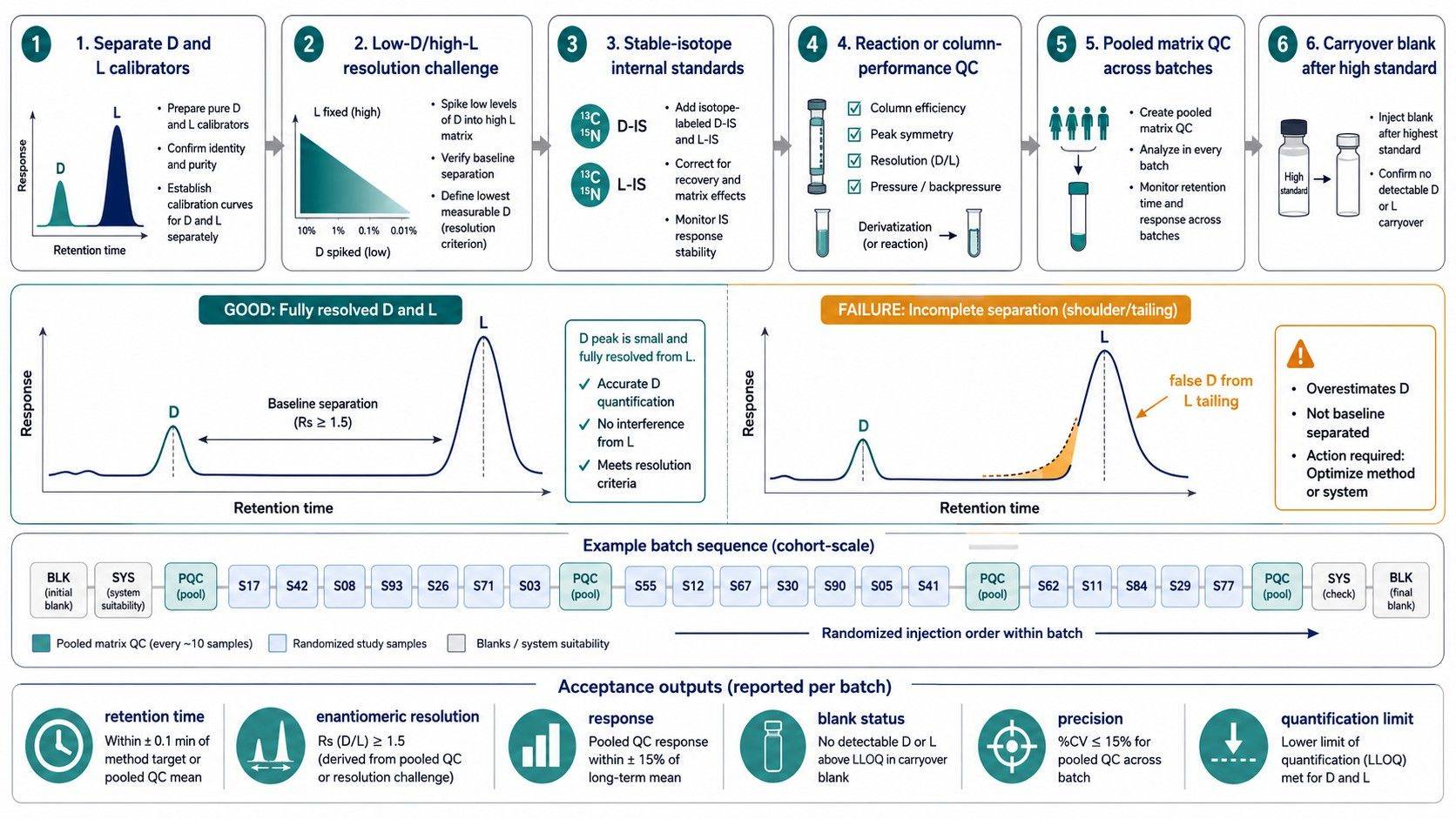 Cohort-scale chiral amino acid analysis requires controls that challenge minority D-enantiomer quantification in the presence of abundant L forms.
Common Interpretation and Reporting Mistakes
Do not report a D:L ratio when the D value is below a validated quantification limit. A numerical ratio can look precise even when the numerator is driven by noise or unresolved L tailing. Report the D and L concentrations, quantification status, and ratio calculation rule together.
Do not treat derivatized and underivatized results as automatically interchangeable. Different methods can show different recovery, selectivity, and interference. Do not infer biological racemization from a processed or hydrolysed sample without a process control. Finally, do not describe a broad “D-amino acid panel” unless each listed D/L pair has demonstrated identity, resolution, and quantitative performance in the relevant matrix.
How Creative Proteomics Supports Chiral Amino Acid Quantification
Creative Proteomics can evaluate the target D/L pairs, sample matrix, expected abundance ratio, cohort size, and quantification objective before selecting direct chiral separation or a derivatization LC-MS/MS strategy. The targeted metabolomics analysis workflow can be adapted with enantiomer-specific calibration, matrix QC, and batch controls.
For feasibility review, provide the amino-acid list, sample type, available sample amount, anticipated D and L concentration ranges, number of samples, and whether the desired output is absolute concentration, relative comparison, or D:L ratio. These details determine whether a focused direct method or a derivatized multi-analyte panel offers the more defensible result.
Frequently Asked Questions
Can LC-MS/MS distinguish D- and L-amino acids without chromatographic separation?
Not by mass transition alone, because enantiomers have the same molecular formula and fragmentation can be identical in an achiral environment. The workflow needs direct chiral recognition or conversion to separable diastereomeric derivatives before MS detection.
When is direct chiral LC better than derivatization?
Direct chiral LC is a strong choice for a focused panel when the stationary phase provides adequate resolution at the expected D:L ratio. It avoids reaction-dependent variability and measures the native amino acid, but every target must be validated in the intended matrix.
Why use chiral derivatization for D-amino acid analysis?
Chiral derivatization can improve reversed-phase retention, sensitivity, and multi-analyte separation by converting enantiomers into diastereomers. It is especially useful when trace D-enantiomers must be quantified beside abundant L-forms, provided reaction yield and reagent purity are controlled.
Do I need separate calibration curves for D- and L-amino acids?
Separate calibration behavior and ranges are often appropriate because D- and L-enantiomers may occur at very different concentrations. Each enantiomer should meet its own identity, linearity, accuracy, precision, and quantification-limit criteria.
Can a D:L ratio be reported if the D-amino acid is below the quantification limit?
A quantitative D:L ratio should not be reported when the D value is not reliably quantifiable. Report the D result as below the validated limit and state the ratio rule rather than converting noise into a numerical ratio.
What information is needed before starting a large chiral amino acid project?
Provide the target D/L pairs, matrix, sample amount, expected concentration range, cohort size, free-versus-hydrolysed analyte definition, and desired quantitative output. These inputs determine method choice, calibration design, internal standards, and batch QC.
References
- Szökő, É., Vincze, I., & Tábi, T. (2016). Chiral separations for D-amino acid analysis in biological samples. Journal of Pharmaceutical and Biomedical Analysis, 130, 100–109. https://doi.org/10.1016/j.jpba.2016.06.054
- Carenzi, G., Sacchi, S., Abbondi, M., & Pollegioni, L. (2020). Direct chromatographic methods for enantioresolution of amino acids: Recent developments. Amino Acids, 52, 849–862. https://doi.org/10.1007/s00726-020-02873-w
- Ayon, N. J., Sharma, A. D., & Gutheil, W. G. (2019). LC-MS/MS-based separation and quantification of Marfey’s reagent derivatized proteinogenic amino acid D/L-stereoisomers. Journal of the American Society for Mass Spectrometry, 30, 448–458. https://doi.org/10.1007/s13361-018-2093-9
- Li, X., Cui, Y., Xing, Y., Lv, C., Li, Q., & Bi, K. (2015). Simultaneous quantitation of nine kinds of D- and L-amino acid enantiomers by HPLC-MS/MS: Application to the quality control of amino acid tablets. Analytical Methods, 7, 8817–8825. https://doi.org/10.1039/C5AY01551K
- Xie, C., Chen, Y., Wang, X., et al. (2022). Chiral derivatization-enabled discrimination and on-tissue detection of proteinogenic amino acids by ion mobility mass spectrometry. Chemical Science, 13, 14114–14123. https://doi.org/10.1039/D2SC03604E
- Koga, R., et al. (2021). Simultaneous measurement of amino acid enantiomers in aged mouse brain samples by LC/MS/MS combined with derivatization using Nα-(5-fluoro-2,4-dinitrophenyl)-L-leucinamide. Metabolites, 11(1), 57. PMID: 33467775
- Weatherly, C. A., Du, S., Parpia, C., Santos, P. T., Hartman, A. L., & Armstrong, D. W. (2017). D-Amino acid levels in perfused mouse brain tissue and blood: A comparative study. ACS Chemical Neuroscience, 8, 1251–1261. https://doi.org/10.1021/acschemneuro.6b00398
Author: CAIMEI LI, Senior Scientist

 Contact Us


