

Microbial Metabolomics Study Design: Growth Phase, Quenching, and Sample Fractions
Submit Your InquiryMicrobial metabolomics studies should define the physiological growth stage, stop metabolism rapidly at collection, and preserve cell-associated and culture-supernatant fractions separately when the question involves both intracellular state and nutrient exchange. These choices determine whether an observed metabolite change can be interpreted as altered cellular metabolism, secretion, uptake, or a handling artefact.
Microbial Metabolomics Study Design at a Glance
- Growth phase is an experimental variable, not merely a culture-recording detail. Compare cultures at the same predefined physiological state, using a growth curve and an agreed normalization measure.
- Cell pellets report the intracellular metabolome after validated quenching and washing; clarified culture supernatant reports the extracellular metabolome or metabolic footprint.
- A single whole-broth sample is useful for some broad screens, but it cannot independently resolve changes in biomass-associated and medium-associated pools.
- Quenching must be assessed for the organism and intended metabolite classes because cold-solvent approaches can produce intracellular leakage in some organisms.
- Include biological replicates, process blanks, medium blanks, pooled QC material, and a documented time-from-sampling-to-quench for every batch.
Why Growth Phase Defines the Meaning of a Microbial Metabolomics Result
Microbial metabolite pools are coupled to growth rate, substrate availability, oxygen transfer, pH, and population density. The same strain can therefore show different intracellular and extracellular profiles in lag, exponential, transition, stationary, or nutrient-limited states. A comparison between two conditions is interpretable only when sampling is anchored to a shared biological reference point rather than to a convenient clock time (Boness et al., 2023; Patejko et al., 2017).
Match Sampling to the Growth Phase
For batch culture studies, the most practical anchor is usually a predefined region of the growth curve. This may be a target optical density, cell count, dry-cell weight, or a combination of these measures. The selected anchor should be justified by the study question.
For example, a perturbation intended to alter central carbon metabolism is commonly evaluated during balanced exponential growth, when biomass accumulation and substrate consumption are changing predictably. A study of overflow products, stress adaptation, sporulation-associated metabolism, or secondary-metabolite production may instead require one or more transition or stationary-phase collections.
Time-Matched vs Physiology-Matched Sampling
The essential design rule is to distinguish time matched from physiology matched sampling. Two cultures harvested after the same number of hours can be at different stages if the perturbation changes growth rate. Conversely, cultures sampled at the same optical-density window may still require interpretation alongside pH, dissolved oxygen, substrate concentration, or morphology.
The appropriate choice depends on the hypothesis: if the question is “What is the metabolic consequence at equal elapsed process time?”, time matching is appropriate; if it is “How does the perturbation alter metabolism at comparable biomass state?”, use physiology-matched sampling.
Growth curves should be generated before the analytical study rather than inferred after sample collection. A pilot should establish the collection window, required culture volume, and whether the organism forms clumps, biofilms, filaments, or other structures that make OD alone unreliable. For filamentous cyanobacteria and unicellular cyanobacteria, different collection strategies can yield reproducible data, but the harvesting method remains a major source of between-sample variation (Krall et al., 2009).
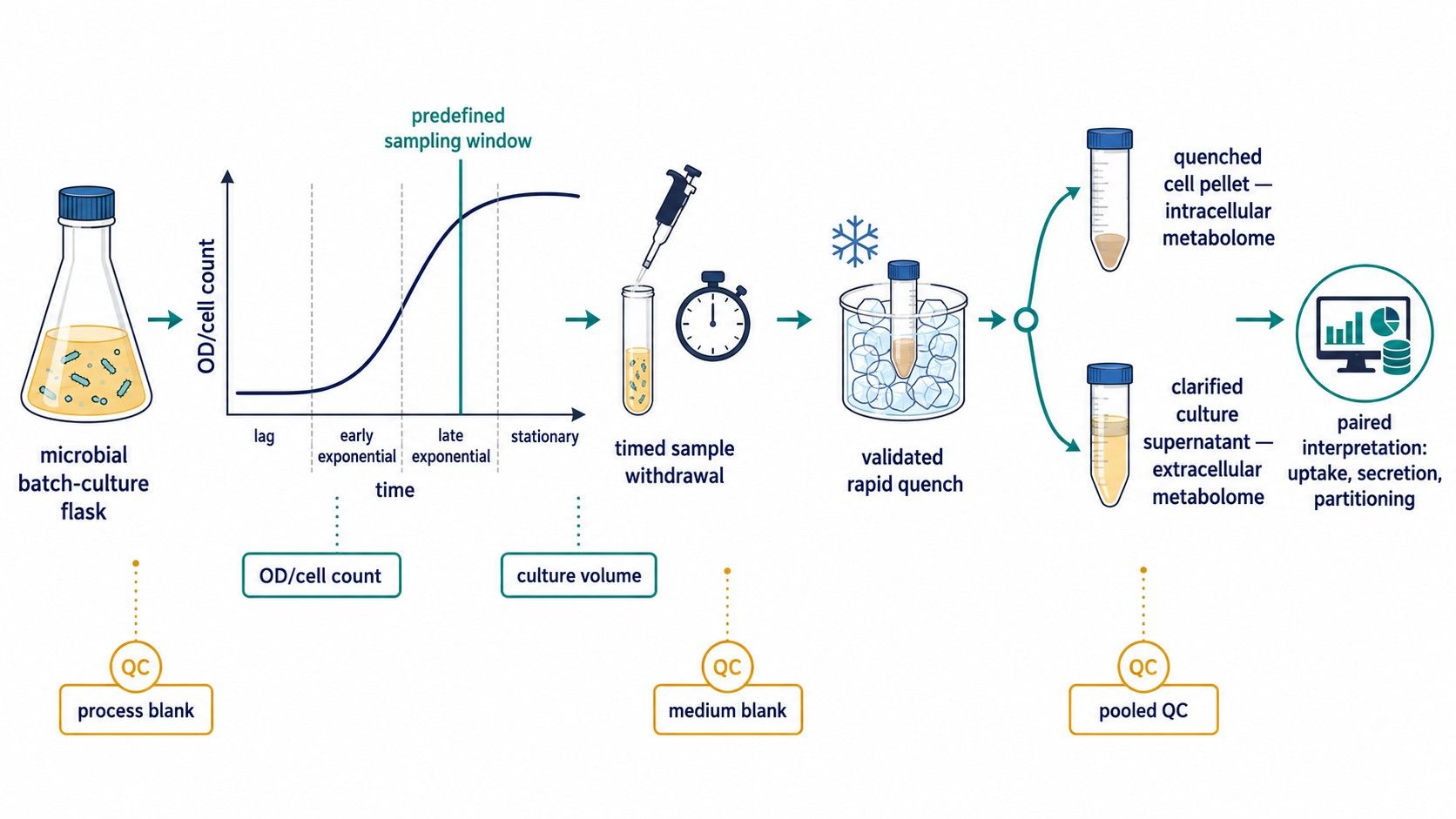 A microbial metabolomics study design links a defined growth-phase window with validated quenching and matched intracellular and extracellular sample fractions.
A Practical Growth-Phase Sampling Plan
Record inoculum source, medium formulation, inoculation density, vessel geometry, temperature, agitation or aeration, and any feed or induction event. Plot at least one relevant biomass measure across the anticipated collection period. Define a narrow sampling window before the experiment—for example, a target OD or dry-cell-mass range—and apply it across biological replicates.
Use more than one time point when the scientific claim concerns a trajectory rather than an endpoint. A minimum design might include an early exponential collection, a late exponential collection, and a transition or stationary collection.
This reveals whether an apparent condition effect is persistent, phase specific, or caused by a shifted growth curve. If you need to compare metabolic states at one defined physiological stage, choose one tightly controlled window and invest the saved analytical capacity in replication.
Should You Analyze the Cell Pellet, Culture Supernatant, or Both?
The cell pellet and the culture supernatant answer related but non-interchangeable questions. The intracellular fraction approximates the cellular metabolite pool at the moment metabolism is arrested. The extracellular fraction measures compounds remaining in, consumed from, released into, or transformed within the medium. Reviews of microbial sample preparation consistently treat intracellular and extracellular workflows as separate pre-analytical problems (Patejko et al., 2017; Boness et al., 2023).
| Study question | Recommended fraction | Interpretation enabled | Essential comparison |
|---|---|---|---|
| Which pathways are altered inside cells? | Quenched cell pellet | Intracellular pool differences | Biomass-normalized intracellular profile |
| Which nutrients are depleted or products accumulated? | Clarified culture supernatant | Uptake, secretion, or extracellular conversion | Matched un-inoculated medium blank |
| Is a compound redistributed between cells and medium? | Both fractions, collected from the same culture | Cell-associated versus extracellular partitioning | Matched pellet, supernatant, and medium blank |
| Is the total culture composition changing? | Whole broth, optionally with separate fractions | Broad system-level change | Whole-broth mass balance and fraction-specific follow-up |
Choose the cell pellet when the endpoint is intracellular pathway state, cofactor balance, stress response, or flux-proximal pool changes. In this workflow, the priority is to halt enzyme activity before substantial turnover, then separate cells from extracellular medium without introducing leakage. The pellet should not be interpreted as purely intracellular without a validation experiment; residual medium and analyte loss during washing are known risks.
Choose culture supernatant when the question concerns substrate depletion, product accumulation, secreted metabolites, cross-feeding candidates, or a metabolic footprint. The supernatant must be separated from cells promptly and compared with a medium blank subjected to the same incubation, handling, and extraction steps. Medium composition can otherwise dominate signals for amino acids, vitamins, salts, and other compounds supplied by the formulation.
Use paired fractions when you need to distinguish uptake from intracellular accumulation, or secretion from cell leakage. This is especially valuable for microbial co-culture, fermentation optimisation, antimicrobial-response research, and strain-engineering studies.
The paired design does not mean adding every possible fraction automatically. It means preserving the fractions that test the causal claim. If you need to know whether a metabolite is exported, choose both fractions; if you only need a culture-level product screen, a well-controlled supernatant workflow may be sufficient.
Decision rule: If your hypothesis concerns enzyme activity, intracellular regulation, or pathway bottlenecks, choose a quenched cell-pellet workflow. If it concerns nutrient consumption or released products, choose supernatant profiling with media blanks. If it concerns exchange between microbial cells and their environment, collect both fractions from the same culture and analyse them as a linked dataset.
How to Plan Quenching and Cell Separation for Microbial Metabolomics
Quenching is the rapid arrest of metabolic activity at sampling. It is not identical to extraction. A suitable quench should minimise continuing metabolism while also avoiding loss of intracellular metabolites into the surrounding solution. The balance is organism and analyte dependent because cell-envelope properties, metabolite turnover, and solvent tolerance differ across bacteria, yeasts, fungi, and photosynthetic microorganisms (Pinu et al., 2017; Boness et al., 2023).
Fast filtration, rapid centrifugation, and cold-solvent quenching are frequently used strategies. No single method should be treated as universally optimal. In a cyanobacterial GC–MS comparison, cold methanol–water quenching caused loss of metabolites from several compound classes, while fast filtration and centrifugation produced similar pool sizes under the tested conditions (Krall et al., 2009).
In yeast, quantitative assessment across whole broth, filtrate, cells, and quench/wash solutions has been used to identify leakage and assess whether a workflow preserves intracellular pools (Carnicer et al., 2012).
The study design should therefore validate the pre-analytical workflow before committing the full cohort. A small method pilot can compare candidate quenching and separation routes for recovery, repeatability, and evidence of leakage. Assess the panel relevant to the biological question rather than relying on one compound. High-turnover or energy-related metabolites may be more vulnerable to handling delay than stable endpoint metabolites.
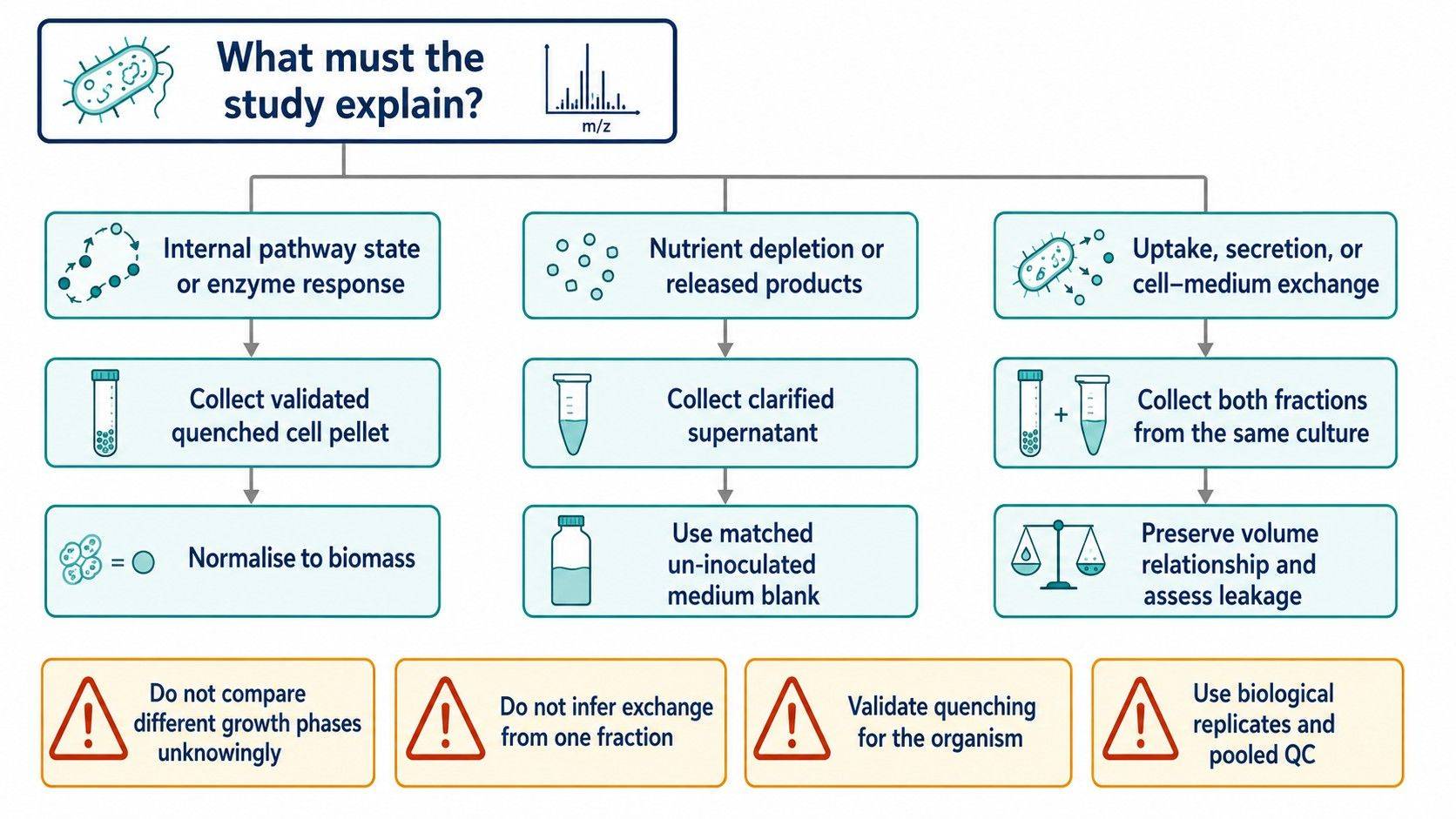 A decision framework for selecting cell-pellet, culture-supernatant, or paired fractions in microbial metabolomics studies.
Build a Quenching Validation Into the Pilot
For each candidate workflow, collect matched test cultures and track the interval from withdrawal to quench. Process an extracellular aliquot in parallel where feasible. Compare metabolite patterns in the cell-associated fraction, clarified medium, and any quench or wash fraction. A substantial increase of typically intracellular metabolites in the quench/wash fraction can indicate leakage, although interpretation should account for residual medium carryover.
Use a process blank to reveal contaminants introduced by solvents, filters, tubes, or extraction steps. Use a pooled QC sample made from representative study extracts to monitor analytical stability. Internal standards should be added at an appropriate, documented point in the preparation workflow so they can report on extraction and injection variation. For targeted experiments, isotope-labelled standards are particularly useful when they are available for the analytes of interest.
Match the Metabolomics Platform to the Study Question
The quenching method should be linked to the platform. Targeted LC–MS/MS may focus on a defined, chemically coherent panel and support relative or absolute quantification with suitable standards. Untargeted LC–HRMS is useful when the study seeks broad discovery, but it requires robust feature-QC, annotation confidence rules, and follow-up for key findings.
The analytical choice should follow the question, not the other way around. If you need concentration changes in a small set of known pathway intermediates, choose targeted analysis; if you need to identify unanticipated metabolic responses, choose untargeted profiling, then confirm priority metabolites in a targeted phase.
Sample Fractions, Normalization, and Controls for Interpretable Data
Normalization should be planned before cultures are grown. Intracellular results may be normalised to dry-cell weight, cell count, total protein, DNA, viable count, or a culture-volume basis, depending on the organism and biological interpretation. Supernatant data may be normalised to culture volume and interpreted with matched biomass information. There is no universally interchangeable denominator: changing cell size or viability can make one normalization appropriate and another misleading.
For a study comparing cell pellets across conditions, record both the harvested culture volume and the biomass measure used for normalization. For paired intracellular–extracellular experiments, retain the relation between the culture volume used for each fraction and do not pool fractions before analysis. This supports mass-balance reasoning and reduces the risk of calling a dilution difference a metabolic change.
Biological replication should reflect independently grown cultures, not repeated injections of one extract. Technical replicates are useful for monitoring analytical variance but cannot substitute for biological replicates. Randomise extraction and injection order where possible, and distribute experimental groups across analytical batches. Include pooled QC injections at regular intervals and assess feature-level precision before interpreting small fold changes.
| Control or record | Why it matters | When to include |
|---|---|---|
| Un-inoculated medium blank | Separates medium-derived signals from microbial uptake or secretion | Every supernatant or whole-broth study |
| Process blank | Detects contaminants from materials and solvents | Every extraction batch |
| Pooled QC | Tracks instrument and preparation stability | Every analytical sequence |
| Matched quench/wash fraction | Tests leakage and carryover during intracellular preparation | Pilot; repeat if organism or method changes |
| Growth curve and biomass measure | Anchors physiological comparability and normalization | Every study |
| Reference strain or bridge sample | Supports comparison across large batches | Multi-batch or longitudinal projects |
Common errors are preventable at the design stage. Sampling all cultures at the same clock time when their growth rates differ confounds growth stage with treatment. Measuring only the supernatant when the claim is intracellular regulation leaves the mechanism untested. Treating a pellet as an intracellular sample without evaluating wash and quench losses can convert leakage into a false secretion signal. Finally, omitting media blanks can make supplied medium components appear to be microbial products.
A Decision Framework for Microbial Metabolomics Study Design
Start with the scientific contrast. Define whether the goal is to compare strains, a perturbation, a culture condition, a time course, or a cell–environment exchange process. Next, select the physiological sampling anchor and determine whether the expected result is inside cells, outside cells, or across both compartments. Then validate a quenching/separation route using the relevant organism and metabolite classes.
- Define the biological event. State the strain, culture condition, and contrast in one sentence.
- Choose the sampling anchor. Use growth phase, biomass, process time, or a justified combination.
- Select fractions that test the claim. Preserve pellet, supernatant, or paired fractions according to the decision table.
- Pilot the pre-analytical workflow. Compare handling routes for repeatability and leakage risk.
- Lock the normalization and QC plan. Specify the denominator, blanks, QCs, randomisation, and batch strategy before the main experiment.
- Choose targeted or untargeted measurement. Match platform coverage and quantification needs to the question.
This framework is deliberately conditional. If you are comparing internal pathway pools at equivalent biomass, sample a validated quenched pellet at a controlled growth stage. If you are tracking substrate consumption and secreted products, prioritise clarified supernatant with matched media blanks. If your interpretation requires both sides of the cell boundary, collect matched pellet and supernatant fractions rather than attempting to infer exchange from either fraction alone.
How Creative Proteomics Supports Microbial Metabolomics Study Design
Creative Proteomics can help align microbial culture design, sample-fraction selection, and targeted or untargeted analytical strategy with the study objective. Explore our microbial metabolomics service for microbial-targeted and untargeted projects, and refer to the metabolomics sample guidance when planning collection, storage, and submission.
For studies that connect microbial metabolism with community composition, the integrative metabolome and microbiome analysis service can provide a coordinated multi-omics study framework. Contact our scientific team to discuss organism type, culture conditions, target fractions, and the analytical question before collection.
Frequently Asked Questions
How do I decide which microbial growth phase to sample for metabolomics?
Select the phase that represents the biological process you need to compare, then confirm it with a growth curve and biomass measurement. Use exponential phase for many pathway-state comparisons, and include transition or stationary points when the question concerns stress adaptation, nutrient limitation, or secondary metabolism.
Can I collect a cell pellet and culture supernatant from the same microbial culture?
Yes. Paired collection is the appropriate design when you need to separate intracellular changes from nutrient uptake, secretion, or extracellular conversion. Keep the culture-volume relationship documented and include an un-inoculated medium blank processed in parallel.
Is cold methanol quenching suitable for every microorganism?
No. Cold-solvent quenching is widely used, but its performance depends on the organism, cell envelope, target metabolites, and downstream method. Validate it with a small pilot that examines repeatability and possible metabolite leakage before applying it to the full cohort.
Should I analyze whole broth instead of separating cells and supernatant?
Whole broth can be useful for broad culture-level screening, but it cannot independently assign a metabolite change to the cellular or extracellular compartment. If compartment-specific interpretation is important, collect separate fractions from the same culture.
What is the most important blank for microbial supernatant metabolomics?
An un-inoculated medium blank matched to the culture formulation and handling is essential. It helps distinguish compounds supplied by the medium from metabolites consumed, released, or transformed during culture.
How many replicates should a microbial metabolomics study include?
Use independent biological cultures as the primary replicates, with the number guided by expected effect size, variability, and the intended statistical comparison. Add technical replicates and pooled QC material to monitor analytical performance, but do not treat them as replacements for independent cultures.
References
- Boness, V. M., de Sá, H. C., Dos Santos, E. K. P., & Canuto, G. A. B. (2023). Sample preparation in microbial metabolomics: Advances and challenges. Advances in Experimental Medicine and Biology, 1439, 149–183. https://doi.org/10.1007/978-3-031-41741-2_7
- Patejko, M., Jacyna, J., & Markuszewski, M. J. (2017). Sample preparation procedures utilized in microbial metabolomics: An overview. Journal of Chromatography B, 1043, 150–157. https://doi.org/10.1016/j.jchromb.2016.09.029
- Pinu, F. R., Villas-Boas, S. G., & Aggio, R. (2017). Analysis of intracellular metabolites from microorganisms: Quenching and extraction protocols. Metabolites, 7(4), 53. https://doi.org/10.3390/metabo7040053
- Carnicer, M., Canelas, A. B., ten Pierick, A., Zeng, Z., van Dam, J., Albiol, J., Ferrer, P., Heijnen, J. J., & van Gulik, W. (2012). Development of quantitative metabolomics for Pichia pastoris. Metabolomics, 8, 284–298. https://doi.org/10.1007/s11306-011-0308-1
- Krall, L., Huege, J., Catchpole, G., Steinhauser, D., & Willmitzer, L. (2009). Assessment of sampling strategies for gas chromatography-mass spectrometry based metabolomics of cyanobacteria. Journal of Chromatography B, 877(27), 2952–2960. https://doi.org/10.1016/j.jchromb.2009.07.006
- Ye, D., Li, X., Wang, C., Liu, S., Zhao, L., Du, J., Xu, J., Li, J., Tian, L., & Xia, X. (2021). Improved sample preparation for untargeted metabolomics profiling of Escherichia coli. Microbiology Spectrum, 9(2), e00625-21. https://doi.org/10.1128/Spectrum.00625-21
- Maharjan, R. P., & Ferenci, T. (2003). Global metabolite analysis: The influence of extraction methodology on metabolome profiles of Escherichia coli. Analytical Biochemistry, 313(1), 145–154. https://doi.org/10.1016/S0003-2697(02)00536-5

 Contact Us


