

How to Select and Validate a Targeted LC-MS/MS Method for a New Analyte–Matrix Pair
Submit Your InquiryA researcher who has identified a specific compound of interest and needs to measure it in a sample that no commercial kit covers faces a practical question: can the published method be transferred directly, or does the new combination of analyte and matrix require method development? The answer determines project scope, timeline, and whether the data will be reliable.
This guide walks through the decisions involved in establishing a targeted LC-MS/MS method for a new analyte–matrix pair: assessing whether an existing method transfers, matching compound chemistry to separation and detection strategy, designing sample preparation, selecting calibration and internal standards, evaluating matrix effects, and defining fit-for-purpose qualification before committing to full method development.
What Makes an Analyte–Matrix Pair "New"?
An analyte–matrix pair is considered new when the combination has not been previously validated in the testing laboratory. Three scenarios commonly arise: the target compound has been measured before in the same matrix using a published method that needs to be transferred; the compound is well-characterized but has never been analyzed in the specific sample type; or both the compound and matrix are untested, with no established extraction or detection protocol.
| Scenario | Method Maturity | Expected Development Scope |
|---|---|---|
| Published method exists for same analyte and matrix | Method transfer and verification | Lower; instrumentation and matrix differences are the main variables |
| Known analyte, new matrix type | Extraction optimization and matrix qualification | Moderate; extraction, clean-up, and matrix effects require focused evaluation |
| New analyte, new matrix, no published method | De novo method development | Higher; all stages from extraction to detection must be established |
Can a Published Method Be Transferred Directly?
A published LC-MS/MS method provides a starting point, but direct transfer is rarely seamless. Instrument platforms differ in ion source geometry, collision cell design, and detector sensitivity — a method optimized on one manufacturer's triple quadrupole may produce different sensitivity and selectivity on another. Chromatographic columns with nominally identical bonded phases can show different selectivity due to silica type, particle morphology, and bonding density. The sample matrix described in the publication may differ from the actual sample in protein content, lipid load, salt concentration, and the presence of formulation excipients or preservatives not mentioned in the methods section.
The calibration approach from the original publication also matters. A method developed with solvent-based calibration may perform differently when applied to a complex biological or food matrix without re-evaluation. Published limits of detection should be treated as instrument-specific estimates rather than guarantees for a different laboratory setup.
Start with the Chemistry of the Target Analyte
The physical and chemical properties of the target compound determine the most appropriate separation and detection strategy before any instrument work begins.
Molecular Weight and Structure
Low molecular weight compounds below approximately 1,000 Da are well-suited to LC-MS/MS with electrospray ionization. Larger molecules may require different ionization approaches or alternative platforms.
Polarity and Solubility
Highly polar compounds that show little retention on reversed-phase C18 columns may require HILIC chromatography or ion-pairing reagents. Nonpolar compounds may need a higher organic mobile phase or normal-phase separation.
Acidic, Basic, or Neutral Behavior
Acidic compounds typically ionize most efficiently in negative-ion mode; basic compounds in positive-ion mode. The mobile phase pH should be at least two units below the pKa of basic analytes or two units above the pKa of acidic analytes to ensure the analyte is predominantly in the ionized form.
Stability and Sensitivity
Compounds susceptible to oxidation, photodegradation, or thermal degradation require protective measures throughout sample handling and analysis — antioxidants in the extraction solvent, amber vials, cooled autosamplers, and minimized exposure to light and heat.
Isomers and Structurally Related Compounds
If the target compound has positional isomers or structurally related metabolites that share the same MRM transitions, chromatographic separation becomes essential. MS alone cannot resolve co-eluting isomers, and baseline chromatographic resolution should be a method development goal when isobaric interferences are expected.
Understanding the Sample Matrix
Each matrix type introduces characteristic interferences that influence extraction design and detection.
| Matrix Type | Primary Interferences | Key Extraction Considerations |
|---|---|---|
| Plasma and Serum | Proteins, phospholipids, salts | Protein precipitation; phospholipid removal for long column life |
| Tissue and Cells | Phospholipids, proteins, cellular debris | Homogenization conditions; detergent or organic solvent extraction |
| Culture Media | Salts, sugars, phenol red, serum components | Media blank subtraction; assess FBS interference |
| Food and Supplements | Fats, sugars, starch, excipients | Lipid removal; matrix-matched calibration for complex formulations |
| Botanical Extracts | Chlorophyll, waxes, tannins, co-extracted polyphenols | SPE clean-up; evaluate co-eluting isomeric compounds |
| Oils and Lipid-Rich Samples | Triglycerides, phospholipids | Liquid-liquid extraction or SPE before LC injection |
| Soil and Environmental | Humic substances, minerals, unknown organics | Extensive clean-up; matrix-matched or standard addition calibration |
Designing the Sample Preparation Strategy
The choice of extraction method depends on the analyte properties and the matrix. Protein precipitation with organic solvent is fast and broadly applicable but leaves phospholipids in the extract that can cause ion suppression and shorten column life. Liquid-liquid extraction selectively partitions the analyte into an immiscible organic solvent, removing salts and polar interferences, but requires the analyte to have favorable partitioning behavior. Solid-phase extraction provides the cleanest extracts and can concentrate dilute analytes, at the cost of additional method development to optimize sorbent chemistry, wash conditions, and elution solvent.
Dilute-and-shoot approaches — diluting the sample and injecting directly — are attractive for their simplicity but are only suitable when the analyte concentration is well above the LLOQ and matrix interference is minimal. Derivatization may be necessary for compounds with poor ionization efficiency, poor chromatographic retention, or instability, though it adds a reaction step that introduces its own variability.
Reference Standard and Internal Standard Selection
Absolute quantification requires an authentic reference standard of known purity for each target compound to construct a calibration curve. The standard's purity directly affects the accuracy of the reported concentration — a standard certified at 95% purity used without correction introduces a systematic 5% bias.
A stable-isotope-labeled internal standard — typically containing ²H, ¹³C, or ¹⁵N — is the most effective tool for correcting extraction recovery, ionization variability, and matrix effects, because it co-elutes with the target analyte and experiences the same suppression or enhancement. When a labeled analog is unavailable, a structurally similar compound can serve as a surrogate, but it may not fully track the analyte through extraction or ionization. For semi-quantitative work where absolute concentration is not required, reporting results as peak area ratios normalized to an internal standard can still support relative comparisons across samples within a study.
Calibration Strategies for Complex Matrices
The calibration approach must account for how the sample matrix affects the analyte response compared to a pure solvent standard.
| Situation | Recommended Calibration Approach |
|---|---|
| Blank matrix is available and analyte-free | Matrix-matched calibration — standards prepared in the same matrix as the samples |
| Analyte is endogenous (no true blank matrix) | Surrogate matrix calibration or standard addition |
| Matrix composition varies widely between samples | Standard addition or qualified matrix-matched approach using pooled matrix |
| Early feasibility assessment | Solvent calibration with clearly stated limitations |
Evaluating Matrix Effects and Extraction Recovery
Matrix effect and extraction recovery are distinct concepts that are often conflated. Extraction recovery is the fraction of analyte transferred from the sample into the final extract. Matrix effect describes how co-extracted matrix components alter the analyte's ionization — suppressing or enhancing the signal relative to a pure solvent standard. The combined influence of both is the process efficiency.
The standard approach to evaluate these separately uses three sample sets: a neat standard in solvent, a sample spiked after extraction, and a sample spiked before extraction. Comparing the post-extraction spike to the neat standard reveals matrix effects. Comparing the pre-extraction spike to the post-extraction spike reveals extraction recovery. Testing across multiple individual matrix lots rather than a single pooled sample captures biological or compositional variability that a single lot cannot represent.
Establishing Selectivity and Analyte Identity
Reliable quantification requires confidence that the measured signal comes from the target compound and not from a co-eluting interferent. Retention time reproducibility, monitored against a reference standard injected in the same sequence, provides the first level of selectivity. At least two MRM transitions — a quantifier and a qualifier — should be monitored, and the ion ratio between them should be consistent between the calibration standards and the samples. A shift in the ion ratio in the sample compared to the standard indicates a co-eluting interference at one of the transitions.
Blank injections after high-concentration samples or calibration standards detect carryover, which can inflate the apparent concentration of low-level samples if not controlled. For analytes with known isomers, chromatographic resolution should be demonstrated rather than relying on MS selectivity alone.
Fit-for-Purpose Method Qualification
Method qualification for research use confirms that the analytical procedure performs acceptably for its intended purpose. The parameters evaluated should reflect the study's requirements rather than a fixed checklist. Calibration performance over the working range, intra-batch and inter-batch precision, accuracy assessed through spike recovery in the relevant matrix, and the lower limit of quantification are typically evaluated. Additional parameters — dilution integrity for samples requiring dilution, stability under storage and processing conditions, and carryover — may be assessed depending on the project.
Acceptance criteria should be defined before testing and based on the intended research use, analyte characteristics, matrix complexity, and method maturity. A single universal threshold applied across all compounds and matrices is not appropriate.
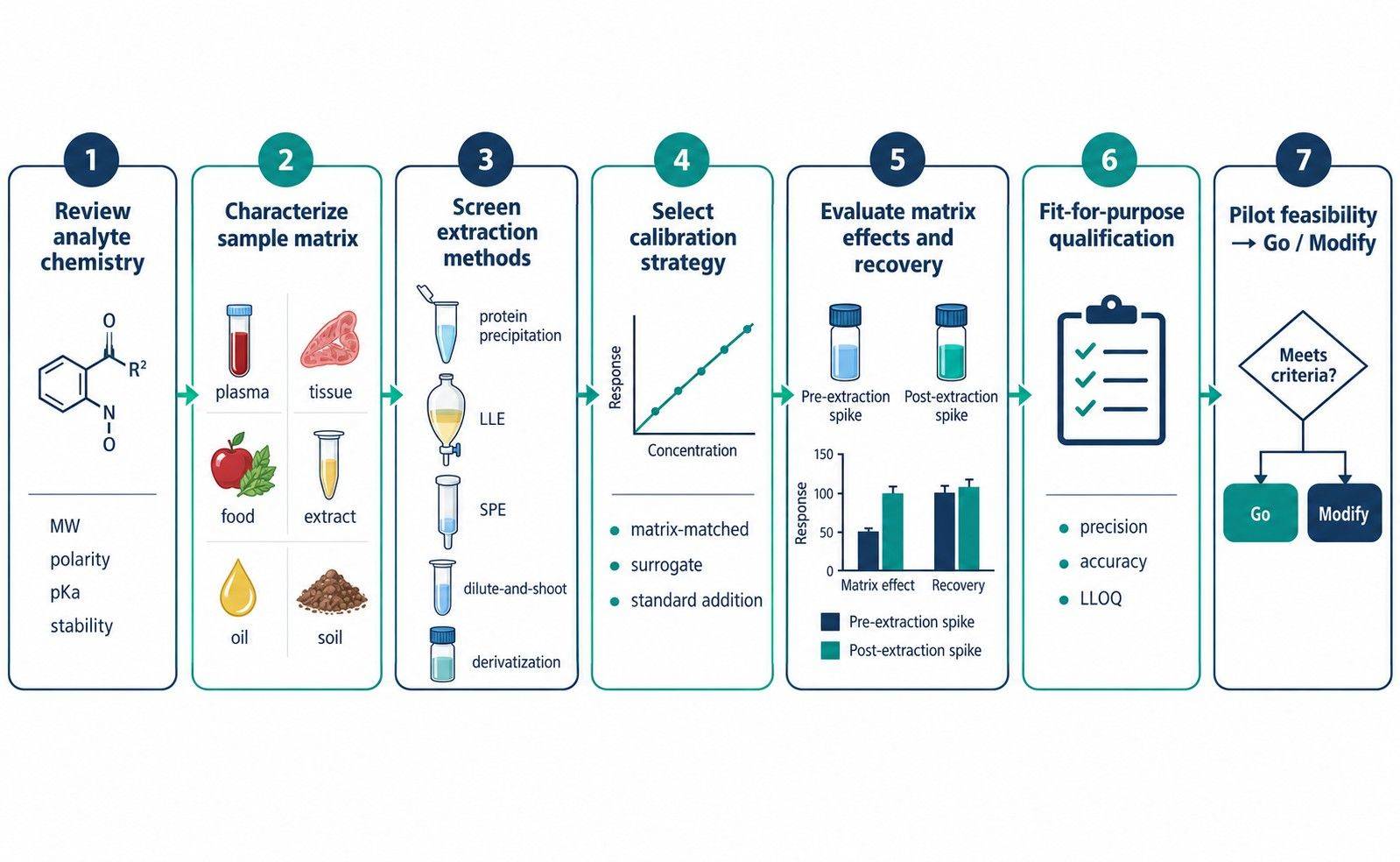 Method development decision path: from analyte chemistry review through extraction, calibration, matrix-effect evaluation, and qualification — each step informed by the specific analyte–matrix combination.
Pilot Feasibility Before Full Method Development
Before committing to a complete method development and qualification project, a feasibility pilot can answer the most critical questions: can the analyte be detected in the sample matrix at the expected concentration, which extraction approach provides acceptable recovery, whether matrix effects are manageable with the chosen calibration strategy, and whether reference standards and internal standards are adequate for the required quantification type. The pilot typically uses a small number of representative samples and focuses on the highest-risk aspects of the method rather than attempting to evaluate every parameter.
A pilot with favorable results provides the evidence needed to proceed with confidence. A pilot that reveals fundamental problems — the analyte concentration is below what the instrument can reliably detect, or matrix interference cannot be resolved with reasonable extraction and chromatography — saves the investment that would have been spent on a full method development project destined to fail.
Information Needed for Feasibility Evaluation
Providing the following information when submitting a new analyte–matrix method inquiry helps the laboratory assess feasibility:
- Target analyte name, structure, and CAS number
- Sample matrix type and species
- Expected concentration range
- Available sample amount and number of samples
- Storage and collection conditions
- Reference to any published method for this analyte
- Reference standard availability and purity
- Required result type — absolute quantification, semi-quantitative estimation, or relative comparison
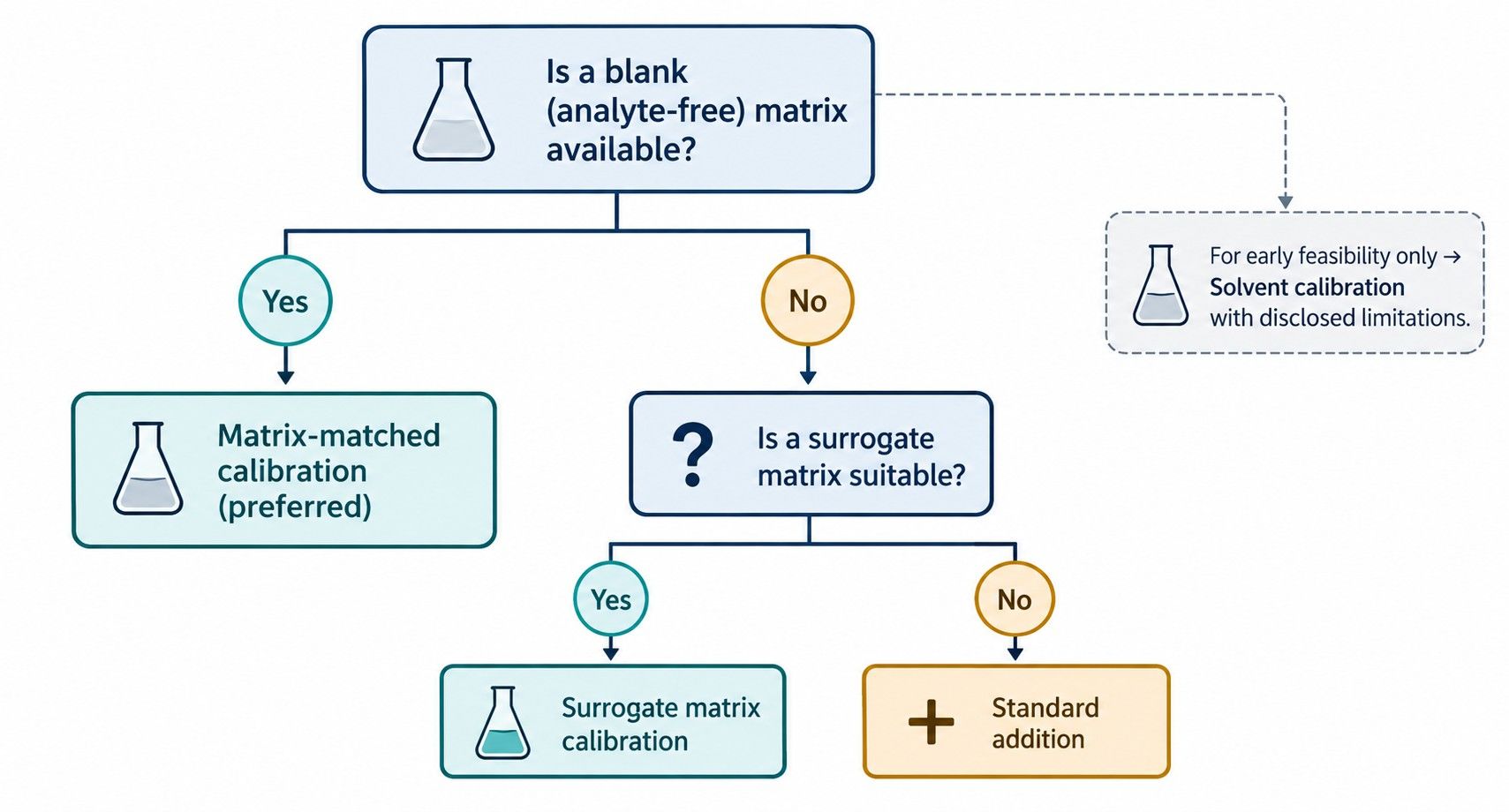 Calibration strategy decision tree: choose matrix-matched calibration when a blank matrix is available, surrogate matrix or standard addition when the analyte is endogenous, and solvent calibration only for early feasibility with disclosed limitations.
What a Custom LC-MS/MS Method Project Can Deliver
Depending on the project scope agreed with the laboratory, a custom targeted LC-MS/MS method development project may deliver:
- Feasibility assessment confirming detection in the sample matrix
- Recommended extraction and sample preparation protocol
- Optimized chromatographic and mass spectrometric conditions
- Calibration approach with appropriate standards
- Analyte-specific sensitivity assessment
- Matrix-effect and recovery evaluation
- Quantitative results for study samples
- QC summary and method limitations documentation
For projects requiring custom targeted LC-MS/MS method development for new analyte–matrix combinations, our targeted metabolomics service supports method establishment, matrix qualification, and quantitative analysis across a wide range of sample types. Not sure whether your analyte can be quantified in your sample matrix? Share the target compound, matrix type, expected concentration, and available sample amount for a feasibility assessment.
FAQs
1) Can a published LC-MS method be used directly for my samples?
A published method provides a starting point, but instrument differences, column selectivity, and matrix-specific effects mean that direct transfer usually requires verification. Published detection limits are instrument-specific and should not be assumed valid for a different laboratory setup without confirmation.
2) What if no stable-isotope-labeled internal standard is available?
A structurally similar compound can serve as a surrogate internal standard, though it may not fully track the analyte through extraction and ionization. Results should be interpreted with this limitation acknowledged. Semi-quantitative or relative quantification approaches may be more appropriate than absolute quantification.
3) What is the difference between matrix effect and extraction recovery?
Extraction recovery measures the fraction of analyte transferred from the sample into the extract. Matrix effect describes how co-extracted components alter ionization — suppressing or enhancing the signal. The combined influence is the process efficiency, which determines the overall reliability of the quantification.
4) How many samples are needed for a method development project?
Method development and qualification typically require blank matrix and representative samples in addition to the study samples. The specific amount depends on the number of target compounds, matrix complexity, and qualification scope. Providing the available sample information early allows the laboratory to design an appropriate plan.
5) Can a method be developed without a reference standard?
A method can be developed for relative comparison or screening purposes without an authentic reference standard. Absolute quantification requires a standard of known purity. Semi-quantitative estimation using a surrogate calibrant is possible with the limitation clearly reported.
References
- Matuszewski, B. K., Constanzer, M. L., & Chavez-Eng, C. M. (2003). Strategies for the assessment of matrix effect in quantitative bioanalytical methods based on HPLC-MS/MS. Analytical Chemistry, 75(13), 3019–3030. DOI: 10.1021/ac020361s
- Kruve, A., et al. (2015). Tutorial review on validation of liquid chromatography-mass spectrometry methods. Analytica Chimica Acta, 870, 8–28. DOI: 10.1016/j.aca.2015.02.016
- van de Merbel, N. C. (2008). Quantitative determination of endogenous compounds in biological samples using chromatographic techniques. TrAC Trends in Analytical Chemistry, 27(10), 924–933. DOI: 10.1016/j.trac.2008.09.002
- Peters, F. T., Drummer, O. H., & Musshoff, F. (2007). Validation of new methods. Forensic Science International, 165(2-3), 216–224. DOI: 10.1016/j.forsciint.2006.05.021

 Contact Us


